
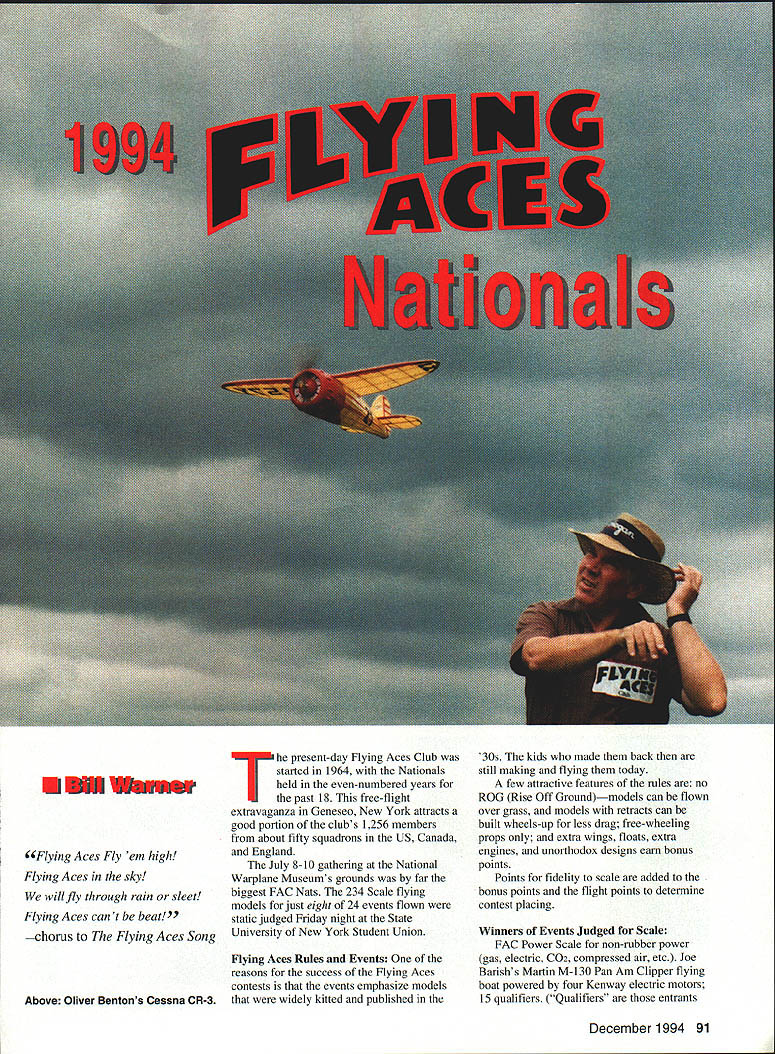
1994 Flying Aces Nationals
Bill Warner
"Flying Aces fly 'em high! Flying Aces in the sky! We will fly through rain or sleet! Flying Aces can't be beat!" —chorus to The Flying Aces Song
Introduction
The present-day Flying Aces Club was started in 1964. Nationals have been held in even-numbered years for the past 18, and this three-flight extravaganza in Geneseo, New York, attracts a good portion of the club's 1,256 members from about fifty squadrons in the U.S., Canada, and England.
The July 8–10 gathering on the grounds of the National Warplane Museum was by far the biggest FAC Nats. A total of 234 scale flying models were entered in just eight of the 24 events flown. Static judging for scale models took place Friday night at the State University of New York Student Union.
Flying Aces Rules and Events
One reason for the success of the Flying Aces contests is that the events emphasize models that were widely kitted and published in the 1930s. The kids who made them back then are still making and flying them today.
A few attractive features of the rules:
- No ROG (Rise Off Ground) requirement — models may be flown over grass.
- Models with retracts may be built wheels-up to reduce drag.
- Free-wheeling props only.
- Extra wings, floats, extra engines, and unorthodox designs earn bonus points.
- Points for fidelity to scale are added to bonus points and flight points to determine contest placing.
If you want a copy of the rules, write to: FAC HQ, 3301 Cindy Lane, Erie, PA 16506.
Winners — Events Judged for Scale
- FAC Power Scale (non-rubber power: gas, electric, CO2, compressed air, etc.)
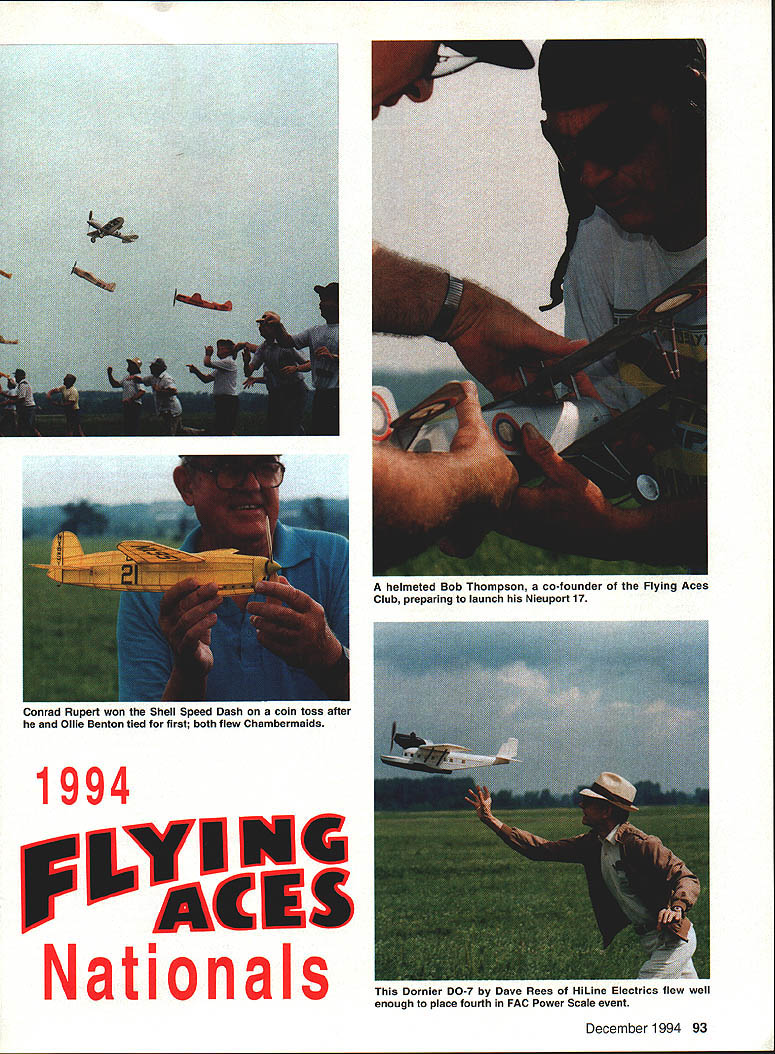
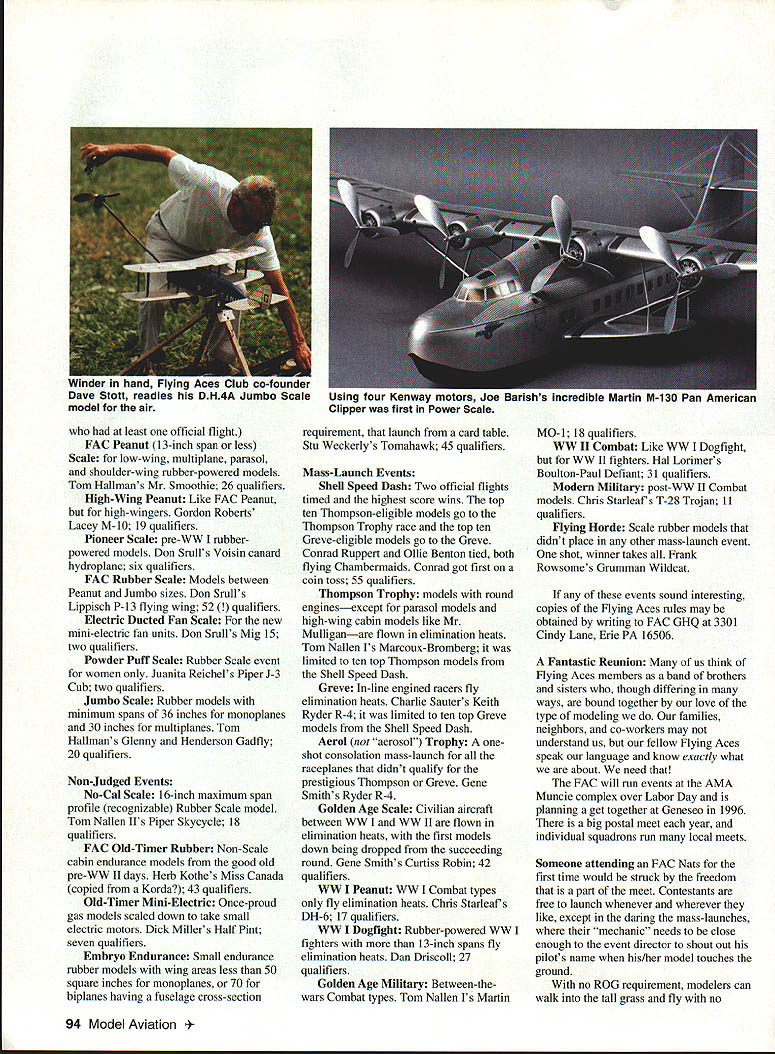
- Joe Barish — Martin M-130 Pan Am Clipper (four Kenway electric motors); 15 qualifiers.
- FAC Peanut (13-inch span and less; scale for low-wing, multiplane, parasol, shoulder-wing rubber-powered models)
- Tom Hallman — Mr. Smoothie; 26 qualifiers.
- High-Wing Peanut (like FAC Peanut, for high-wing models)
- Gordon Roberts — Lacey M-10; 19 qualifiers.
- Pioneer Scale (pre–World War II rubber-powered models)
- Don Srull — Voisin canard hydroplane; 6 qualifiers.
- FAC Rubber Scale (models between Peanut and Jumbo sizes)
- Don Srull — Lippisch P-13 flying wing; 52 qualifiers.
- Electric Ducted Fan Scale (for the new mini-electric fan units)
- Don Srull — MiG-15; 2 qualifiers.
- Powder Puff Scale (rubber-scale event for women)
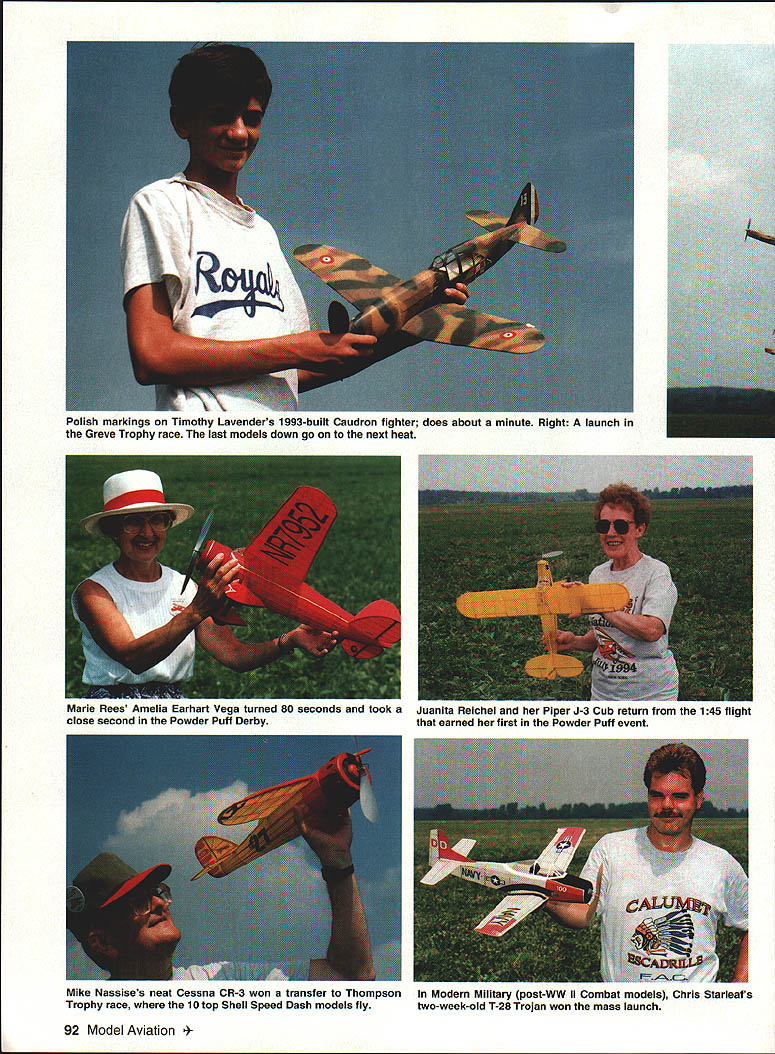
- Juanita Reichel — Piper J-3 Cub; 2 qualifiers.
- Jumbo Scale (rubber models; minimum spans — monoplanes 36 inches, multiplanes 30 inches)
- Tom Hallman — Glenny Henderson Gadfly; 20 qualifiers.
Non‑Judged Events
- No‑Cal Scale (16-inch maximum span; profile but recognizable rubber-scale model)
- Tom Nallen II — Piper Skycycle; 18 qualifiers.
- FAC Old‑Timer Rubber Non‑Scale (cabin endurance models from the pre–WWII days)
- Herb Kothes — Miss Canada (copied from Korda); 43 qualifiers.
- Old‑Timer Mini‑Electric (gas models scaled down to take small electric motors)
- Dick Miller — Half Pint; 7 qualifiers.
- Embryo Endurance (small endurance rubber models; wing area limits and fuselage cross-section requirements)
- Stu Weckerly — Tomahawk; 45 qualifiers.
Mass‑Launch Events
- Shell Speed Dash
- Two official flights are timed; the highest score wins. The top ten Thompson‑eligible models advance to the Thompson Trophy race; the top ten Greve‑eligible models advance to the Greve.
- Conrad Ruppert and Ollie Benton tied, both flying Chambermaids; Conrad won the coin toss; 55 qualifiers.
- Thompson Trophy
- For models with round engines (except parasol models). Eliminations are flown in heats.
- Tom Nallen II — Marcoux‑Bromberg was among the top ten Thompson qualifiers.
- Greve
- Inline-engine racers fly elimination heats.
- Charlie Sauter — Keith Ryder R-4 was among the top Greve qualifiers.
- Aerol Trophy
- A one-shot consolation mass-launch for raceplanes that didn't qualify for Thompson or Greve.
- Gene Smith — Ryder R-4.
- Golden Age Scale
- Civilian aircraft between WWI and WWII, flown in elimination heats.
- Gene Smith — Curtiss Robin; 42 qualifiers.
- WWI Peanut
- WWI combat types only, elimination heats.
- Chris Starleaf — DH-6; 17 qualifiers.
- WWI Dogfight
- Rubber-powered WWI fighters with more than 13-inch span, elimination heats.
- Dan Driscoll; 27 qualifiers.
- Golden Age Military
- Between-the-wars combat types.
- Tom Nallen II — Martin MO-1; 18 qualifiers.
- WWII Combat
- WWII fighters, elimination heats.
- Hal Lorimer — Boulton-Paul Defiant; 31 qualifiers.
- Modern Military
- Post-WWII combat models.
- Chris Starleaf — T-28 Trojan; 11 qualifiers.
- Flying Horde
- Scale rubber models that didn't place in any other mass-launch event; one shot, winner takes all.
- Frank Rowsome — Grumman Wildcat.
A Fantastic Reunion
Many participants think of Flying Aces members as a band of brothers and sisters who, though differing in many ways, are bound together by a love of the type of modeling they do. Families, neighbors, and co-workers may not understand, but fellow Flying Aces share the language and know exactly what it's about.
The FAC will run events at the AMA Muncie complex over Labor Day and is planning a get-together at Geneseo in 1996. There is also a big postal meet each year, and individual squadrons run many local meets.
A first-time attendee is struck by the freedom at the meet. Contestants may launch whenever and wherever they like except in the dangerous mass-launches, where a "mechanic" needs to be close enough to the event director to shout the pilot's name when a model touches the ground.
With no ROG requirement, modelers can walk into the tall grass and fly without worrying about anything except their models' welfare and staying off the museum runway, where occasional Stearman biplanes or similar aircraft might be taking off or landing.
Models are light, and despite thousands of official, test, and fun flights, injuries from these slow-moving models are rare. Spectators and fliers freely intermingle on the flying site, allowing interaction that many types of "keep-the-spectators-back" competitions cannot match. Once released by the flier, the model is on its own, and the uncertainty of the outcome adds excitement to each flight.
A Few Exceptional Models
- Joe Barish's Martin M-130 Pan American Clipper (electric) was a flying museum piece and won honors for outstanding accomplishment.
- Pres Bruning's Martin PBM Mariner was a show-stopper. Some damage on a test hop prevented it from competing, but it drew plenty of praise.
- Ducted-fan subjects by Dave Rees and Ralph Kuzem were daring but fell victim to gremlins.
- Dave Niedzielski's rubber-powered Miles Libellula proved fully aerobatic though somewhat intractable. His sons Stephen and Chris performed well in the Embryo Endurance event.
- Earl Schick's seven-ounce jumbo rubber Cessna C-37 (A. A. Lidberg plans) flew exceptionally well.
- Don Srull's Short S-26 floatplane and Vance Gilbert's Cantrimotor showed sturdy, reliable performance.
- Paul Baynowski's Short S-26 flying boat was elegant in the air; his motor stick arrangement prevented trouble with the inboard engine nacelles.
- Eric Clutton's Hosler Fury achieved a rocket-like climb. The Peanut with a two-foot-long fuselage climbed about 200 feet in about three seconds, then returned by the same route. Eric adjusted trim and managed a 62-second flight.
- John Bishop of Niagara Falls displayed a plastic scratch-built 1/16-scale Sopwith Dolphin with exquisite detailing, including a disassembled cowl showing engine and gun mechanisms.
- Ed (last name not given) flew a Beardmore whose first test flight was a majestic 38 seconds; big models drew attention whenever he flew.
- At the other extreme, George Nason's 2.35-gram, 4½-inch-span paper Spitfire flew more than 100 feet in a straight line — an impressive accomplishment given its size.
An Odd Coincidence
Artist Tom Hallman lost two models that flew all the way from the Warplane Museum site into town — more than a mile away. His Mr. Smoothie was found under a car in a parking lot and returned to him after the meet. While driving around searching for his other model, Tom heard a song about a lost pigeon returning home and then spotted his Gadfly sitting on a street corner waiting for him.
Banquet, Awards, and Membership
Sunday night's banquet was a big success, with emcee Vance Gilbert providing humor and song. Blue Maxes and Distinguished Service Medals were awarded along with many trophies.
The only way to experience the FAC Nats is to attend. Membership gives you the club newsletter with plans, data, hints, and fun for $10 a year for the U.S. and Canada, $15 overseas.
FAC Commandant Lin Reichel joked that he hoped someone would put out a video of the contest so he could see what went on. Running a meet may have rewards, but seeing the great flying firsthand is special.
Thanks and Closing
A huge Flying Aces thank you to the key people who made the event a success:
- Lin Reichel (Commandant)
- Contest directors Dave Livesay and Dan Kane
- Administrative staff Juanita Reichel and Shirley Kenz
- Outstanding judges: Vic Diedot, Ross Mayo, Don Srull, Jack Moses, Charlie Schoboler, Fred Wunsch, Tom Nallen I, Tom Nallen II, and Mick Nallen
- Doug Witek, who supplied the Guffhawk plan given to each entrant
Despite minor inconveniences — a bit of rain, heat and wind, gremlins tweaking trim tabs, and a salt-mine cave-in that forced a five-mile detour to the banquet site — the good memories from this year's FAC Nats have already inspired FACers to begin building for the next one. See you there!
Transcribed from original scans by AI. Minor OCR errors may remain.

