
1995 SAM Champs
John Oldenkamp
Overview
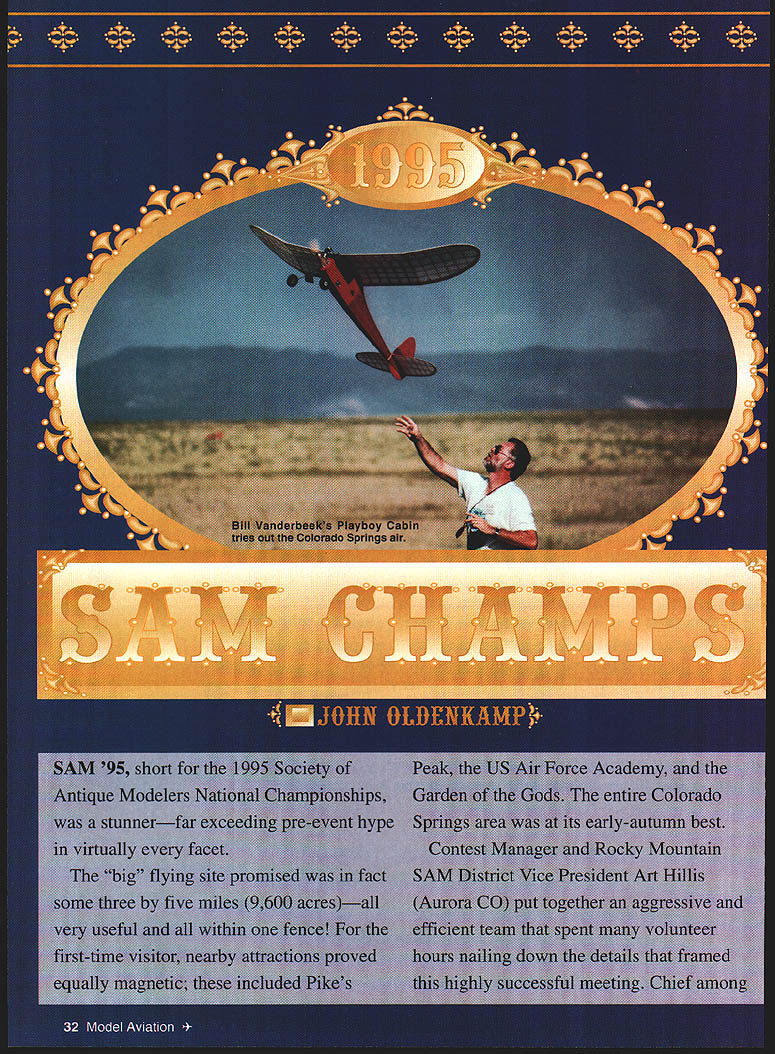
SAM '95, short for the 1995 Society of Antique Modelers National Championships, was a stunner—far exceeding pre-event hype in virtually every facet.
The "big" flying site promised was in fact some three by five miles (9,600 acres)—all very useful and all within one fence. Nearby attractions for first-time visitors included Pike's Peak, the U.S. Air Force Academy, and the Garden of the Gods. The entire Colorado Springs area was at its early‑autumn best.
Organization and site
Contest Manager and Rocky Mountain SAM District Vice President Art Hillis (Aurora, CO) put together an aggressive and efficient team that spent many volunteer hours nailing down the details that framed this highly successful meeting. Chief among these details were the negotiations that led to gratis site use—a nice gesture by Steve Norris, the owner of the T‑Cross Ranch property where the event was held.
- The U.S. Army provided first aid facilities.
- An upscale caterer signed on at the field.
- Shuttle buses provided transportation between SAM headquarters at the Colorado Springs Sheraton and the flying site.
- Various tours were available to fliers and their families throughout the week.
Finally, in another gratis gesture to SAM, the Colorado Springs Visitors' Bureau sent out hundreds of colorful broadsides of the area for an eye‑catching close to the planning phase. What was to follow would amply justify Art Hillis and company's hard work.
Five days of SAM '95 flying competition were scheduled, sandwiched between the Model Engine Collectors' Association (MECA) swap meet and the concluding banquet. The large MECA show featured many hard‑to‑find items; some were bargains, others—like rare multicylinder engines from the '40s—fetched astronomical prices.
The concluding "victory" banquet was a somewhat oxymoronic climax to a generally laid‑back contest.
The flying week
The main event was the action on the field, where 28 Free Flight and 20 Radio Control events awaited. It was as varied a menu as one could wish and a great enticement to enter many events.
Late‑summer monsoons had plagued the area, but by the eve of the opener the rains had tapered off, leaving the turf soft underfoot and dustless, with a nil pollen count. Aside from the tiny prickly pear cactus (which ruled out sandals and threadbare motorcycle tires) and ankle‑deep holes left by decades of cattle grazing, the site was prime and eminently suitable. We deem it a rare privilege to be allowed full access to such a spectacular layout, the trifling obstacles notwithstanding.
Local weather forecasters gave the week a thumbs up. The RC truck/car encampment swelled to several hundred. Anticipation ran high. Some 18 miles to the north, "No Vacancy" signs went up in Colorado Springs as SAM shared the time slot with major‑college football (Air Force versus Colorado) and several conventions, including a reunion of P‑51/H instructors and pilots.
With test‑flying and social preliminaries ending Sunday night, SAM bean counters gleefully tallied the registration receipts. More than 300 contestants paid the basic fees and entered almost 950 individual events—big numbers for these somewhat‑stressed economic times and an excellent indicator of future SAM prospects.
Events and highlights
The week opened with several arcane events such as RC Texaco, Brown Jr., and 8‑foot RC Nostalgia (small displacement). Monday was largely given over to Free Flight Nostalgia, a category representing mainly glow‑engine‑powered designs of the late '40s and early‑to‑mid '50s. Free Flight Nostalgia is a National Free Flight Society (NFFS)‑initiated and governed program; the SAM '95 arrangement allowed competitors to fly the entire Antique/Old‑Timer/Nostalgia period models with choice of engines, materials, and styles to match.
Both SAM and NFFS, AMA‑recognized Special Interest Groups, maintain interlocking technical and political ties. AMA, huffing and puffing through testing stages at 1/2A Nostalgia, found the 5,800‑foot field altitude spared further exertion. A 1955 Italian FAI Podda crashed into a boundary marker stake; otherwise the well‑proven airplane—after 85 flights—showed nary a smudge nor dent.
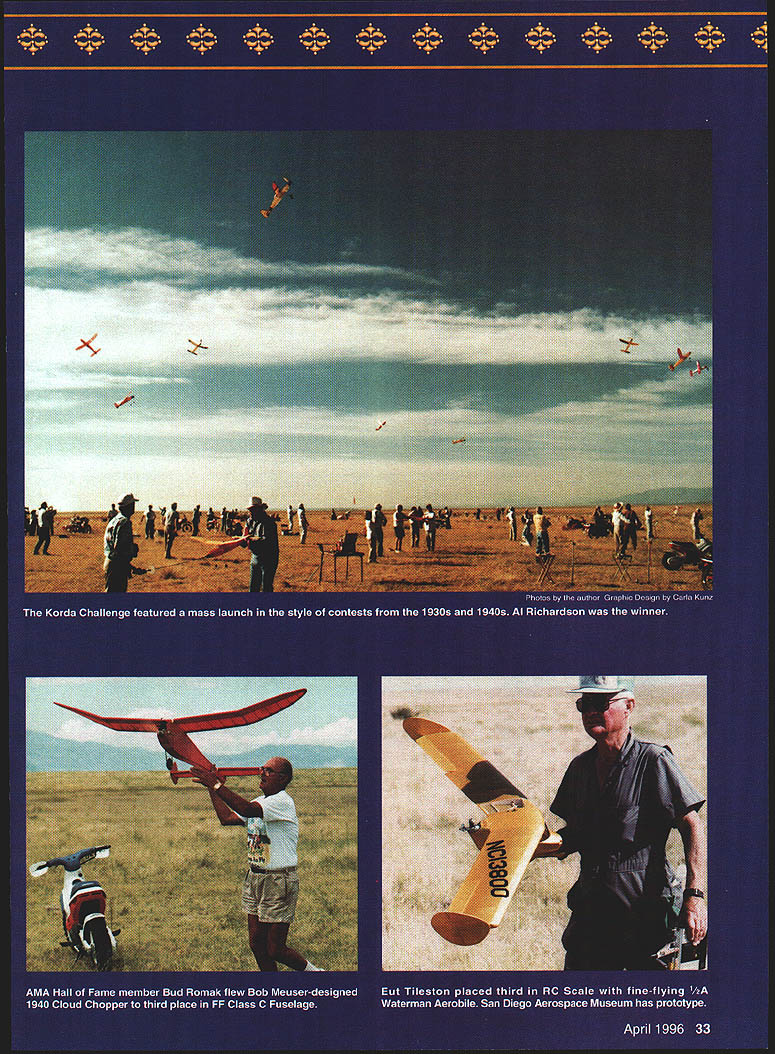
Brown Jr.'s premier event Monday was the Korda Wakefield. Richard Korda, 1939 World Champion in New York, astonished everyone with a 43‑minute‑plus single flight in his championship year—then described as heroic and now perhaps recognized as aided by fortuitous lift. The mystique surrounding Korda's dramatic triumph continues. Building a 1939 airplane replica is labor‑intensive and trimming can be difficult; nevertheless, 33 top gumbanders lined up to see who could top the field. The rules called for three maxes (three minutes required) plus flyoff flights increasing in one‑minute increments to determine the winner.
Californian Al Richardson maxed out and added a four‑minute flyoff round. Al waited out Herb Kothe, who also maxed out but fell a bit shy in the flyoff. Meanwhile Bill Gibbons' outstanding modern Wakefielder distanced a strong field in 1/2A Free Flight Texaco, scoring 1,016 seconds—a tad under 17 minutes—on a single flight. Bill, a longtime Boulder, Colorado resident, has moved to Sun City, Arizona.
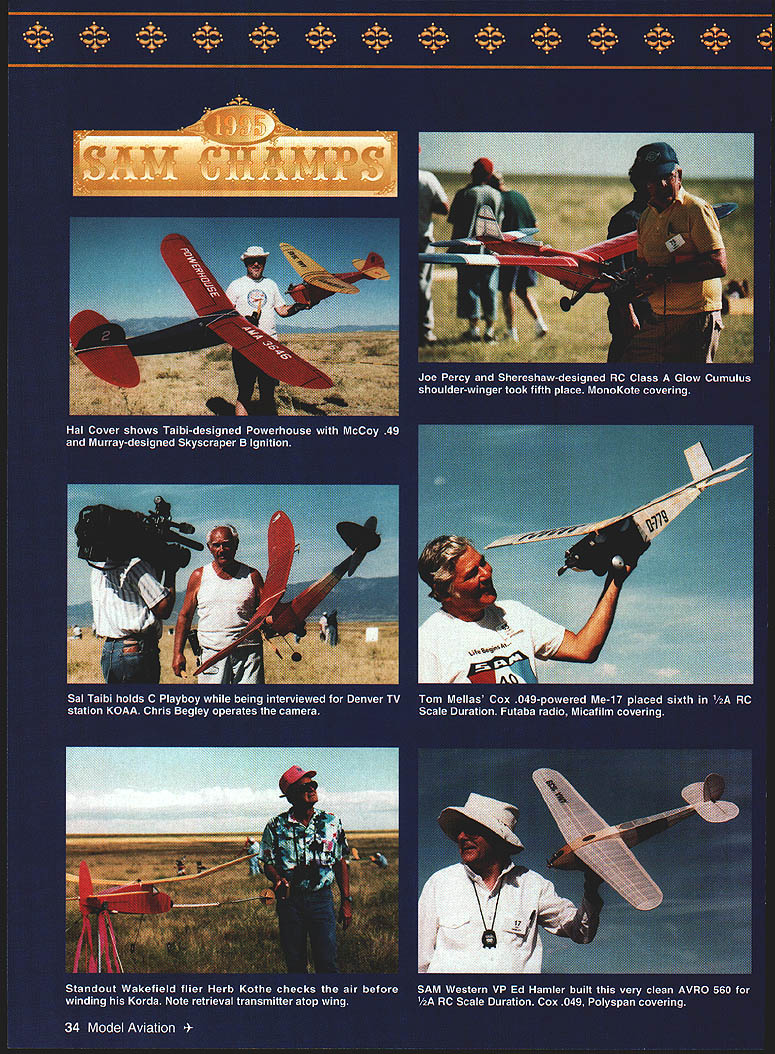
The Nostalgia Division was, as usual, dominated by Hal Cover of Covina, California. He won the A/B Class and C Class and was first in Large Ignition (right behind Hoosier Harry Murphy). Hal took second in Small Ignition before abruptly quitting and returning to California after a group of local miscreant youths copped his prized vintage chase bike. The theft was the only observed nastiness of the entire contest; happily, the motorcycle was recovered in good shape and the offenders were apprehended and charged.
Weather for the balance of the week was favorable, with comfortable temperatures, predictable mild‑to‑medium drift, and abundant, well‑marked lift. Smiles prevailed as high scores were posted among the thousands of official flights. Few crashes were witnessed, and the overall craftsmanship in nearly every category was outstanding—are these "winter" builders? SAM '95 was a continuing feast for eye and ear: bright skies, clear air, and low humidity were welcome pluses.
Each day was another parade of vintage designs—many the product of countless hours in front of piles of sticks, tissue, and glue. Red ones, yellow ones, big and small, each model was a visceral yank against blue sky. Each was a piece of history and a handmade product as of old—the reason we gather for a SAM Champs in the first place.
Results and statistics
By far the biggest (most popular) event was 1/2A RC Texaco; it drew 47 pilots with Cox .049‑powered craft. John McRae's 234‑square‑inch Don Foote Westerner did 3,377 seconds, besting Bud Tileston's Scorpio 256 (3,239 seconds) in an extended flyoff.
On the opposite side of the venue, Carl Redlin took first place in both Small Rubber events: Stick and Cabin. (Cabin models have wheels/takeoff/landing gear; Stick models do not.) The events had 34 and 38 entries, respectively. Times were 1,440 and 1,080 seconds, well over the 540‑second max target. The winning margin in Stick was nearly 8 1/2 minutes; it was 15 seconds in the Cabin division—very strong performances for four‑ounce airplanes with only about 135 square inches of wing area. Good testimony to the power and consistency of Colorado thermals.
Despite SAM's stated emphasis on low‑pressure, folksy competition, each Champs seems to have individuals who go the extra mile—as if some marathon or Ironman goal were in sight. The '95 event was no exception.
- Free Flight's Ed Konfes flew 13 events in Gas and Rubber. He won one event (Large Rubber Fuselage) and finished in the top five in three others.
- RC's Fred Mulholland flew in 14 events. He had an outright first place in one event (Class C Glow RC), won trophies in nine others, and had top‑ten records in 12 categories.
Beyond these epic results lay a whole week of opportunity to meet and greet, share stories, secrets, and methods.
About SAM and membership
If you crave diversity in your Free Flight or RC aeromodelling activities, consider SAM membership and participation in its local, regional, and national programs.
- SAM annual dues: $20.
- Membership: through Secretary/Treasurer Larry Clark, Box 528, Lucerne Valley, CA 92356.
SAM competition is challenging enough for most. Eligible designs number in the thousands; the period spans roughly from the 1920s through 1942. Prices range from a couple of bucks for an all‑sheet hand‑launched glider, to $10 or so for a competitive rubber model, to "whatever the pocket holds" for some 10‑foot RC models.
The main business of SAM is to make the history and lore of the period fun and to accommodate those of us who, by accident of birthday, missed the so‑called "Golden Age" of airplane modeldom.
SAM '96 is scheduled to be held in Florida—a long trip for some, downright convenient for others, but endless enjoyment for all who ramble down South.
Acknowledgements
Special thanks to:
- SAM '95 Contest Manager Art Hillis
- Free Flight Director Bill Etherington
- Computer Scorer Gregory Svec
- Lee Campbell, owner of Campbell's Custom Kits, for the Lorna Doone survival kit
All of you made the week go smoothly.
Transcribed from original scans by AI. Minor OCR errors may remain.

