
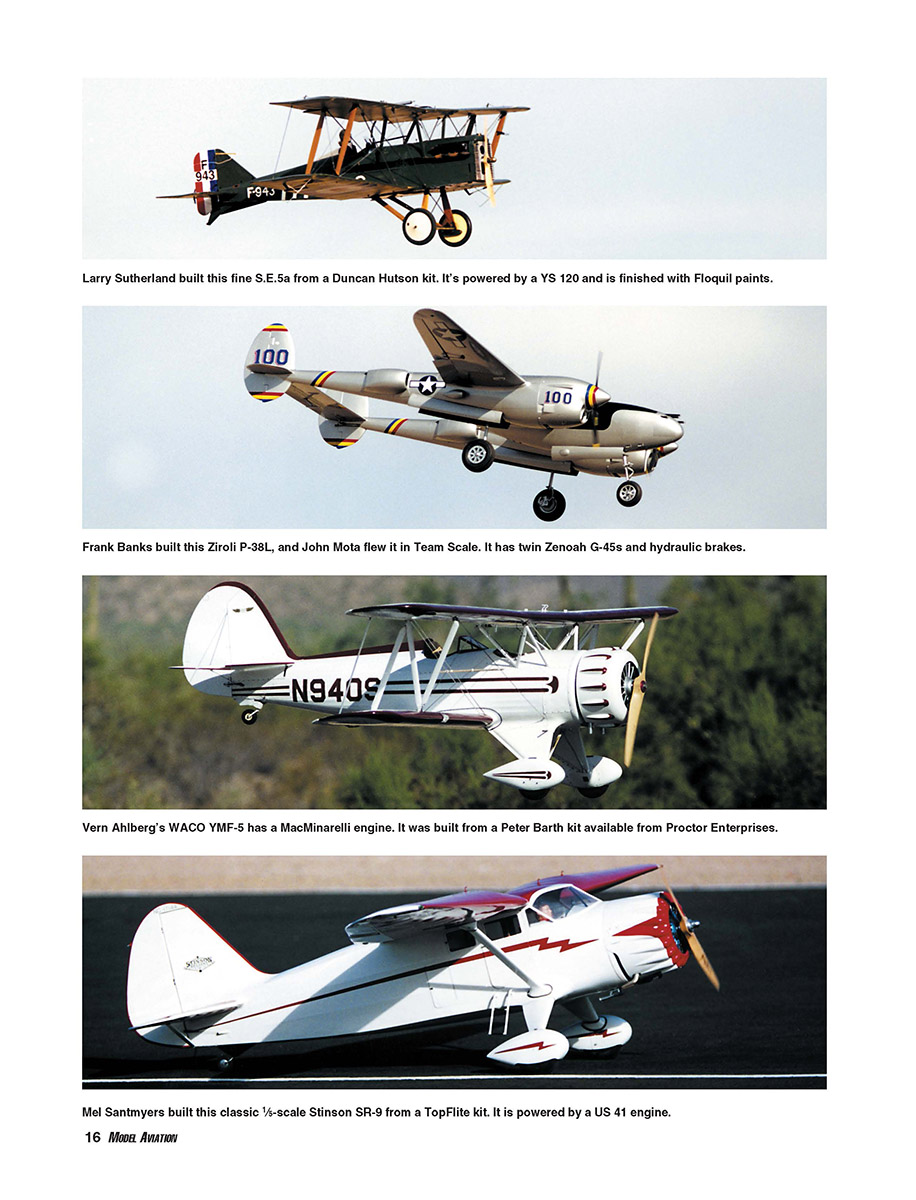
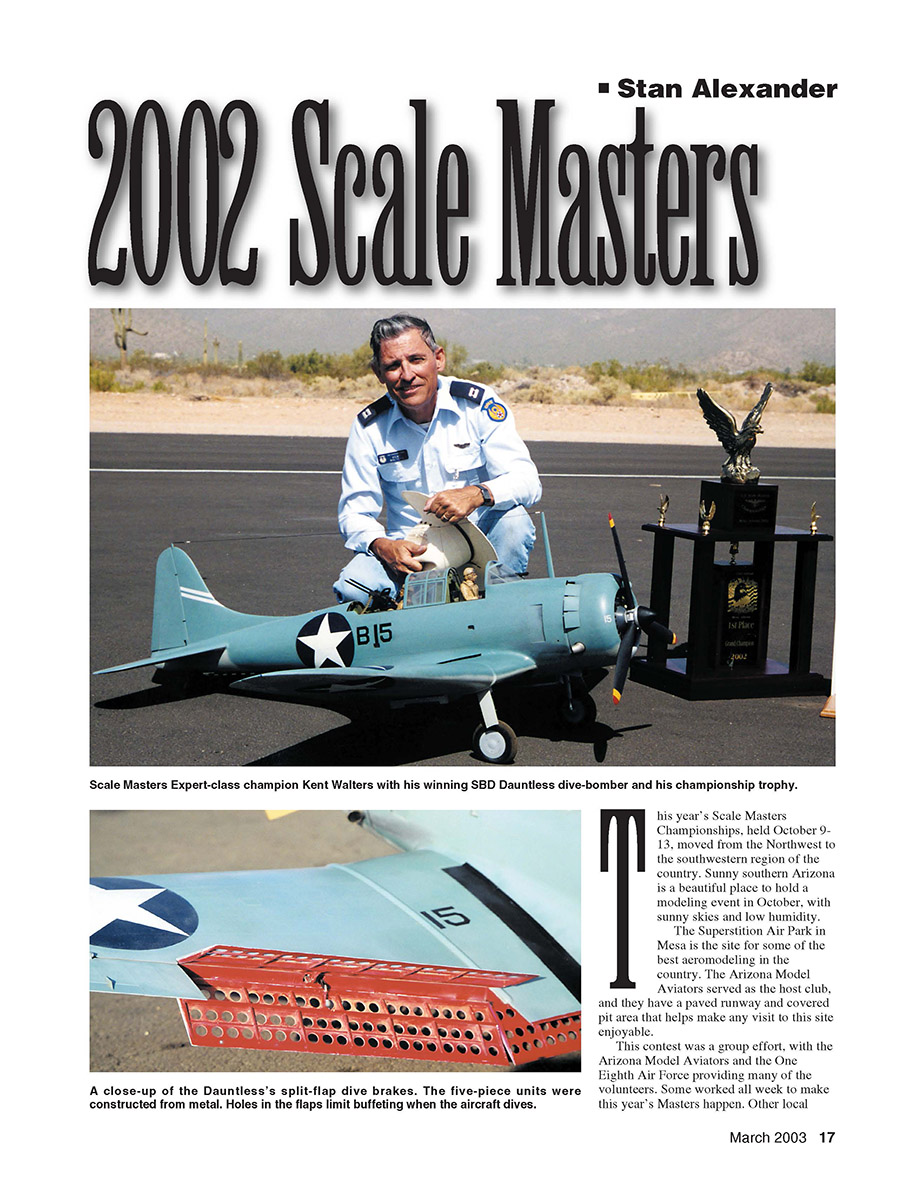
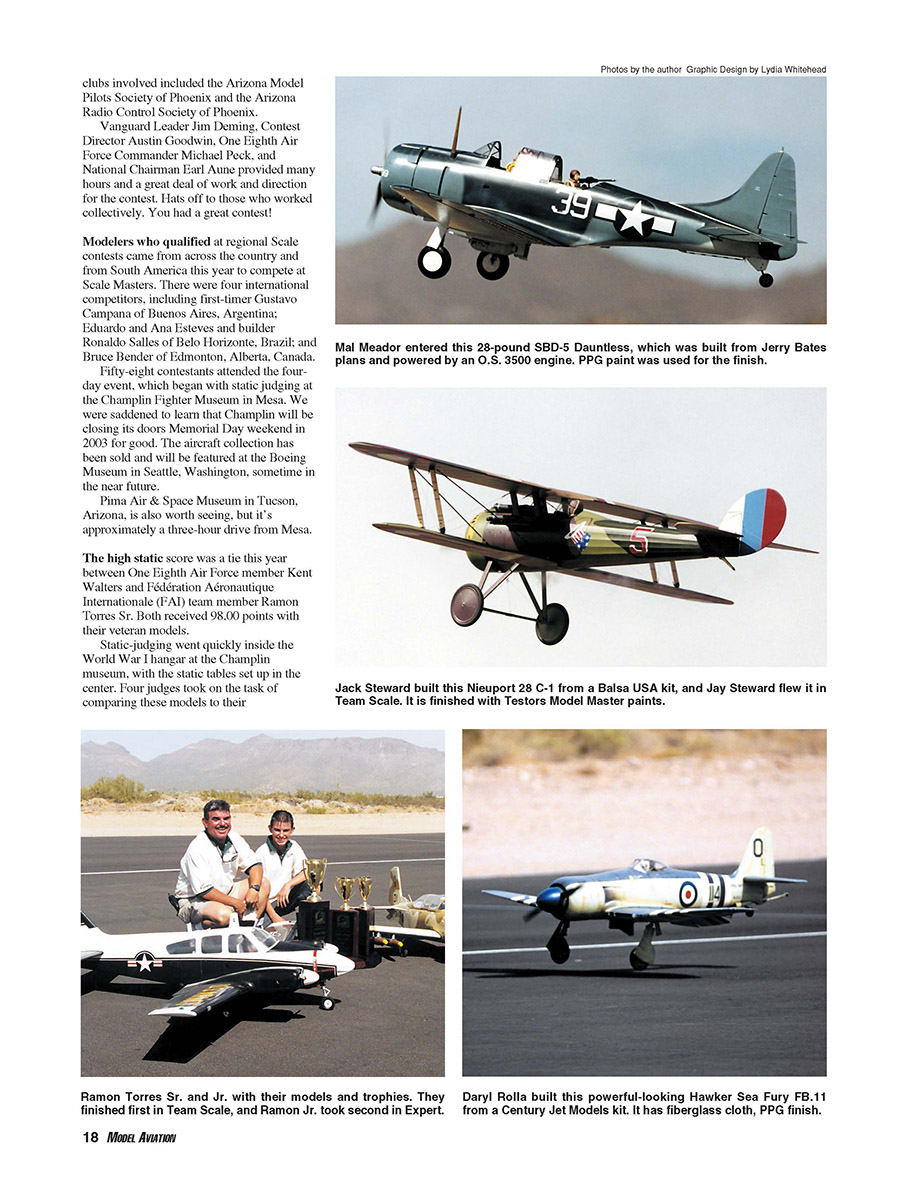
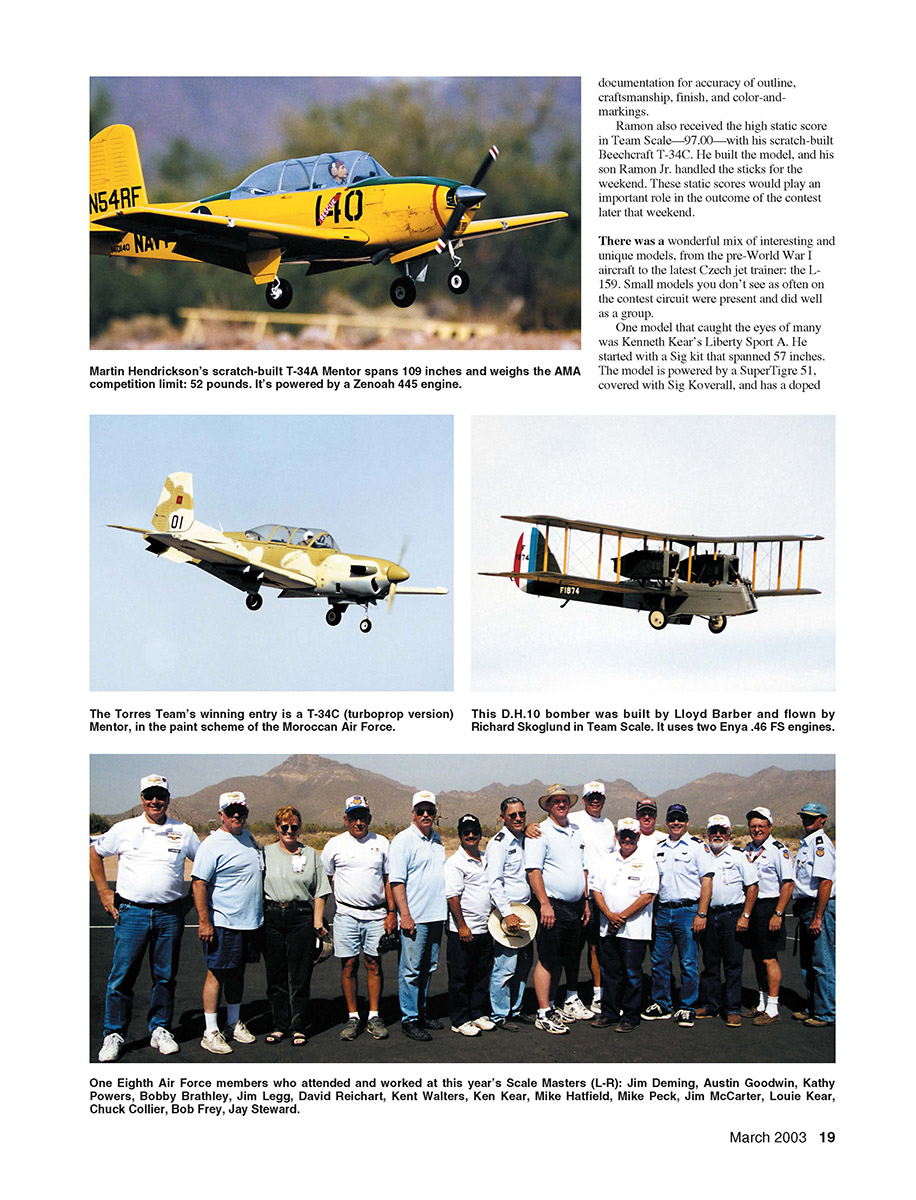
2002 Scale Masters
Stan Alexander
This year's Scale Masters Championships, held October 9–13, moved from the Northwest to the southwestern region of the country. Sunny southern Arizona is a beautiful place to hold a modeling event in October, with clear skies and low humidity.
The Superstition Air Park in Mesa is the site for some of the best aeromodeling in the country. The Arizona Model Aviators served as the host club; they have a paved runway and covered pit area that helps make any visit to this site enjoyable.
This contest was a group effort, with the Arizona Model Aviators and the One Eighth Air Force providing many volunteers. Some worked all week to make this year's Masters happen. Other local clubs involved included the Arizona Model Pilots Society of Phoenix and the Arizona Radio Control Society of Phoenix.
Vanguard Leader Jim Deming, Contest Director Austin Goodwin, One Eighth Air Force Commander Michael Peck, and National Chairman Earl Aune provided many hours of work and direction for the contest. Hats off to those who worked collectively — you had a great contest!
Modelers who qualified at regional scale contests came from across the country and from South America this year to compete at Scale Masters. There were four international competitors, including first-timer Gustavo Campana of Buenos Aires, Argentina; Eduardo and Ana Esteves and builder Ronaldo Salles of Belo Horizonte, Brazil; and Bruce Bender of Edmonton, Alberta, Canada.
Fifty-eight contestants attended the four-day event, which began with static judging at the Champlin Fighter Museum in Mesa. We were saddened to learn that Champlin will be closing its doors Memorial Day weekend in 2003. The aircraft collection has been sold and will be featured at the Boeing Museum in Seattle, Washington, sometime in the near future.
Pima Air & Space Museum in Tucson, Arizona, is also worth seeing, but it's approximately a three-hour drive from Mesa.
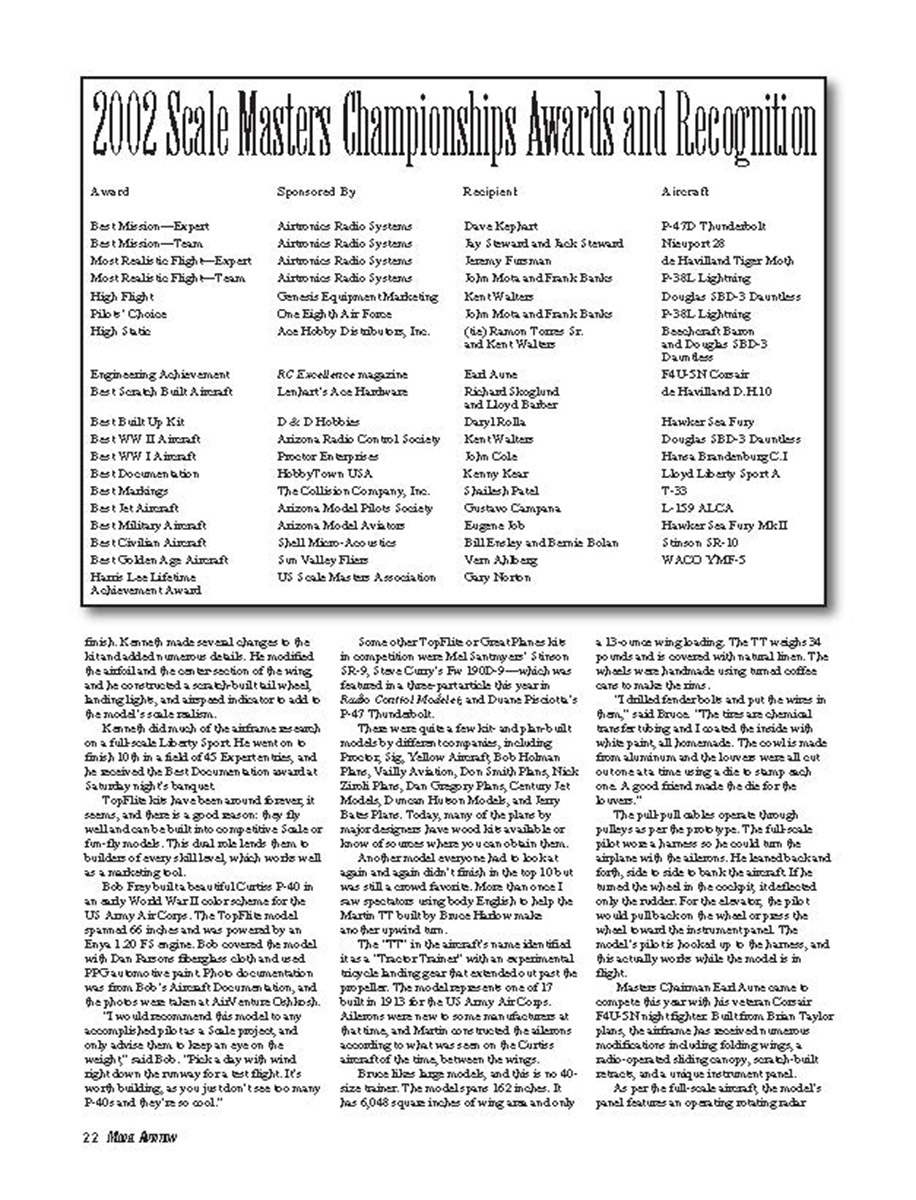
The high static score was a tie this year between One Eighth Air Force member Kent Walters and Fédération Aéronautique Internationale (FAI) team member Ramon Torres Sr. Both received 98.00 points with their veteran models.
Static judging went quickly inside the World War I hangar at the Champlin Museum, with the static tables set up in the center. Four judges compared the models to their documentation for accuracy of outline, craftsmanship, finish, and color-and-markings. Ramon also received the high static score in Team Scale — 97.00 — with his scratch-built Beechcraft T-34C. He built the model, and his son Ramon Jr. handled the sticks for the weekend. These static scores played an important role in the outcome of the contest later that weekend.
There was a wonderful mix of interesting and unique models, from pre-World War I aircraft to the latest Czech jet trainer, the L-159. Small models you don't often see on the contest circuit were present and did well as a group.
One model that caught many eyes was Kenneth Kerr’s Lloyd-Liberty Sport A. He started with a Sig kit that spanned 57 inches. The model is powered by a SuperTigre 51, covered with Sig Koverall, and has a doped finish. Kenneth made several changes to the kit and added numerous details. He modified the windshield, built a scratch-built full-width landing gear, and added an open-cockpit windscreen and tail to enhance the model’s scale realism.
Kenneth did much of the airframe research on a full-scale Liberty Sport. He finished 10th in a field of 45 Expert entries and received the Best Documentation award at Saturday night’s banquet.
TopFlite kits have been around forever, it seems, and there is a good reason: they fly well and can be built into competitive scale or fun-fly models. This dual role lends them to builders of every skill level.
Bob Frey built a beautiful Curtiss P-40 in an early World War II color scheme for the U.S. Army Air Corps. The TopFlite model spans 66 inches and is powered by an Enya 120 FS engine. Bob covered the model with Doc’s Aerol fabric and used PPG paint for the finish. Photo documentation came from Bob’s aircraft photography taken at AirVenture Oshkosh.
“I would recommend this model to any accomplished pilot to build as a scale project, and only advise them to keep an eye on the weight,” said Bob. “P-40s are a lot of fun and they fly well. It’s worth building, as you just don’t see so many P-40s and they’re so cool.”
Other TopFlite or Great Planes kits in competition included Mel Santoyo’s Stinson SR-9, Steve Curny’s Fw 190 D-9 — finished in a three-tone tactical scheme — and Dwayne Perciotto’s P-47 Thunderbolt.
There were quite a few kit-and-plan-built models by different companies, including Proctor, Sig, Yellow Aircraft, Bob Holman Plans, Valley Aviation, Don Smith Plans, Nick Ziroli Plans, Don Gregory Plans, Century Jet Models, Duncan Howson Models, and Jerry Bates Plans. Today, many plan-only major designers have wood kits available or know sources where you can obtain them.
Another crowd favorite that didn’t finish in the top 10 was Bruce Hallow’s Martin TT. More than once I saw spectators using body English to help the Martin TT make a very slow, very scale-like approach.
The “TT” in the aircraft’s name stood for “Two-Timer,” an experimental bicycle landing-gear arrangement used on some prototypes. The model represents one of 17 built in 1913 for the U.S. Army Air Corps. Bruce likes large models, and this is a 40-size trainer. The model sports a 162-inch wingspan, has 6,048 square inches of wing area, and only a 13-ounce wing loading. The TT weighs 24 pounds and is covered with fabric like the full-scale; Bruce hand-crafted cowlings and louvers to make the trim.
“I drilled the spars out and put the wires in them,” said Bruce. “The turns are anchored inside the fuselage and then laced to the inside with thin wire and homemade fittings. The cowls were made from aluminum and the louvers were all cut out one at a time using a die to stamp them out; I then made the die for the louvers.”
The pull-pull cables operate through pulleys at the nose. The full-scale pilot wore a harness so he could lean the airplane with his arms to initiate a bank; he would back off and slide to a bank to start it, turning the wheel in the cockpit, which affected only the rudder. For the model, Bruce simulated this action using a pull-back on the wheel and a rearward-mounted harness so the glider would respond while the model was in flight.
Masters Chairman Earl Aune came to compete this year with his veteran Corsair F4U-5N night fighter built from Brian Taylor plans. The airframe received numerous modifications including folding wings, a radio-operated arresting hook, scale-built brackets, a unique instrument panel, and — as per the full-scale aircraft — an operating rotating-radar sweep. Earl used a motor card, a holograph device and a magnet, LEDs (light-emitting diodes), fiber-optic light tubes, and a switching transistor to put the panel together during many rainy Oregon weekends.
By Saturday afternoon it was clear that the top-placing modelers would be hard to displace from the first three spots in Expert and Team Scale. In Expert, Kent Walters, Ramon Torres Sr., and Eugene Job had pretty well locked up the top places with excellent flight scores and high static scores. All three are past Masters champions. With the field of static scores ranging from 98.00 to 76.00, only a few modelers had a chance to catch them.
Eugene was only out of second place by 1.167 points, flying his Veteran Hawker Sea Fury Mk II. The big warbird racer spans 90 inches and weighs 42 pounds. Eugene has put more than 300 flights on the model since 1995. It finished first in 1995, 1996, and 1997. Eugene built the model from Vailly Aviation plans and painted it with colors from the full-scale aircraft. Power is provided by a 3W 4.2 engine swinging an APC 24 x 10 propeller.
Ramon finished second with his scratch-built Beechcraft Baron twin. He drew his own plans, designed the airframe, and built the model. The Baron is powered by two YS 63 engines, spans 91 inches, and weighs 22 pounds. It was originally designed for FAI Scale competition and has competed in the World Championships.
Kent Walters is “Mr. Dauntless” whether he likes the title or not. I don't know of anyone who has modeled not only the same aircraft type, but the same airframe in competition for 22 years. Throughout the years Kent has built up volumes of documentation on Dauntless dive-bombers, including the one he uses as a contest model.
Kent's scratch-built SBD-3 Dauntless is fully detailed with upper and lower flaps, bomb release, deployable arrestor hook, retracts, and onboard glow to the O.S. 1.08 engine which powers the 23-pound model. It spans 74 inches, is covered with Dan Parsons fiberglass, and the finish is AeroGloss dope. Kent controls the dive-bomber with a Futaba 9Z radio system.
Kent used the same maneuvers he has always used at contests, including dive-bombing at a 70° angle, for which the full-scale aircraft is famous. It takes 10 servos in the model to control all the flaps and other scale functions. With two high flight scores after Round Three, Kent continued and finished flying the entire competition, not wanting to waste a flight in front of the judges or give eventual second-place finisher Ramon Torres a chance to catch him.
In Team Scale there was a standout father-and-son team. Ramon Torres Sr. and Jr. brought Ramon Sr.'s own-design T-34C. Ramon Jr. provided control at the sticks and helped the team finish first by almost four points.
The 1/5-scale T-34C spans 80 inches and weighs 20 pounds. A YS 140 FS engine provides the power. Kits are available from RT Aerospace. Everyone seemed to enjoy seeing a younger competitor doing well. The team is the second and third generation of modelers from this family.
Second place in Team Scale went to builder Ronaldo Salles and pilot Eduardo Esteves of Brazil. This team won last year's event in Oregon; Eduardo's wife served as caller and mechanic at the field. The 1/3-scale Sig Spacewalker makes a great but simple contest machine if all the details are added, as they were to this model. It spans 104 inches and is powered by an Eagle 3.2 engine; a JR 10 radio provided control.
Jay and Jack Steward used a Balsa USA Nieuport 28 to finish third. The all-wood kit was finished with Solartex and painted with Testors Model Master paints with an overcoat of polyurethane. The 80-inch-span model is powered by a Saito 150 FS engine.
Airtronics Radio Systems continues to sponsor the Team Scale event at the championships and the qualifiers each year. The company awards a six-channel radio system to winners at the qualifier and its Vision computer radio system at the championships.
Other sponsors this year included:
- Bob Smith Industries
- Century Jet Models
- Pacer Technology
- Proctor Enterprises
- Southwest Airlines
- The Boeing Company
- Williams Bros.
- Balsa USA
- Hitec/RCD USA
- Hobbico
- Jet Hanger Hobbies
- JR Radios
- Multiplex USA
- Anzio Landing Italian Restaurant
- Hansen Scale Aviation Videos
- Nelson Hobby Specialties
- One Eighth Air Force
- Sun Valley Fliers
- Superior Drywall
Next year's event will be held in Dayton, Ohio. Hope to see you there!
Fair skies and tailwinds,
Stan Alexander 3709 Valley Ridge Dr. Nashville, TN 37211 onawing@mindspring.com
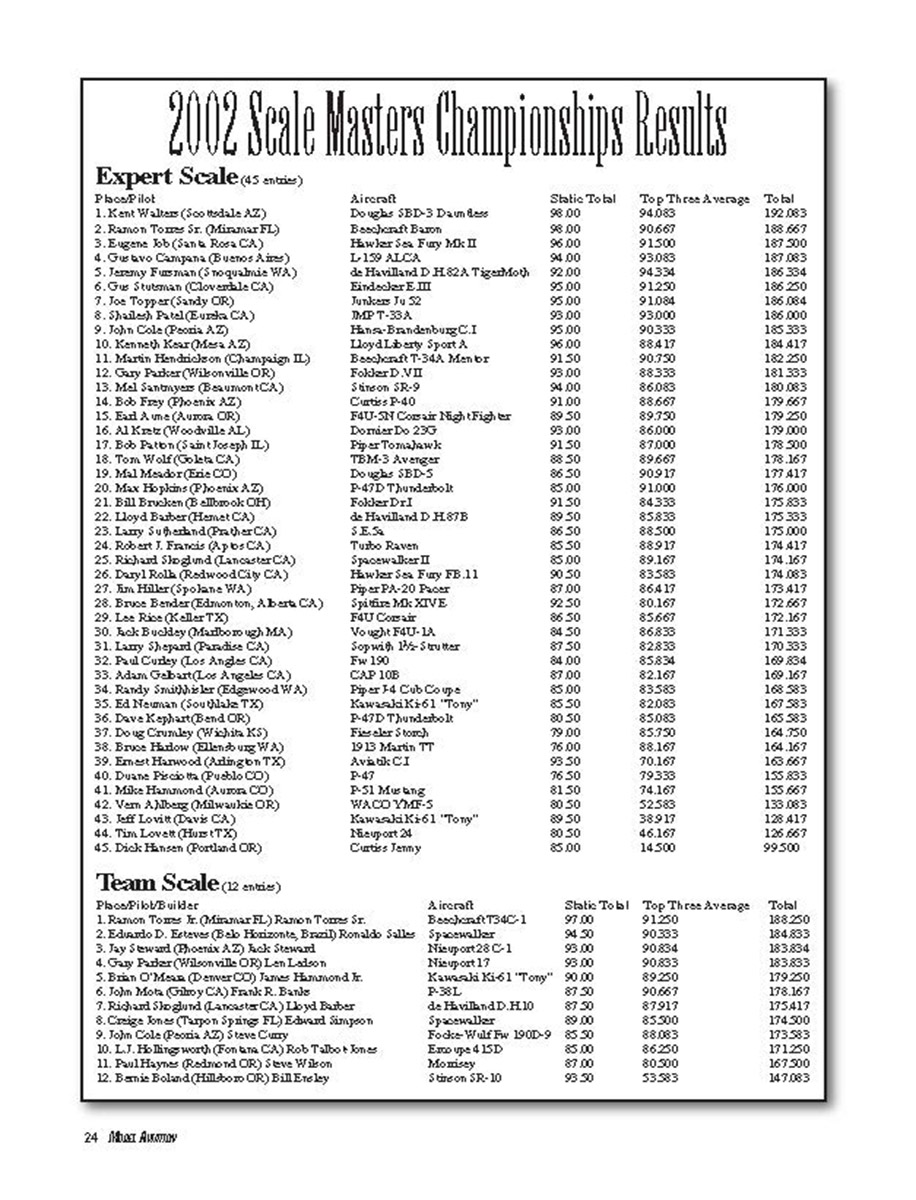
2002 Scale Masters Championships Results
Expert Scale (45 entries)
- Kent Walters (Scottsdale, AZ) — Douglas SBD-3 Dauntless; Static Total 98.00; Top Three Average 94.083; Total 192.083
- Ramon Torres Sr. (Miramar, FL) — Beechcraft Baron; Static Total 98.00; Top Three Average 90.667; Total 188.667
- Eugene Job (Santa Rosa, CA) — Hawker Sea Fury Mk II; Static Total 96.00; Top Three Average 91.500; Total 187.500
- Gustavo Campana (Buenos Aires) — L-159 ALCA; Static Total 95.00; Top Three Average 93.083; Total 188.083
- Jeremy Flanagan (Sequim, WA) — de Havilland DH.82A Tiger Moth; Static Total 92.00; Top Three Average 94.334; Total 186.334
- Guy Stutman (Cloverdale, CA) — Bücker Jungmann; Static Total 95.00; Top Three Average 91.250; Total 186.250
- Joe Topper (Sandy, OR) — Junkers Ju 52; Static Total 95.00; Top Three Average 91.084; Total 186.084
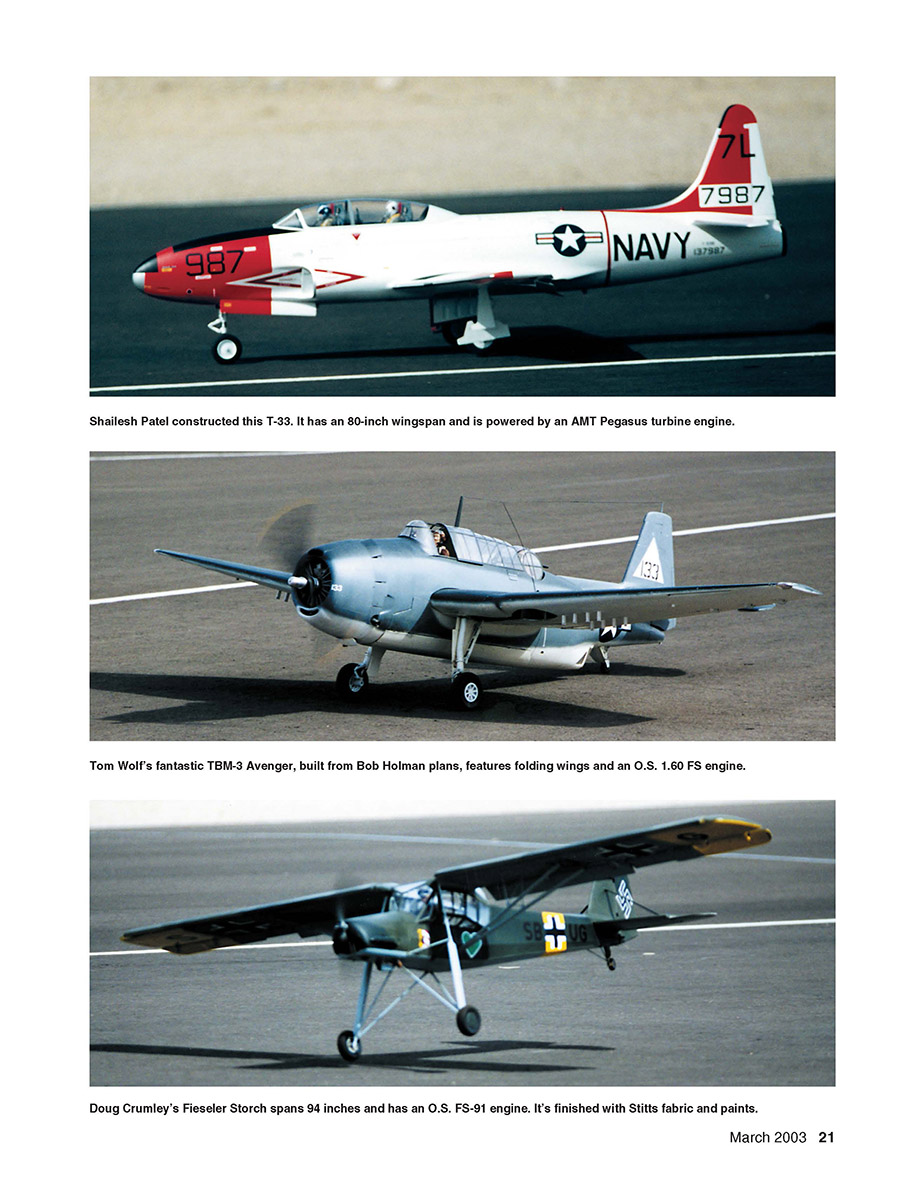
- Shailesh Patel (Eureka, CA) — MIP T-33A; Static Total 95.00; Top Three Average 93.000; Total 188.000
- John Cole (Peoria, AZ) — Henschel Hs 123; Static Total 95.00; Top Three Average 90.333; Total 185.333
- Kenneth Kerr (Mesa, AZ) — Lloyd-Liberty Sport A; Static Total 96.00; Top Three Average 88.417; Total 184.417
- Martin Hendrickson (Champaign, IL) — Beechcraft T-34A Mentor; Static Total 91.50; Top Three Average 90.750; Total 182.250
- Gary Packer (Wilsonville, OR) — Fokker D.VII; Static Total 93.00; Top Three Average 88.333; Total 181.333
- Hal Sinyor (Beaumont, CA) — Stinson SR-9; Static Total 94.00; Top Three Average 86.083; Total 180.083
- Bob Frey (Phoenix, AZ) — Curtiss P-40; Static Total 91.00; Top Three Average 86.667; Total 177.667
- Earl Lane (Aurora, OR) — F4U-5N Corsair Night Fighter; Static Total 93.50; Top Three Average 89.750; Total 183.250
- Al Kref (Woodville, AL) — Morane-Saulnier 230; Static Total 93.00; Top Three Average 86.000; Total 179.000
- Bob Pattison (St. Joseph, IL) — Piper Tomahawk; Static Total 91.50; Top Three Average 87.000; Total 178.500
- Tom Wolf (Goleta, CA) — TBM-3 Avenger; Static Total 88.50; Top Three Average 89.667; Total 178.167
- Hal Mesador (Erie, CO) — Douglas SBD-5; Static Total 86.50; Top Three Average 90.917; Total 177.417
- Max Hopkins (Phoenix, AZ) — P-47D Thunderbolt; Static Total 85.00; Top Three Average 91.000; Total 176.000
- Bill Brukern (Glenbrook, OH) — Fokker D.1; Static Total 91.50; Top Three Average 84.333; Total 175.833
- Lloyd Barber (Hermosa, CA) — de Havilland DH.87B; Static Total 89.50; Top Three Average 85.833; Total 175.333
- Larry Shepherd (Porter, CA) — S.E.5a; Static Total 86.50; Top Three Average 88.500; Total 175.000
- Robert J. Francis (Tupelo, CA) — Turbo Raven; Static Total 85.50; Top Three Average 88.917; Total 174.417
- Richard Skinner (Lancaster, CA) — Spacewalker II; Static Total 85.00; Top Three Average 89.167; Total 174.167
- Daryl Rolla (Redwood City, CA) — Hawker Sea Fury FB.11; Static Total 90.50; Top Three Average 83.583; Total 174.083
- Jim Haller (Spokane, WA) — Piper PA-20 Pacer; Static Total 87.00; Top Three Average 86.417; Total 173.417
- Bruce Bender (Edmonton, Alberta, Canada) — Spitfire Mk. IX/E; Static Total 92.50; Top Three Average 80.167; Total 172.667
- Lee Rice (Keller, TX) — F4U Corsair; Static Total 86.50; Top Three Average 85.667; Total 172.167
- Jack Buckley (Marlboro, MA) — Waco YMF-1A; Static Total 84.50; Top Three Average 86.833; Total 171.333
- Lanny Shepard (Paradise, CA) — Sopwith 1½-Strutter; Static Total 87.50; Top Three Average 82.833; Total 170.333
- Paul Cuday (Los Angeles, CA) — Fw 190; Static Total 84.00; Top Three Average 85.834; Total 169.834
- Adam Gabriel (Los Angeles, CA) — Caudron C.460; Static Total 87.50; Top Three Average 82.167; Total 169.667
- Randy Stohlheber (Edgewood, WA) — Piper J-4 Cub Coupe; Static Total 85.00; Top Three Average 83.583; Total 168.583
- Ed Newman (Southlake, TX) — Kawasaki Ki-61 "Tony"; Static Total 85.00; Top Three Average 82.083; Total 167.083
- Dave Kephart (Bend, OR) — P-47D Thunderbolt; Static Total 80.50; Top Three Average 85.083; Total 165.583
- Doug Crawley (Yakima, KS) — Fokker E.III; Static Total 79.00; Top Three Average 85.333; Total 164.333
- Bruce Hallow (Ellensburg, WA) — 1913 Martin TT; Static Total 76.00; Top Three Average 88.167; Total 164.167
- Ernest Harwood (Abilene, TX) — Avro Anson C.I; Static Total 93.50; Top Three Average 70.167; Total 163.667
- Duane Pisciotta (Pueblo, CO) — P-47; Static Total 76.50; Top Three Average 79.333; Total 155.833
- Mike Hammond (Aurora, CO) — P-51 Mustang; Static Total 81.50; Top Three Average 74.167; Total 155.667
- Vern Alibeg (Milwaukee, OR) — Waco YMF-5; Static Total 80.50; Top Three Average 52.583; Total 133.083
- Jeff Lovitt (Davis, CA) — Kawasaki Ki-61 "Tony"; Static Total 83.50; Top Three Average 38.917; Total 122.417
- Tim Lovett (Austin, TX) — Nieuport 24; Static Total 80.50; Top Three Average 46.167; Total 126.667
- Dick Hansen (Portland, OR) — Curtiss Jenny; Static Total 85.00; Top Three Average 14.500; Total 99.500
Team Scale (12 entries)
- Ramon Torres Jr./Sr. (Miramar, FL) — Beechcraft T-34C-1; Static Total 97.00; Top Three Average 91.250; Total 188.250
- Eduardo D. Esteves / Ronaldo Salles (Belo Horizonte, Brazil) — Spacewalker; Static Total 94.50; Top Three Average 90.333; Total 184.833
- Jay Steward (Phoenix, AZ) / Jack Steward — Nieuport 28 C-1; Static Total 93.00; Top Three Average 90.083; Total 183.083
- Gary Packer (Wilsonville, OR) / Len Ladson — Nieuport 17; Static Total 95.00; Top Three Average 90.833; Total 185.833
- Brian O’Neal (Denver, CO) / James Hammond Jr. — Kawasaki Ki-61 "Tony"; Static Total 93.00; Top Three Average 89.250; Total 182.250
- John Mohr (Clovis, CA) / Frank R. Banks — P-3L; Static Total 87.50; Top Three Average 90.667; Total 178.167
- Richard Skinner (Lancaster, CA) / Lloyd Barber — de Havilland D.H.10; Static Total 87.50; Top Three Average 87.917; Total 175.417
- Craig Jones (Clinton Springs, FL) / Edward Simpson — Spacewalker; Static Total 85.00; Top Three Average 85.333; Total 170.333
- John Cole (Peoria, AZ) / Steve Curry — Focke-Wulf Fw 190D-9; Static Total 85.00; Top Three Average 88.083; Total 173.083
- L.T. Hightower (Fontana, CA) / Rob Tabb & Jones — Ercoupe 415D; Static Total 85.00; Top Three Average 86.250; Total 171.250
- Paul Hayes (Redmond, OR) / Steve Wilson — Morissey; Static Total 87.00; Top Three Average 80.300; Total 167.300
- Bernie Boland (Hillsboro, OR) / Bill Eleky — Stinson SR-10; Static Total 93.50; Top Three Average 53.583; Total 147.083
Transcribed from original scans by AI. Minor OCR errors may remain.

