
2002 Tournament of Champions
Mike Hurley
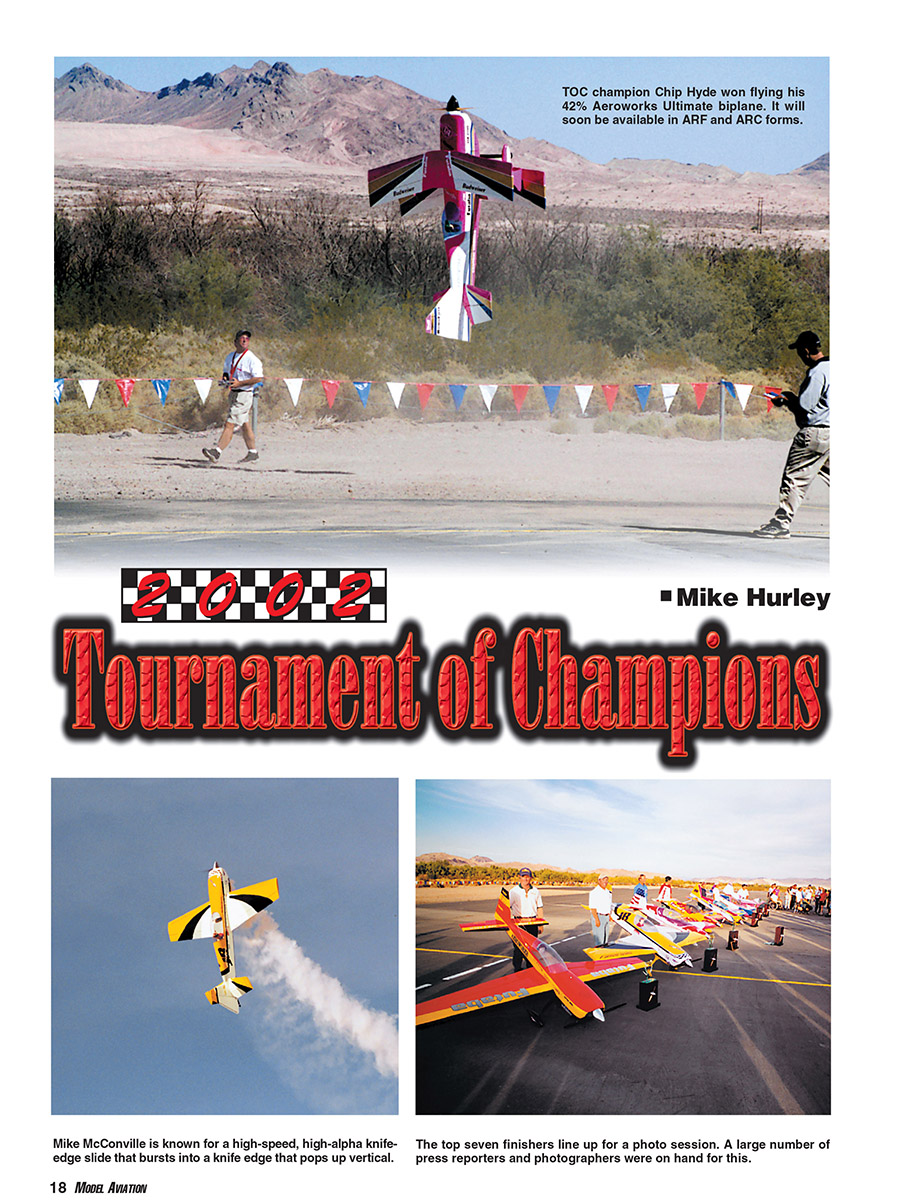
By now those who follow radio-control (RC) precision aerobatics know that Chip Hyde was the winner of the 2002 Tournament of Champions (TOC), held October 9–13 in Las Vegas, Nevada. What the broader RC community may not know is how the TOC has affected nearly every aspect of the RC aircraft hobby for the last 25 or so years and the significance of this contest each time it is held. The best way to describe the TOC is to liken it to the Oscars — not the World Series or the Super Bowl. This contest is watched by pilots, enthusiasts, manufacturers, and journalists from around the world. The following year’s trends are often set by what happens here: who is flying which airplane, which engine, and whose propeller; which equipment holds up and which fails. Gossip flows for months afterward as manufacturers gear up to capitalize on successes.
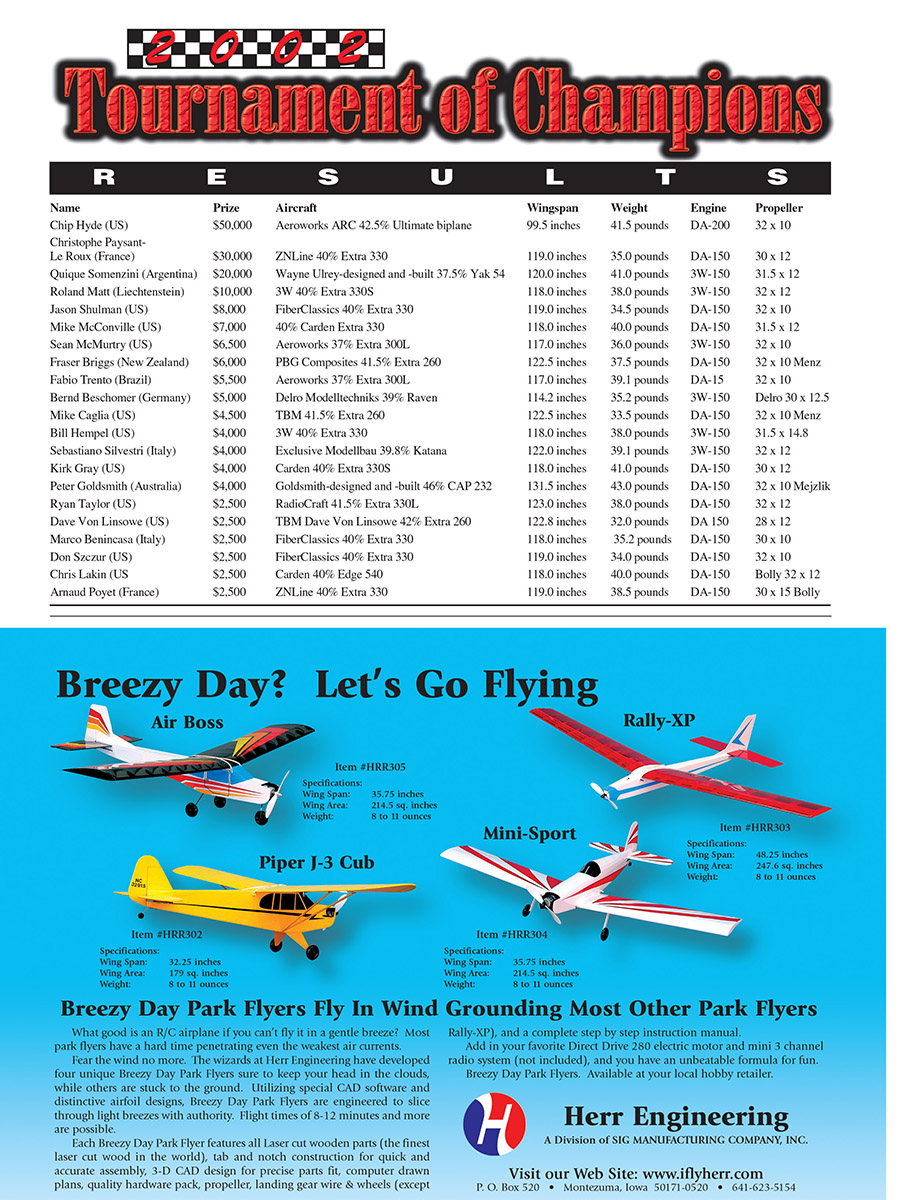
Results
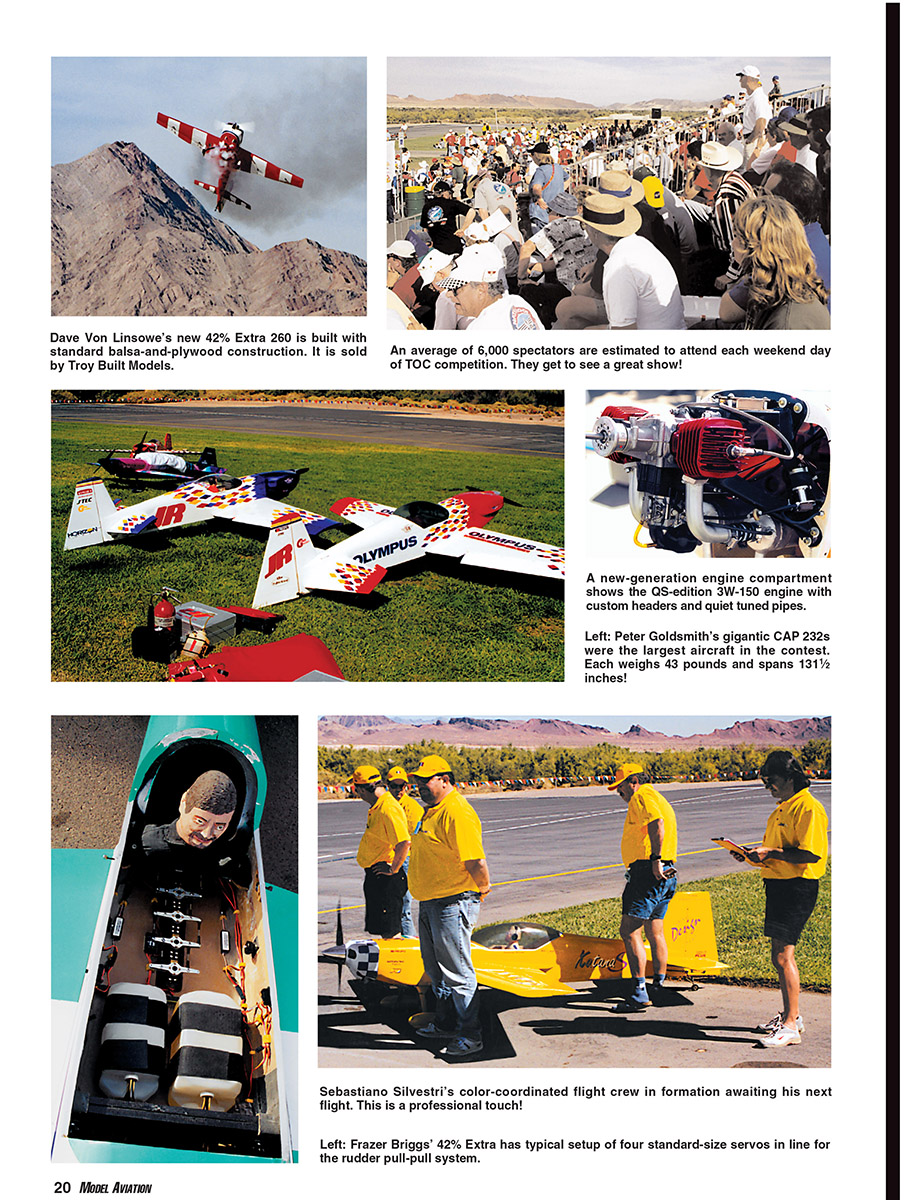
- Chip Hyde (US) — $50,000 — Aeroworks ARC 42.5% Ultimate biplane — 99.5 in — 41.5 lb — DA-200 — 32 x 10
- Christophe Paysant-Le Roux (France) — $30,000 — ZNLine 40% Extra 330 — 119.0 in — 35.0 lb — DA-150 — 30 x 12
- Quique Somenzini (Argentina) — $20,000 — Wayne Ulrey-designed and -built 37.5% Yak 54 — 120.0 in — 41.0 lb — 3W-150 — 31.5 x 12
- Roland Matt (Liechtenstein) — $10,000 — 3W 40% Extra 330S — 118.0 in — 38.0 lb — 3W-150 — 32 x 12
- Jason Shulman (US) — $8,000 — FiberClassics 40% Extra 330 — 119.0 in — 34.5 lb — DA-150 — 32 x 10
- Mike McConville (US) — $7,000 — 40% Carden Extra 330 — 118.0 in — 40.0 lb — DA-150 — 31.5 x 12
- Sean McMurtry (US) — $6,500 — Aeroworks 37% Extra 300L — 117.0 in — 36.0 lb — 3W-150 — 32 x 10
- Fraser Briggs (New Zealand) — $6,000 — PBG Composites 41.5% Extra 260 — 122.5 in — 37.5 lb — DA-150 — 32 x 10 (Menz)
- Fabio Trento (Brazil) — $5,500 — Aeroworks 37% Extra 300L — 117.0 in — 39.1 lb — DA-150 — 32 x 10
- Bernd Beschorner (Germany) — $5,000 — Delro Modelltechnik 39% Raven — 114.2 in — 35.2 lb — 3W-150 — Delro 30 x 12.5
- Mike Caglia (US) — $4,500 — TBM 41.5% Extra 260 — 122.5 in — 33.5 lb — DA-150 — 32 x 10 (Menz)
- Bill Hempel (US) — $4,000 — 3W 40% Extra 330 — 118.0 in — 38.0 lb — 3W-150 — 31.5 x 14.8
- Sebastiano Silvestri (Italy) — $4,000 — Exclusive Modellbau 39.8% Katana — 122.0 in — 39.1 lb — 3W-150 — 32 x 12
- Kirk Gray (US) — $4,000 — Carden 40% Extra 330S — 118.0 in — 41.0 lb — DA-150 — 30 x 12
- Peter Goldsmith (Australia) — $4,000 — Goldsmith-designed and -built 46% CAP 232 — 131.5 in — 43.0 lb — DA-150 — 32 x 10 (Mejzlik)
- Ryan Taylor (US) — $2,500 — Radiocraft 41.5% Extra 330L — 123.0 in — 38.0 lb — DA-150 — 32 x 12
- Dave Von Linsowe (US) — $2,500 — TBM Dave Von Linsowe 42% Extra 260 — 122.8 in — 32.0 lb — DA-150 — 28 x 12
- Marco Benincasa (Italy) — $2,500 — FiberClassics 40% Extra 330 — 118.0 in — 35.2 lb — DA-150 — 30 x 10
- Don Szczer (US) — $2,500 — FiberClassics 40% Extra 330 — 119.0 in — 34.0 lb — DA-150 — 32 x 10
- Chris Lakin (US) — $2,500 — Carden 40% Edge 540 — 118.0 in — 40.0 lb — DA-150 — Bolly 32 x 12
- Arnaud Poyet (France) — $2,500 — ZNLine 40% Extra 330 — 119.0 in — 38.5 lb — DA-150 — 30 x 15 (Bolly)
History
The TOC was founded in 1974 by William G. Bennett, owner of Circus Circus Hotel and Casino and Circus Circus Hobbies in Las Vegas. Walt Schroeder of Model Airplane News conceived the idea of a premier contest with a major prize purse for the world’s top F3A pilots and knew Bennett could make it happen.
The objective was to create a program considerably harder than the sequences being flown at the time. The contest was structured as an invitational exclusive to the best pilots in the world. Initially run in a traditional F3A Pattern style, the TOC shifted in 1977 to emulate full-scale precision aerobatics more closely, adopting a formula closer to that flown by the International Aerobatics Club (IAC).
In addition to requiring aircraft to have a scale outline, the evolving TOC rules began to favor increasingly larger aircraft. Bennett and organizers believed larger airplanes flew better and were easier to see for pilots, judges, and spectators. Making the contest a spectator event has always been a key goal as it evolved.
Freestyle programs carry significant weight in the overall score. Each year the sequences got progressively more difficult, aircraft sizes increased, and vertical performance became more important. Unlike many flying events, excitement is the name of the game at the TOC. The contest has arguably the largest prize purse of any aerobatic flying contest worldwide — full-scale or RC — and with prize money totaling $183,500 and only the best pilots invited, it is rightly the most publicized and photographed event in RC aviation. Journalists from Japan, Germany, France, Italy, Australia, Brazil, Argentina, Liechtenstein, and the United States crowd the flightline for the best photographs. This year the TOC even made CNN world news coverage.
TOC Spawns Innovation
Manufacturers clamor to have their products associated with the TOC and its competitors. They continually develop products to be the TOC pilot’s choice. Nearly every aspect of RC today has been influenced by this contest. Obvious developments such as large, reliable gas engines designed for TOC demands and high-powered digital servos were spawned by the contest’s requirements.
Other offshoots have been less obvious. The popularity of Almost Ready to Fly (ARF) airplanes grew from a demand for quick, easy-to-build entry-level scale aerobatics airplanes. Advancements in lightweight, reliable radio equipment helped give birth to sophisticated computer radios. Simple, lightweight solutions in construction and equipment developed into other areas of RC, from racing to scale and even the park-flyer revolution.
Put bluntly, much of the reliable, capable, and precise equipment used in many RC categories today might not exist without the TOC’s influence. The contest has even influenced flying techniques: maneuvers created by talented freestyle competitors quickly spread to local fields. Ten years ago experts deemed high-alpha (high angle of attack) 3-D flight impossible; today 3-D flight has revitalized excitement in RC and generated renewed youth interest in the hobby.
Five Days of Flying
The contest starts with 21 pilots flying over three days: Wednesday, Thursday, and Friday. Each day they fly an Unknown, a Known, and a Freestyle. The Unknown sequence is revealed the night before it is flown, and no actual in-air practice is allowed. The Knowns are different at the TOC: pilots are told the maneuvers in advance but not the order or placement, effectively making them another form of Unknown to increase difficulty and keep judging feasible. The Freestyle is a four-minute timed event; the routine is up to the pilot and is judged on originality, versatility, harmony and rhythm, and execution. The intent is to make the Freestyle the most exciting spectator portion of RC.
Scoring rewards the ability to consistently fly every maneuver with precision. Any pilot might post the best score on a given figure, but those who avoid mistakes consistently move to the top.
Pilots and Performances
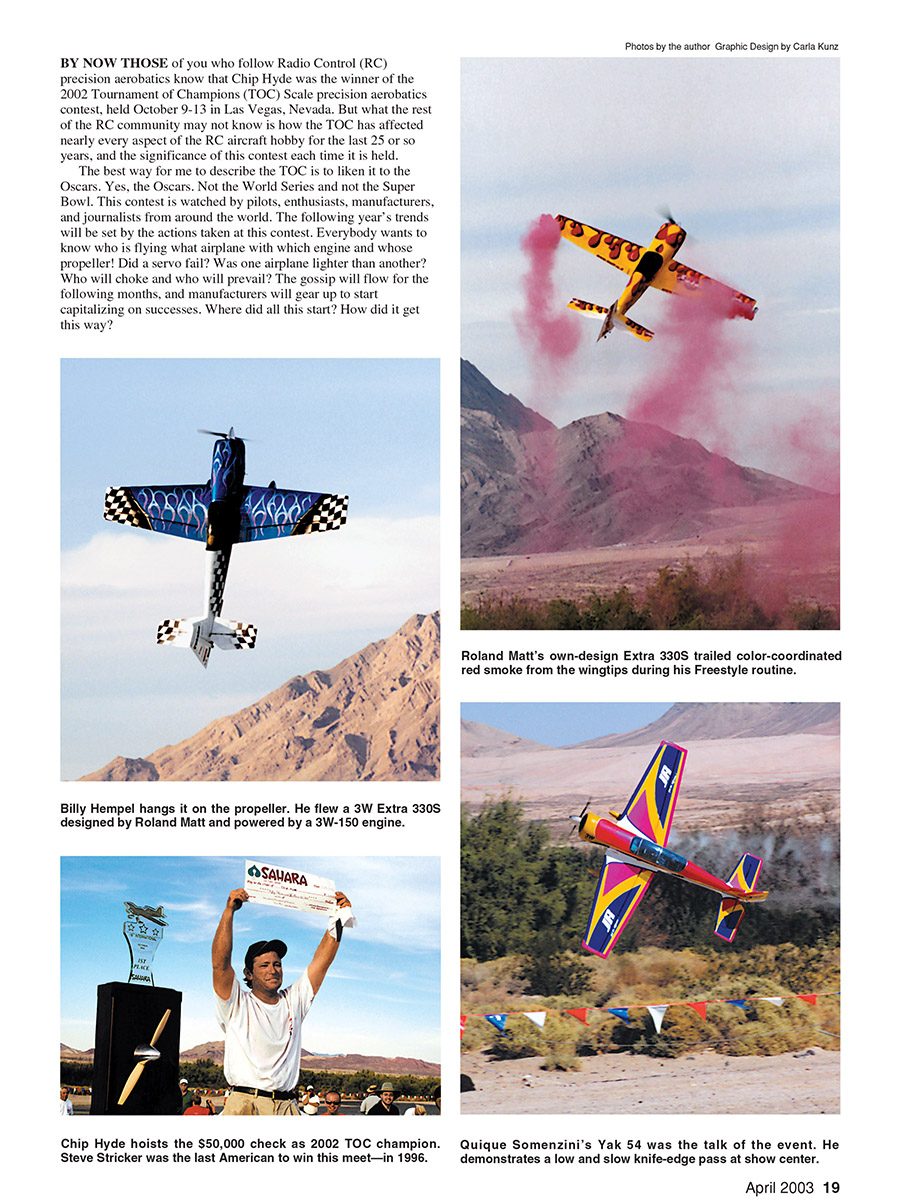
Early in the contest, Chip Hyde, Quique Somenzini (Argentina), defending champion Christophe Paysant-Le Roux (France), and Jason Shulman (US) looked strong, trading positions after each round. Mike McConville (US) appeared to be at his personal best, putting in solid Known and Unknown flights and thrilling the crowd with an energized, high-stress Freestyle close to show center.
On Friday, Peter Goldsmith (Australia) suffered bad luck when a well-seasoned propeller split and exploded on his goldsmith-designed 46% CAP 232. The imbalance violently shook the airframe and broke the engine hub, resulting in zeros for that round and dropping him to 15th place—just short of the top 14 for Saturday’s finals. Peter told me the biggest pressure in this contest is not letting the spectators down. Roughly 6,000 spectators travel from around the world to see the best, and pilots feel obligated to put on a show. Peter also noted that creating a Freestyle is the hardest part of the contest; while FAI figures are straightforward, crafting, practicing, and perfecting a Freestyle takes most of the off-season.
Saturday’s program cut the field and added a second Freestyle round. With two Freestyle rounds and one Known and Unknown, Freestyle had an even greater effect on the outcome. Fabio Trento, the Brazilian National Freestyle champion and the youngest competitor at 18, was one of the most exciting crowd-pleasers in his first TOC appearance, placing a respectable ninth. Fabio is a master of low-level, high-alpha flight in all attitudes, with astounding control of the inverted harrier.
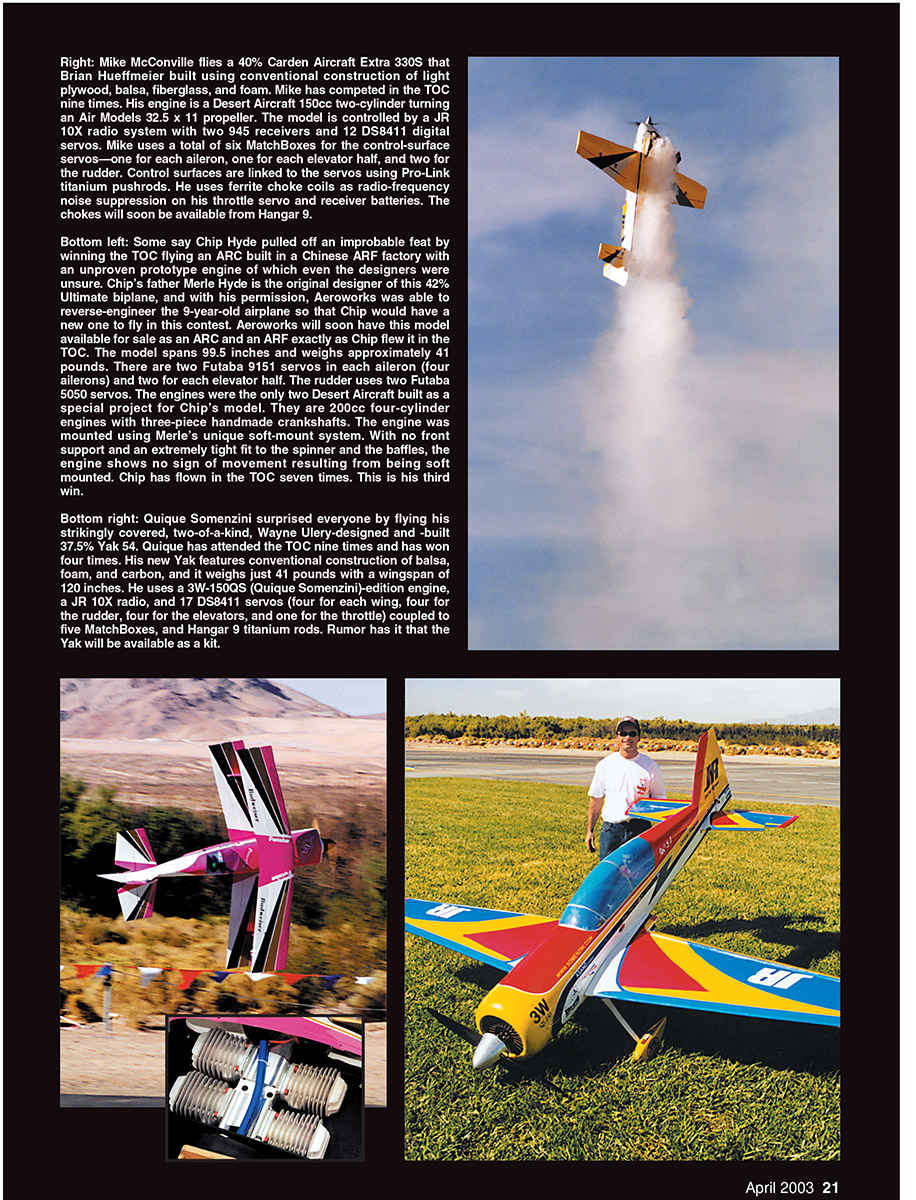
Four-time TOC champion Quique Somenzini is credited with bringing extreme Freestyles and many 3-D maneuvers to the TOC. This year Quique appeared to favor a more precise and elegant Freestyle—artistic, precise, and polished—rather than the high-impact tactics he introduced years ago. The crowd, however, often expects high-adrenaline “monster-truck” performances. Bill Hempel is the king of high-impact, fast-paced Freestyles; from his dramatic takeoff to dropping a USA banner at the end of his routine, Bill commanded the spectators’ attention.
The close of Saturday cut seven more competitors, and Sunday was crunch time. With an estimated 6,000 people watching every flight, even Known and Unknown flights receive applause; the crowd knows when a flight is truly excellent.
Equipment and Setup
A few myths should be dispelled. Gyros are not allowed in the TOC—not for Freestyle and not for precision—so none of these airplanes are gyro-equipped. Coupled flaps or ailerons to the elevators and split ailerons are not allowed; models are set up like scale airplanes. The engines used are typically Desert Aircraft (DA) or 3W two-cylinder, two-stroke engines; these are off-the-shelf engines, not special variants available only to TOC pilots. You can build an aircraft like these without special equipment.
Most models are ~40%-scale monoplanes with 118–120 inch wingspans and average weights around 36–40 pounds. Construction varies (composite, Nomex, wood, foam wings). Most airplanes (except Chip’s biplane) used a 150cc two-cylinder two-stroke engine (Desert Aircraft or 3W). Some use quiet canister muffler systems at a ~2 lb penalty but with pleasing, quiet tone.
Typical control setups: four standard-size servos for the rudder in a cabled pull-pull configuration, two servos per elevator half, and three per wing with direct solid linkages. Servos generally provide roughly 120–200 in·oz torque with fairly fast speeds. JR digital servo users often used JR MatchBoxes for adjustments. Power distribution is usually via two receivers, though some pilots use one receiver with a power-distribution system. Switches, linkages, and turnbuckles are standard off-the-shelf items (JR, Futaba, Nelson, Hangar 9, SWB); many pilots use titanium turnbuckles. Smoke systems are typically removable and installed only for Freestyle. Fuel tanks are standard off-the-shelf items holding ~50 oz. Battery systems varied; many pilots are experimenting with regulated Li‑Ion systems.
Many TOC airplanes are ready-made ARFs or ARCs (Almost Ready to Cover), including the Radiocraft Extra and FiberClassics Extras flown by several pilots, as well as Chip’s biplane. You can buy these airplanes and all the parts to equip them just like you see at the TOC.
Conclusion
Reading this report, I hope you get a hint of the excitement, inspiration, and fun this level of competition brings to model aviation. Videos are available from producers who filmed the contest, but nothing compares to being there in person. The TOC is scheduled again for October 2004. If you want to be part of the action, Las Vegas is waiting. Plan your trip, experience the world’s most exciting RC competition, and support the Sahara Hotel for outstanding TOC rates.
Mike Hurley 11542 Decatur Ct. Westminster, CO 80234 m.hurley@attbi.com
Transcribed from original scans by AI. Minor OCR errors may remain.

