
2004 FAI Control Line World Championships-2004/11
FOR THE FIRST time in 20 years, the FAI Control Line World Championships (CLWC) was contested in the United States. Between July 4 and July 10, the best CL modelers on the planet made their way to AMA’s International Aeromodeling Center in Muncie, Indiana, to compete in the four FAI F2 events at the 23rd CLWC: A (Speed), B (Aerobatics), C (Team Race), and D (Combat).
The last CLWC held in the states was in 1984 at Westover Air Force Base in Chicopee, Massachusetts. It was a great success, but even then the world competitors felt that the expense and hassle to travel to the US was excessive. The question this year was, Will they attend? And the current world situation in respect to security added to the problem. Traveling in large groups with lots of support equipment used to be fairly easy—not so today. Heightened airport security and luggage restrictions have added to the frustration of trying to get delicate, trim-sensitive models to a site safely and on time.
But attend they did. There were 304 competitors, team managers, mechanics, and helpers from 28 countries, plus numerous supporters.
The only real drama was that there were visa issues for a few members of the Chinese, Ukrainian, and South African teams. Special arrangements had to be made through the State Department to quickly cut a bunch of red tape to allow the Chinese to get to the meet in time to compete.
The only Chinese team member who received his visa in time—F2B Junior competitor Yaokun Wang—arrived on AMA’s doorstep Monday, July 6, with his luggage, and he had no room reservations or transportation. AMA President Dave Brown took Yaokun under wing and put him up for the night, and then helped him with billeting and transportation until the rest of his team arrived.
by Dave Mark
F2A (Speed)
Thirty-three Speed fliers from around the world competed in this CLWC, and 15 North American Speed Society (NASS) members volunteered their time to perform the jobs required for competition at this level.
Sunday, July 4, NASS members prepared the site for the Speed event. The Nats Racing circle, located to the west of the Speed circle, was used for line layout, fuel dispensing, tank flushing, pull-testing safety straps and wires, and staging fliers before their turn to enter the circle. Height markers were installed at four points around the circle. AMA supplied a stand for the height judge—Al Kelly—and it was adjusted so that his eyes were at the exact level required by FAI rules. Four people timed flights with stopwatches along with the Trans Trace electronic timing system that Goran Olsson designed.
Model processing was Monday, July 5, at Cardinal Hills Country Club. The aircraft were weighed, and then the engines were marked to identify which ones would be used in competition. Control handles and safety straps were checked to verify compliance with the rules, and the models’ wing and stabilizer areas were measured. All of this data was entered into a computer program that Bill Lee designed and wrote. The software used the measurements to compute areas and indicate whether or not the models conformed to the rules. All airplanes processed that day were in compliance.
After the models were processed, the software randomly mixed the contestant list and created the flight order for the first day of competition. Then it shuffled the list by thirds to create the contestant orders for the second and third days. It ensured that no one flew at the same time each day. A printout showed the order and flying time for each pilot for each round of competition. In F2A, fliers are assigned a time to fly and are allowed six minutes to complete the task.
The event was scheduled to start at 9 a.m. Tuesday. On the first day of flying, equipment was checked to ensure that each worker had the tools required for the job. It was learned that there were no instruments to measure line diameter. AMA was to provide measuring devices, and they were located at the tech impound area.
The site technical inspector, Carl Dodge, was contacted, and he said that the equipment supplied was inadequate. US team member Will Naemura saved the day; he loaned a set of digital micrometers that measured to 50 millionths.
The first modeler to fly was Peter Halman of Great Britain. As the crew began measuring his lines, Jo Halman—Great Britain's team manager—pointed out that the line-length and pull-test method did not conform to FAI standards. The line-length measuring system was modified, measured with a steel tape, and marked to everyone's satisfaction.
The pull test was to use a load cell that NASS supplied. The problem with the load cell was the method of anchoring it to supply a strong point to pull against. This was changed by adding a two-line flying handle to the cell and using that to pull the model, which was accepted. Each model was pulled three times, and the safety strap was also pulled three times.
Fuel handling presented a small cultural difference: many Europeans use small 2- to 3-ounce bottles to fuel their models. The 5-gallon tank at the site had a large spigot, so a funnel was needed but none could be found. The outside of a fuel syringe was used as a makeshift funnel. At this point the contest was about 25 minutes behind schedule and ready to fly.
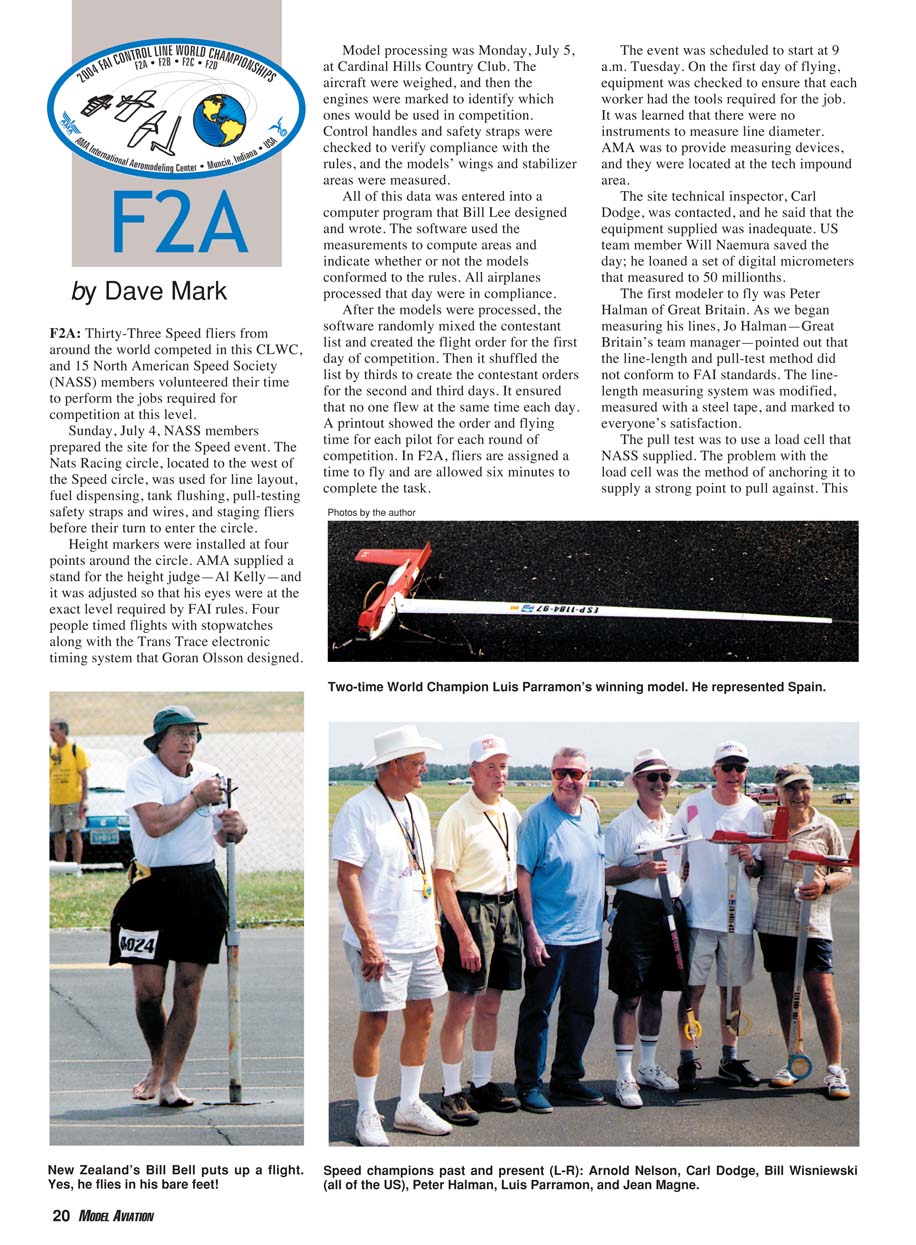
Peter Halman set the pace with a good, clean 292.3 kph run. World Champion Luis Parramon of Spain followed and raised the mark to 295.6 kph. No other fliers came close to those speeds the first day. Ten competitors took refights after they could not get their equipment to run in the Muncie air on their first day.
Attempts and weather issues affected early results. At the close of competition Monday, 14 competitors had zeros for their times. The weather stations that modelers used showed many shifts in altitude density and humidity during the day, making it difficult to tune engine setups.
The second day of flying, Wednesday, started on time at 9 a.m., with equipment problems mostly behind the competitors. Jean Magne of France posted a 291.0 kph using a Halman Special engine; that speed held as fastest of the day until Luis Parramon flew at 11:28 with a 291.5 kph. Many contestants were still having setup problems, and 12 took reflights when they could not get official flights on their first attempts. US team member Will Naemura turned a 288.4 kph on his reflight, which put him in eighth place. Nine fliers took zeros for the day, and five still had not posted times for the meet.
Thursday was scheduled for practice, and both circles were available. The British team practiced for more than 10 hours, trying to figure out the correct setup. They took readings from their Oregon Scientific weather station all day and made many equipment changes, logging every move as the day progressed. British team member Ken Morrissey said that of all the world meets the British team had attended, the Muncie site set the record for unpredictable air. The Russian team members were having similar problems; they made many practice flights and were still shaking their heads at the end of the day. Sole Lithuanian competitor Sigitas Snukiskis had posted two zeros during the first two rounds and spent many hours on the practice circle trying to get his model to come on the pipe.
The final round of competition was Friday, during which all three Junior fliers posted their fastest times. British team member Matthew Hart turned a 282.6 kph for second as a Junior and 15th overall. Scott Matson of the US turned 269.0 kph for third as a Junior and 29th overall. Luca Grossi of Italy took a reflight and then posted a 285.9 kph, first as a Junior and 12th overall. Sigitas Snukiskis finally got his model to run, posting a clean 223.1 kph; the crowd cheered his effort.
Peter Halman’s final flight increased his speed to 292.5 kph. Luis Parramon then posted the meet’s highest speed: 295.9 kph, with data showing his model gained speed on each lap. British fliers Ken Morrissey and Paul Eisner posted speeds of 289.0 kph, moving Great Britain into a strong team position. French team member Jean Magne later tied Parramon at 295.9 kph. Jean Marc Aube of France posted 290.2 kph and Jari Valo of Finland, on a last-chance reflight, posted 289.5 kph. Todd Ryan of the US turned a 286.9 kph on his reflight, moving him to ninth place behind teammate Will Naemura, and pushing the American team into third place overall.
Team standings are determined by the sum of each team member’s highest speed. Final team totals:
- Great Britain: 870.5
- France: 868.4
- United States: 858.0
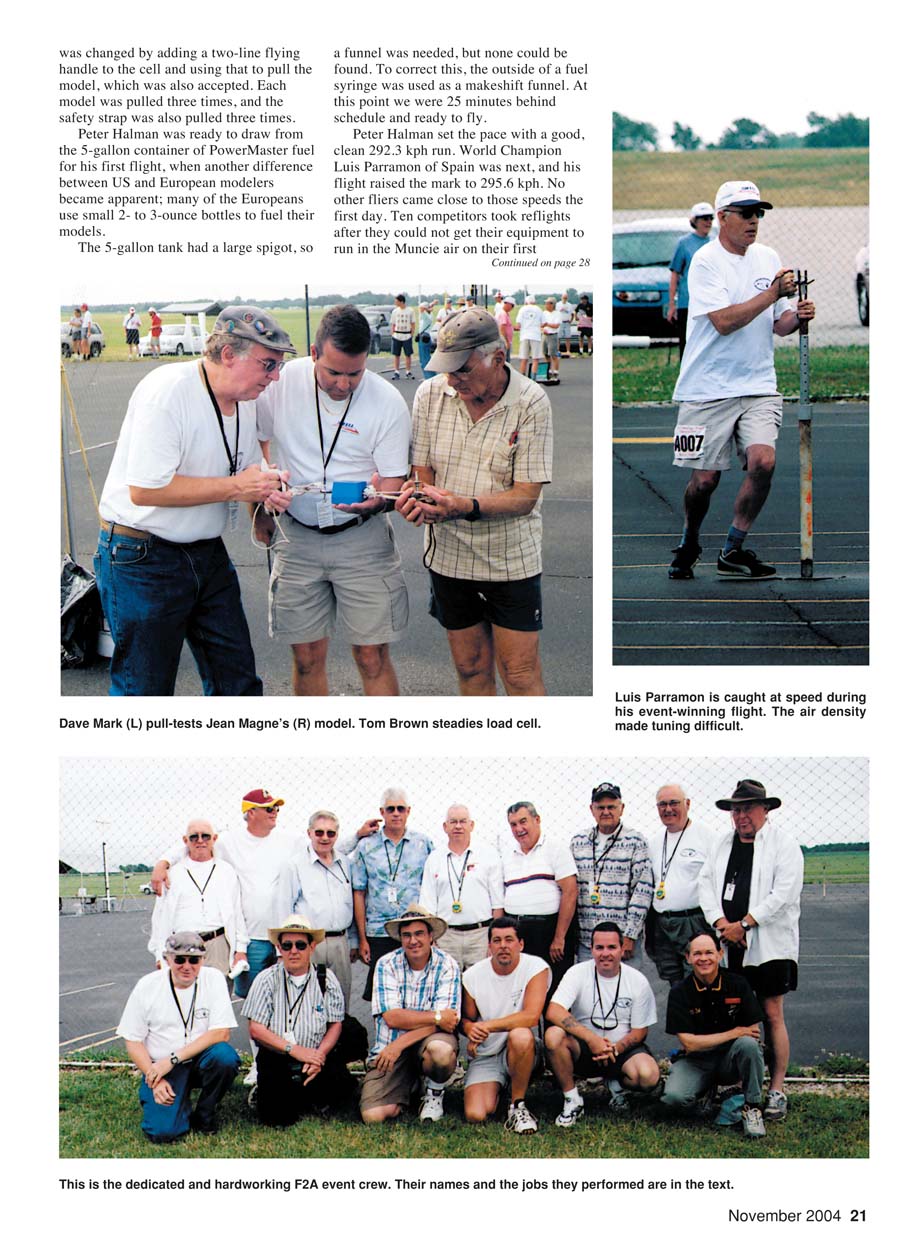
Volunteers who made the Speed event happen included:
- Bill Lee (software and general event management)
- Barry Tippett (event director and timing)
- Bill Hughes (circle marshal)
- Bob Fogg (Trans Trace timing system)
- Al Kelly (height judge)
- Al Stegens (timing)
- Chris Montagnino (timing)
- Larry Tennen (timing and model impound driver)
- Tom Brown (line diameter and length)
- (author) Dave Mark (pull test)
- Bob Taipale (tabulation)
- Arnie Nelson (data input to log flight)
- Joe Brownlee (data input to log flight)
- Dick Yatson (time posting)
- Al Jones (fuel dispensing)
- Joey Mathison (fuel flush and holding-area marshal)
This contest was completed with no formal protests. Many commented that it had been years since that had happened. All contestants placed official flights, which was another first in years.
F2B (Aerobatics)
Rob Gruber had great qualifying flights. Ted (Fancher) flew first in the first round and had terrific air, but the early flight draw hurt his first-round scoring chances. He flew his beautiful, original Final Edition design powered by a RoJett .61.
The rest of the US team contended with difficult conditions. Paul Walker flew a Saito 72-powered Miss America Mustang of his own design. Bill Werwage flew a piped PA .61-powered P-47 Razorback, and Rob Gruber flew a Randy Smith-designed Dreadnought with a piped PA .61. The diversity of models, engines, and flying styles was a major talking point at the contest.
There were many piped models, long two-strokes, and four-strokes. In perfect air they all seemed to work fine, but in wind some approaches held up better than others. Four-strokes and long-stroke two-strokes had characteristic issues: slowing on climbs and speeding downhill, difficulty penetrating wind in overheads, and drifting on vertical portions of square maneuvers. These attributes showed up across many designs, including hand-built ones.
A standout builder was Andrai Yatsenko of Ukraine, whose take-apart models assembled in just 10 minutes from a compact box; several of his airplanes were competitive.
Three approaches to four-stroke use were evident:
- Paul Walker’s Saito 72 muscled through with an impressive growl and aggressive style.
- The French Rémi Beringer Saito 56 models flew fast in level flight but slowed dramatically in parts of some maneuvers, giving the appearance of rotating on their propellers. Their designs had exceptionally long tails and showed a sliding-turn look.
- Defending and five-time World Champion Xinping Han of China and teammate Anlin Niu ran Saito 56 engines with a conservative, consistent program.
In the finals it was a fight to the finish between Bill Werwage, Rémi Beringer, and Xinping Han. Rémi led after the first round and flew third in the final round. Bill flew next and posted the highest score of the contest, taking the lead. Xinping flew later and put up his best flight of the week.
Final results:
- Gold: Bill Werwage (USA)
- Silver: Xinping Han (China)
- Bronze: Rémi Beringer (France)
Rob Gruber won First Place in Junior. With strong support from teammates Paul Walker and Ted Fancher, the US team finished in first place in the team competition, sweeping all the Gold Medals in this category. Congratulations to all, including US Team Manager Keith Trostle.
F2C (Team Race)
by Dave McDonald
This event provided a unique opportunity for many in the US to see some of the best in Team Race compete. Although there was a noticeable decrease in the number of competitors at this WC and the reigning World Champion did not attend, there was still competition at a level seldom seen in this country.
The people who helped run this event should receive a big round of applause. The timekeepers and people in the line-check area were great. Event Director Tom Fluker kept those present on their toes and ran a smooth and orderly WC event.
John Ballard probably walked five miles. His responsibilities included impounding airplanes and checking them for compliance when fast times were turned in during the heat races and semifinals, and checking all three airplanes at the conclusion of the final. It takes a team to run these events, and this group was outstanding.
Although the Jury members missed some calls and made some decisions some disagreed with, they did an excellent job overall. Their consistency was superb, and that is what you look for from a Jury as a competitor. They are unable to please everyone, but they did a hard job and showed no favoritism.
The US contingent—Lenard Ascher, Aaron Ascher, Stewart Willoughby, Bob Oge, Tim Gillott, and Todd Ryan—did not have the strong performances expected on their home turf.
US team finishes:
- Team Ascher: 15th overall (best time 3:23.00; two substandard times 3:50.80 and 3:40.40)
- Team Ryan/Gillott: 22nd overall (one DQ, one DNF, one 3:38.00)
- Team Willoughby/Oge: 30th overall (DNF Lap 1, DQ, DNF Lap 79)
After Round One the quick time went to the Russian team of Yury Shabashov and Vladimir Ivanov with 3:15.90. Second quickest after the first round were the two French teams of Pascal Surugue/Georges Surugue and Fabrice Picard/Claire Perret, posting strong 3:17.70s.
Round Two saw some up-and-down performances. Team Shabashov/Ivanov had a DNF at 49 laps. The Swedish team of Bengt-Olof Samuelsson and Kjell Axtilius posted a 3:17.00. Team Steven Smith/Colin Brown of Great Britain posted a 3:18.40, and the Russian team of Victor Averin/Victor Marchenko posted a 3:18.00.
The third and last elimination round was do-or-die for most teams. The three French teams took advantage:
- Surugue/Surugue: 3:15.60
- Thierry Ougen/Roland Surugue: 3:16.70
- Picard/Perret: 3:19.90
The Ukrainian team of Valeriy Kramarenko/Yuriy Chayka posted 3:17.10 to secure a spot in the semifinals. Team Smith/Brown of Great Britain upped its performance to 3:16.40. The Russian team of Andrey Yushchenko/Victor Yugov posted a strong 3:16.70 when it counted.
Teams that moved on to the semifinals included:
- Surugue/Surugue
- Ougen/Surugue
- Picard/Perret
- Shabashov/Ivanov
- Averin/Marchenko
- Yushchenko/Yugov
- Kramarenko/Chayka
- Samuelsson/Axtilius
- Smith/Brown
The semifinal rounds were hotly contested. Surugue/Surugue posted a world record of 3:09.06 in one semifinal (noting the race was two-up after a disqualification). Other strong semifinal times were Shabashov/Ivanov at 3:11.50 and Kramarenko/Chayka at 3:15.30. These teams would go on to battle for the World Championship.
The second semifinal round had one standout time—Ougen/Surugue’s 3:16.10—while other times ranged from 3:23 to 3:28.
The final race for the title was between Surugue/Surugue (France), Shabashov/Ivanov (Russia), and Kramarenko/Chayka (Ukraine). The French and Russians were roughly equal in airspeed for much of the race, but the Russians were fouled out at Lap 185, leaving the French with a comfortable lead over the Ukrainians. Final results:
- Individual Gold: France (Surugue/Surugue) — 6:42.70
- Individual Silver: Ukraine (Kramarenko/Chayka) — 7:02.00
- Individual Bronze: Russia (Shabashov/Ivanov) — 185 laps
Team medals:
- Gold: France
- Silver: Russia
- Bronze: Great Britain
Performance observations and trends:
- Many outstanding teams turned lap times in the 16.7–17.0 second range in three-up traffic. Speeds may be approaching a point where line/gear limits and pilot ability need re-evaluation.
- F2C is becoming a young person’s sport, but relatively few young pilots are entering at the highest level.
- Innovations visible at this WC included retractable landing gear and carbon wings fabricated in molds to ensure consistent airfoils. The French made use of carbon wings and retracts (not necessarily on the same model), and carbon fuselages are reappearing in more refined forms.
- Racing is a team effort: a skilled pit crew is as valuable as a good pilot. Pit stops often decide races, and higher speeds require innovations in wing technology and recovery methods to avoid failures during catches.
- The FAI discussed increasing line diameter for safety; talks indicated any change was likely to be held off for at least another cycle.
For American teams, the message is clear: competing at world-class F2C requires sacrifice of time and resources and total commitment. There is always next time.
F2D (Combat)
by Rich Lopez
The CLWC always has exciting events. This year, FAI Combat had 57 competitors from 18 countries. Team USA was composed of Ron Colombo (Michigan), David Owen (Tennessee), Mark Rudner (California), and Junior Holden Hill (California). Mike Willcox of Texas was also present to defend his World Champion title.
It had been 20 years since the US hosted a CLWC, and coincidentally it had been 20 years since we had a Combat World Champion defending his title (Tom Fluker Jr. was the first American Combat World Champion).
The 2004 WC afforded all Combat pilots ample practice opportunities, given numerous official and unofficial practice circles. In past years, a lack of practice facilities put some teams at a disadvantage. The Combat pilots appreciated the facility that AMA provided.
Thanks to Pat Willcox for making the Combat event thoroughly professional. He ensured plenty of black and orange vests to distinguish teams in the circle, plentiful high-quality streamers, fuel bottles with filters for competitors, extra practice fuel, quality field preparation, judges, timers, and pit workers. The contest ran smoothly and without too many protests.
Judges were Andy and Bobby Mears, Larry Driskill, Roy Glenn, Chris Gay, and Roy Krupa. In the pits, Pat recruited Howard Shenton and Doug and Jean Powell to hand out fuel, do line measurements, venturi checks, and pull-testing. Sheila Cranfill did an amazing amount of work to get all matches posted and registered in the contestant-visible computer, allowing competitors to view results shortly after they were entered.
The F2D FAI judges were Rob Olijve (Netherlands), Ingemar Larsson (Sweden), Vernon Hunt (United Kingdom), and Mack Henry (United States).
Round-by-round highlights:
- First round: the US had mixed results. Mike Willcox, Mark Rudner, and Holden Hill lost to Xavier Riera (France), Stanislav Chornyy (Ukraine), and Dominykas Zubas (Lithuania) respectively. Ron Colombo and David Owen posted early wins over Ivan MacKenzie (Canada) and Swedish Junior Mikael Sjölund.
- Mike’s first-round loss was particularly painful because judges missed a second cut; such missed calls are hard to rectify and require composure, which Mike displayed.
- Second day: Mike, Mark, and David posted wins, while Holden lost to Russian Junior Alexander Shalaev and was eliminated. Ron lost to former World Champion Mervyn Jones (UK).
- Subsequent rounds: Mike and Mark continued to advance with wins over strong competition, while Ron and David had mixed results. David’s loss to eventual third-place finisher Boris Faizov (Russia) eliminated him.
- A notable design seen in the contest: Volodymyr Vesich’s models used a molded Kevlar leading edge with a molded carbon-fiber engine mount—this reduces engine adjustability for balance but is a noteworthy first at a WC.
- As the contest progressed, the Russian team proved dominant. With Mark, Mike, and Mervyn Jones out of contention at various points, Peteris Brokans (Latvia) was the only non-Russian in the final four.
Final results:
- Gold: Igor Trifonov (Russia)
- Silver: Alexander Shalaev (Russia)
- Bronze: Boris Faizov (Russia)
Observations on equipment:
- Russian-made AKM engines appeared to have a slight edge over Ukrainian Foras and Russian Zorros. All three types run consistently fast and are competitive in capable hands.
- Jari Valo’s propeller balancing and shaping is notable for maximizing performance from Zorros.
- A few teams used Cyclons and Redkos; Vesich used a Zap engine. The entire strong Russian contingent used AKMs.
Singapore’s team consisted entirely of Juniors. Although they did not fare well, they gained valuable experience and will likely return stronger. The Dutch and German teams were missed at this WC but may return in future events.
Team USA achieved a solid fourth-place finish. This WC will be remembered as the year the Russians dominated Combat. Team USA can be proud of its performance and should aim to challenge the Russians in the future.
Transcribed from original scans by AI. Minor OCR errors may remain.

