
2004 Flying Aces Nationals
by Dennis Norman
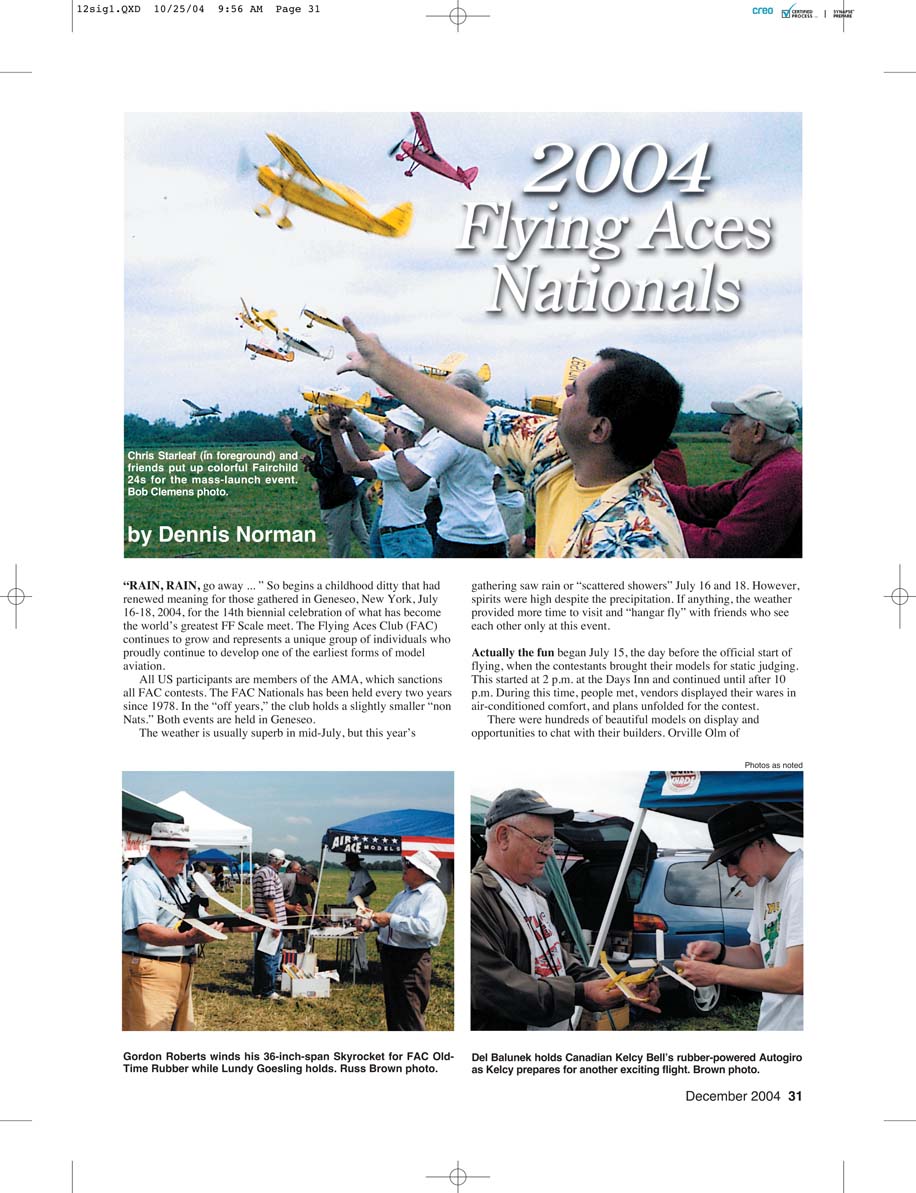
“RAIN, RAIN, go away ... ” So begins a childhood ditty that had renewed meaning for those gathered in Geneseo, New York, July 16–18, 2004, for the 14th biennial celebration of what has become the world’s greatest FF Scale meet. The Flying Aces Club (FAC) continues to grow and represents a unique group of individuals who proudly continue to develop one of the earliest forms of model aviation.
All US participants are members of the AMA, which sanctions all FAC contests. The FAC Nationals has been held every two years since 1978. In the “off years,” the club holds a slightly smaller “non Nats.” Both events are held in Geneseo.
The weather is usually superb in mid-July, but this year’s gathering saw rain or “scattered showers” July 16 and 18. However, spirits were high despite the precipitation. If anything, the weather provided more time to visit and “hangar fly” with friends who see each other only at this event.
Static Judging and a Masking Tip
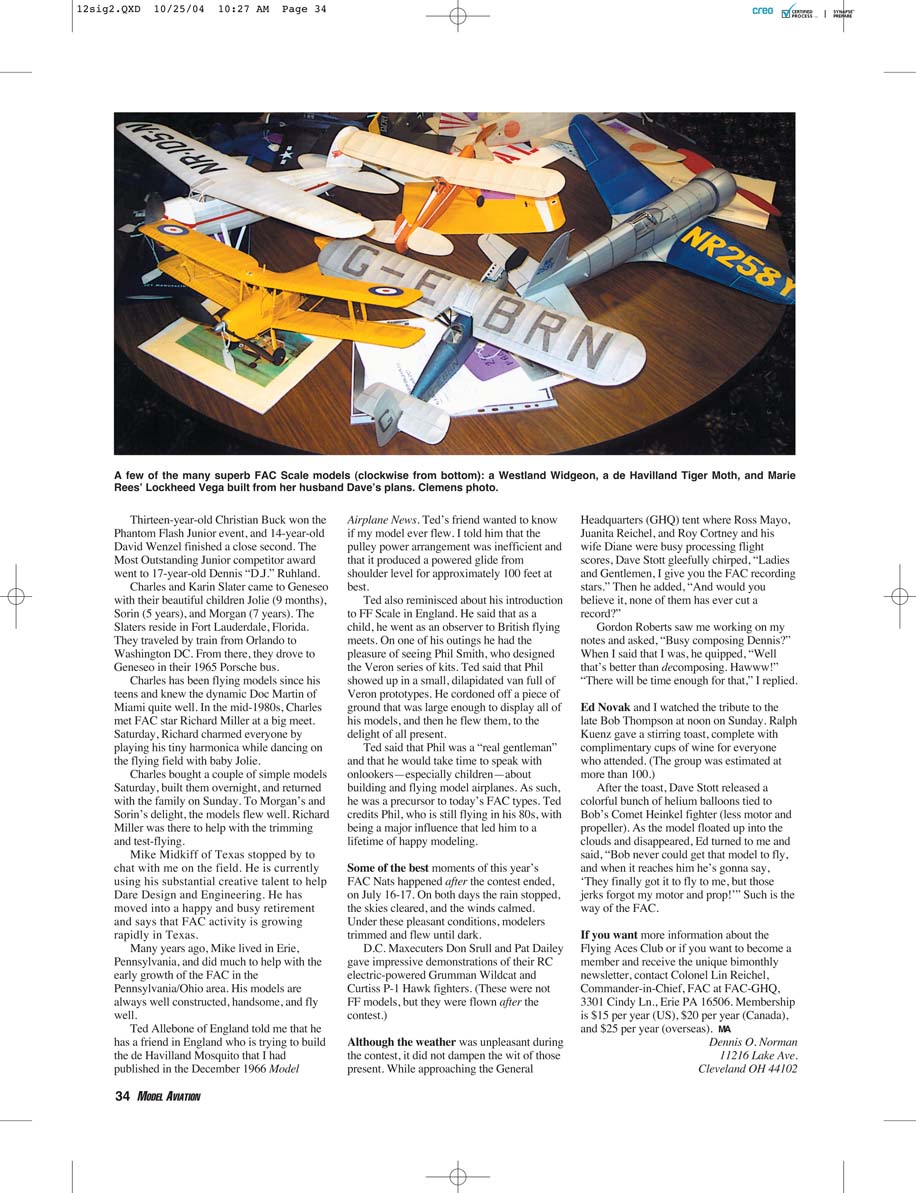
The fun actually began July 15, the day before the official start of flying, when contestants brought their models for static judging. This started at 2 p.m. at the Days Inn and continued until after 10 p.m. During this time, people met, vendors displayed their wares in air-conditioned comfort, and plans unfolded for the contest. There were hundreds of beautiful models on display and opportunities to chat with their builders.
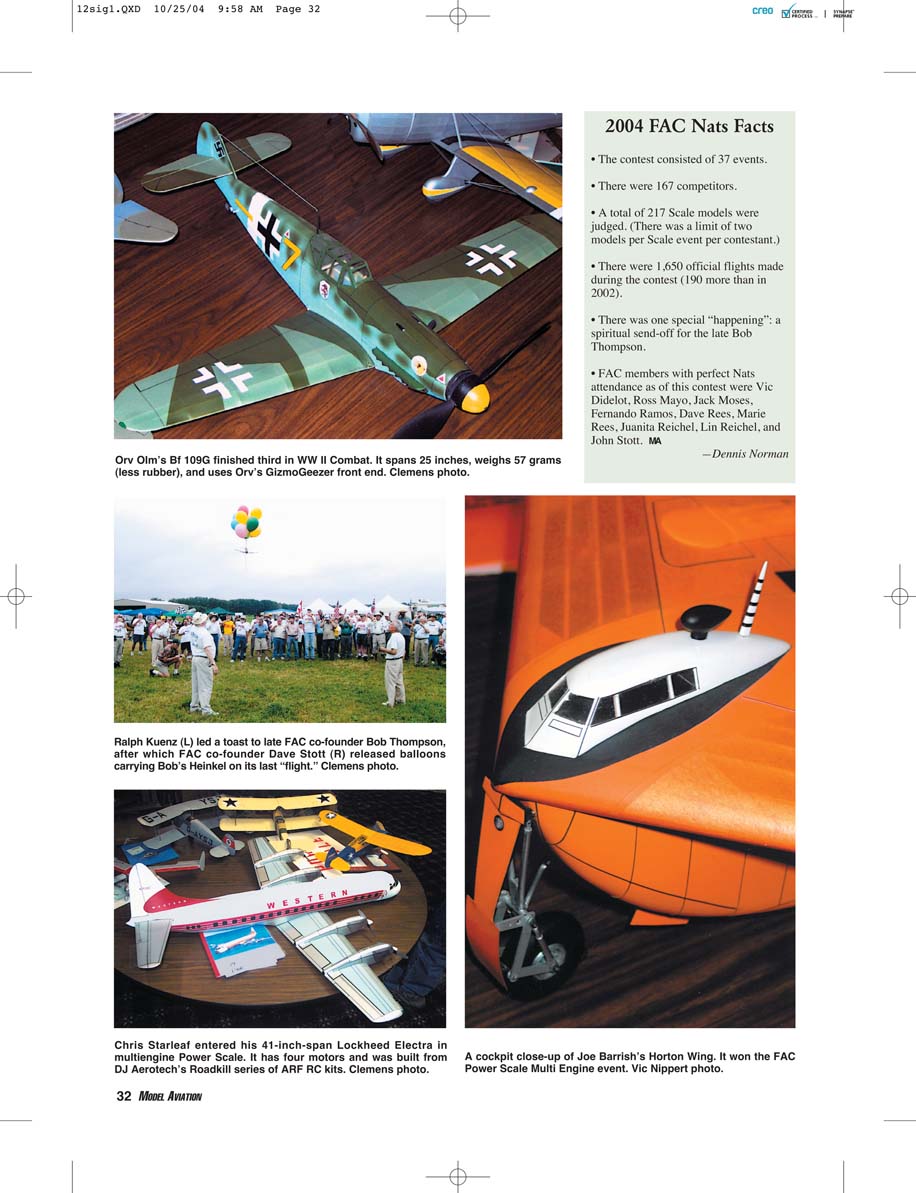
Orville “Orv” Olm of GizmoGeezer Products walked past me carrying a beautiful scratchbuilt Bf 109G with an outstanding airbrushed finish. I complimented him on it, and he stopped, thanked me, and told me that he used to hate airbrushing because he found it difficult to use frisket paper. He said that the commercial paper did not adhere well and that caused fuzzy separation lines that were difficult to correct.
Orv’s solution was to use Japanese tissue as his masking paper. He adhered it to his model using a Scotch removable glue stick. This gave him a mask that followed the contours of the airplane and assured sharp separation lines. Orv said that he could remove the tissue mask cleanly, flip it over, and reuse it to paint a symmetrical pattern on the other side of his model.
Fellowship, Mentoring, and the Internet
Dave Mitchell of the D.C. Maxecuters joined the conversation and readily attested to the merits of Scotch low-tack glue sticks. As we chatted, Dave shared how he joined the FAC. He said he had been building FF Scale models for years and, like many, worked alone without much contact with other modelers—a phase I call the "Lone Eagle" period of modeling.
Then Dave met Hurst Bowers, a former curator of the AMA museum, who took him to a meeting of the D.C. Maxecuters and introduced him to master modelers Don Srull and Stew Meyers. With Hurst, they mentored Dave and brought him, as he put it, "out of the stone age" and into the excitement and wonder of contemporary FAC modeling.
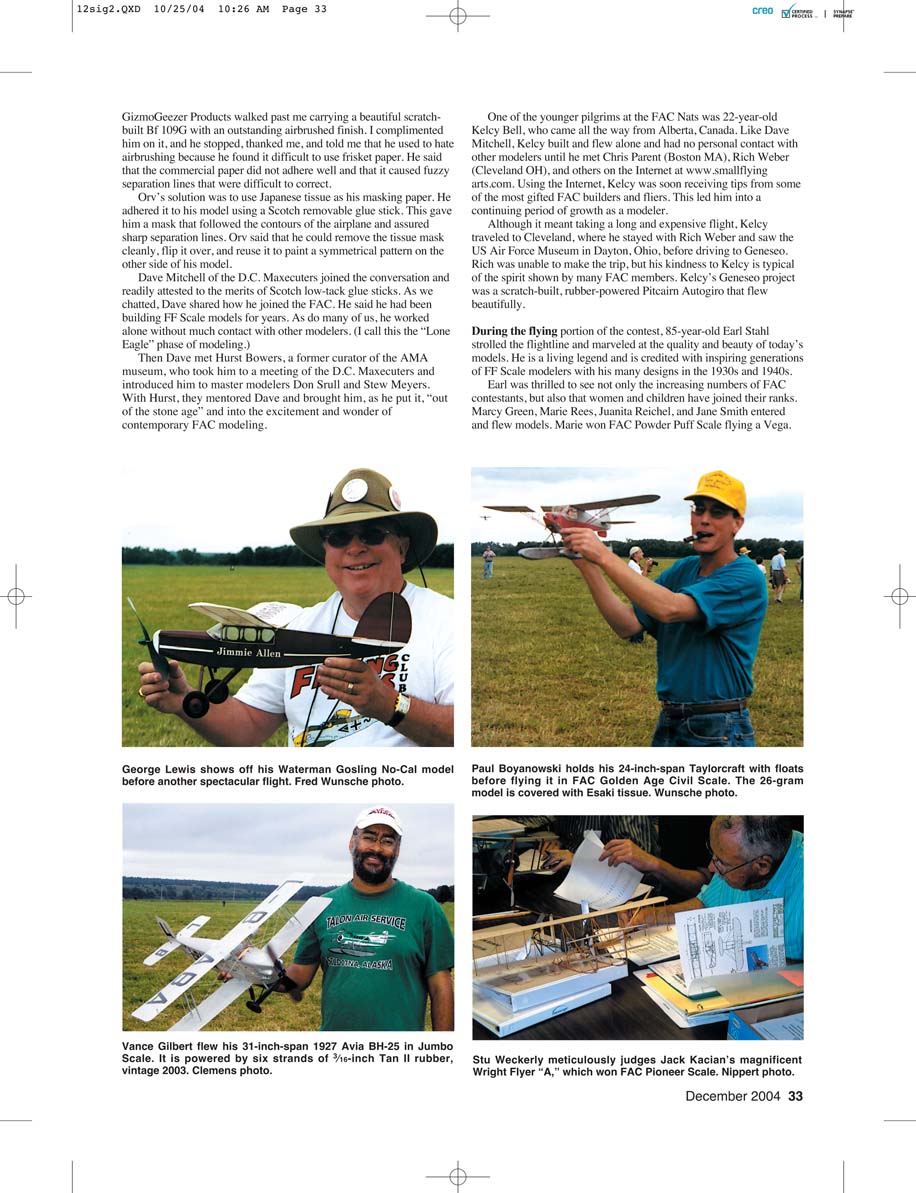
One of the younger pilgrims at the FAC Nats was 22-year-old Kelcy Bell, who came all the way from Alberta, Canada. Like Dave Mitchell, Kelcy built and flew alone and had no personal contact with other modelers until he met Chris Parent (Boston, Mass.), Rich Weber (Cleveland, OH), and others on the Internet at www.smallflyingarts.com. Using the Internet, Kelcy was soon receiving tips from some of the most gifted FAC builders and fliers, which led him into a continuing period of growth as a modeler.
Although it meant taking a long and expensive flight, Kelcy traveled to Cleveland, where he stayed with Rich Weber and saw the U.S. Air Force Museum in Dayton, Ohio, before driving to Geneseo. Rich was unable to make the trip, but his kindness to Kelcy is typical of the spirit shown by many FAC members. Kelcy’s Geneseo project was a scratch-built, rubber-powered Pitcairn Autogiro that flew beautifully.
Notable Attendees and Generations
During the flying portion of the contest, 85-year-old Earl Stahl strolled the flightline and marveled at the quality and beauty of today’s models. He is a living legend and is credited with inspiring generations of FF Scale modelers with his many designs from the 1930s and 1940s.
Everyone was thrilled to see not only the increasing numbers of FAC contestants, but also that women and children have joined their ranks. Marcy Green, Marie Rees, Juanita Reichel, and Jane Smith entered and flew models. Marie won FAC Powder Puff Scale flying a Vega.
Thirteen-year-old Christian Buck won the Phantom Flash Junior event, with 14-year-old David Wenzel finishing a close second. The Most Outstanding Junior competitor award went to 17-year-old Dennis "D J" Ruhland.
Families, Stories, and Traditions
Charles and Karin Slater came to Geneseo with their beautiful children Jolie (9 months), Soren (5 years), and Morgan (7 years). The Slaters reside in Fort Lauderdale, Florida. They traveled by train from Orlando to Washington, D.C., and from there drove to Geneseo in their 1965 Porsche bus.
Charles has been flying models since his teens and knew the dynamic Doc Martin of Miami quite well. In the mid-1980s, Charles met FAC star Richard Miller at a big meet. On Saturday, Richard charmed everyone by playing his tiny harmonica while dancing on the flying field with baby Jolie.
Charles bought a couple of simple models on Saturday, built them overnight, and returned with the family on Sunday. To Morgan’s and Soren’s delight, the models flew well. Richard Miller was there to help with the trimming and test-flying.
Mike Midkiff of Texas stopped by to chat with me on the field. He is currently using his substantial creative talent to help Dare Design and Engineering. He has moved into a happy and busy retirement and says that FAC activity is growing rapidly in Texas. Many years ago, Mike lived in Erie, Pennsylvania, and did much to help with the early growth of the FAC in the Pennsylvania/Ohio area. His models are always well constructed, handsome, and fly well.
Ted Allebone of England told me that he has a friend in England who is trying to build the de Havilland Mosquito that I published in the December 1966 Model Airplane News. Ted’s friend wanted to know if my model ever flew. I told him that the pulley power arrangement was inefficient and that it produced a powered glide from shoulder level for approximately 100 feet at best.
Ted also reminisced about his introduction to FF Scale in England. As a child he went as an observer to British flying meets and on one outing had the pleasure of seeing Phil Smith, who designed the Veron series of kits. Phil arrived in a small, dilapidated van full of Veron prototypes. He cordoned off ground large enough to display all of his models and then flew them to the delight of all present.
Ted said that Phil was a “real gentleman” who would take time to speak with onlookers—especially children—about building and flying model airplanes. As such, he was a precursor to today’s FAC types. Ted credits Phil, who is still flying in his 80s, with being a major influence that led him to a lifetime of happy modeling.
Post-Contest Flying and Demonstrations
Some of the best moments of this year’s FAC Nats happened after the contest ended, on July 16–17. On both days the wind stopped, the skies cleared, and conditions calmed. Under these pleasant conditions, modelers trimmed and flew until dark.
D.C. Maxecuters Don Srull and Pat Daley gave impressive demonstrations of their RC electric-powered Grumman Wildcat and Curtiss P-1 Hawk fighters. (These were not FF models, but they were flown after the contest.)
Wit, Toasts, and a Tribute
Although the weather was unpleasant during the contest, it did not dampen the wit of those present. While approaching the General Headquarters (GHQ) tent where Ross Mayo, Juanita Reichel, and Roy Cortney and his wife Diane were busy processing flight scores, Dave Stott gleefully chirped, “Ladies and Gentlemen, I give you the FAC recording stars.” Then he added, “And would you believe it, none of them has ever cut a record?”
Gordon Roberts saw me working on my model and asked, “Busy composing, Dennis?” When I said that I was, he quipped, “Well that’s better than decomposing. Hawww!” I replied, “There will be time enough for that.”
Ed Novak and I watched the tribute to the late Bob Thompson at noon on Sunday. Ralph Kuenz gave a stirring toast, complete with complimentary cups of wine for everyone who attended (the group was estimated at more than 100).
After the toast, Dave Stott released a colorful bunch of helium balloons tied to Bob’s Comet Heinkel fighter without motor and propeller. As the model floated up into the air, the clouds parted and disappeared. Ed turned to me and said, “Bob never could get that model to fly, and when it reaches him he’s going to say, ‘They finally got it to fly to me, but those jerks forgot my motor and prop!’” Such is the way of the FAC.
2004 FAC Nats Facts
- The contest consisted of 37 events.
- There were 167 competitors.
- A total of 217 Scale models were judged. (There was a limit of two models per Scale event per contestant.)
- There were 1,650 official flights made during the contest (190 more than in 2002).
- There was one special “happening”: a spiritual send-off for the late Bob Thompson.
- FAC members with perfect Nats attendance as of this contest were Vic Didelot, Ross Mayo, Jack Moses, Fernando Ramos, Dave Rees, Marie Rees, Juanita Reichel, Lin Reichel, and John Stott.
Membership and Contact
If you want more information about the Flying Aces Club or want to become a member and receive the club’s bimonthly newsletter, contact:
Colleen Li Reichel Commander-in-Chief, FAC FAC-GHQ 3301 Cindy Ln. Erie, PA 16506
Membership is $15 per year (US), $20 per year (Canada), and $25 per year (overseas).
—Dennis O. Norman 11216 Lake Ave. Cleveland, OH 44102
Transcribed from original scans by AI. Minor OCR errors may remain.

