
2006 Don Lowe Masters Aerobatic Championship
By Jerry Smith
Overview
The 2006 Don Lowe Masters, held October 4–7, produced some of the best flying by top aerobatic pilots. The Masters has replaced the Tournament of Champions at a new location. With high-dollar cash prizes, the event is attracting the world’s best aerobatic model pilots.
Weather and Schedule
- The four-day event enjoyed generally excellent weather. The first two days were almost windless with daytime temperatures in the mid-80s. A small front moved in on the third day, dropping temperatures but not introducing significant wind until late. The final contest day was overcast with tolerable wind. A fifth day (Sunday) was reserved as a rain day and was indeed rainy.
- Format:
- First two days: opening rounds (Known Pattern, Unknown Pattern, Freestyle) with the full field competing.
- End of day two: cut to the top 14 pilots.
- Third day: one round flown, then cut to the top 7.
- Final day: the top seven flew two rounds to determine the winner.
- First-place prize: $25,000.
Venue — Triple Tree Aerodrome
- Location: a few miles east of Woodruff, South Carolina; developed over eight years by owner Pat Hartness.
- Features: long, wide runway open both ends; broad, well-manicured Bermuda grass; long white fence with shade trees for spectator protection; large gazebo as the social focal point; overnight RV parking and shower/bathroom facilities.
Judging and Organization
- Past AMA president Don Lowe is chief judge. Due to health concerns, Don delegated many responsibilities to assistant chief judge Tom Miller, who organized patterns, contacted judges, and coordinated the event.
- Judges: two groups of seven judges, each group supported by scribes and two jury judges. Two judges were from Europe (United Kingdom and Ireland).
- Don Lowe on the jury judge role:
- "The task of the jury judge is to determine the technical correctness of the maneuver only; i.e., they look for correct direction, attitude and sequence but do not rule on the quality of the maneuver. If they determine that a maneuver was performed incorrectly, that maneuver will be given a zero, overriding (possibly) the judge's score."
- This system helps catch technically incorrect maneuvers that may be missed by judges focusing on quality.
- Challenges: morning sun in the judges’ eyes and very high-altitude maneuvers (airplanes becoming small silhouettes) made judging difficult.
- Noise abatement: owner Pat Hartness invoked a 94 dB maximum policy for all pilots; compliance made the flightline unusually quiet during Known and Unknown patterns.
Pilots and Callers
- The Masters is invitational, structured to include 20 pilots (ten from the 2004 Masters automatically invited, plus ten selected for ability and accomplishments). At this event 18 pilots flew in the opening rounds.
- International competitors included Marco Benincasa and Sebastiano Silvestri (Italy) and Bernd Beschorner (Germany). Canadian Ivan Kristensen was also invited.
- Pilot callers (remind the pilot of the next maneuver, help ready the airplane, sometimes help start the engine) included:
- Julius Benincasa
- Tony Szeczur
- Mike McMurtry
- Peter Glezellis
- (Other callers were present as well.)
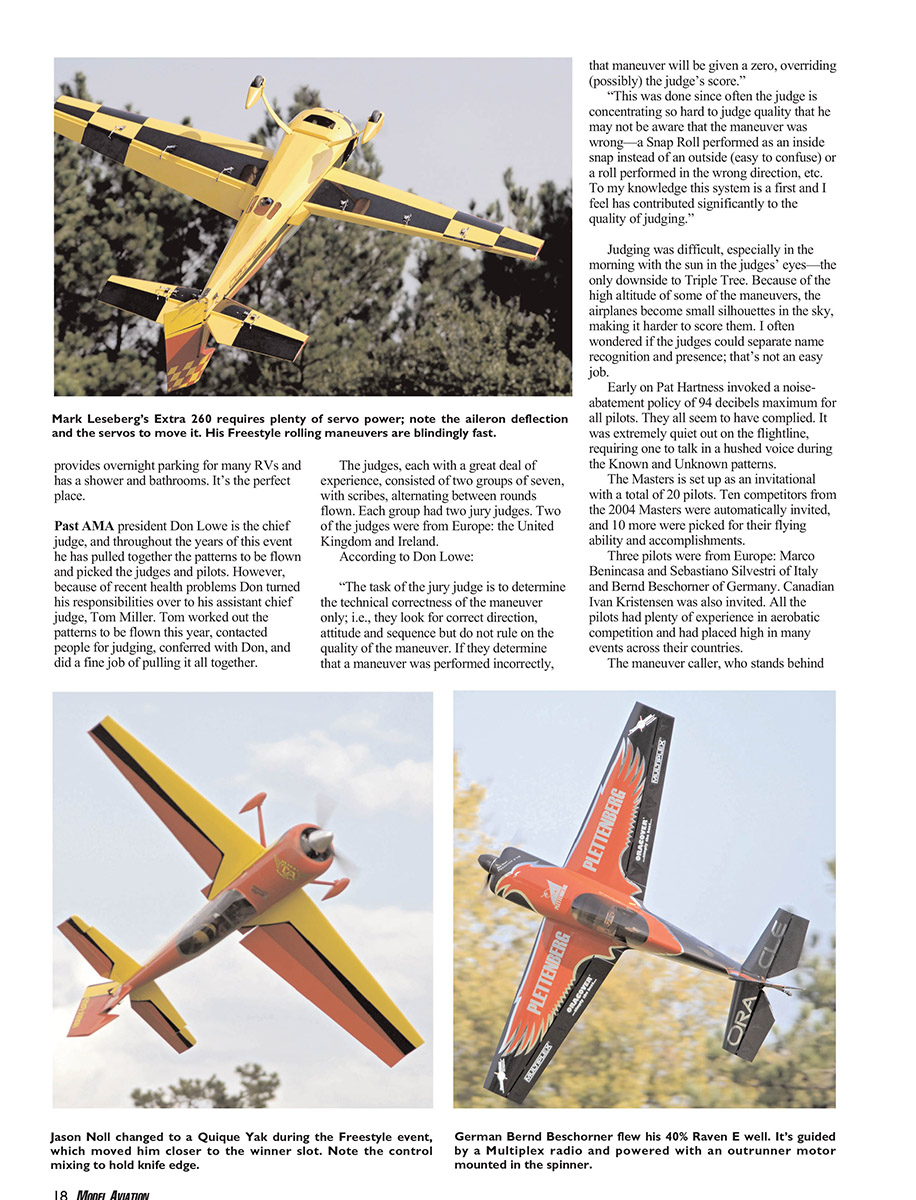
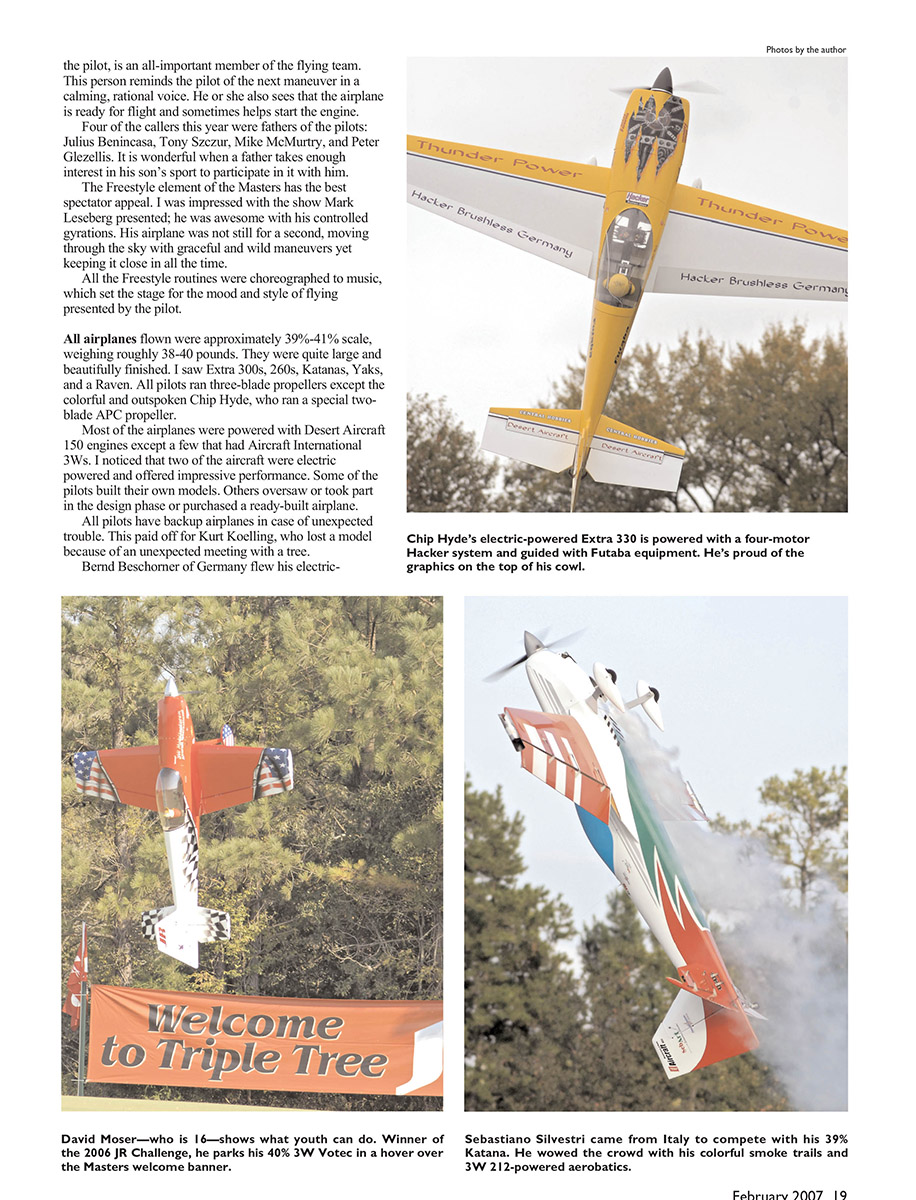
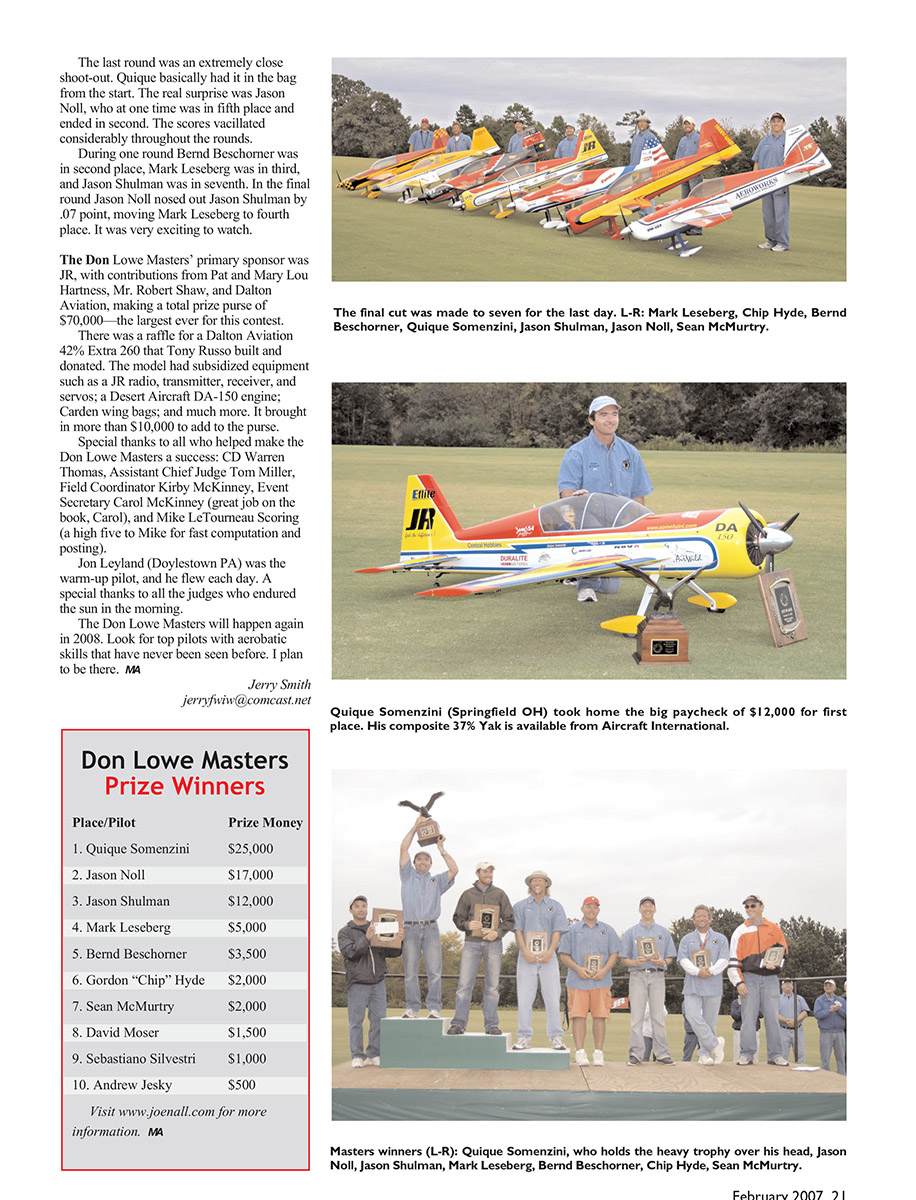
- Notable pilots mentioned: Quique (winner), Jason Noll (second), Jason Shulman (close contender), Mark Leseberg, Bernd Beschorner, Kurt Koelling, Andrew "Animal" Jesky, Chip Hyde, Sebastiano Silvestri.
Aircraft and Powerplants
- Typical models: approximately 39%–41% scale, weighing roughly 38–40 pounds. Examples seen: Extra 300s, Extra 260s, Katana, Yaks, and a Raven.
- Propellers: most pilots used three-blade props; Chip Hyde used a special two-blade APC propeller.
- Engines: most airplanes were powered by Desert Aircraft DA-150 engines; several used Aircraft International 3W engines. Two aircraft were electric-powered and performed impressively.
- Pilots either built, supervised the design, or purchased ready-built airplanes. All pilots carried backup airplanes, which proved valuable when Kurt Koelling lost a model to a tree.
Electric Prototypes and Notable Power Systems
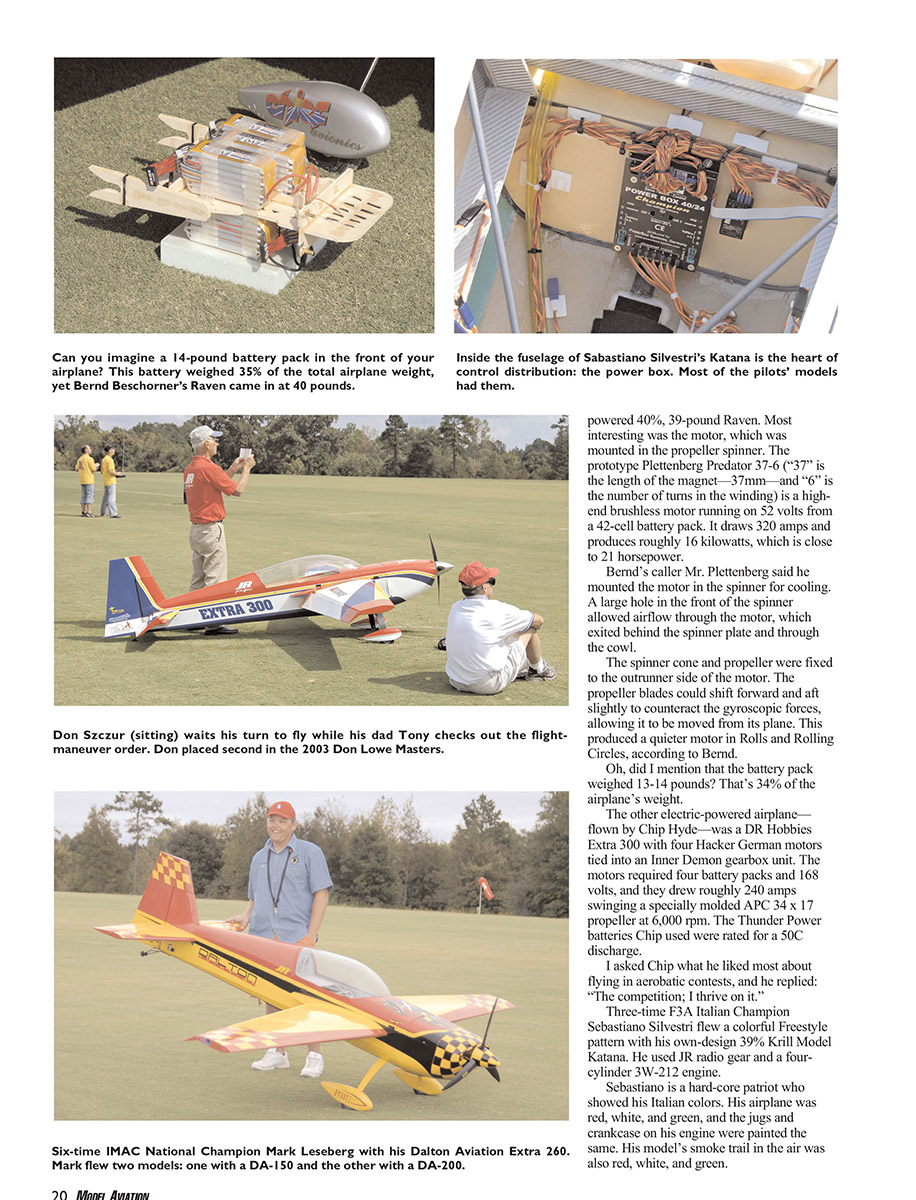
- Bernd Beschorner’s Raven (approx. 39%, 39-pound model) used a prototype Plettenberg Predator 37-6 outrunner motor mounted in the propeller spinner:
- Motor spec: "37" magnet length (mm), "6" turns in winding; ran on 52 volts from a 42-cell battery pack.
- Performance: drew ~320 amps, produced ~16 kW (close to 21 hp).
- Cooling: a large hole in the front of the spinner provided airflow through the motor, exiting behind the spinner plate and through the cowl.
- Propeller mounting: spinner cone and propeller fixed to the outrunner side; propeller blades could shift slightly to counteract gyroscopic forces, producing quieter Rolls and Rolling Circles.
- Battery pack weight: ~13–14 pounds (about 34% of airplane weight).
- Chip Hyde’s electric setup:
- Airframe: DR Hobbies Extra 300.
- Propulsion: four Hacker German motors tied to an Inner Demon gearbox unit.
- Power: required four battery packs at ~168 volts, drew ~240 amps, driving a specially molded APC 34x17 propeller at ~6,000 rpm.
- Batteries: Thunder Power packs rated for 50C discharge.
- Chip’s comment on contest flying: "The competition; I thrive on it."
Freestyle and Highlights
- Freestyle routines were choreographed to music to set mood and style.
- Mark Leseberg delivered a particularly impressive Freestyle: continuous, tightly controlled gyrations and graceful wild maneuvers kept close to the field.
- Sebastiano Silvestri (three-time F3A Italian Champion) flew a colorful Freestyle with his 39% Krill Model Katana, JR radio gear, and a four-cylinder 3W-212 engine. He displayed strong Italian patriotism: aircraft colors and smoke trail were red, white, and green.
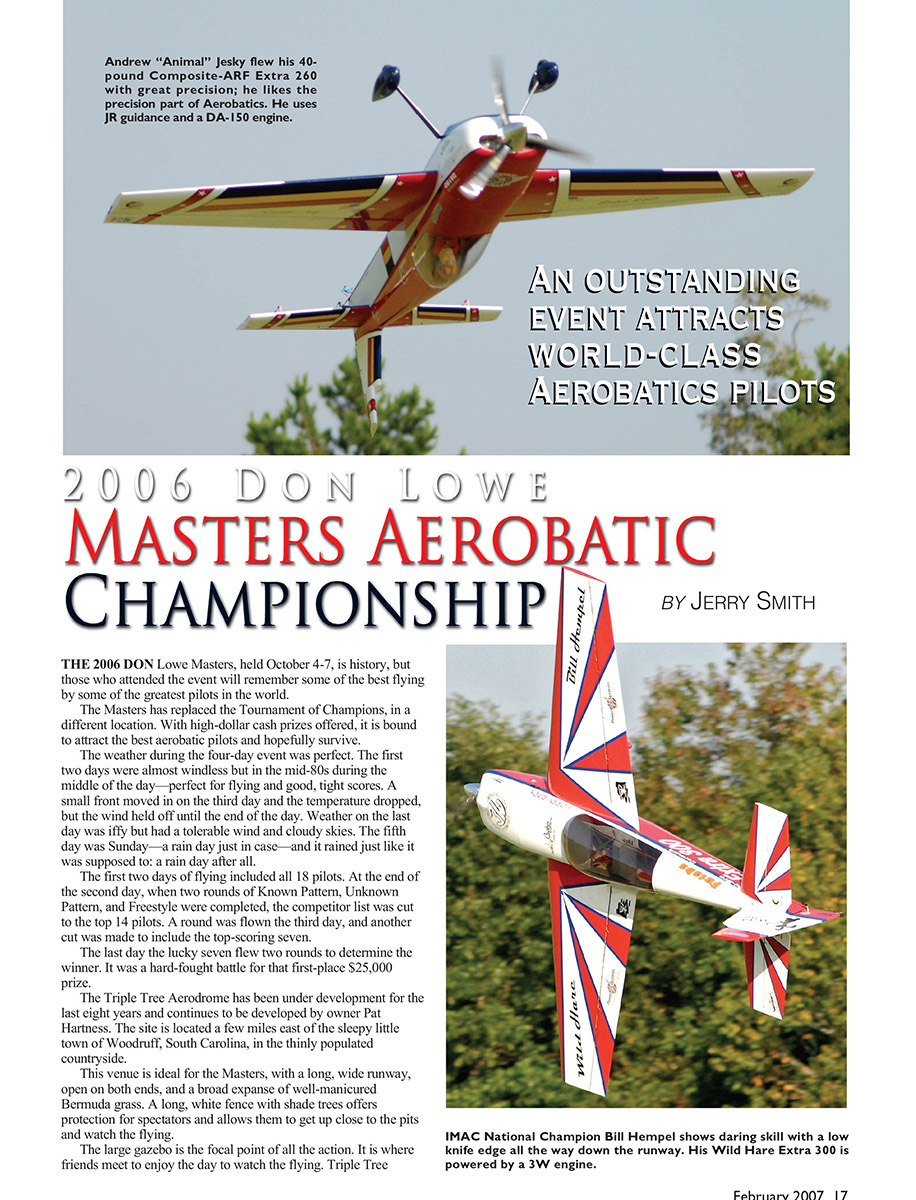
- Andrew "Animal" Jesky flew a 40-pound Composite-ARF Extra 260 with great precision using JR equipment and a DA-150 engine.
Final Round and Results
- The last round was an extremely close shoot-out. Quique essentially led from the start and won the event.
- Jason Noll delivered a strong comeback, moving from fifth at one point to finish second, edging Jason Shulman by 0.07 point. Mark Leseberg finished fourth after close score shifts in the final round.
- The scores vacillated considerably throughout the rounds, making for exciting viewing.
Sponsors, Prize Purse, and Raffle
- Primary sponsor: JR.
- Additional contributions: Pat and Mary Lou Hartness, Robert Shaw, Dalton Aviation.
- Total prize purse: $70,000 (the largest ever for this contest).
- Raffle: a Dalton Aviation 42% Extra 260 (built and donated by Tony Russo) with subsidized equipment (JR radio gear; Desert Aircraft DA-150; Carden wing bags, etc.) raised over $10,000 to add to the purse.
Acknowledgments
Special thanks to:
- Contest Director (CD) Warren Thomas
- Assistant Chief Judge Tom Miller
- Field Coordinator Kirby McKinney
- Event Secretary Carol McKinney (for the event book)
- Mike LeTourneau (scoring — fast computation and posting)
- Jon Leyland (Doylestown, PA), the warm-up pilot who flew each day
- All the judges who endured the morning sun
- Event sponsors and contributors
Looking Ahead
- The Don Lowe Masters is scheduled to happen again in 2008. Expect top pilots and aerobatic skills not often seen elsewhere.
MA
Jerry Smith jerryflywiw@comcast.net
Transcribed from original scans by AI. Minor OCR errors may remain.

