
24th US Free Flight
John Oldenkamp
Labor Day weekend in California's Great Central Valley was dry, calm, toasty warm, and loaded with airplane-hugging thermals — much to the delight of nearly 200 free flight enthusiasts who gathered at the Lost Hills site to contest the 24th running of the United States Free Flight Championships.
Up for grabs were hardware and bragging rights in no less than 41 regular AMA, SAM, and NFFS rule-book events, plus 15 "special" categories in Dawn-to-Midnight format (Sunrise Shootout Power, Dawn Mulvihill Rubber, and Night flying — dark until done — as examples) for the energetic insomniacs among the group.
Those arriving Thursday or Friday for a bit of test flying or to unwind from the workplace found the car/truck/van/RV line already stretched two deep for a half-mile; Port-O-Lets firmly in place; and the catering compound under assembly by Chef Jay Sloane and family.
A collection of old and new faces went about gearing up in high anticipation. Several aeromodeling industry vendors rolled in to display a nice assortment of free flight products usually seen only in catalog form, but here now to be touched, coveted, and, for the sake of the entrepreneur's livelihood, bought for that future project. Many tailbooms, engines, kits, rubber strip, and the like made the transit.
These mini-bazaars have become a regular feature at the larger West Coast contests. They fill a vital need, especially for the newcomer who otherwise would not have physical access to useful components available only by mail order. Making the welcome effort were:
- Aerodyne (rare and imported kits, engines, props, nitrate dopes, etc.; proprietor Al Heinrich)
- FAI Model Supply
- Starline International
While the food and commercial-products diversion continued, the planned precontest trim sessions fared badly, owing to uncomfortably high winds both Thursday and Friday as a weak upper-level low-pressure weather system moved through the area. Trying to prove a point perhaps, several groups departed for an hour's drive south to Taft, only to find equally poor conditions there.
Back at Lost Hills, there was a minor shot at testing during the "golden" hour after sunset Friday when drift became marginally acceptable. Chez Sloane and the Skirt Steak menu special were the real benefactors, since ample time was available to socialize over a decent meal at the field kitchen.
By the 0700 starting time on Saturday, the nasty low had scurried off eastward. Happily, a veritable oasis of superb air/temperature/nil drift had set in — the fabled stuff that makes the heart race, the mind boggle, and the airplane fly so much better. As usual, we cannot wait to get home and tell everyone how really slam-dunk it was; but then, no one will believe us — no way!
Such are the moments that help spin the legends of the sport: after two days of tenuous activity, long faces, and endless speculation, we now had an absolutely perfect situation to work with. Sunday and Monday were no more than a tick or two off by comparison, so all comers had the best of the best to fly in.
Event highlights
Win, place, or show, times were high, with maxes running out in long strings. The "difficult" events, while still not pushovers, saw times approaching record categories. In many cases the first-place scores were so far above the rest that little incentive existed for going after new marks.
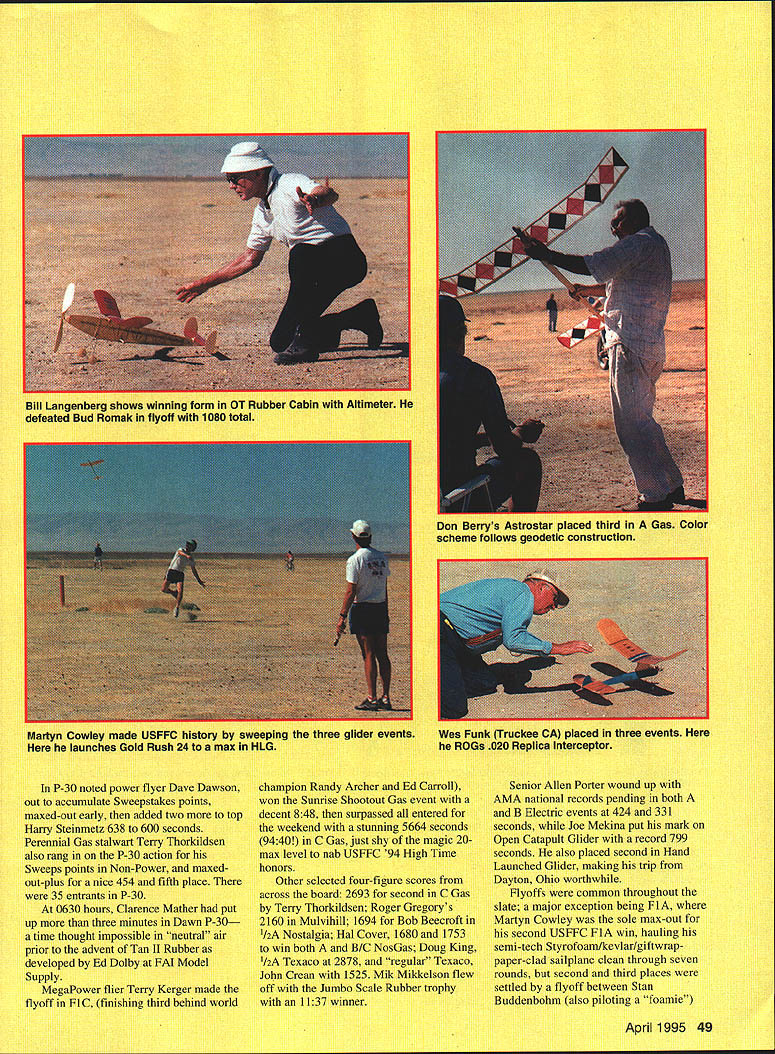
- P-30: Noted power flyer Dave Dawson, out to accumulate Sweepstakes points, maxed out early, then added two more to top Harry Steinmetz 638 to 600 seconds. Perennial gas stalwart Terry Thorkildsen also rang in on the P-30 action for his Sweeps points in Non-Power, maxing-out-plus for a nice 454 and fifth place. There were 35 entrants in P-30.
- Dawn P-30: At 0630 Clarence Mather put up more than three minutes in Dawn P-30 — a time thought impossible in "neutral" air prior to the advent of Tan II Rubber as developed by Ed Dolby at FAI Model Supply.
- Megapower/C Gas: Megapower flier Terry Kerger made the flyoff in F1C, finishing third behind world champion Randy Archer and Ed Carroll on the Sunrise Shootout Gas event with a decent 8:48, then surpassed all entered for the weekend with a stunning 5,664 seconds (94:40) in C Gas, just shy of the magic 20-max level to nab USFFC '94 High Time honors.
Selected four-figure and notable scores
- Terry Thorkildsen — 2,693 (second, C Gas)
- Roger Gregory — 2,160 (Mulvihill)
- Bob Becroft — 1,694 (1/2A Nostalgia)
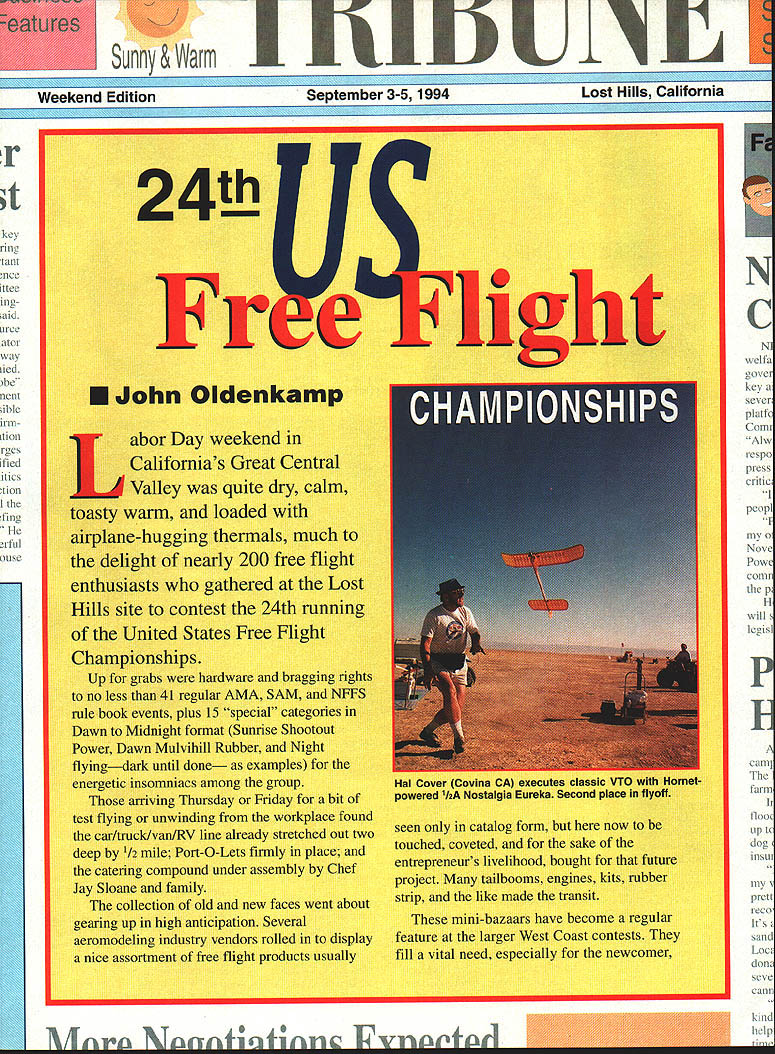
- Hal Cover — 1,680 and 1,753 (wins in A and B/C NosGas)
- Doug King — 2,878 (1/2A Texaco)
- John Crean — 1,525 (regular Texaco)
- Mik Mikkelson — Jumbo Scale Rubber trophy with an 11:37 winner
Senior Allen Porter wound up with AMA national records pending in both A and B Electric events at 424 and 331 seconds, while Joe Mekina put his mark on Open Catapult Glider with a record 799 seconds. He also placed second in Hand Launched Glider, making his trip from Dayton, Ohio worthwhile.
Flyoffs and glider dominance
Flyoffs were common throughout the slate; a major exception being F1A, where Martyn Cowley was the sole max-out for his second USFFC F1A win, hauling his semi-tech Styrofoam/kevlar/glitter-wrap paper-clad fuselage glider through seven rounds. Second and third places were settled by a flyoff between Stan Buddenbohm (also piloting a "foamy") and Ernesto Busnelli, 300 to 151 seconds.
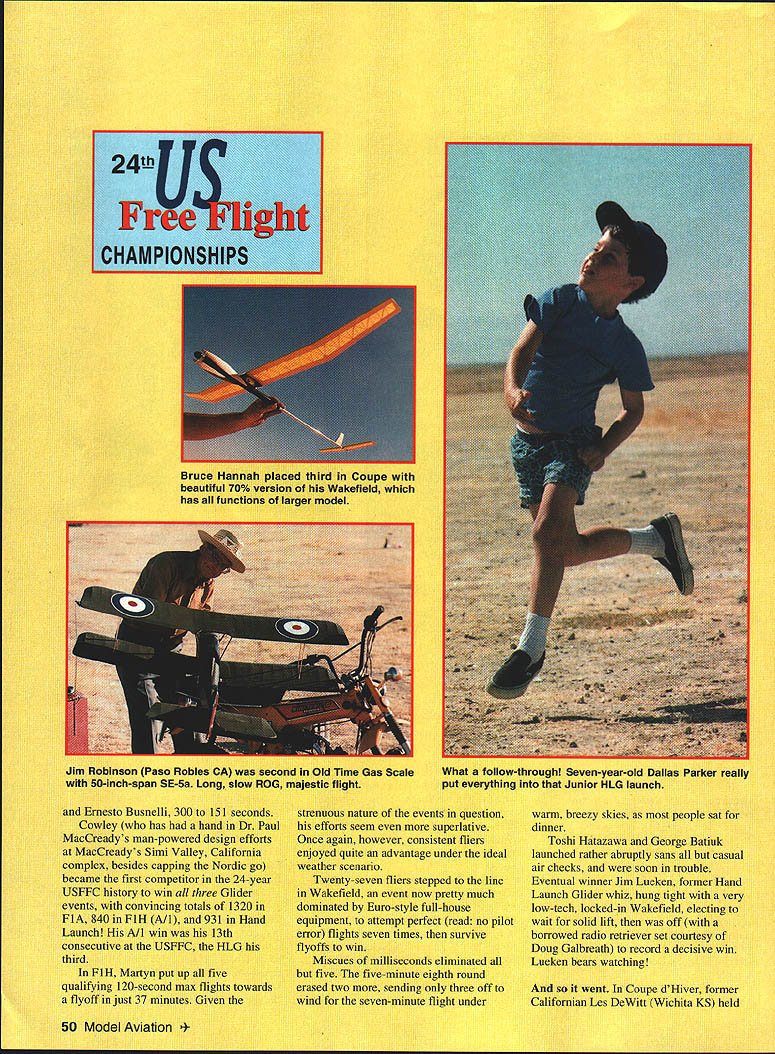
Cowley (who has had a hand in Dr. Paul MacCready's man-powered design efforts at MacCready's Simi Valley complex, besides capping the Nordic go) became the first competitor in the 24-year USFFC history to win all three glider events, with convincing totals of 1,320 in F1A, 840 in F1H (A1), and 931 in Hand Launch. His F1A win was his 13th consecutive at the USFFC; the HLG was his third.
In F1H, Martyn put up all five qualifying 120-second max flights toward a flyoff in just 37 minutes. Given the strenuous nature of the events in question, his efforts seem even more superlative. Once again, however, consistent fliers enjoyed quite an advantage under the ideal weather scenario.
Twenty-seven flyers stepped to the line in Wakefield, an event now pretty much dominated by Euro-style full-house equipment, to attempt perfect flights seven times, then survive flyoffs to win. Muscles of milliseconds eliminated all but five. The five-minute eighth round erased two more, sending only three off to the wind for the seven-minute flight under warm, breezy skies, as most people sat for dinner.
Toshi Hatazawa and George Batiuk launched rather abruptly as the sun sank after casual air checks and were soon in trouble. Eventual winner Jim Lueken, a former Hand Launch Glider whiz, hung tight with a very low-tech, locked-in Wakefield, electing to wait for solid lift, then was off (with a borrowed radio retriever set courtesy of Doug Galbreath) to record a decisive win. Lueken bears watching.
In Coupe d'Hiver, former Californian Les DeWitt (Wichita, KS) held off a three-way flyoff challenge to top Bill Fitch and Bruce Hannah, 780-772-762. Crowd favorite and past Wakefield World Champion Bob (Robert P.) White was a close fourth.
Old-Timers, returnees, and newcomers
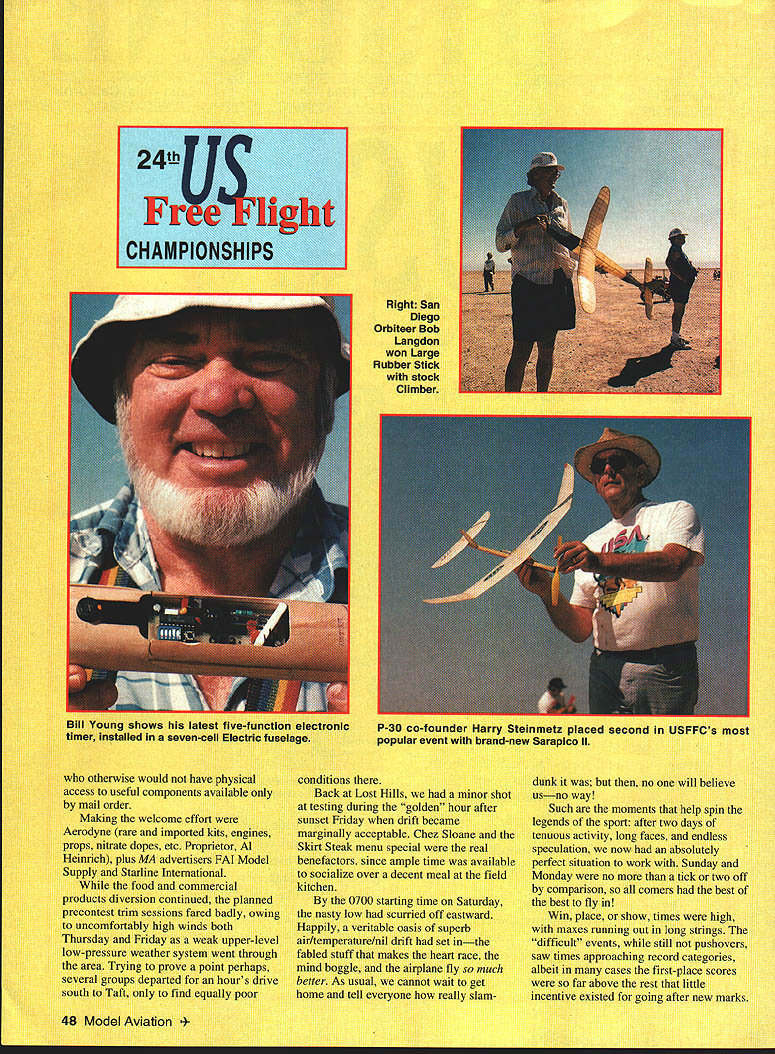
Recent AMA Hall of Fame inductee Bud Romak lived up to his Ironman tag in the Old-Timer events, entering almost all of them, winning three outright, and collecting trophies in seven. Tough keeping up with this dynamo, although the competition was not far behind: Fred Emmert, Bob Langdon, and Bill Langenberg each placed in four Old-Timer events. Each also won at least one event; Emmert won two.
Don Burke did exceptionally well after a 30-year break, pulling down third in the highly competitive P-30 event after nearly losing his model on a two-hour on-foot retrieve, and won Payload with an airplane he more-or-less built from scratch on-site during the meet. The starting place was bits from a '60s-era original design mauled by the big 1994 Northridge earthquake; 95% was new stuff. Not many of us are willing to go that far with the effort.
Newcomers may be a valuable replacement pool for free flight, but returnees possibly should receive our most urgent support and attention. They certainly are more numerous.
Conclusion and looking ahead
Clearly the 24th USFFC was a fulfilling and challenging weekend for all the thermal-chasing, trophy-hungry pilots in attendance — a natural high for some of the correct calendar age, and a fabulous entertainment for one and all: fliers, friends, and spectators alike. Demonstrated once again was that at the right time of the year, Lost Hills can provide the turf and skies that we have all imagined in our past fantasies. Throwing in a little on-field food and fellowship will get you an unbeatable deal.
To the Committee planning the Silver Anniversary USFFC in 1995: if the 25th is half as good as '94, we will be there times two! +
Transcribed from original scans by AI. Minor OCR errors may remain.

