
The 25th Toledo
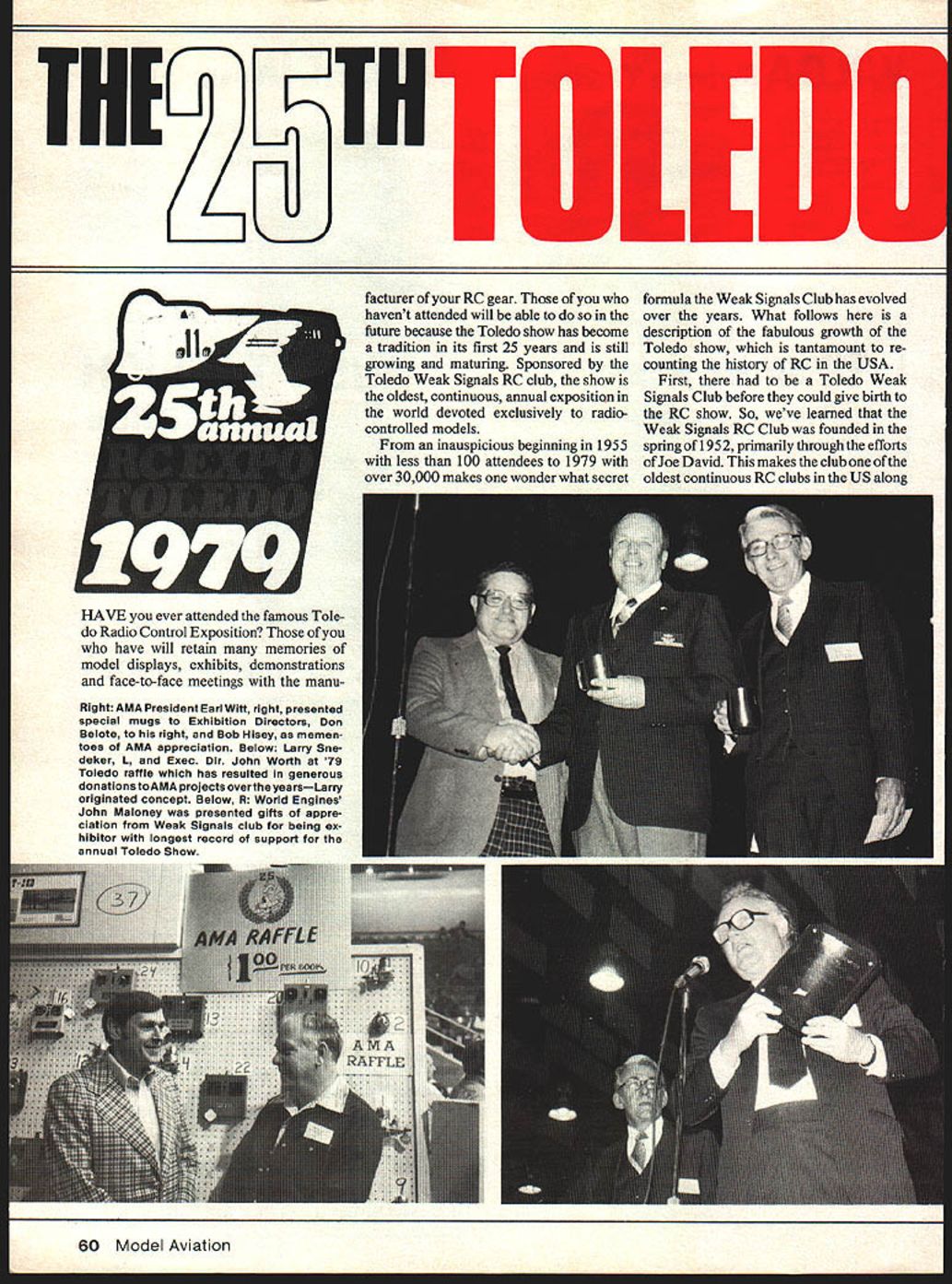
Have you ever attended the famous Toledo Radio Control Exposition? Those who have will retain many memories of model displays, exhibits, demonstrations and face-to-face meetings with the manufacturers of their RC gear. Those who haven't will be able to do so in the future because the Toledo show has become a tradition in its first 25 years and is still growing and maturing. Sponsored by the Toledo Weak Signals RC Club, the show is the oldest continuous annual exposition in the world devoted exclusively to radio-controlled models.
From an inauspicious beginning in 1955 with less than 100 attendees to 1979 with over 30,000, one wonders what secret formula the Weak Signals Club has evolved over the years. What follows is a description of the growth of the Toledo show, which is tantamount to recounting the history of RC in the USA.
Origins (1952–1959)
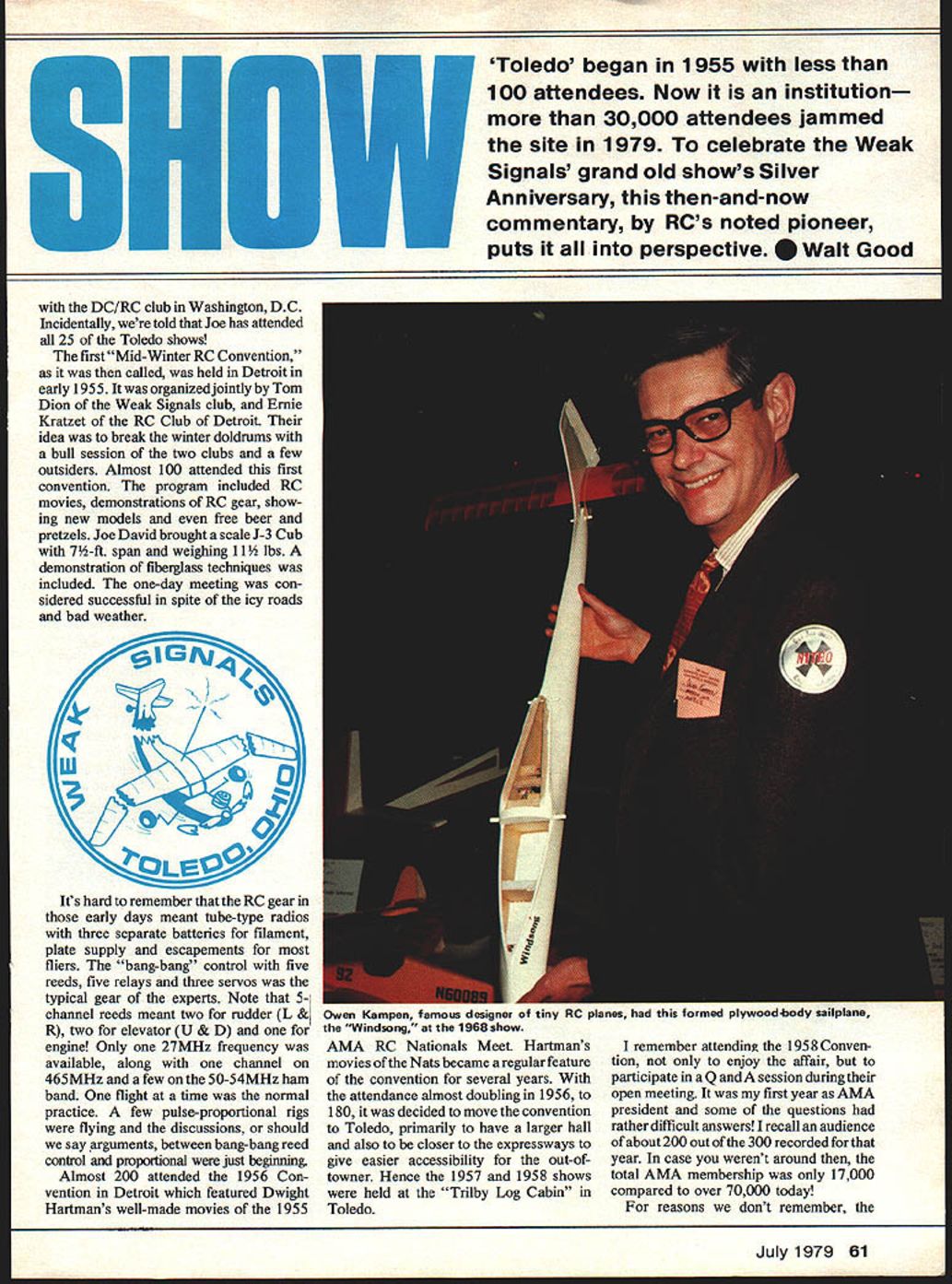
The Weak Signals RC Club was founded in the spring of 1952, primarily through the efforts of Joe David, making the club one of the oldest continuous RC clubs in the U.S., along with the DC/RC Club in Washington, D.C. Joe has attended all 25 of the Toledo shows.
The first "Mid-Winter RC Convention," as it was then called, was held in Detroit in early 1955. It was organized jointly by Tom Dion of the Weak Signals Club and Ernie Kratzet of the RC Club of Detroit. Their idea was to break the winter doldrums with a bull session of the two clubs and a few outsiders. Almost 100 attended this first convention. The program included RC movies, demonstrations of RC gear, displays of new models and even free beer and pretzels. Joe David brought a scale J-3 Cub with a 7 1/2-ft span weighing 11 1/2 lbs. A demonstration of fiberglass techniques was included. The one-day meeting was considered successful despite icy roads and bad weather.
Early RC gear meant tube-type radios with three separate batteries for filament, plate supply and escapements for most fliers. The "bang-bang" control with five reeds, five relays and three servos was typical among experts. Five-channel reeds meant two for rudder (L & R), two for elevator (U & D) and one for engine. Only one 27 MHz frequency was available, along with one channel on 465 MHz and a few on the 50–54 MHz ham band. One flight at a time was the normal practice. A few pulse-proportional rigs were flying, and the debates between bang-bang reed control and proportional control were just beginning.
Almost 200 attended the 1956 convention in Detroit, which featured Dwight Hartman's movies of the 1955 AMA RC Nationals. With attendance almost doubling in 1956, it was decided to move the convention to Toledo for a larger hall and easier access. The 1957 and 1958 shows were held at the Trilby Log Cabin in Toledo.
The 1958 convention drew about 300 recorded attendees; roughly 200 were present for an open Q&A session during which the author participated in his first year as AMA president. For reasons not recalled, the Detroit club dropped out of the joint sponsorship after the 1957 show, and in 1958 the Weak Signals Club took on sponsorship alone.
The 1959 show introduced several "firsts": it became a two-day event, an auction of equipment brought by attendees proved popular, manufacturers' exhibits began with a handful participating, and modeler displays expanded to RC planes, cars, boats and apparatus. A major highlight in 1959 was the AMA success in obtaining six RC frequencies on 27 MHz, and talk at the show focused on the need for narrow-band superhet receivers to use these new frequencies as wide-band superregen receivers began to phase out.
Growth and the Experimenters Decade (1960–1964)
From 1960 through 1964 attendance grew rapidly to over 1,000 at the two-day February sessions. The convention moved through larger halls—from the Trilby Log Cabin to the Miracle Mile Ballroom to the Sunnydale Country Club—and for two years was held at the Toledo Express Airport in the Champion Spark Plug hangar.
The auction became too popular in 1962, lasting from 7 p.m. to 3 a.m. and still not finishing. In 1963 the Trading Post (or Swap Shop) was inaugurated to handle the huge number of items, while the auction was retained for a smaller number of selected items. This practice has continued.
Although the first World Championship for RC (1960) was won by Ed Kazmirski using a reed-equipped Orion and the second (1962) by Tom Brett with reeds, Toledo featured a speaker on feedback proportional in 1962. Zel Ritchie spoke on Space Control proportional based on analog principles; other analog systems such as Sampey and DeeBee were also in use.
By 1964 the number of manufacturer exhibits had grown to about 30. Manufacturers found it valuable to show new RC items first hand and get timely feedback from customers. A notable last-minute exhibit debut in 1962 was the Falcon .56 by Carl Goldberg.
Thus ended the first decade, a period that might be dubbed the "Experimenters Decade."
The Lucas Decade (1965–1974)
From 1965 the meeting site was the Lucas County Recreation Center, which served well for the next ten years and gives this period the "Lucas Decade" name. Early in this period Tom Dion, a mainstay of the conference, felt he could not continue, and it looked as if the conference might stop. Larry Snedeker stepped forward, applied management skills, appointed Don Belote to handle manufacturers' exhibits, and put in place other key assignments. By 1969 attendance had exploded to over 4,000 with 56 manufacturers exhibiting, and by 1973 the show drew about 10,000 attendees and 119 exhibitors.
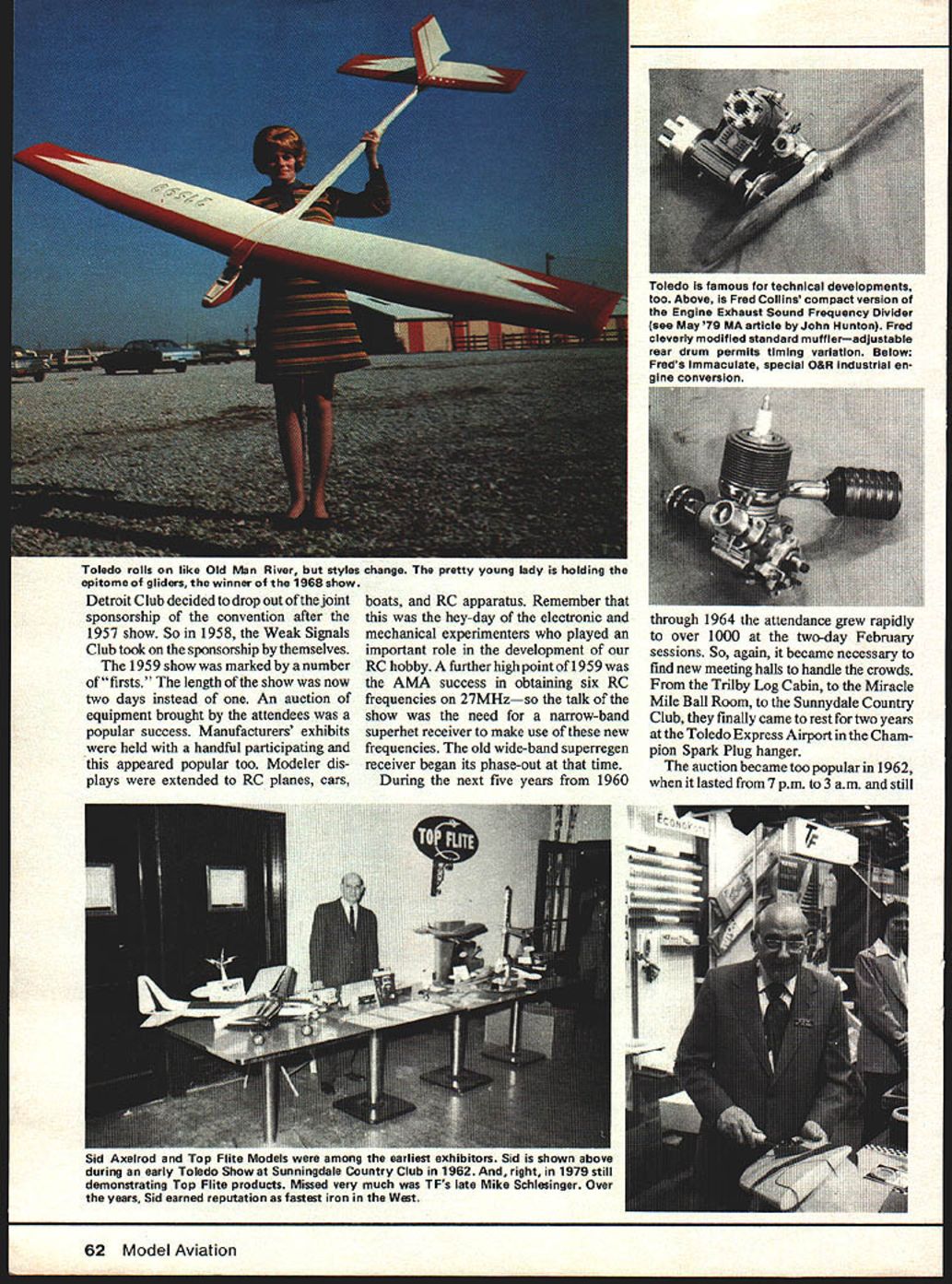
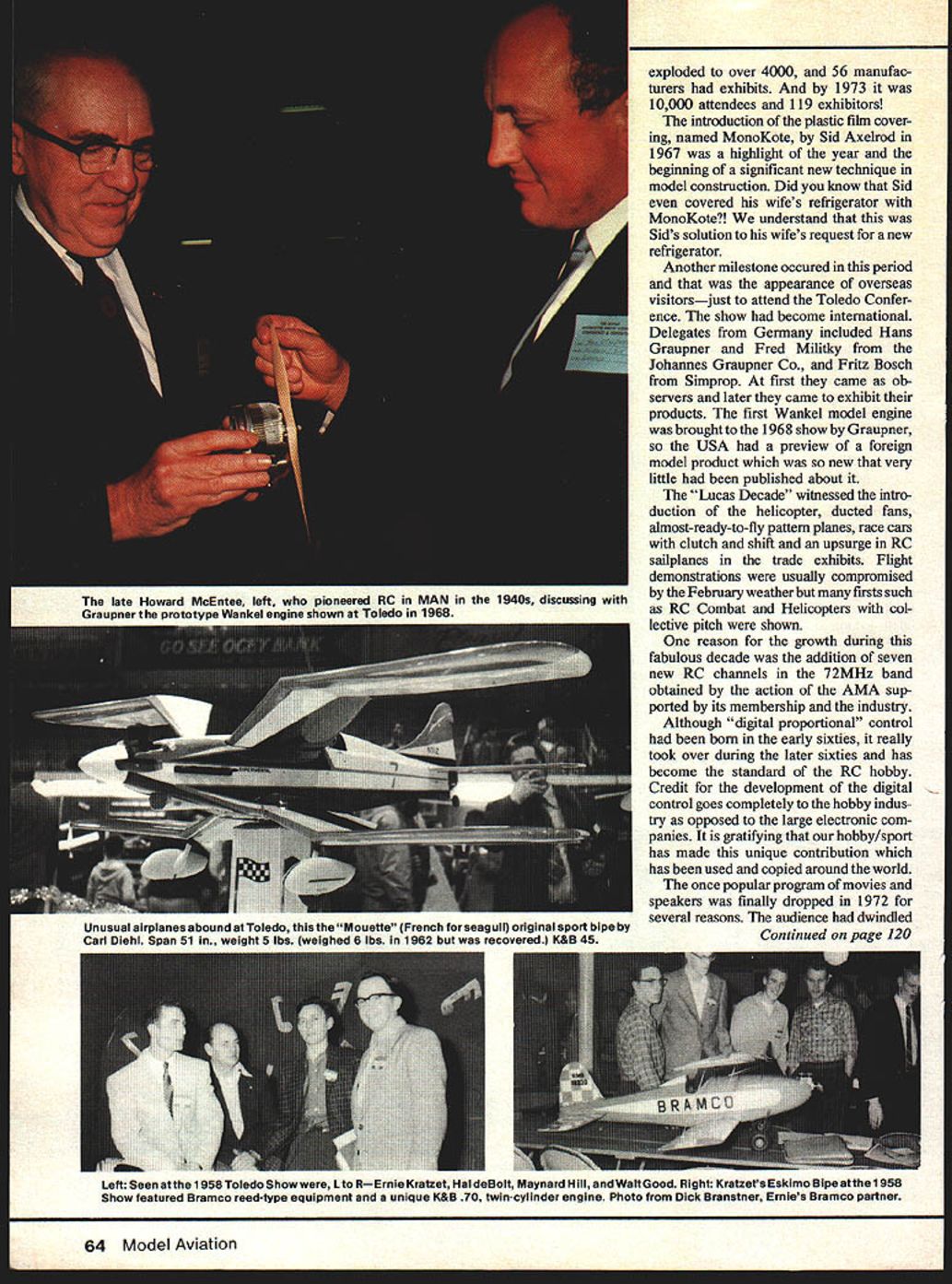
The introduction of the plastic film covering MonoKote by Sid Axelrod in 1967 was a highlight and the beginning of a significant new model-construction technique. Overseas visitors began attending regularly, including Hans Graupner and Fred Militky of Johannes Graupner Co., and Fritz Bosch of Simprop. Graupner brought the first Wankel model engine to the 1968 show.
The "Lucas Decade" saw the introduction of helicopters, ducted fans, almost-ready-to-fly pattern planes, race cars with clutch and shift, and an upsurge in RC sailplanes. Flight demonstrations were often limited by February weather, but many firsts—such as RC Combat and collective-pitch helicopters—appeared in trade exhibits.
Part of the growth was helped by the addition of seven new RC channels in the 72 MHz band, obtained with AMA support. Digital proportional control, born in the early sixties, became dominant during the late sixties; the hobby industry drove its development rather than large electronics firms.
The once-popular program of movies and speakers was dropped in 1972 because the audience had dwindled and the floor space was needed for exhibits. This marked the end of the "conference" flavor of the event. The last DC/RC Symposium was in 1969, another sign that the experimenters era was giving way to a more stabilized sport supported by industry.
The "Lucas Decade" closed on a mixed note in 1974. The gasoline shortage contributed to attendance dropping from 10,000 in 1973 to 6,500 in 1974, but this proved a temporary hiccup.
The Sports Arena Era and Recent Years (1975–1979)
In 1975, overcrowding at the Lucas County facility forced the Weak Signals Club to move to the larger Sports Arena near downtown Toledo. The show expanded to three days and the date was changed to early April to avoid harsh February weather. Ironically, the first show at the Arena in April 1975 was met by an unseasonal snow storm that disrupted travel.
Growth continued at the new site; attendance recorded around 20,000 during the three-day sessions over the next five years. Many meetings—AMA committees, special interest groups, industry gatherings—take place during the show period in area hotels, making Toledo a focal point for model activities beyond the immediate RC exposition.
The club has occasionally had to handle unusual requests. In 1975 Graupner flew in from Germany to show a new .40 helicopter. Their exhibit boxes were delayed by a Chicago snow storm and were forwarded to Toledo without customs processing. With the Toledo customs office closed on Friday, the club arranged to have a customs official at the airport early on Saturday, and volunteers transported the boxes so the Bell 47G was on display and even put on a demonstration flight. The effort by the Weak Signals Club and volunteers ensured a happy ending.
Do you remember how the six 27 MHz RC frequencies were almost lost in 1976? The Toledo show played a part in that rescue. The FCC proposed on March 31, 1976, to reassign 27 MHz frequencies to CB users. The RC community learned of this on April 2 at Toledo. The AMA, industry and RC boat and car organizations mounted a campaign that produced several thousand letters to the FCC, which helped save the 27-band frequencies for the time being. In 1978 the AMA petitioned the FCC to assign 30 frequencies for RC; that petition was then in process.
Technically, the past five years at the show have showcased extremes: tiny planes with tiny RC gear and large 1/4-scale planes with large engines. RC gear has become programmable and frequency-changeable. The introduction of FM-RC gear on 53 MHz marks the beginning of another era and is expected to become standard when the FCC adopts newly petitioned frequencies and permits new forms of modulation.
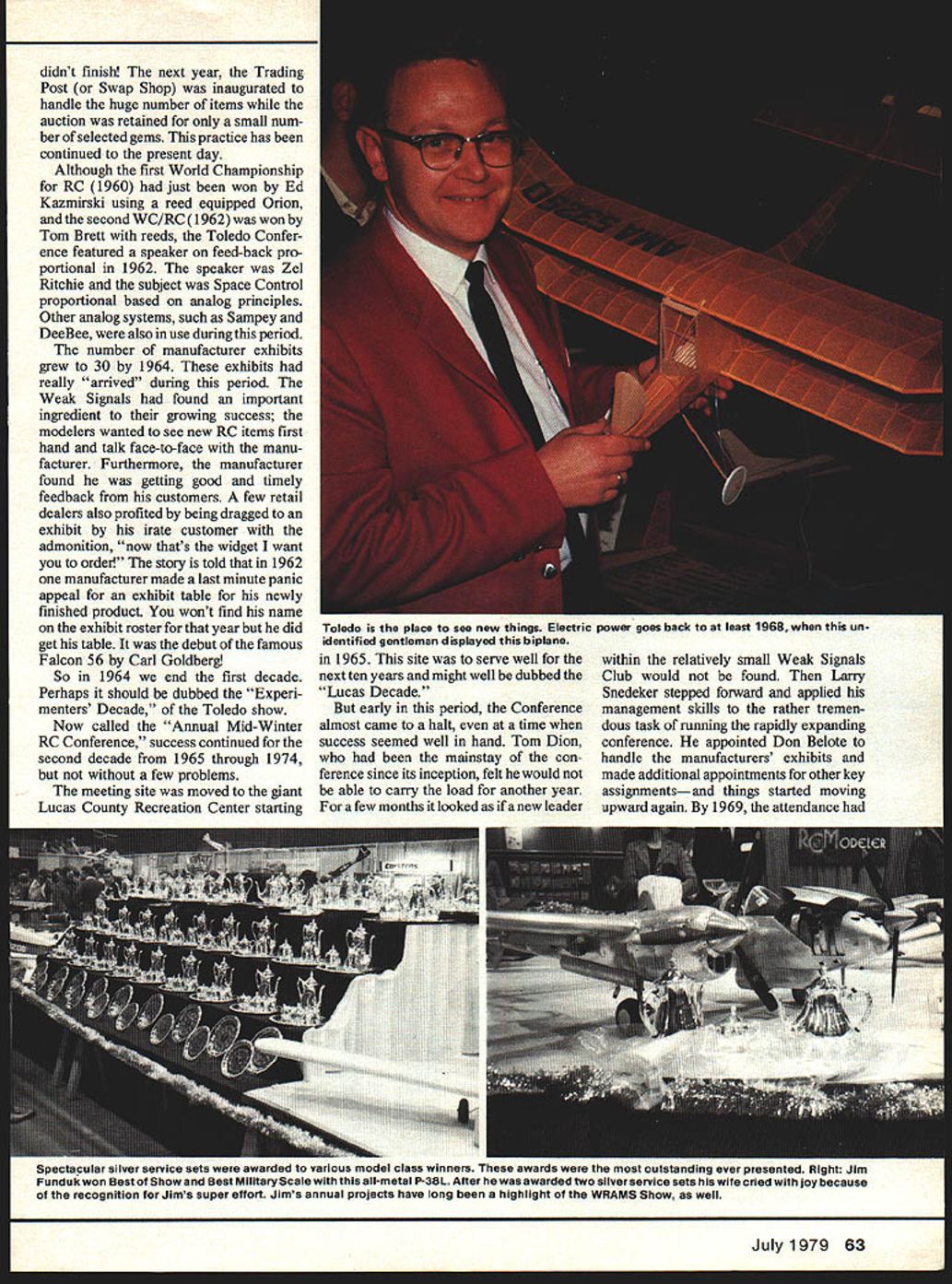
The 1979 "Silver Anniversary" show was held April 6–8 in the Sports Arena. It claimed over 20,000 spectators despite windy, icy, snowy and rainy weather. Winning modelers carried away over $9,000 worth of silver tea sets made especially for the occasion—a prize likely to be well received by modelers' spouses.
For the first time in show history, all 250 display tables were reserved months in advance, and some potential exhibitors were turned away. Many of those turned away nevertheless appeared by sharing tables or squeezing into corners—creating a new problem for the Weak Signals Club to solve.
Memories and People
We interviewed several old-timers during the show and enjoyed jogging foggy memories.
- Larry Snedeker attended all 25 shows despite his job taking him away from Toledo. His fondest memory was initiating the popular AMA Raffle while he was show director in 1965. The raffle has grown each year and involved eight RC systems in 1979. Larry's management skills came from being personnel director for a large firm.
- Dwight Hartman attended the first show in 1955 and has missed only three shows—all due to bad weather that prevented him from driving from Illinois.
- Dick Branstner, behind the early Bramco RC gear, helped Ernie Kratzet with the 1955 meeting and called it an "RC bull session." The display of the Bramco throttle and five-channel reed set could be considered the show's first manufacturer's exhibit.
- Keith Finkenbeiner recalled that club members and their families prepared and served the food for the first ten years. The club was cautious about overextending its finances and chose the do-it-yourself method. By 1966, professional food concessionaires took over. Keith has attended 24 of the shows but missed the first one.
- Bob Hisey, the club's anti-publicity director, actively discourages local advertising. Because the show is the largest annual event in Toledo and pours several million dollars into the local economy each April, it attracts attention from the chamber of commerce and local media. Bob prefers the show not become a big public spectacle, so he schedules it in April when local newspapers are saturated with other events and the county fair is still months away. He also screens exhibitors to provide the widest variety of RC products by allowing only original or exclusive items to be shown, reducing needless repetition. This philosophy caters to both one-man companies and the industry giants.
Foreign visitors again made their annual trek to the RC mecca from Japan, Australia, New Zealand, England, Canada, Mexico, Brazil, India, the Philippines, Germany and other European countries—truly an international affair.
Why Toledo Succeeds
The Weak Signals Club has provided three essential things for the RC sport:
- A place for manufacturers to display wares and interact directly with customers.
- Coveted awards recognizing modelers' displays of planes, boats and cars.
- A Trading Post and auction that recycle RC equipment and provide sellers with cash toward new items.
This success formula evolved through considerable effort by the Weak Signals Club and the dozen or so members who each year manage different areas. Their families have also endured annual sacrifices. Don Belote and Bob Hisey have been co-directors for almost ten years, and the hope is they will continue to guide the exposition into its third decade.
We salute the Weak Signals Club on the 25th anniversary of their Toledo RC Exposition and look forward to more shows in the future.
P.S. Toledo Show next year: April 11, 12, 13 — 1980. See you there.
Transcribed from original scans by AI. Minor OCR errors may remain.

