
2nd Great International Paper Airplane Contest
Introduction
This event, announced in Science 85 magazine, challenged airplane enthusiasts worldwide to build a better paper airplane. Sponsored by the Seattle Museum of Flight, Science 85 magazine, and the Smithsonian Institution's National Air and Space Museum, the contest offered a chance to have fun while participating in a worldwide competition of imagination and craftsmanship. The sponsors hoped the venture would get young people excited about aeronautics and stimulate continuing interest in aeroscience.
The second contest generated as much interest as the first International Paper Airplane Contest, conducted by Scientific American in 1967. Regional trials and other tie-ins sprang up around the world to spark enthusiasm. Local museums, corporations, and schools of all levels involved their communities in paper flight.
Participation and entries
The response was immediate. Packing containers began arriving at the Museum of Flight soon after the contest was announced. A total of 4,348 legal entries from 21 countries were logged in before the May 1 deadline and stored to await competition.
Entries were proxy-flown by retired Boeing engineers and members of the Seattle Museum of Flight. Airplanes competed in one of four categories:
- Distance
- Duration
- Aerobatics
- Aesthetics
Entrants were separated according to ability:
- Professionals in the aeronautics field
- Non-professional adults
- Juniors under the age of 14
Rules and technological changes
The rules were revised to reflect changes in aircraft construction technology since the first contest. Sponsors allowed composites—laminated paper with glue—on the condition that glue not be used solely to add weight. Composites made possible lighter, stronger structures while retaining flexibility in high-stress areas.
The use of glued construction was most evident in the Aesthetics entries, enabling scale replicas, helicopters, and exotic designs previously infeasible. The contest also tested whether Distance and Duration performances benefited from these modern techniques; the results indicated they did.
Distance
The Distance event showed considerable improvement over the first contest 18 years earlier, where the winning flight had been 91 ft., 6 in. Many entrants this year exceeded that distance. During the first two days, entries were screened with repetitive flights until 25 finalists remained. On the third day, each finalist had three attempts to achieve its best distance.
Judge Sheila Widnall, an aerodynamics engineer from MIT, and the volunteer fliers compiled notes during qualifying flights and used them in the finals to maximize each airplane’s performance.
Directional stability proved a major challenge for distance entries, even though the field allowed for wandering. A couple of entries tended to turn away from the field and toward the seats; when launched from the opposite side they turned and homed in on the turf center.
Distance winners included:
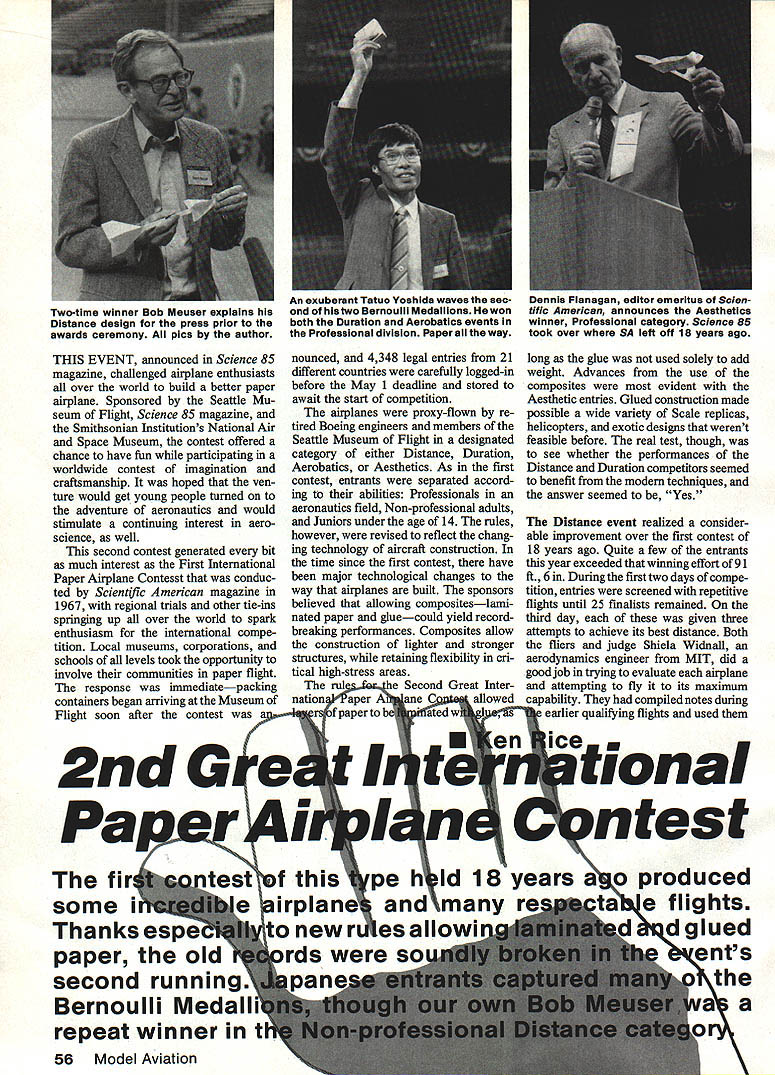
- Non-professional: Bob Meuser (Oakland, CA) — 141 ft., 4 in. (beat 1967 record by 55%; bested 834 entries)
- Professional: Akio Kobayashi (Tokyo, Japan) — 122 ft., 8 in.
- Junior: Eltin Lucero (Pueblo, CO) — 114 ft., 8 in. (reported he had only managed to fling it 22 ft. himself)
Some of the better Distance entries also achieved higher times aloft than the winning Duration airplanes, despite many Duration entries posting times higher than the winning 102-sec. mark from the first contest.
Duration
Like Distance, each Duration airplane’s score was the best of three attempts in the time-aloft competition. Duration proved difficult to fly consistently; many entries failed to achieve notable flights. The event judge was Apollo astronaut Michael Collins; he and the fliers tried to give each entry three fair chances.
The unpredictable nature of some airplanes, along with vague or incomplete instructions from builders, allowed chance to play a large part in results—a characteristic of proxy-flown contests. Successful entries tended to be designs that tolerated a wide variety of conditions and launch techniques, and those with clear flying instructions for the volunteer fliers.
Duration winners:
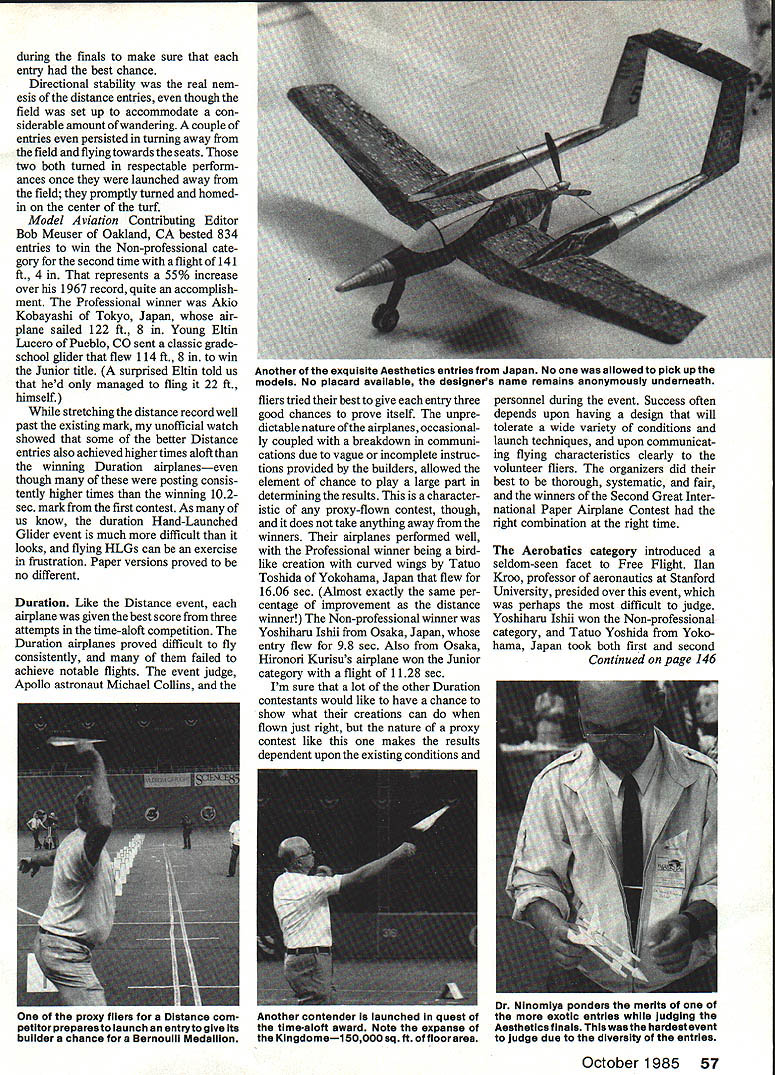
- Professional: Tatsuo Yoshida (Yokohama, Japan) — 116.06 sec.
- Non-professional: Yoshiharu Ishii (Osaka, Japan) — 98.8 sec.
- Junior: Hironori Kurisu (Osaka, Japan) — 11.28 sec.
Aerobatics
The Aerobatics category introduced a seldom-seen facet of free flight. Ilan Kroo, professor of aeronautics at Stanford University, presided over this event, which was perhaps the most difficult to judge.
Aerobatics winners:
- Non-professional: Yoshiharu Ishii
- Professional: Tatsuo Yoshida — took both first and second place with two very small but highly active aircraft
Aesthetics
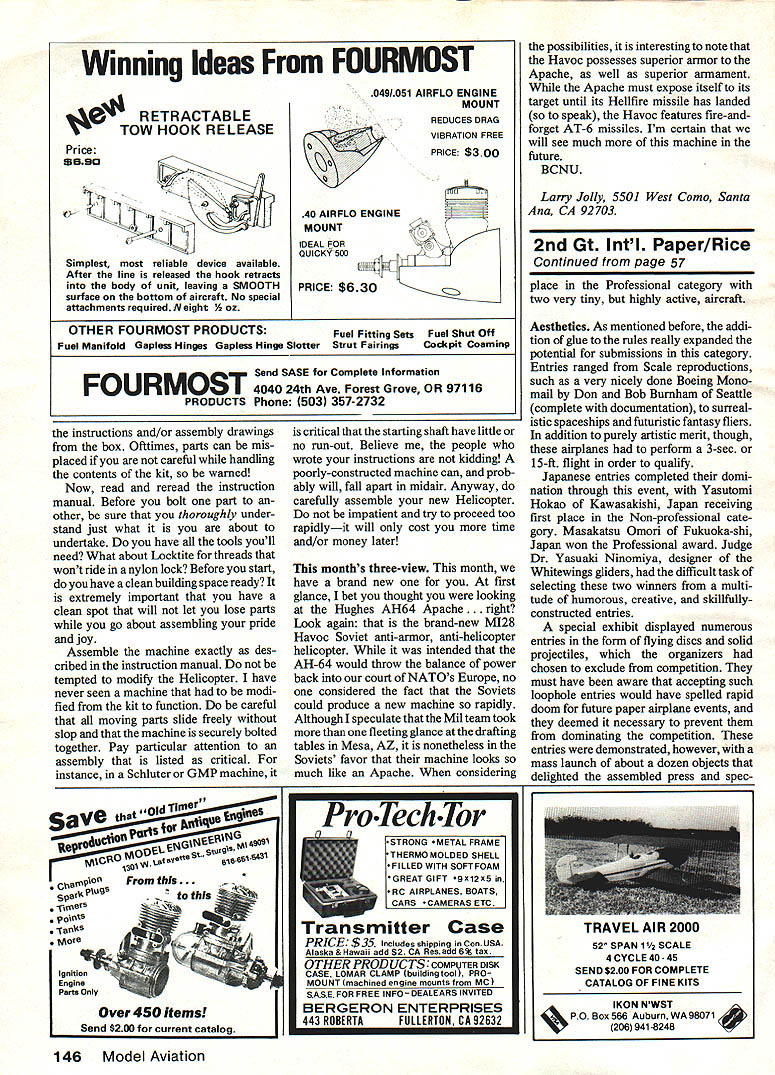
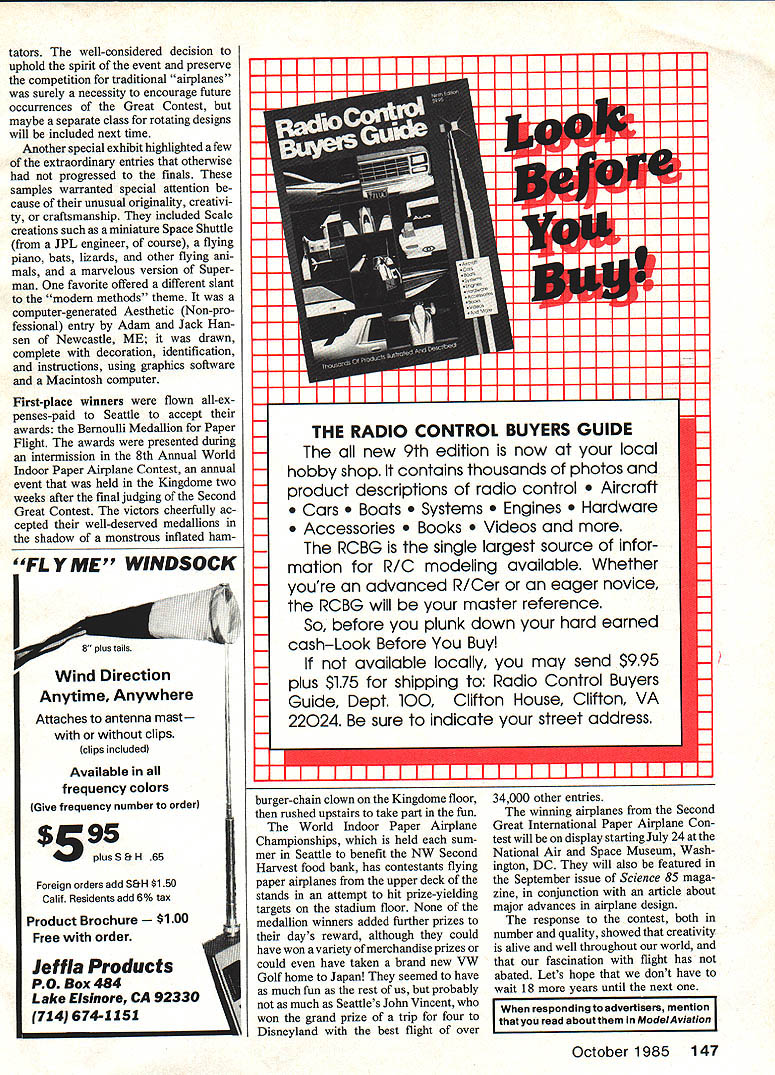
The allowance of glue greatly expanded potential Aesthetics submissions. Entries ranged from scale reproductions—such as a well-done Boeing Monomail by Don and Bob Burnham of Seattle (complete with documentation)—to surreal spaceships and futuristic fantasy fliers. To qualify, these airplanes also had to perform a 3-second or 15-foot flight.
Aesthetics winners:
- Non-professional: Yasutomi Hoka (Kawasaki, Japan) — 1st place
- Professional: Masakatsu Omori (Fukuoka-shi, Japan) — 1st place
Judge Dr. Yasukuni Ninomiya, designer of the Whitewings gliders, selected the winners from a multitude of humorous, creative, and skillfully constructed entries.
Special exhibits
A special exhibit displayed numerous flying discs and solid projectiles that had been excluded from competition. Organizers demonstrated these with a mass launch of about a dozen objects for the assembled press and spectators. They excluded such entries from competition to preserve the spirit of the event and prevent loophole designs from dominating future contests; a separate class for rotating designs might be considered next time.
Another special exhibit highlighted extraordinary entries that had not progressed to the finals. Notable items included:
- Scale creations such as a miniature Space Shuttle (from a JPL engineer)
- A flying piano, bats, lizards, and other flying animals
- A marvelous version of Superman
- A computer-generated Aesthetic (Non-professional) entry by Adam and Jack Hansen of Newcastle, ME—drawn, decorated, identified, and printed using graphics software and a Macintosh computer
Awards and the World Indoor Championships
First-place winners were flown all-expenses-paid to Seattle to accept the Bernoulli Medallion for Paper Flight. Awards were presented during an intermission at the 8th Annual World Indoor Paper Airplane Contest, held in the Kingdome two weeks after final judging.
The World Indoor Championships—held each summer in Seattle to benefit the NW Second Harvest food bank—involves contestants flying paper airplanes from the upper deck to hit prize-yielding targets on the stadium floor. None of the medallion winners also won additional prizes at that event, though they could have won merchandise or even a brand-new VW Golf. Seattle’s John Vincent won the grand prize of a trip for four to Disneyland with the best flight among over 34,000 entries.
Exhibition and publication
The winning airplanes from the Second Great International Paper Airplane Contest were scheduled to be on display starting July 24 at the National Air and Space Museum in Washington, DC. They were also to be featured in the September issue of Science 85 magazine, in an article about major advances in airplane design.
Conclusion
The contest response, in both number and quality, showed that creativity remains strong worldwide and that our fascination with flight endures. Let’s hope we don’t have to wait another 18 years for the next Great International Paper Airplane Contest.
Transcribed from original scans by AI. Minor OCR errors may remain.

