
3-Km Racers
Don Berliner
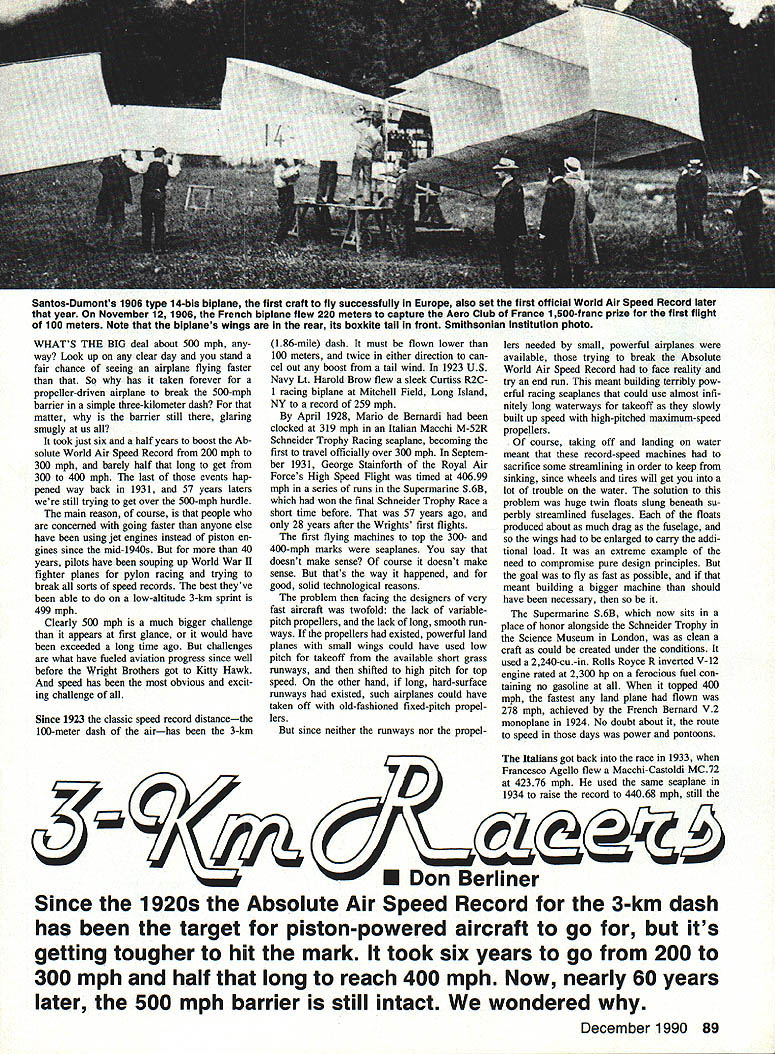
What's the big deal about 500 mph, anyway? Look up on any clear day and you stand a fair chance of seeing an airplane flying faster than that. So why has it taken forever for a propeller-driven airplane to break the 500-mph barrier in a simple three-kilometer dash? For that matter, why is the barrier still there, glaring smugly at us all?
It took just six and a half years to boost the Absolute World Air Speed Record from 200 mph to 300 mph, and barely half that long to get from 300 to 400 mph. The last of those events happened way back in 1931, and nearly 60 years later we're still trying to get over the 500-mph hurdle.
The main reason, of course, is that people who are concerned with going faster than anyone else have been using jet engines instead of piston engines since the mid-1940s. But for more than 40 years pilots have been souping up World War II fighter planes for pylon racing and trying to break all sorts of speed records. The best they've been able to do on a low-altitude 3-km sprint is 499 mph.
Clearly 500 mph is a much bigger challenge than it appears at first glance. But challenges are what have fueled aviation progress since well before the Wright Brothers got to Kitty Hawk. And speed has been the most obvious and exciting challenge of all.
The 3-km Dash and Early Records
Since 1923 the classic speed-record distance—the 3-km (1.86-mile) dash—has been the 100-meter dash of the air. It must be flown below 100 meters altitude, and twice in either direction to cancel out any boost from a tailwind. In 1923 U.S. Navy Lt. Harold Brow flew a sleek Curtiss R2C-1 racing biplane at Mitchell Field, Long Island, NY, to a record of 259 mph.
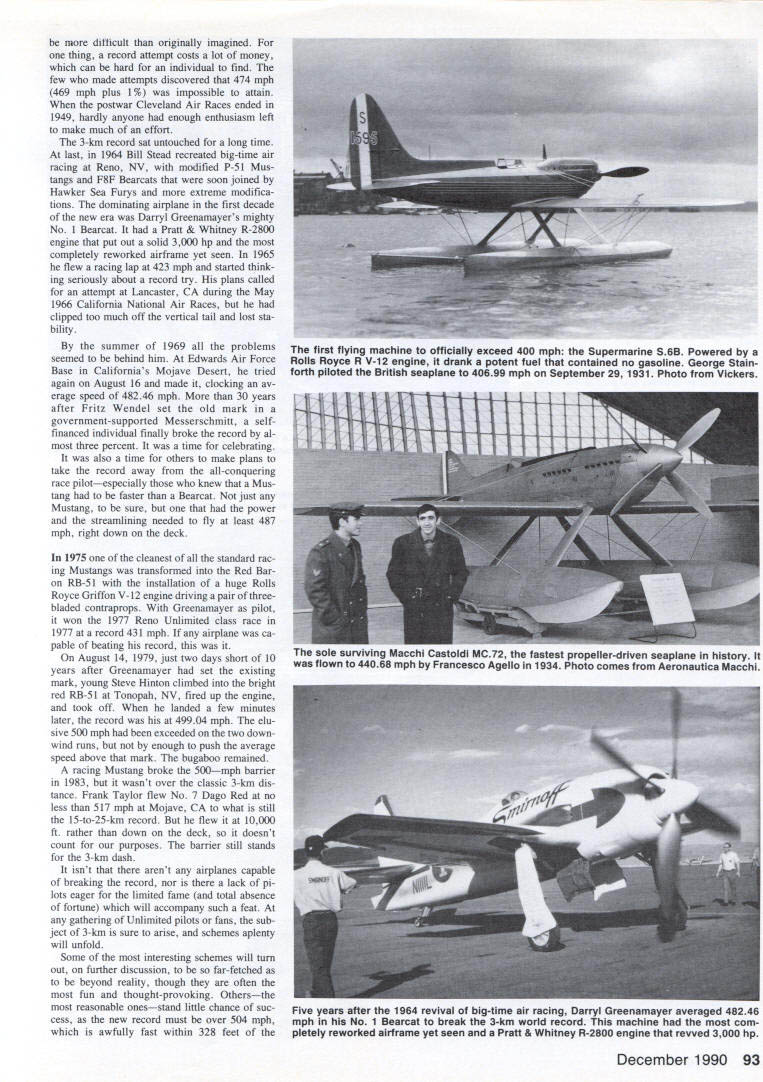
By April 1928, Mario de Bernardi had been clocked at 319 mph in an Italian Macchi M-52R Schneider Trophy racing seaplane, becoming the first to travel officially over 300 mph. In September 1931, George Stainforth of the Royal Air Force's High Speed Flight was timed at 406.99 mph in a series of runs in the Supermarine S.6B, which had won the final Schneider Trophy Race a short time before.
Why Seaplanes?
The first machines to top the 300- and 400-mph marks were seaplanes. That may not make sense at first glance, but there were solid technological reasons. Designers faced two main problems: the lack of widely available variable-pitch propellers and the lack of long, smooth runways. Variable-pitch props allow powerful land planes with small wings to use low pitch for takeoff from short grass fields, then shift to high pitch for top speed. Long, hard-surface runways would have allowed fast fixed-pitch landplanes to operate, but neither the runways nor the propellers needed were yet common.
The workaround was to build extremely powerful racing seaplanes that could use long waterways for takeoff while running high-pitch, maximum-speed propellers. That mandated floats to keep wheels out of the water, producing large amounts of drag and requiring larger wings to carry the load—a costly but necessary compromise to reach speed.
The Supermarine S.6B, now in the Science Museum, London, was as clean a seaplane as could be built. It used a 2,240-cu.-in. Rolls-Royce R "Type" V-12 engine rated at 2,300 hp and, on a ferocious fuel mixture, topped 400 mph. The fastest land plane then had flown 278 mph (the French Bernard V.2 in 1924), so pontoons and raw power were the route to speed in those days.
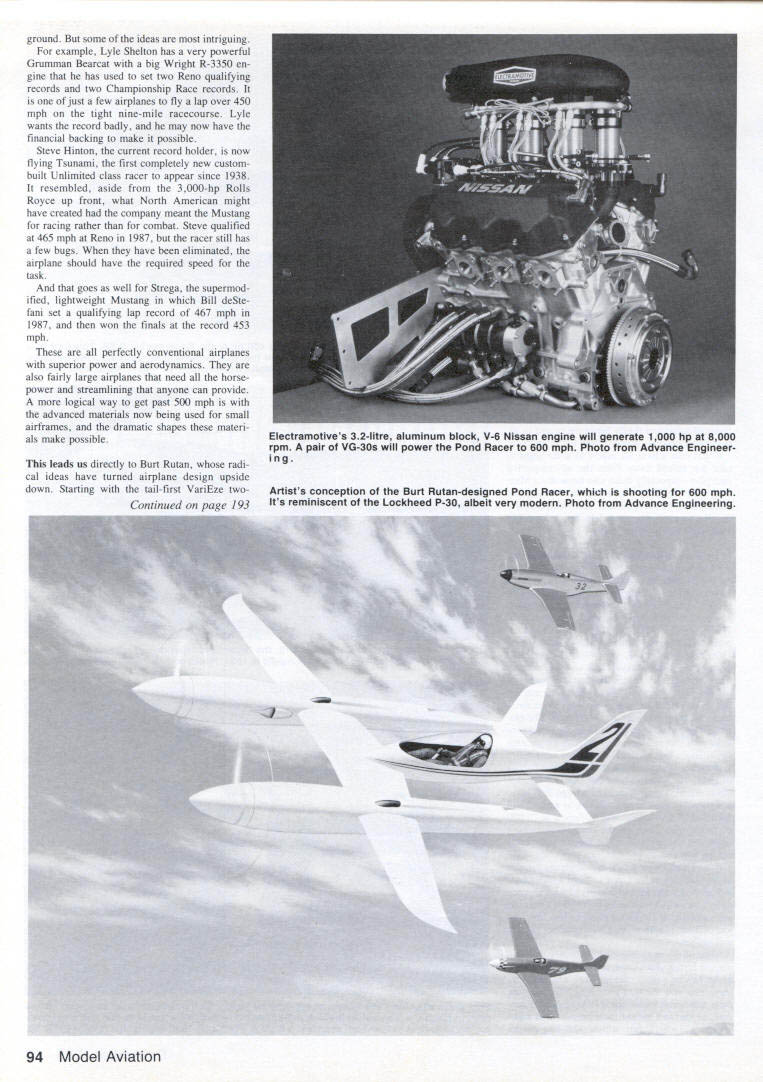
The Italian Macchi-Castoldi MC.72, flown by Francesco Agello, reached 423.76 mph in 1933 and 440.68 mph in 1934; it still stands as the seaplane record. The MC.72 used a similar layout to the Supermarine but relied on two Fiat V-12s in tandem driving a contra-rotating propeller pair.
So far, progress toward 500 mph had been impressive, but the power required rises rapidly with speed. An increase from 440 to 500 mph (a factor of about 1.14) demands roughly 1.14^3 ≈ 1.5 times the horsepower—about a 50% increase. With roughly 3,000 hp already in the MC.72, it would have taken about 4,500 hp to hit 500 mph. The engines to do that did not exist then, and other problems—such as propeller tips approaching supersonic speeds and losing efficiency—loomed.
Landplanes Take the Lead
With the Schneider Trophy retired, interest turned to land planes and streamlining rather than brute power. A number of advanced projects began:
- France: Caudron C.714R, designed around a large Renault V-12 for about 480 mph.
- Italy/France: Bugatti 100, using two Type 50 race-car engines in a tiny airframe with long shafts and reverse-flow cooling.
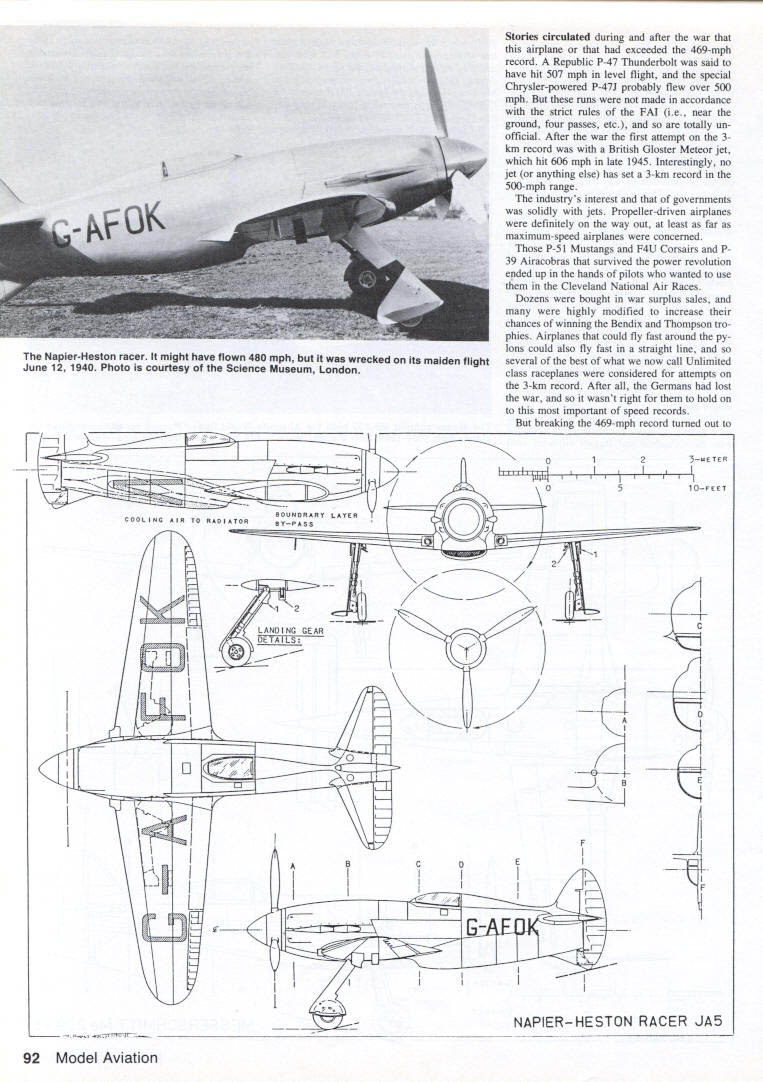
- England: Napier-Heston, a supersleek testbed for the 24-cylinder, 2,300-hp Napier Sabre.
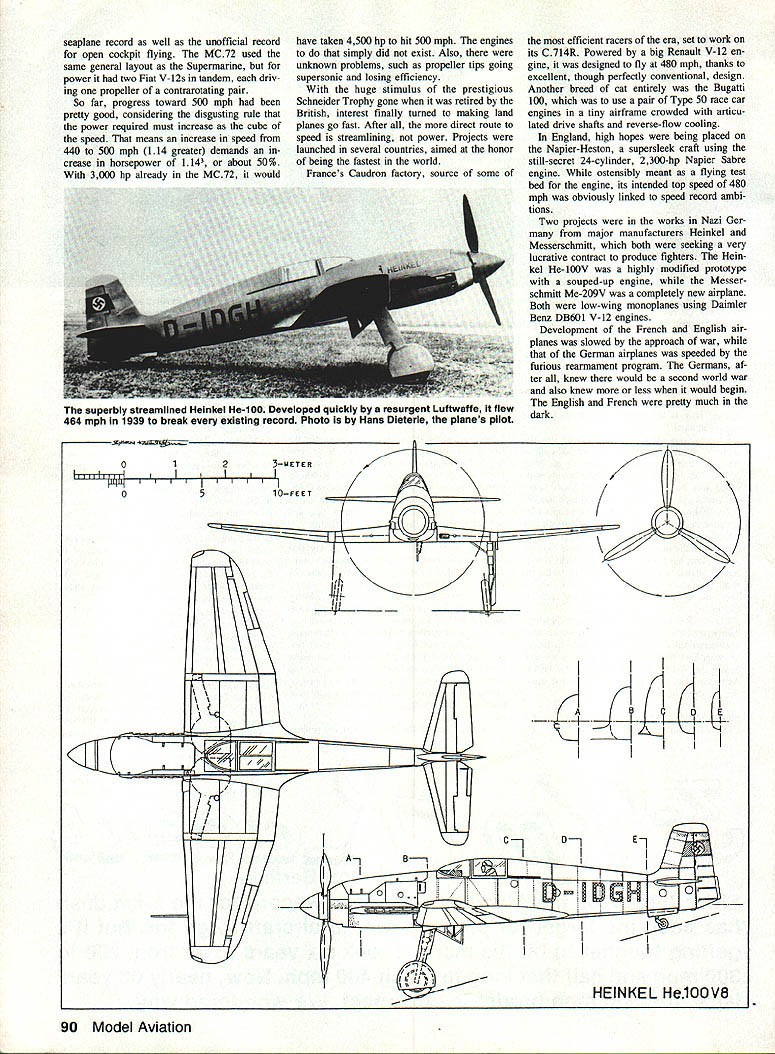
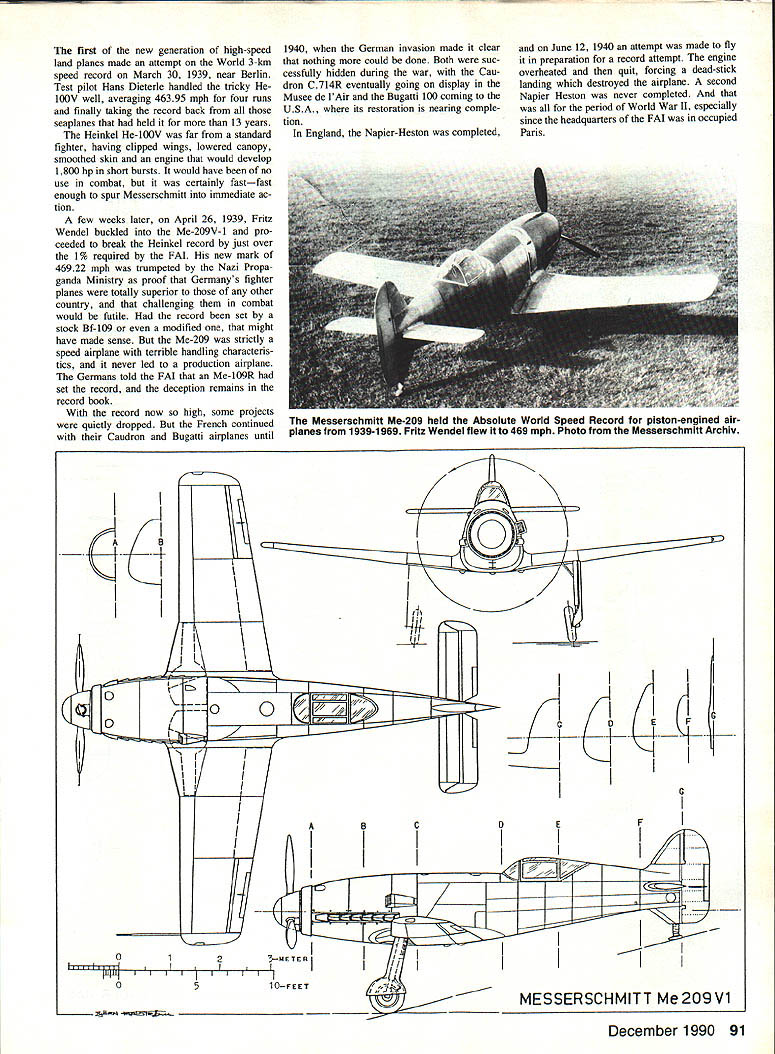
- Germany: Heinkel and Messerschmitt projects (He 100V and Me 209V) using Daimler-Benz DB601 V-12 engines.
Development of the French and English designs slowed as war approached, while German rearmament accelerated their work. The first of the new generation attempted the world 3-km speed record on March 30, 1939, near Berlin. Hans Dieterle averaged 463.95 mph in the Heinkel He-100V, taking the record back from the seaplanes.
A few weeks later, on April 26, 1939, Fritz Wendel flew the Messerschmitt Me 209V-1 to 469.22 mph, just over the 1% margin required by the FAI. Nazi propaganda loudly proclaimed German superiority, but the Me 209 was strictly a speed airplane with terrible handling and did not lead to a production fighter. The Germans even told the FAI the record had been set by a modified Bf 109, a deception that remains in the record books.
The French continued development until the German invasion in 1940; the Caudron and Bugatti designs were hidden during the war. The incomplete Napier-Heston was destroyed in 1940 after an engine-overheat incident on a record-preparation flight; a second airframe was never finished.
World War II, Jets, and the Postwar Era
During and after the war there were numerous stories of fast piston airplanes—Republic P-47 Thunderbolts and specially Chrysler-powered P-47s were said to have exceeded 500 mph level speed—but these were not made under the strict FAI 3-km rules and thus are unofficial.
The postwar era quickly shifted interest and government support to jets. In late 1945 a British Gloster Meteor jet recorded 606 mph for a 3-km run—the first jet 3-km record—and, intriguingly, no jet (or other airplane) has set a 3-km record in the 500-mph range since.
Many surplus piston fighters found new life in pylon racing at Cleveland and later Reno. Dozens of Mustangs, Corsairs and others were modified for the Bendix and Thompson trophies; pylon racers capable of high straight-line speed began to be considered for record attempts. But breaking the 469-mph record proved far tougher than expected. Record attempts are expensive, and the 474-mph mark (469 plus 1%) seemed impossible for many.
Reno Revival and Modern Unlimited Racers
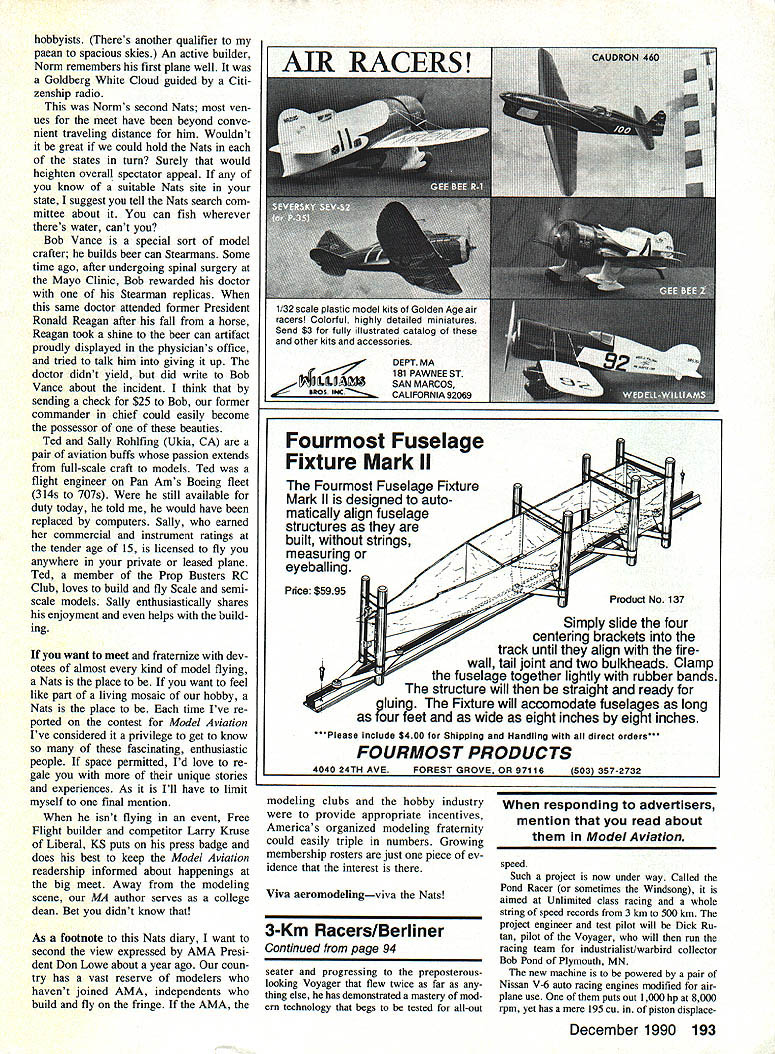
In 1964 Bill Stead revived big-time air racing at Reno, NV, with modified P-51 Mustangs and F8F Bearcats. Early domination came from Darryl Greenamayer's No. 1 Bearcat, a heavily reworked airframe with a Pratt & Whitney R-2800 producing about 3,000 hp. After initial setbacks, on August 16, 1969, at Edwards AFB, Greenamayer averaged 482.46 mph, finally breaking the postwar record.
Other racers immediately aimed for the title. Notable developments:
- Red Baron RB-51: A modified Mustang with a Rolls-Royce Griffon V-12 driving contra-rotating props. With Steve Hinton as pilot, it won at Reno and set a record 431 mph in 1977. On August 14, 1979, Hinton averaged 499.04 mph at Tonopah, NV—just shy of a 500-mph average (the downwind runs exceeded 500 mph, but not by enough to lift the average).
- Frank Taylor's N.7 "Dago Red": In 1983 Taylor flew 517 mph at Mojave, CA, but that was over a longer 15–25 km distance and at 10,000 ft; it does not count for the low-altitude 3-km dash.
- Contemporary contenders: Lyle Shelton's powerful Grumman Bearcat with a Wright R-3350, Steve Hinton's Tsunami (a clean custom racer with a 3,000-hp Rolls-Royce), and Strega, Bill del Destefani's lightweight, supermodified Mustang. These conventional but highly optimized racers offer the best near-term prospects among piston-driven aircraft.
Advanced Materials and Radical Designs
A more logical route to exceed 500 mph is to exploit advanced materials and radical shapes for very small, extremely clean airframes. That brings us to Burt Rutan.
Starting with his tail-first VariEze two-place seater and progressing to the record-setting Voyager, Rutan has shown mastery of modern composite technology and unconventional configurations. One of his projects, often called the Pond Racer or Windsong, aims at Unlimited-class racing and speed records from 3 km up to 500 km.
Key points about the Pond Racer:
- Pilot/project engineer: Dick Rutan (Voyager pilot).
- Sponsor/owner: Bob Pond of Plymouth, MN.
- Configuration: Twin-engine layout resembling a Lockheed P-38 Lightning (to avoid spraying oil onto the windshield in case of a leak).
- Structure: Graphite fuselage and tail, carbon-fiber wing spar, ribs and covering.
- Powerplant: A pair of Nissan V-6 auto-racing engines modified for aviation. One engine reportedly produces about 1,000 hp at 8,000 rpm with 195 cu. in. of displacement—slightly less than the 200-cu.-in. Continental O-200 used in small Formula One race planes. (A Nissan VG-30 variant has been used in Le Mans entries.)
- Design top speed: 500 mph, well into territory normally reserved for jets.
Rutan projects often succeed where others fail, but success is not guaranteed. If the 500-mph barrier falls, the next targets are obvious: 600 mph, the first custom-built supersonic piston or propeller-driven airplane, and so on.
The 3-km dash has been the world’s 100-meter sprint in the air for more than six decades. The barrier remains because the engineering and piloting demands are severe at low altitude and very high speed. The attempts—and the machines built to attempt them—are among the most fascinating chapters in aviation history.
Transcribed from original scans by AI. Minor OCR errors may remain.

