
50th Anniversary Wakefield Commemorative at Taft
By John Oldenkamp
Overview
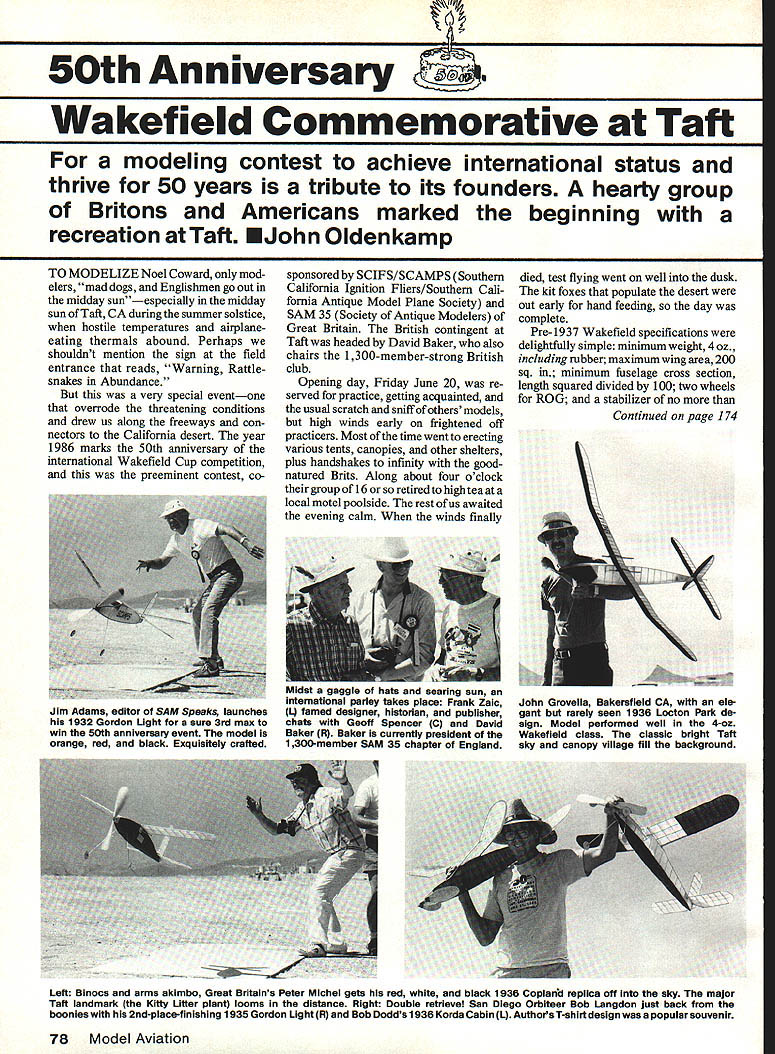
For a modeling contest to achieve international status and thrive for 50 years is a tribute to its founders. A hearty group of Britons and Americans marked the anniversary with a reenactment at Taft, California. The 1986 event commemorated the 50th anniversary of the 1937 international Wakefield Cup competition and was co‑sponsored by SCIFS/SCAMPS (Southern California Ignition Fliers / Southern California Antique Model Plane Society) and SAM‑35 (Society of Antique Modelers, Great Britain). The British contingent was headed by David Baker, who chairs the 1,300‑member SAM‑35 chapter in England.
Event details
- Opening day, Friday, June 20, was reserved for practice and getting acquainted. High winds early in the day kept many from practicing, so much time was spent erecting tents, canopies, and other shelters, and exchanging handshakes and conversation with the visiting Brits.
- Around 4:00 p.m. the British group retired for high tea at a local motel poolside while others waited for the evening calm. When the winds finally died, test flying continued well into dusk.
- The desert kit foxes made an appearance at dusk, adding a local touch to the day.
Pre‑1937 Wakefield specifications
Pre‑1937 Wakefield rules were delightfully simple:
- Minimum weight: 4 oz., including rubber
- Maximum wing area: 200 sq. in.
- Minimum fuselage cross‑section: (length squared) ÷ 100
- Two wheels for rise‑off‑ground (ROG)
- Stabilizer: no more than 30% of the wing area
These rules produced stubby, somewhat fragile airplanes with spindly undercarriages (often bamboo), large fins, and large props. Suitably trimmed and flown on modern rubber strip, however, they are outstanding performers. The ROG feature adds excitement—and occasional heartbreak.
Flight procedures and trimming
- The first powered flight should be wound to approximately one‑third of maximum turns.
- The climb should be to the right; adjust with thrust changes. A stalling climb should be corrected by adding downthrust or more right thrust before increasing turns.
- Fine adjustments will be necessary as power is increased and as flying conditions change.
- Larger, slower models are less susceptible to trim changes than smaller, faster models; they are forgiving and relatively easy to adjust.
- One anecdote: at the Reno Nats, a tail boom was knocked from right‑hand to left adjustment on launch at full power, and the model flew perfectly to the left and even thermaled left in the glide.
Because of the generic fragility of these light four‑ouncers, Contest Director Andy Faykun announced that the 50th‑anniversary event would be flown in rounds of one hour each on Saturday to reduce retrieval time and model losses. That decision required well‑coordinated team flying (one to fly, one to retrieve).
DT (dethermalizer) arrangements
The DT (delayed release or dethermalizer) hook and rubber‑band arrangements have been refined since the original plans. The objective was a more positive action with a less complicated setup. Four methods were investigated; the two most successful are:
- Leading‑edge (LE) pivot: pivots on the wing leading edge and requires an LE mount similar to a stab DT. This was used on a one‑piece wing and is the preferred method for a positive action.
- Trailing‑edge (TE) pivot: requires rounding and reinforcing the trailing edge, and using a hook to hold the rubberband at least 3/8 in. above the wing to provide enough leverage to make the wing pivot from the fuselage. Two sets of dual hooks help hold a two‑piece wing together in flight.
Questions or comments can be sent with a SASE to: Chuck Markos 655 Carlisle Ave. Deerfield, IL 60015
Contest rounds and results
- Several latecomers missed the 7:00–8:00 a.m. round and were out. Others were at the launch line at 7:50 a.m., furiously winding and shouting for timers but unable to enter the round once the whistle signaled its close.
- For the most part, flying was low‑key but of very high quality. There were hordes of photographers at every launch and plenty of advice on thermal picking and release timing. The crowd cheered the successes and groaned at the inevitable smushes.
- Conditions on the field were unusually pleasant for Taft: temperatures in the 90s rather than the typical 110s, low humidity, slight drift early, and generally benign thermals—although about eight models disappeared overhead during one notable "boomer."
Genial Jim Adams maxed out his Gordon S. Light replica to win first place, closely followed by Bob Langdon's later‑day Light. All who participated were winners in spirit: the contest was unique in its vintage quality and camaraderie. For many, being on the U.S. team flying Wakefield against an international entry on an excellent site was unforgettable.
Next event
As a bottom line, a 50th reenactment of the 1937 Wakefield Cup contest was planned to be held at Old Warden in England. Many participants are already making preparations for that event.
Transcribed from original scans by AI. Minor OCR errors may remain.

