
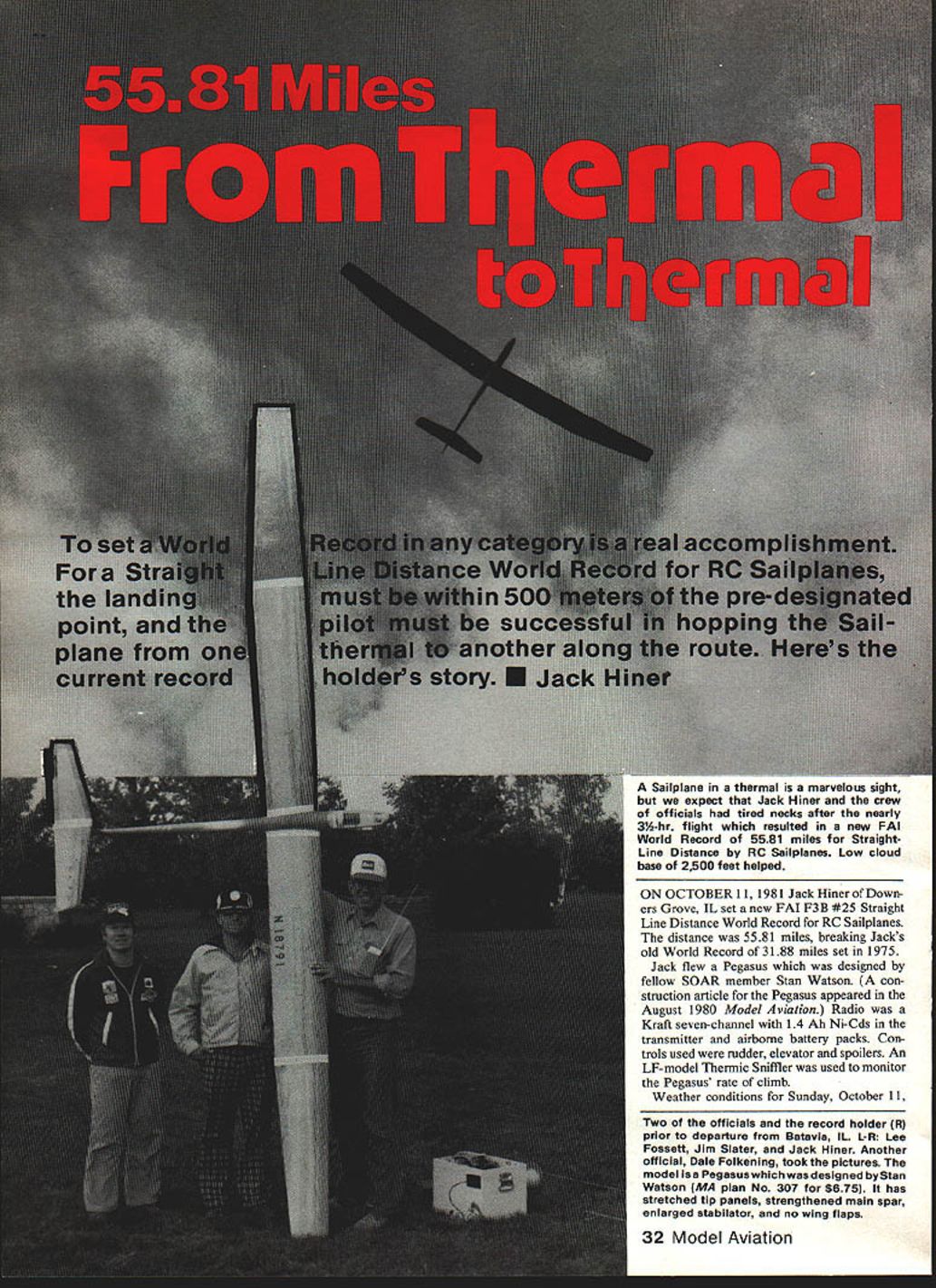


55.81 Miles From Thermal to Thermal
By Jack Hiner
To set a World Record in any category is a real accomplishment. For a Straight Line Distance World Record for RC sailplanes, the landing must be within 500 meters of the pre-designated point, and the pilot must be successful in hopping the sailplane from one thermal to another along the route. Here is the holder's story.
A sailplane in a thermal is a marvelous sight, but we expect that Jack Hiner and the crew of officials had tired necks after the nearly 3-1/2-hour flight which resulted in a new FAI World Record of 55.81 miles for Straight Line Distance by RC sailplanes. A low cloud base of about 2,500 feet helped.
The Record Flight
On October 11, 1981, Jack Hiner of Downers Grove, IL set a new FAI F3B #25 Straight Line Distance World Record for RC sailplanes. The distance was 55.81 miles, breaking Jack's old world record of 31.88 miles set in 1975.
Equipment
- Sailplane: Pegasus, designed by Stan Watson (construction article in the August 1980 Model Aviation).
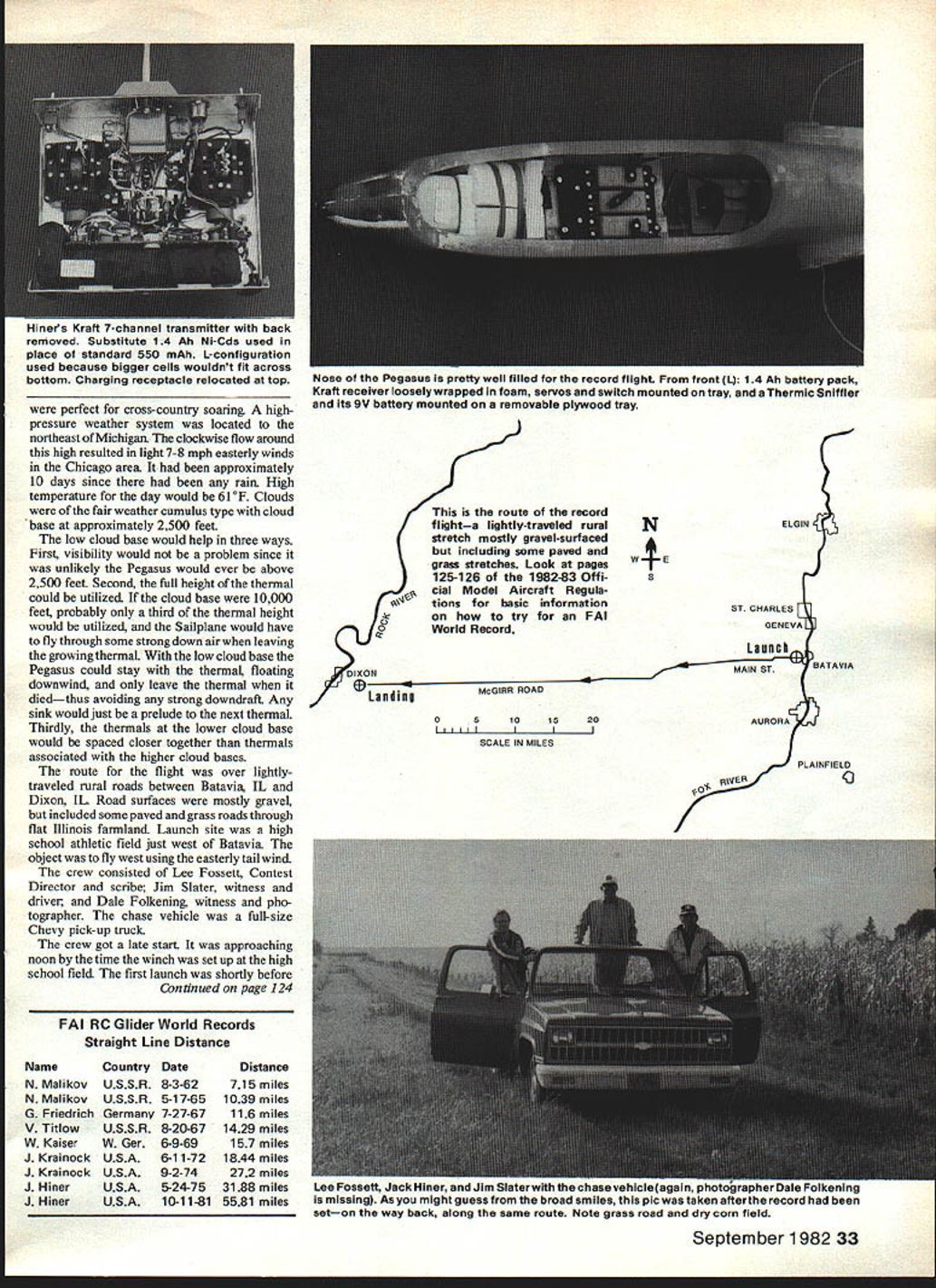
- Radio: Kraft seven-channel with 1.4 Ah Ni-Cads in the transmitter and airborne battery packs.
- Controls: rudder, elevator, and spoilers.
- Instrumentation: L/F-model Thermic Sniffer used to monitor the Pegasus' rate of climb.
Weather
A high-pressure system was located to the northeast of Michigan. The clockwise flow around this high produced light easterly winds of about 7–8 mph in the Chicago area. It had been approximately ten days since any rain. The high temperature that day reached about 61°F. Clouds were fair-weather cumulus with a cloud base of approximately 2,500 feet.
The low cloud base helped in three ways:
- Visibility was not a problem since it was unlikely the Pegasus would be above 2,500 feet.
- The full height of the thermal could be utilized. With a low cloud base the Pegasus could stay with the thermal, floating downwind, and only leave the thermal when it died—avoiding strong downdrafts that occur when leaving a growing thermal.
- Thermals at the lower cloud base were spaced closer together than thermals associated with higher cloud bases.
Route and Crew
The route for the flight was over lightly traveled rural roads between Batavia, IL and Dixon, IL. Road surfaces were mostly gravel, with some paved and grass roads through flat Illinois farmland. The launch site was a high school athletic field just west of Batavia. The plan was to fly west using the easterly tail wind.
Crew:
- Lee Fossett, Contest Director and scribe
- Jim Slater, witness and driver
- Dale Folkening, witness and photographer
The chase vehicle was a full-size Chevy pickup truck.
Flight Description
The crew got a late start. It was approaching noon by the time the winch was set up at the high school field. The first launch was shortly before noon; no lift was encountered. Before the second launch, Dale Folkening took some pictures of the crew and the sailplane. The second launch was at 12:03 p.m., and light lift was encountered.
It took over two hours for the Pegasus to cover the first 25 miles. This early part of the flight was characterized by small but fairly strong thermals with a cloud base of about 2,500 feet. Jack would keep the Pegasus in the center of the thermal and let it drift downwind until the thermal died. Only at that time would Jack fly straight down the road until the Pegasus ran into the next thermal. This kept the average speed down because the ground speed, due to wind drift while thermalling, was only about 5 mph. The Pegasus was much easier to see under a cloud than in a clear blue sky. Between thermals the Pegasus flew at a ground speed of 25 to 30 mph. A more aggressive flying style would have increased speed but also the chance of a premature landing.
The last hour and 18 minutes of the flight covered 30 miles. The thermals then were very broad but much weaker. Much less time was spent circling in lift than earlier in the flight. Some very large areas of light lift were flown straight down the road at best sink rate. When the lift strengthened, Jack made large gentle turns to gain altitude. When the lift stopped, Jack would speed up a bit and cover ground, slowing if any lift was encountered.
Altitude became even more important later in the day. Jack knew that if the Pegasus ever got down to 1,000 feet or less, it would be the beginning of the final glide to landing. If altitude was protected, the Pegasus could fly on for another two hours or so. A little over an hour later, at 3:24 p.m., the Pegasus was over the goal and up near cloud base. Landing was at 3:31 p.m., resulting in a new FAI World Record of 55.81 miles.
Aftermath and Potential
This flight is only a fraction of the distance that could be covered in the area. Three downwind distance flights of over 40 miles have averaged from a little over 15 mph to over 20 mph. Two of the flights were with an Aquila XLS, a rather slow sailplane for cross-country flying. Yet it was an Aquila XL that averaged over 20 mph on a flight of over 40 miles on a day with strong thermals and a brisk tail wind.
None of these flights was flown aggressively. A faster, more efficient sailplane would allow a more aggressive flying style and could make an average speed of 25 mph or more possible on good days.
With the right weather conditions on a long June day, it is possible to fly an RC sailplane cross-country for seven hours or more in this area. Simple math indicates a possible 100-mile flight with a floater. With a sailplane designed for fast cross-country flying, a 200-mile flight should be within reach.
Transcribed from original scans by AI. Minor OCR errors may remain.

