
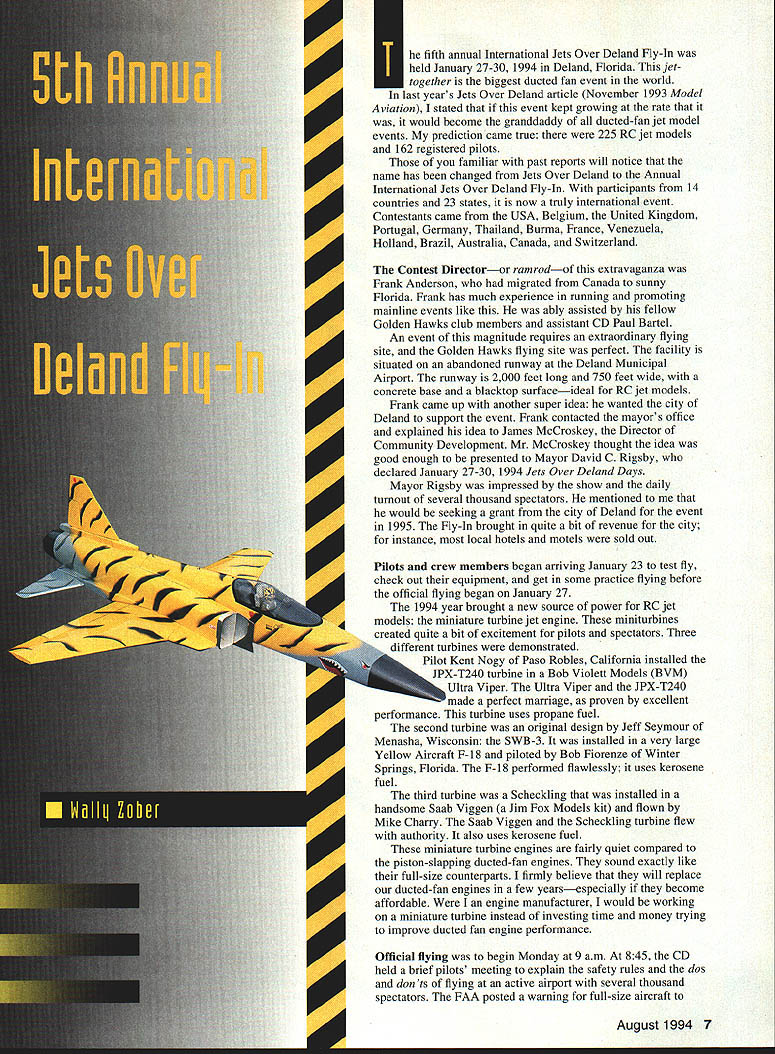
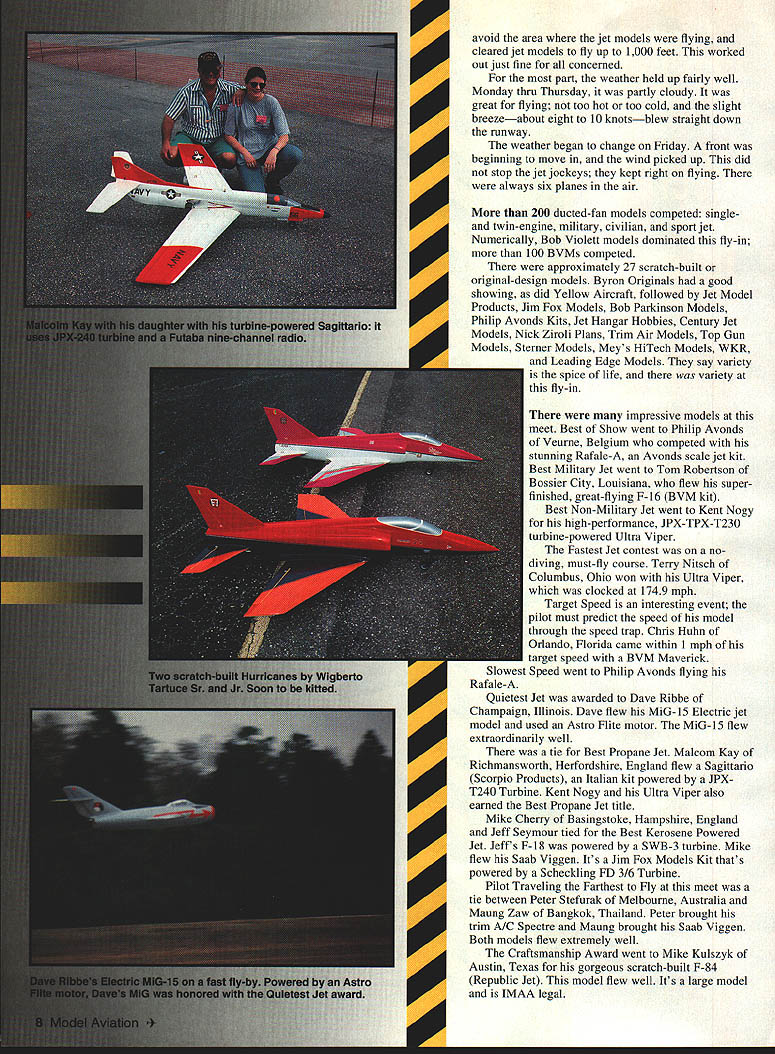
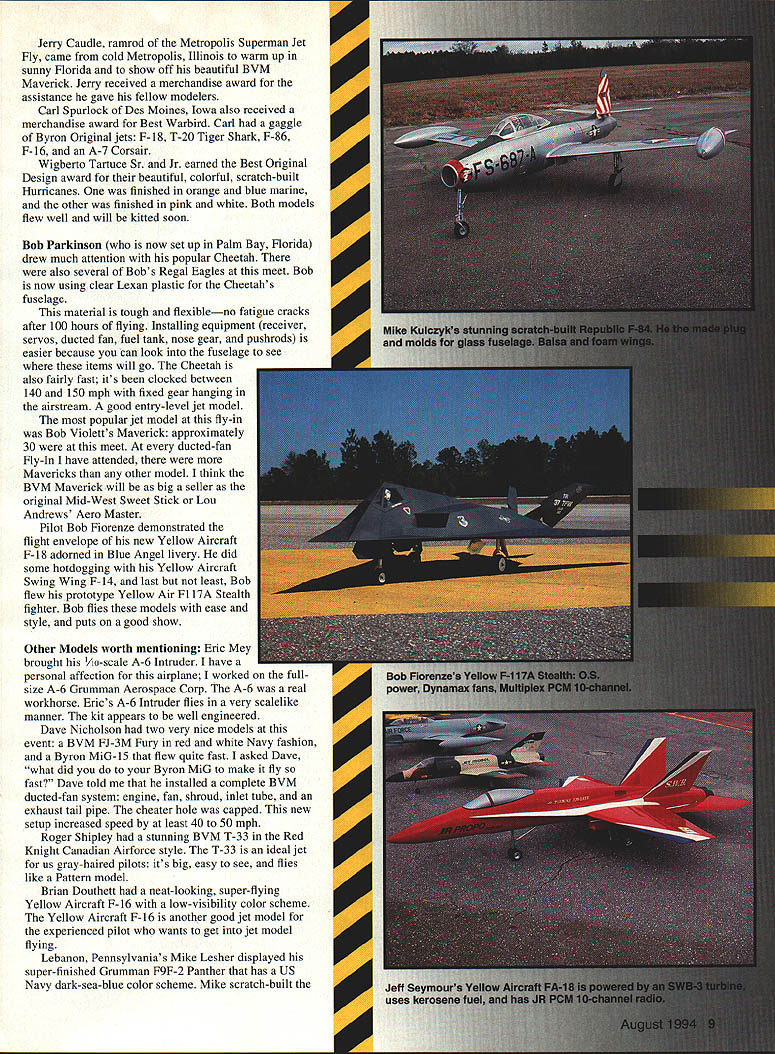
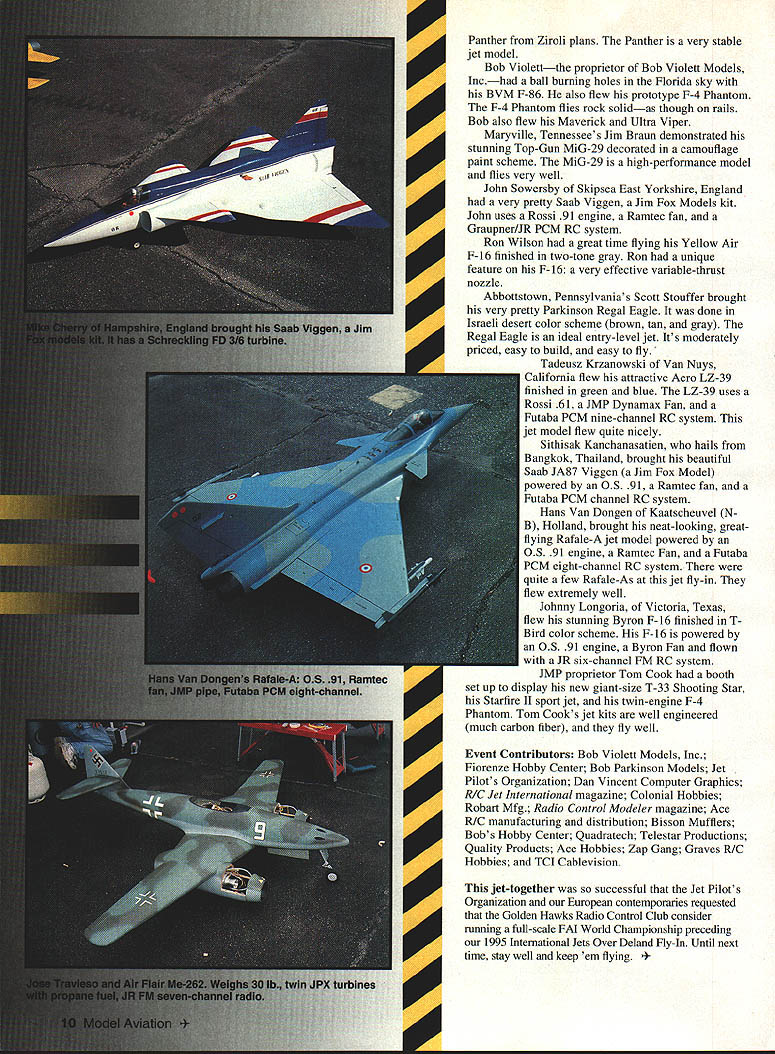
5th Annual International Jets Over Deland Fly-In
By Wally Zober
The fifth annual International Jets Over Deland Fly-In was held January 27–30, 1994, in DeLand, Florida. This jet-together is the largest ducted-fan event in the world. In last year’s Jets Over DeLand article (November 1993, Model Aviation) I stated that if this event kept growing at the rate it was, it would become the granddaddy of all ducted-fan jet model events. My prediction came true: there were 225 RC jet models and 162 registered pilots.
Those familiar with past reports will notice the name change from Jets Over DeLand to the Annual International Jets Over DeLand Fly-In. With participants from 14 countries and 23 states, it is now a truly international event.
Participating countries
- USA
- Belgium
- United Kingdom
- Portugal
- Germany
- Thailand
- Burma
- France
- Venezuela
- Holland
- Brazil
- Australia
- Canada
- Switzerland
Organization and site
The Contest Director (ramrod) of this extravaganza was Frank Anderson, who had migrated from Canada to sunny Florida. Frank has much experience in running and promoting mainline events and was ably assisted by his fellow Golden Hawks club members and assistant CD Paul Bartel.
An event of this magnitude requires an extraordinary flying site, and the Golden Hawks flying site was perfect. The facility is situated on an abandoned runway at the DeLand Municipal Airport. The runway is 2,000 feet long and 750 feet wide, with a concrete base and a blacktop surface—ideal for RC jet models.
Frank secured city support by contacting James McCroskey, Director of Community Development, who presented the idea to Mayor David C. Rigsby. Mayor Rigsby declared January 27–30, 1994, Jets Over DeLand Days. He was impressed by the show and the daily turnout of several thousand spectators and mentioned he would seek a city grant for the 1995 event. The Fly-In brought substantial revenue to the city; most local hotels and motels were sold out.
Pilots and crew began arriving January 23 to test fly, check equipment, and practice before official flying began January 27.
New power: miniature turbine engines
The 1994 event showcased a new power source for RC jet models: miniature turbine jet engines. These miniturbines created excitement for pilots and spectators. Three different turbines were demonstrated:
- JPX-T240 (propane) — installed by Kent Nogy (Paso Robles, CA) in a Bob Violett Models (BVM) Ultra Viper. The pairing delivered excellent performance.
- SWB-3 (kerosene) — an original design by Jeff Seymour (Menasha, WI), installed in a large Yellow Aircraft F-18 and piloted by Bob Fiorenze (Winter Springs, FL). The F-18 performed flawlessly.
- Scheckling (kerosene) — installed in a Jim Fox Models Saab Viggen and flown by Mike Cherry. The Viggen and Scheckling turbine flew with authority.
These miniature turbines are relatively quiet compared to piston-driven ducted-fan engines and sound very much like their full-size counterparts. I believe they may replace ducted-fan engines in a few years, especially if they become affordable.
Flights, safety, and weather
Official flying was scheduled to begin Monday at 9 a.m. At 8:45 a.m. the CD held a brief pilots’ meeting to explain safety rules and the dos and don’ts of flying at an active airport with several thousand spectators. The FAA posted a warning for full-size aircraft to avoid the area where the jet models were flying and cleared the models to fly up to 1,000 feet. This worked out well.
For the most part, the weather cooperated. Monday through Thursday was partly cloudy—great for flying: not too hot or cold, with a slight breeze of about eight to ten knots blowing straight down the runway. The weather began to change on Friday as a front moved in and the wind increased, but the flyers kept flying—there were always six planes in the air.
Models, manufacturers, and variety
More than 200 ducted-fan models competed: single- and twin-engine, military, civilian, and sport jets. Numerically, Bob Violett Models dominated the meet; more than 100 BVMs competed. Approximately 27 scratch-built or original-design models were present.
Manufacturers and kit suppliers represented included:
- Byron Originals
- Yellow Aircraft
- Jet Model Products
- Jim Fox Models
- Bob Parkinson Models
- Philip Avonds Kits
- Jet Hangar Hobbies
- Century Jet Models
- Nick Ziroli Plans
- Trim Air Models
- Top Gun Models
- Sterner Models
- Mey’s HiTech Models
- WKR
- Leading Edge Models
There was a great variety of models and styles at the fly-in.
Awards and results
- Best of Show: Philip Avonds (Veurne, Belgium) — Rafale-A (Avonds scale jet kit)
- Best Military Jet: Tom Robertson (Bossier City, LA) — F-16 (BVM kit)
- Best Non-Military Jet: Kent Nogy — Ultra Viper (JPX-T240 turbine-powered)
- Fastest Jet: Terry Nitsch (Columbus, OH) — Ultra Viper, 174.9 mph (no-diving course)
- Target Speed: Chris Huhn (Orlando, FL) — BVM Maverick, within 1 mph of target
- Slowest Speed: Philip Avonds — Rafale-A
- Quietest Jet: Dave Ribbe (Champaign, IL) — MiG-15 electric model (Astro Flite motor)
- Best Propane Jet (tie): Malcolm Kay (Rickmansworth, Hertfordshire, England) — Sagittario (Scorpio Products) powered by JPX-T240; and Kent Nogy — Ultra Viper
- Best Kerosene-Powered Jet (tie): Mike Cherry (Basingstoke, Hampshire, England) — Saab Viggen (Scheckling FD 3/6 turbine); and Jeff Seymour — Yellow Aircraft F-18 (SWB-3 turbine)
- Pilot Traveling the Farthest (tie): Peter Stefurek (Melbourne, Australia) — A/C Spectre; and Maung Zaw (Bangkok, Thailand) — Saab Viggen
- Craftsmanship Award: Mike Kulzsy (Austin, TX) — scratch-built F-84 (Republic jet), IMAA legal
- Merchandise awards: Jerry Caudle (Metropolis, IL) — assistance to fellow modelers; Carl Spurlock (Des Moines, IA) — Best Warbird
- Best Original Design: Wigberto Tartuce Sr. and Jr. — scratch-built Hurricanes (distinctive color schemes). Both will be kitted soon.
Notable models and pilots
- Bob Parkinson (now in Palm Bay, FL) drew attention with his Cheetah and Regal Eagle models. He is using clear Lexan fuselage material, which is tough, flexible, and allows easier equipment installation. The Cheetah is a good entry-level jet, clocked between 140–150 mph with fixed gear.
- The most popular model at the fly-in was the BVM Maverick—about 30 were present.
- Bob Fiorenze demonstrated a Yellow Aircraft F-18 in Blue Angel livery, a Yellow Aircraft F-14, and a prototype Yellow Air F-117A Stealth fighter.
- Eric Mey brought a 1/6-scale A-6 Intruder that flew in a very scale-like manner; the kit appears well engineered.
- Dave Nicholson: BVM FJ-3M Fury (Navy scheme) and Byron Mig-15. His Byron Mig-15 was modified with a complete BVM ducted-fan system and flew 40–50 mph faster.
- Roger Shipley: stunning BVM T-33 in Red Knight Canadian Air Force style—big, easy to see, and flies like a pattern plane.
- Brian Douthett: Yellow Aircraft F-16 in low-visibility scheme—good jet for experienced pilots.
- Mike Lesher (Lebanon, PA): scratch-built Grumman F9F-2 Panther from Ziroli plans—stable jet model in US Navy dark-sea-blue scheme.
- Bob Violett (Bob Violett Models, Inc.): flew a BVM F-86, prototype F-4 Phantom (rock solid), Maverick, and Ultra Viper.
- Jim Braun (Maryville, TN): Top-Gun MiG-29 in camouflage—high-performance model.
- John Sowersby (Skipsea, East Yorkshire, England): Saab Viggen (Jim Fox kit) using Rossi .91, Ramtec fan, Graupner/JR PCM RC system.
- Ron Wilson: Yellow Air F-16 with an effective variable-thrust nozzle.
- Scott Stouffer (Abbottstown, PA): Parkinson Regal Eagle in Israeli desert scheme—ideal entry-level jet.
- Tadeusz Krzanowski (Van Nuys, CA): Acro LZ-39 with Rossi .61, JMP Dynamax fan, Futaba PCM nine-channel system.
- Sithisak Kanchanasatian (Bangkok, Thailand): Saab JA37 Viggen (Jim Fox) powered by O.S. .91, Ramtec fan, Futaba PCM system.
- Hans Van Dongen (Kaatsheuvel, Holland): Rafale-A powered by O.S. .91, Ramtec fan, Futaba PCM eight-channel system.
- Johnny Longoria (Victoria, TX): Byron F-16 in T-Bird scheme, powered by O.S. .91, Byron fan, JR six-channel FM system.
- JMP proprietor Tom Cook: displayed giant-size T-33 Shooting Star, Starfire II sport jet, and twin-engine F-4 Phantom—well engineered with carbon fiber.
Event contributors
- Bob Violett Models, Inc.
- Fiorenze Hobby Center
- Bob Parkinson Models
- Jet Pilot’s Organization
- Dan Vincent Computer Graphics
- R/C Jet International magazine
- Colonial Hobbies
- Robart Mfg.
- Radio Control Modeler magazine
- Ace R/C manufacturing and distribution
- Bisson Mufflers
- Bob’s Hobby Center
- QuadraTech
- Telestar Productions
- Quality Products
- Ace Hobbies
- Zap Gang
- Graves R/C Hobbies
- TCI Cablevision
This jet-together was so successful that the Jet Pilot’s Organization and our European contemporaries requested the Golden Hawks Radio Control Club consider running a full-scale FAI World Championship preceding the 1995 International Jets Over DeLand Fly-In.
Until next time, stay well and keep ’em flying.
Transcribed from original scans by AI. Minor OCR errors may remain.

