
652 Miles Per Gallon!
Richard R. Weber
Setting a new FAI Closed Course Record of 225 miles in 5 hours and 38 minutes, the Tortoise landed with 55% of its fuel still in the tanks.
IN THE AUTUMN OF 1973 I decided to go after FAI distance and duration records. I had completed a satisfying summer of pylon racing, but there were not enough Quarter Midget races in my area. World records offered a new challenge.
The first order of business was to find an engine that would run economically, so engine tests were initiated. From the outset I intended to use a diesel engine because it runs longer than glow, without the complication and interference of ignition. However, most of the engines tested were glow, since they were available. An engine that runs economically on glow fuel should be even better as a diesel. Articles were found on records set by Bertrand, Giertz, Hill, Hirota, Kaiser, Reed and later Giertz. The engines they used ranged from .15 to .49 cu. in. displacement. After many hours of running about 20 different engines, I chose a Supertigre 29 RV. One of the reasons for this choice was that since the same basic crankcase is used up to a .46, it seemed that it should be strong enough to convert to a diesel.
Next it was time to bone up on aerodynamics. I gathered many books and articles on the subject. Perhaps the most useful book found was Man Powered Flight by Keith Sherwin. The problems it considers are quite similar to those encountered in distance or duration models, viz., designing to fly with minimum power. Another valuable book for the dedicated modeler is Fluid-Dynamic Drag by S. F. Hoerner, which contains the results of a great many airplane drag experiments relevant to model design. A third source of information deserving more attention than we give it is the collection of NACA annual reports from the 1920's and 1930's.
There are three record categories stressing fuel economy: Duration, Closed Course Distance, and Straight Line Distance. Closed course distance was chosen first because it requires a smaller plane than Duration and is a much easier undertaking than driving several hundred miles (and back) for Straight Line Distance. The Straight Line Distance record also requires more reliability, because the landing point must be specified within 500 meters before take-off.
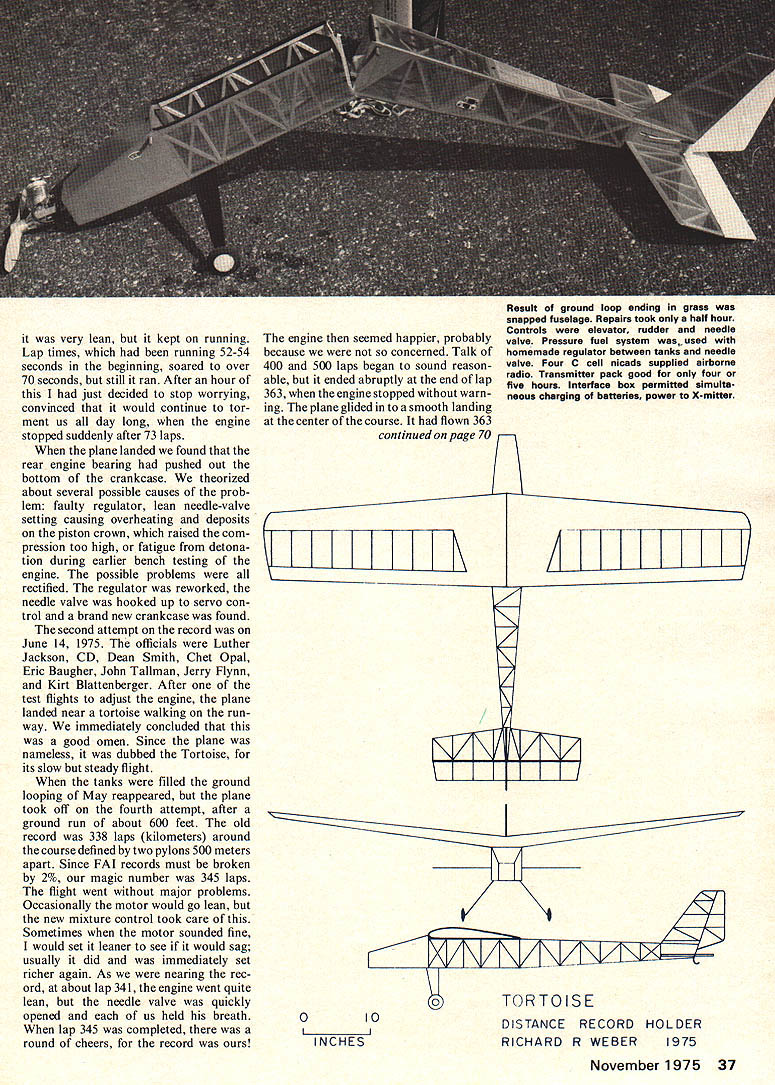
The airplane went through numerous design stages, keeping in mind the FAI limitations. These include a maximum weight of 11.02 pounds, maximum flying surface loading (wing and horizontal tail) of 24.57 ounces per square foot, and maximum engine displacement of 0.61 cu. in. Early sketches were beautifully streamlined, but by the time construction began the design had become rather simple, not unlike its record-setting predecessors. Its chief features are the tapered wing with a genuine Clark Y airfoil, and a built-up fuselage with no formers or cross braces.
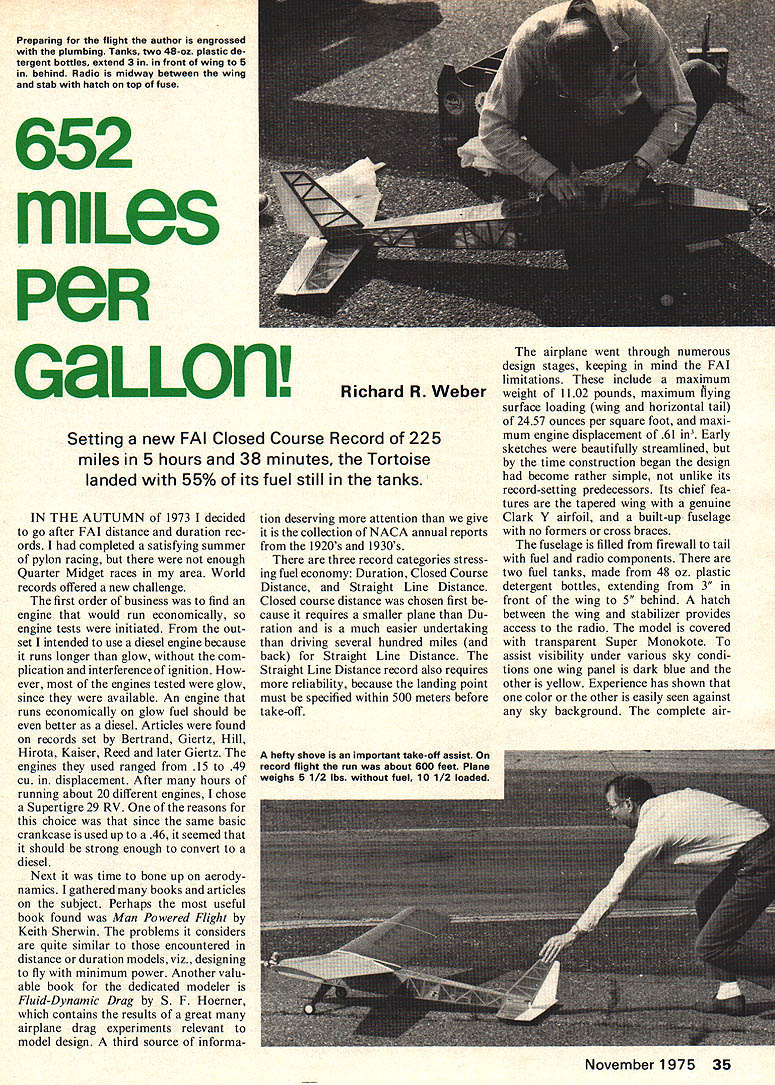
The fuselage is filled from firewall to tail with fuel and radio components. There are two fuel tanks, made from 48-oz. plastic detergent bottles, extending from 3 in. in front of the wing to 5 in. behind. A hatch between the wing and stabilizer provides access to the radio. The model is covered with transparent Super Monokote to assist visibility under various sky conditions; one wing panel is dark blue, the other yellow. Experience has shown that one color or the other is easily seen against any sky background. The complete airplane. A hefty shove at take-off is important; the record flight required a takeoff run of about 600 feet. The plane weighs 5½ pounds without fuel and nearly 10½ pounds fully fueled.
The radio control system had to be reliable, compact, and easy on the battery. A check of the current drain of several systems indicated that the Kraft 3‑channel brick would be ideal. I obtained a brick which was then converted to my transmitter frequency of 53.2 MHz. Some additional work by Doug Spreng of Kraft Systems reduced the servo current drain further. I planned to use rudder and elevator controls, but the third channel would be available for engine control if needed.
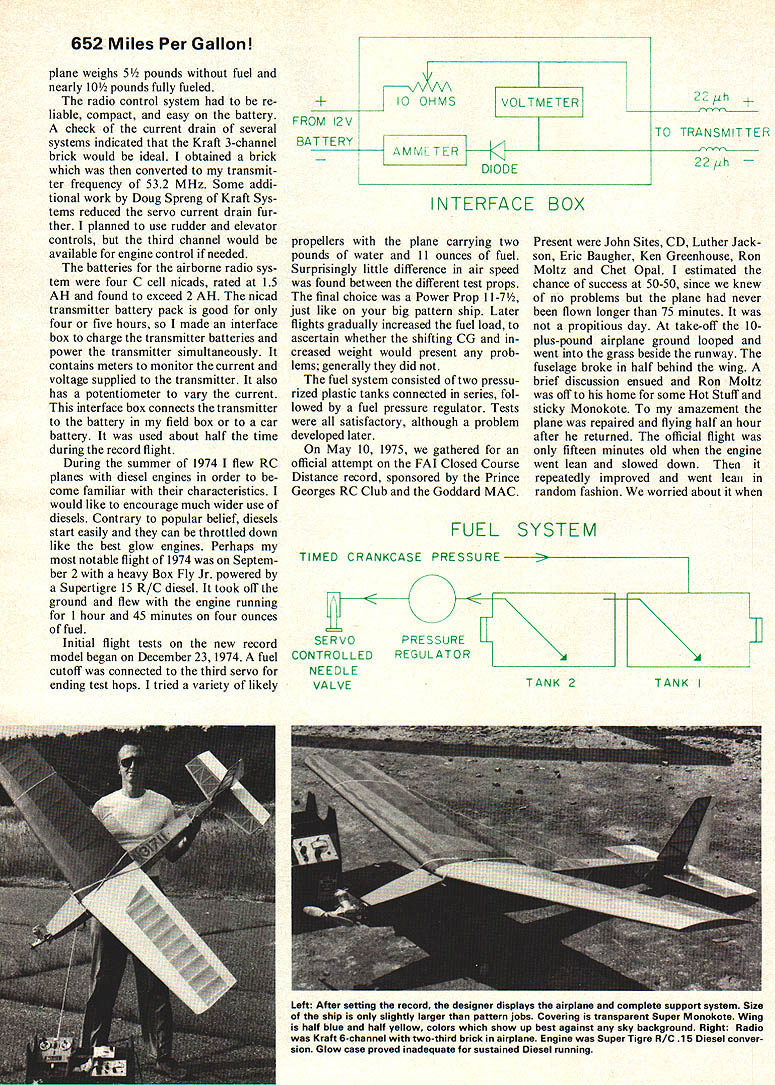
The batteries for the airborne radio system were four C‑cell nicads, rated at 1.5 AH and found to exceed 2 AH. The nicad transmitter battery pack is good for only four or five hours, so I made an interface box to charge the transmitter batteries and power the transmitter simultaneously. It contains meters to monitor the current and voltage supplied to the transmitter. It also has a potentiometer to vary the current. This interface box connects the transmitter to the battery in my field box or to a car battery. It was used about half the time during the record flight.
During the summer of 1974 I flew RC planes with diesel engines in order to become familiar with their characteristics. I would like to encourage much wider use of diesels. Contrary to popular belief, diesels start easily and they can be throttled down like the best glow engines. Perhaps my most notable flight of 1974 was on September 2 with a heavy Box Fly Jr. powered by a Supertigre 15 R/C diesel. It took off the ground and flew with the engine running for 1 hour and 45 minutes on four ounces of fuel.
I tried a variety of likely propellers with the plane carrying two pounds of water and 11 ounces of fuel. Surprisingly little difference in airspeed was found between the different test props. The final choice was a Power Prop II‑7½, just like on your big pattern ship. Later flights gradually increased the fuel load, to ascertain whether the shifting CG and increased weight would present any problems; generally they did not.
FUEL SYSTEM
The fuel system consisted of two pressurized plastic tanks connected in series, followed by a fuel pressure regulator. Tests were all satisfactory, although a problem developed later.
On May 10, 1975, we gathered for an official attempt on the FAI Closed Course Distance record, sponsored by the Prince Georges RC Club and the Goddard MAC. Present were John Sites, CD, Luther Jackson, Eric Baugher, Ken Greenhouse, Ron Moltz and Chet Opal. I estimated the chance of success at 50-50, since we knew of no problems but the plane had never been flown longer than 75 minutes. It was not a propitious day. At take-off the 10‑plus‑pound airplane ground‑looped and went into the grass beside the runway. The fuselage broke in half behind the wing. A brief discussion ensued and Ron Moltz was off to his home for some Hot Stuff and sticky Monokote. To my amazement the plane was repaired and flying half an hour after he returned. The official flight was only fifteen minutes old when the engine went in and slowed down. Then it repeatedly improved and went level in random fashion. We worried about it when it was very lean, but it kept on running. Lap times, which had been running 52–54 seconds in the beginning, soared to over 70 seconds, but still it ran. After an hour of this I had just decided to stop worrying, convinced that it would continue to torment us all day long, when the engine stopped suddenly after 73 laps.
When the plane landed we found that the rear engine bearing had pushed out the bottom of the crankcase. We theorized about several possible causes of the problem: faulty regulator, lean needle-valve setting causing overheating and deposits on the piston crown, which raised the compression too high, or fatigue from detonation during earlier bench testing of the engine. The possible problems were all rectified. The regulator was reworked, the needle valve was hooked up to servo control and a brand new crankcase was found.
The second attempt on the record was on June 14, 1975. The officials were Luther Jackson, CD, Dean Smith, Chet Opal, Eric Baugher, John Tallman, Jerry Flynn, and Kirt Blattenberger. After one of the test flights to adjust the engine, the plane landed near a tortoise walking on the runway. We immediately concluded that this was a good omen. Since the plane was nameless, it was dubbed the Tortoise, for its slow but steady flight.
When the tanks were filled the ground loop of May reappeared, but the plane took off on the fourth attempt, after a ground run of about 600 feet. The old record was 338 laps (kilometers) around the course defined by two pylons 500 meters apart. Since FAI records must be broken by 2%, our magic number was 345 laps. The flight went without major problems. Occasionally the motor would go lean, but the new mixture control took care of this. Sometimes when the motor sounded fine, I would set it leaner to see if it would sag; usually it did and was immediately set richer again. As we were nearing the record, at about lap 341, the engine went quite lean, but the needle valve was quickly opened and each of us held his breath. When lap 345 was completed, there was a round of cheers, for the record was ours!
The engine then seemed happier, probably because we were not so concerned. Talk of 400 and 500 laps began to sound reasonable, but it ended abruptly at the end of lap 363, when the engine stopped without warning. The plane glided into a smooth landing at the center of the course. It had flown 363 laps.
Transcribed from original scans by AI. Minor OCR errors may remain.

