
6th RC Soaring Nationals
Dan Pruss
A FEW YEARS ago when plans were formulated for the R/C Soaring Nationals, nearly all aspects of a large contest were considered and were planned for accordingly. All, that is, except the drama that climaxed the 1975 event.
Many descriptions of the contest—from great theatre to great sport—followed the final round of competition and if great theatre is a proper simile, then it is because the stage, Lewis University and its management, saw to it that the field was groomed for the event. Some 29 members of S.O.A.R. made up a production staff that makes a contest director's chair a chaise lounge. Add to this a cast of 184 and the curtain is up, all ready to open.
The first two acts, Monday and Tuesday, had near perfect weather. Temperatures were in the 80's—wind was southerly, same velocity. Wednesday, between scenes one and two, saw a shower come as per forecast and remain long enough to dampen everything except enthusiasm. The gods of fury were with us, for the rain was gone within two hours and scene two followed. The third round climaxed the greatest R/C soaring event ever held and the "theatre" became history.
If "great sport" is a more accurate way to describe the three days of competition, who can dispute that description? With names of past Nationals' winners—Mark Smith, Walt Good, Jeff Mrlik, and Otto Heithecker—in the same arena with past event winners like California's Rick Walters, Texas' LeMon Payne, and Ohio's Warren Plohr. Add to these the names of local area winners through the contest season, and you include John Baxter, the first LSF Level V, from Calif.; Dick Beltz, Penn.; Mike Broadbent, Canada; Denny Darnell, Okla.; California's Kirk Hanson—Don Edberg and Junior-Senior competitors Pete Rambo, Terry Malsbury and Jeff Walters. The list goes on: Clarks, Al, Chuck and Don; Finkenbiner, Gill, Goughnour, Haga, Hayes, Koplan, Pike—Kelly and Dick; Tiahrt, Thornburg, Tuthill, Wagner, and a pair of Williams (both Toms) from Calif. and Tex., and Young from the state of Wash.
Omit a name and you might exclude a new champion.
Saturday and Sunday, July 19 and 20, saw the 184 flyers out of 209 pre-registrations getting processed. This period is not unlike homecoming week for many; past acquaintances seeing one another, old friendships being renewed, new friendships being made. The processing included verification of assigned frequencies that were issued as a part of pre-registration; name tags, besides bearing the contestant's name, included flight group, state, and color group, were also issued during processing. AMA and FCC licenses were checked, banquet tickets issued, and room assignments made if campus housing was being used. The dormitory accommodations, while not necessarily AAA in rating, were low in cost and convenient. Where else can you stay overnight and walk out the front door and across the road and be at the contest site?
The pre-registration and processing procedures are imperative for contests with the magnitude of the Nationals. These two steps are both parts of the master plan so that flying can start as scheduled without those preliminaries that usually bog down the start of a contest and produce so many unpredictable variables.
6th RC Soaring Nationals
—number on a given frequency, the crowded frequencies, number of contestants per age group, and size class.
As mentioned earlier, all aspects of this contest were considered years ago. This included the 15 contestants per frequency restriction. So that one may more clearly understand the thoughts and ideas behind the system for the conducting of the flying, a little background is in order.
If flying site boundaries were of no limit and logistics presented no problems, a contest could be run with 17 winches, one for each frequency. We are also assuming that the retrieval of lines is no problem. With such conditions, one can readily see that there is no reason why 17 sailplanes couldn't be in the air at all times. And with efficient retrieval systems the most efficient to date seems to be motor-bikes or cycles. Lines can be returned within two minutes after release.
If Utopian contest facilities as mentioned did exist, one must admit this would be a slight case of extravagance on the part of contest managers and surely a case of "over-kill" with respect to the solution of the logistical problems.
Since the sailplane Utopia is still beyond the horizon and fields do have boundaries and the work force numbers are finite and the conveniences for the contestants are a consideration, S.O.A.R. has planned contests since 1973 as follows.
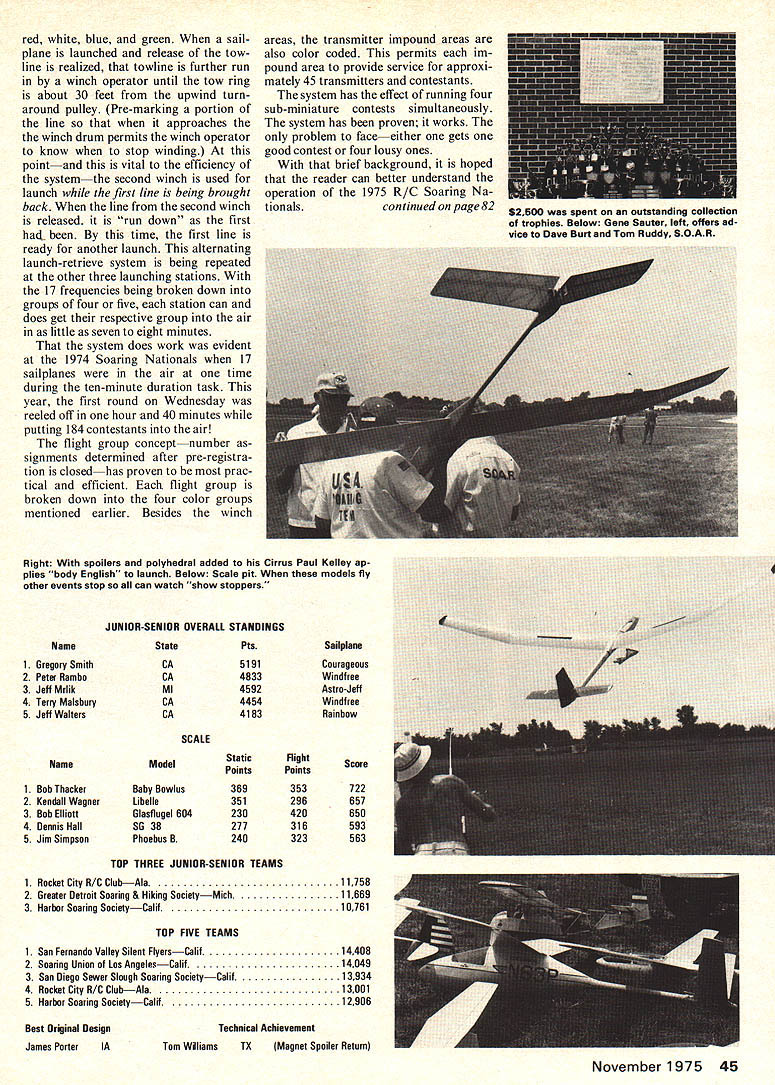
Since 17 winches surely aren't needed and an efficient means of line retrieval is available, the number of winches was determined to be eight. (This does not include three spares, along with spare batteries and other winch components.) The eight winches are arranged into four groups of two each. Both of the two are spaced about 12 feet apart, the next two, 60 feet away. The two winches are considered one winch site, and each of the four sites is identified red, white, blue, and green. When a sailplane is launched and release of the towline is realized, that towline is further run in by a winch operator until the tow ring is about 30 feet from the upwind turnaround pulley. (Pre-marking a portion of the line so that when it approaches the winch drum permits the winch operator to know when to stop winding.) At this point—and this is vital to the efficiency of the system—the second winch is used for launch while the first line is being brought back. When the line from the second winch is released, it is "run down" as the first had been. By this time, the first line is ready for another launch. This alternating launch-retrieve system is being repeated at the other three launching stations. With the 17 frequencies being broken down into groups of four or five, each station can and does get their respective group into the air in as little as seven to eight minutes.
That the system does work was evident at the 1974 Soaring Nationals when 17 sailplanes were in the air at one time during the ten-minute duration task. This year, the first round on Wednesday was reeled off in one hour and 40 minutes while putting 184 contestants into the air!
The flight group concept—number assignments determined after pre-registration is closed—has proven to be most practical and efficient. Each flight group is broken down into the four color groups mentioned earlier. Besides the winch areas, the transmitter impound areas are also color coded. This permits each impound area to provide service for approximately 45 transmitters and contestants.
The system has the effect of running four sub-miniature contests simultaneously. The system has been proven; it works. The only problem to face—either one gets one good contest or four lousy ones.
With that brief background, it is hoped that the reader can better understand the operation of the 1975 R/C Soaring Nationals.
JUNIOR-SENIOR OVERALL STANDINGS
- Gregory Smith CA 5191 Courageous
- Peter Rambo CA 4833 Windfree
- Jeff Mrlik MI 4592 Astro-Jeff
- Terry Malsbury CA 4454 Windfree
- Jeff Walters CA 4183 Rainbow
SCALE
- Bob Thacker Baby Bowlus Static Points 369 Flight Points 353 Score 722
- Kendall Wagner Libelle Static Points 351 Flight Points 296 Score 657
- Bob Elliott Glasflugel 604 Static Points 230 Flight Points 420 Score 650
- Dennis Hall SG 38 Static Points 277 Flight Points 316 Score 593
- Jim Simpson Phoebus B Static Points 240 Flight Points 323 Score 563
TOP THREE JUNIOR-SENIOR TEAMS
- Rocket City R/C Club—Ala. ....................................... 11,758
- Greater Detroit Soaring & Hiking Society—Mich. ..................... 11,669
- Harbor Soaring Society—Calif. .................................... 10,761
TOP FIVE TEAMS
- San Fernando Valley Silent Flyers—Calif. .......................... 14,408
- Soaring Union of Los Angeles—Calif. .............................. 14,049
- San Diego Sever Slough Soaring Society—Calif. ..................... 13,934
- Rocket City R/C Club—Ala. ....................................... 13,001
- Harbor Soaring Society—Calif. ................................. 12,906
Best Original Design
James Porter — IA
Technical Achievement
Tom Williams — TX (Magnet Spoiler Return)
6th RC Soaring Nationals
Monday 0750. The site is nearly ready for the first call for flight groups. As mentioned at the pilot's briefing on Sunday evening, the order of call-up would be announced Monday morning. Rick Pearson from Calif. draws number seven from a hat and that flight group is called to the ready area. In the meantime, transmitters are being impounded in their respective areas. Order for the day would be flight groups seven through 15 and one through six. Moans and sighs echo through the massive pit area—the moans no doubt from flight group six, the last to be called after about two hours. That second cup of coffee will be sipped on the field not leisurely at some motel as they would have had they realized the order of call-up earlier. Besides that, more timers will be available when all flight groups are on the field. There is a method to S.O.A.R.'s madness.
- The first plane is launched and underway—Don Ellis, from Ill., flying a modified Imperial 100—a Jetco kit designed by Don McGovern over 15 years ago(!)—has the honor of launching the 1975 R/C Soaring Nationals. The crowd roars as it displays its approval and anxiety. In a matter of minutes, seven sailplanes, their transparent wings glistening, are seen in the early morning sun.
This year's tasks, the two-minute precision and the ten-minute duration, are not unlike past contests. The landing zone, while not entirely a new system, is new to this contest. Four landing circles, each with a radius of 25 feet are located behind each launch area. Each circle has two tapes anchored in the center of the circle. Point values for landings vary from 100 points to zero. These values, in one point increments, are marked on the tape every three inches. The value of a landing is read directly from the tape as it is measured to the nose of the sailplane after it has come to rest.
The method of flying the tasks is different. Each contestant will have one minute after a launch to decide which task—the two minute precision or ten minute duration—he or she will fly. This gives the flyer the opportunity to be able to take advantage of "down air" should it prevail. However, in all cases, the end of a round, right each contestant will have flown four rounds each of the two-minute and the ten-minute tasks.
The ninth round will be at the option of the flyer so he or she can better either of the two tasks. If the contestant chose the ninth round, the task must be declared and the low round for that task struck from the score card. The flyer will then accept whatever points are scored in the ninth round. This innovation was greatly accepted and proved to be the most popular feature in the discussion that followed the contest.
- The early morning air is warming, but the contestants are choosing the two-minute tasks during the first go.
- The first ten-minute max, a respectable 09:48, is by Ken Bates of Mich. flying a Legion Air. He proves the air is alive and many follow suit to "max out." Ken is one of the few to declare himself for the ten-minute duration task the first four times he flies!
- The first round is being flown at a record setting pace. The mixture of "two-minute" and "ten-minute" flights won't permit the likelihood of 17 sailplanes in the air at one time, but ten to 13 in the air is not an uncommon sight.
- The first perfect score is turned in by Col. Bob Thacker. 02:00 and a 10-point landing for a 700 point total.
- The first round is completed and it is the consensus of nearly everyone that this year's competition is of the highest caliber ever assembled. More landings, more good landings, were made than ever before and more near-perfect flights were recovered than in previous years. The scores posted at the end of round one verified this.
As round two began, more and more flyers were recording their second near perfect flights. Now an individual's attention shifted from his own achievements to the scorecards of others.
Round two went as routinely as the first. At 1337 the third round was ready to begin.
Ten-minute breaks were taken between rounds to give everyone a chance to relax during this first day. Radios failed as did sailplanes, and back-up ships and electromechanics had to be replaced. However, the attrition rate was extremely low the first two rounds which further attested to the proficiency of the competitors.
The end of the round three came at 1637 and the prediction of ending the first day at 1630 was missed by a mere seven minutes.
As Tuesday dawned and the winches with fresh line were positioned, it was determined, again by chance, that flight group 12 would begin the competition.
This day saw the strategy of many competitors vary. Those that decided to take three two-minute flights on Monday knew that at least two flights today would have to be attempts to get ten-minute "maxes." Those few that maxed out three or four times on Monday knew they could relax a bit for the rest of the day and try to get one more ten-minute duration flight.
- By this time the air was alive and many flyers found themselves riding out super "boomers." More landings were closer on the other's scores because events as this club teams were getting increasingly aware of their own possibility for taking home the "hardware." This year over one-half of the contestants represented 34 AMA chartered clubs. Twenty-nine Open age groups and five Junior-Senior groups from 27 states made team competition the toughest ever. A ten-dollar team entry fee was imposed this year with the proceeds going towards a USA/FAI team's expenses.
- The fifth round is well underway and this weather is as favorable as predicted. Thermals abound and the sight of the sun playing out the colors of a dozen or so gossamer-like wings creates a picture seen in no other sport. The beauty of these same planes is further realized as many try to outride the same thermal long enough to see their transparent colors change to a black silhouette against a billowing cumulus. This is R/C soaring at its best!
This pattern is repeated throughout the day and broken only when one of the planes nearing a "max" is flown out of the thermal—if possible—and spiraled down towards the landing areas.
Mishaps do occur. Dave Shadel, after four "in the money" flights, has a sure ten-minute max in the making when he decides to clear the thermal that has already given him eight minutes. Flying inverted—not an uncommon maneuver for some—but dissipating altitude at an alarming rate his plane sheds a wing. The model plummets immediately—luckily onto the field where it is retrievable. However, part of the wing was shed disappears into a blue part of the sky.
- Between rounds five and six a break was called and the static judging of scale entries began. This year out of 15 pre-registered entries, seven were statically judged on Monday.
All regular flying is stopped and every chance is given the scale flyer as he prepares his ship. These "show stoppers" prove to be a high level of interest category from a spectator's viewpoint as the pit area nearly empties and lines form around the launch and landing areas.
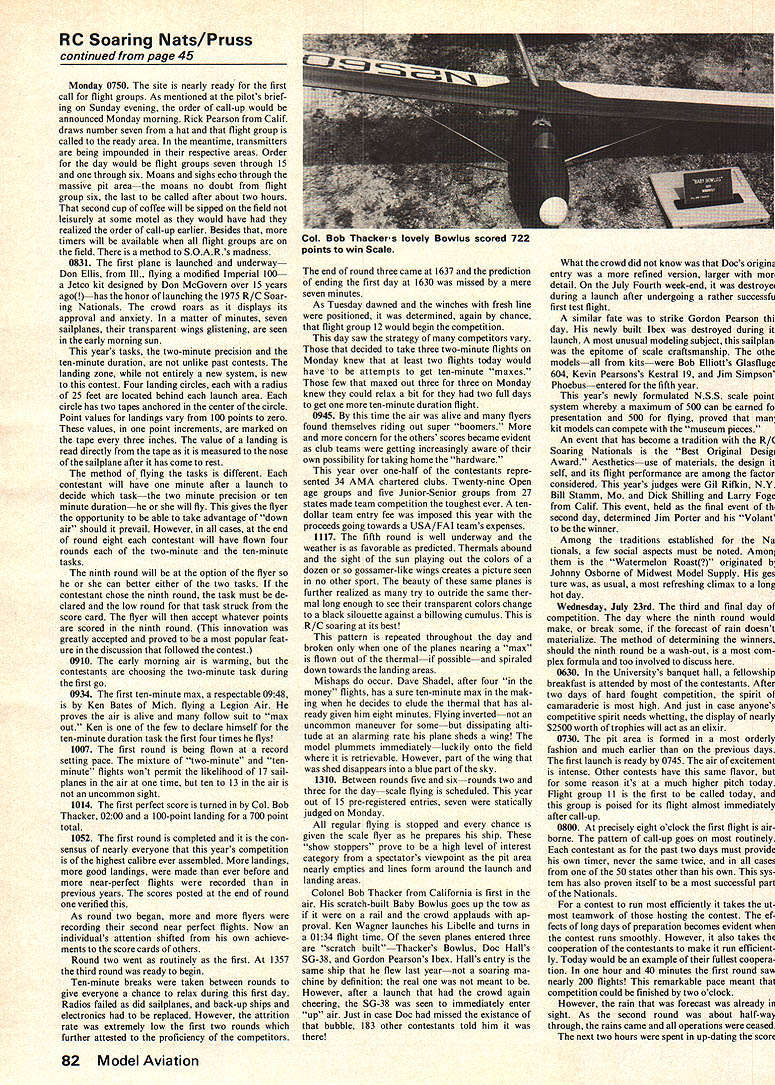
Colonel Bob Thacker from California is first in the air. His scratch-built Baby Bowlus goes up the tow as if it were on a rail and the crowd applauds with approval. Ken Wagner launches his Libelle and turns in a 01:34 flight time. Of the seven planes entered three were scratch-built: Thacker's Bowlus, Doc Hall's SG-38, and Gordon Pearson's Ibex. Hall's entry is the same ship that he flew last year—not a soaring machine by definition; the real one was not meant to be flown.
What the crowd did not know was that Doc's original entry was a more refined version, larger with more detail. On the July Fourth weekend, it was destroyed during a launch after undergoing a rather successful first test flight.
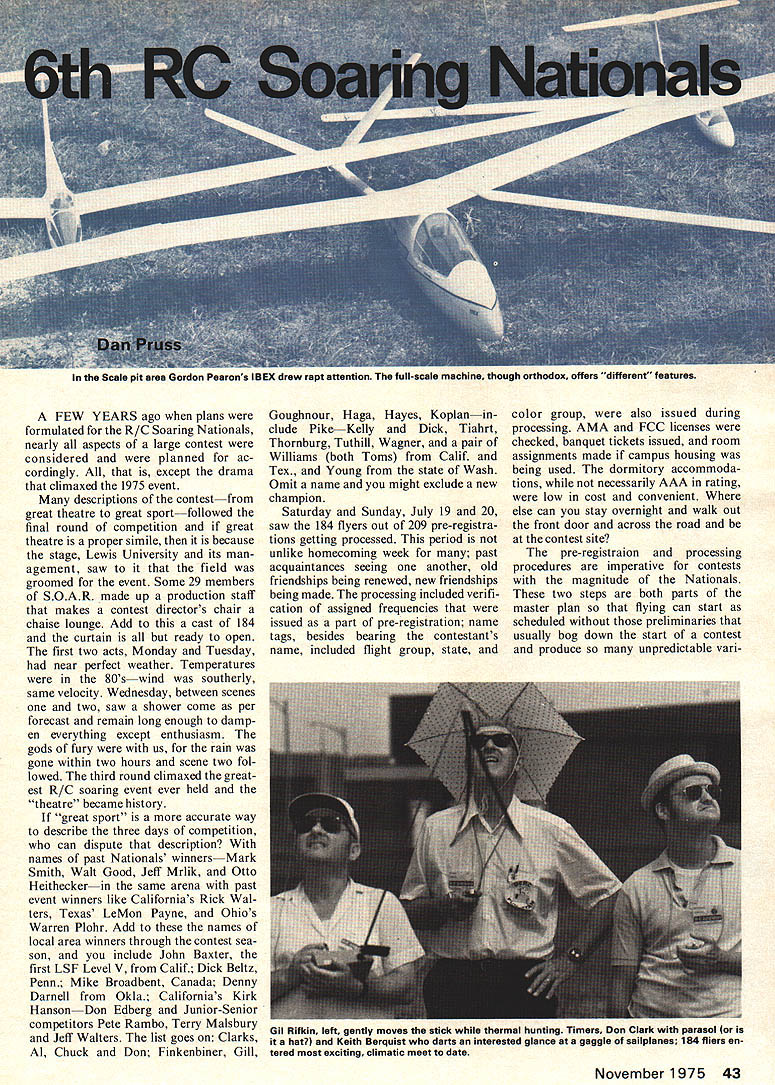
A similar fate was to strike Gordon Pearson that day. His newly built Ibex was destroyed during its launch. A most unusual model though a soaring ship, this sailplane was the epitome of scale craftsmanship. The other models—all from kits—were Bob Elliott's Glasflugel 604, Kevin Pearson's Kestrel 19, and Jim Simpson's Phoebus.
This year's newly formulated N.S.S. scale point system, whereby a maximum of 500 can be earned for presentation and 300 for flying, proved to be instrumental in keeping contests competitive with the "museum pieces" scoring high. An event that has become an established part of the R/C Soaring Nationals is the "Best Original Design Award." Aesthetics, use of materials, the design and its flight performance are among the factors considered. This year's judges were Gil Rifkin, N.Y.; Bill Stamm, Mo.; and Dick Shilling of Calif. This award, presented at the final activities of the second day, went to Jim Porter and his "Volunteer."
Among the traditions established for the Nationals, a few social aspects must be noted. Among them is the "Watermelon Roast" organized by Johnny Osborne of Midwest Model Supply. His area had, as usual, a most refreshing climax to a long hot day.
Wednesday, July 23rd. The third and final day of competition; the day where the ninth round would make, or break some, if the forecast of rain didn't materialize. The weather did its usual unpredictable thing but the contest staff stayed on schedule as best possible. The next two hours were spent in up-dating the score sheets and final tallies were made.
At precisely eight o'clock the first flight is airborne. The pattern of call-up goes on most routinely. Each contestant takes his turn on the tow and waits his time, never the same twice, and in all cases from one of the 50 states other than his own. This system has also proven itself to be a most successful part of the Nationals.
For a contest to run most efficiently it takes the utmost teamwork of those hosting the contest. The feelings of long days of preparation become evident when the contest runs smoothly. However, it also takes the cooperation of the contestants to make it run efficiently. Today would be an example of their full cooperation.
In one hour and 40 minutes the first round was completed and the second round was underway in another hour. Between flights pilots swapped stories and compared notes. The final round was staged for the afternoon and scores were checked as they came in.
The awards banquet was well attended. After two days and a third of intense competition, the meet was summarized and the winners announced. The Nationals had run smoothly and the spirit of camaraderie among contestants was apparent up to the finish.
(End of article) board, shop talk and lunch. At about one p.m. the sky showed some promise of allowing the eighth round to be completed. It was, and at the same pace as the early morning round. By now the sun was again shining and an assuring promise that round nine could be completed seemed to be in the air.
The second round of scale was flown, and during this time contestants were contemplating how best to use that ninth round. Many phases of strategy could be heard. "If Smith blows his ninth and I can better my 454 then maybe I ...." "Let's see, it's a better tow by a two-minute score, mathematically speaking, because if I don't make then I lose."
One final announcement on the "P.A." is heard before the final round begins: "The first eight rounds are posted! Contestants will have one final chance to study the score board and to plan your strategy. As flight groups are called, each of you will either pass the ninth round and stand pat on your score or declare the task you will fly."
As contestants and timers filed past the call-up area, cards were either filed for final tabulating or an "X" was crossed over the lowest round—the task selected by the contestant.
In all cases, as a flight was completed, the results were not given to other contestants—lest one who had not flown suddenly realize someone had "blown" his round and his own score is suddenly better.
However, gamblers abounded! Monday morning quarterbacks later would have a field day. Examples: Warren Plohr with a 5058 score threw away 450 points and ended up with 298 and 906 for a final score, thereby giving away a chance on at least fifth place. Keith Finkenbiner had a sure fourth and threw away a 401-point flight and entered the biggest sink that he had seen since he left N.J. His "ten-minute max" ended up 028 and 148 points. Others profited. Rick Pearson, Calif., gave away 193 points and bettered the throw-away round with a 557. A few others and how they fared: Chuck Anderson, Tenn., threw away 133 and picked up 557; Don Harris, Ohio, gambled away 252 and got back 675! Biggest gambler was Steve Work, New Mex., who threw away 613 points to come back short with 595.
It should be noted that scoring per round was as follows: The ten-minute duration task was based on a point per second up to ten minutes or 600 points. This plus a perfect landing (100 points) method a total of 700 points for the flyer.
The two-minute precision was scored on a curve that gave a contestant 100 points for a perfect two-minute flight. More than 30 seconds either side of two minutes results in a zero score. The landing was based on a ten-meter distance task. All scores in the two-minute task (a perfect one being 200 points) were then multiplied by a normalizing factor of 3.5; this result in all rounds having a potential value of 700.
The highest score attainable for the contest was 5,600 points.
This method of scoring had a definite advantage. Rather than wait, as in previous contests, until a task was completed and around 100 points being the standard, flight times were immediately known. Past contest reports indicate that this led to fewer changes in rankings after the final tabulation.
As round nine was nearing the end, one could, as during past rounds, watch a string of sailplane designs fill the air. If statistics indicate one design to be more popular than the next, this was not necessarily evident during any one ten-minute portion of a day. To see a dozen different brands mixing it up with models of original design all riding in the same thermal proves, to some degree, that this competition is that of man with his machine.
At 1540 on Wednesday, July 23 the curtain lowered on the Sixth R/C Soaring Nationals after what was the most hard-fought three days of sailplane contest ever seen. The 1,800-plus flights established a high mark by any contest. Line retrievers logged nearly 700 miles in performing their tasks and over 12 miles of tow line were used.
The blood and the sweat on the part of the winch operators was not measured.
The Awards Presentation
If any of modeling's social events are to be recognized, surely the R/C soaring banquet is on that list. It seems the third year John Nielson, who also serves as LSF secretary, had some 310 guests and prizes were awarded, mixed with moments of both reverence and irreverence. Guests included University representation, AMA's Executive Director, John Worth and District VI P.R., Glenn Lee.
For a few, the limelight shined more than once on the banquet night; most often for Mark Smith who swept the Standard Class by taking first places in the Two-Minute precision and Ten-Minute Duration tasks and First Place overall. Frank Deis, from Huntsville, Ala., took the Open Unlimited honors by placing 12th in precision and first in duration. Deis flew a Legion Air with rudder, elevator, spoilers, release tow hook, and thermallift flaps.
Smith's Winfree, rudder-elevator-only, missed Deis' score by only three points! (Those proponents of a rudder-elevator-only standard class—as a beginners class—now have further opportunity to speculate the future for such a category.)
Scale honors were taken by Col. Bob Thacker with a score of 722 points out of a possible 1000.
Best original design was won by Jim Porter and "Texas" Tom Williams won Best Technical Achievement honors.
Team honors for Open age category went to the San Fernando Valley Silent Flyers. Team members were Terry Koplani, Rick Pearson, and Bill Nibley. The Junior-Senior team trophy went to Gregory Smith, Richard Kuciejko, and James Fitch of the Rocket City Radio Controllers, Huntsville, Ala. This is the second time in two years this club has won this award.
For the second year, the University of Michigan presented the Felix Pawlowski Memorial Trophy. This award honors the memory of the aeronautical engineer from this same University. The winner, Pete Rambo from Calif., earned the award by having the highest combined score on a written examination and flight sheet.
The coveted Willow-Bee award was presented to Sid Arledge by last year's recipient Rod Smith. Traditionally, something must be added to this dubious award and the West Coast will be glad to know that Colonel Thacker's 1956 vintage tin now adorns the wand.
The awarding of door prizes, some 75 in all, closed out the festivities. If any contest can be labeled successful then part of that success can be attributed to the generosity of sponsors and donors. To list them all would be like an index in an R/C buyer's guide. To them, on behalf of all associated with the Sixth R/C Soaring Nationals, a sincere thank you.
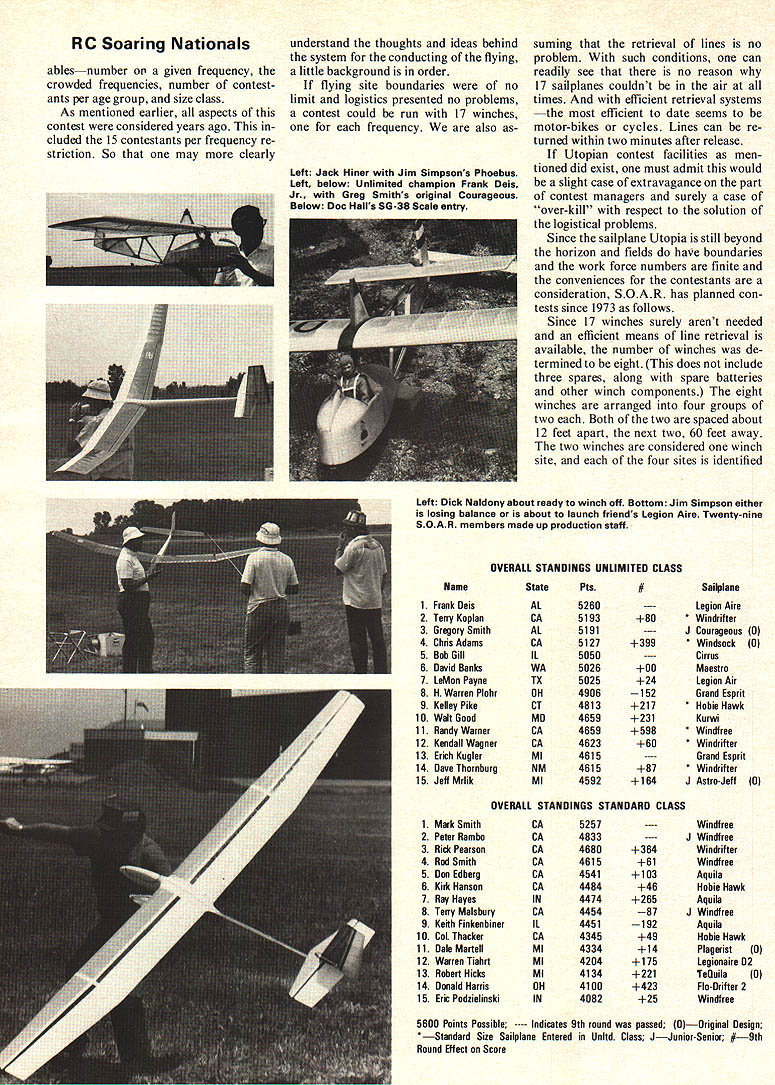
The top 15 in each class are presented together with the results on how round nine affected the scoring.
Some Facts and Figures
Twenty-seven states and Canada were represented. Mich. had 36 entries; Calif. had 32. Of the 184 contestants, 85% were LSF members. Six contestants were women. Of the planes entered, 346 were original designs or built from kits; 213 of the flyers used electric winches. Thirteen "Standard" size ships were entered; seven of these finished among the top eighteen — all were rudder-elevator function only. Approximately 85% of all landings were "in the circle"; 22 different "kitted" models were flown.
Transcribed from original scans by AI. Minor OCR errors may remain.

