
7-12 Model Aviation Youth Academy
Author: Leo Greenwald
What a difference a couple of years can make! The January 1993 Model Aviation carried an account of the first Top Gun competition between rival Orange County, California, high schools. The students had completed an aeronautics course called the Saturday Enrichment Academy, a program conceived and implemented by Charles Kelley and his friend Prentiss Ellis.
During the 1993–94 school year, the aeronautics program has undergone important changes and expansion. Now officially dubbed the 7-12 Model Aviation Youth Academy, this course takes secondary school students through the basics of aircraft design, combining academic theory with practical application.
Program structure
Students attend lectures on Saturday mornings where they learn a mixture of physics, math, and aerodynamics. The goal is for each school's group of engineers to design a model that incorporates aerodynamic formulas and mathematical calculations. Each year's aircraft design requirements have been altered somewhat to allow for an element of creativity by the students.
Growth and competition format
Two changes have occurred in the aeronautics program since its inception in 1992. First, the number of Orange County high schools has grown from two to five. In addition, four high schools and one middle school in Los Angeles County school districts participated this year, bringing the total number of schools to ten.
The second change — a result of the huge increase in participating schools — was having two Top Gun competitions, one week apart. The annual competition officially marks the end of each year's class, and successful completion garners participants up to five credits toward graduation.
Design focus and themes
The students' goal in 1992 and 1993 was to design a basic trainer, and this year the Los Angeles County schools continued the original concept by designing advanced trainers. The winner of their competition on June 3 was Long Beach Jordan High School. Their blue-and-white MonoKoted model airplane featured flaps and twin vertical stabilizers.
Trainers had become old hat in the Orange County schools, so to encourage creativity students were asked to design models with the greatest high and low speeds as measured by a police department's radar gun on the day of competition. Surprising as it may seem, this premise left the door open for loads of exciting ideas.
Top Gun — Orange County competition (June 10)
On the morning of Friday, June 10, students from Orange County schools gathered on Savanna High School's athletic field for the big showdown. Student engineers from Savanna, Magnolia, Cypress, and Artesia High Schools proudly displayed their models on a table flanked by the U.S. and California flags.
The quality and diversity of the designs the students created was nothing short of spectacular. It was evident they had really "done their homework."
Sadly, Western High School's aircraft, which was based on a flying-wing concept, did not survive the test flight. In a sense, though, these students may have realized the ultimate "learning experience."
As is traditional, Top Gun opened with glider and electric flight demonstrations provided by members of the Soaring Union of Los Angeles (SULA). Following the formalities, the real competition began.
Judging and oral exam
Students from each school briefly introduced their design to school officials and the panel of judges, explaining reasons for selecting a particular airfoil, tail design, etc. The common denominator for all the aircraft was a Magnum Pro .46 engine and the same APC propeller.
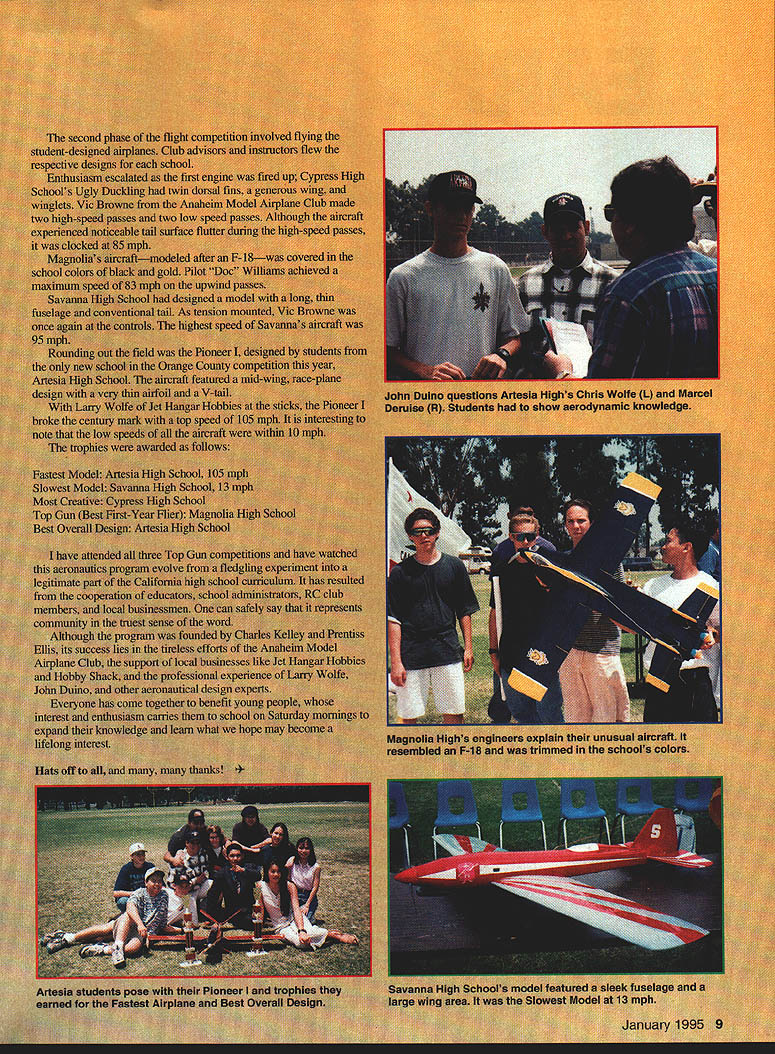
The oral exam consisted of four questions pertaining to the principles of flight. The fifth question required students to compute the stall speed of a 65,000-pound aircraft with a given wing loading. Students discussed their answers as a team, then orally gave the results to the three judges — John Duino of Rockwell International, Mark Page of McDonnell-Douglas, and Blaine Rowden of McDonnell-Douglas. Not only were these gentlemen engineers, but they were modelers themselves.
After assessing the students' knowledge of the academic portion of the course, judges were treated to two flight competitions. While all students were essentially required to become design engineers, they were also afforded the opportunity to become flight engineers — RC pilots.
Most schools had as many as four or five student pilots who received training during the year, but only one or two from each school became proficient enough to compete for the Top Gun student pilot award. Two students who came into the program as proficient RC pilots were disqualified from competing in this phase.
Student pilots performed a simple routine consisting of a takeoff, a loop, a roll, and a landing while hooked up to a buddy box with an adult volunteer instructor. As in a contest, the flight judges scored each maneuver on a scale from 1–10.
Students were also judged on the design and workmanship of their models, the creativity of the design, and the overall presentation.
Flight demonstrations and results
The second phase of the flight competition involved flying the student-designed airplanes. Club advisors and instructors flew the respective designs for each school.
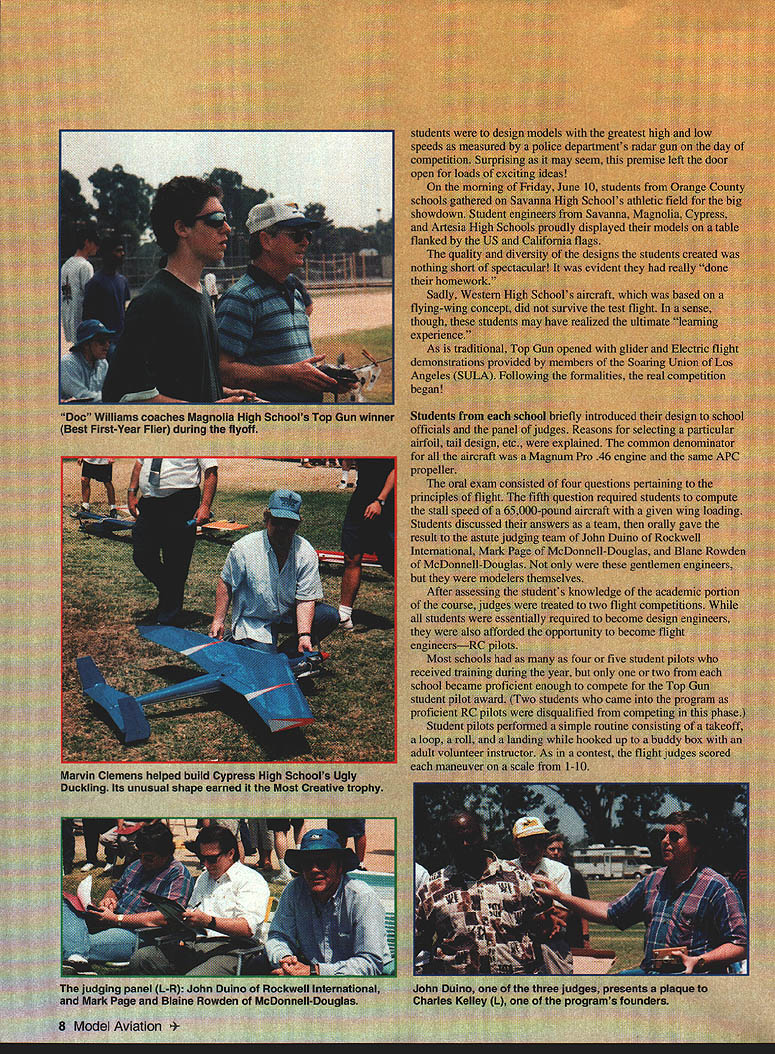
Enthusiasm escalated as the first engine was fired up. Cypress High School's Ugly Duckling had twin dorsal fins, a generous wing, and winglets. Vic Browne from the Anaheim Model Airplane Club made two high-speed passes and two low-speed passes. Although the aircraft experienced noticeable tail-surface flutter during the high-speed passes, it was clocked at 85 mph.
Magnolia's aircraft — modeled after an F-18 — was covered in the school colors of black and gold. Pilot "Doc" Williams achieved a maximum speed of 83 mph on the upwind passes.
Savanna High School had designed a model with a long, thin fuselage and conventional tail. As tension mounted, Vic Browne was once again at the controls. The highest speed of Savanna's aircraft was 95 mph.
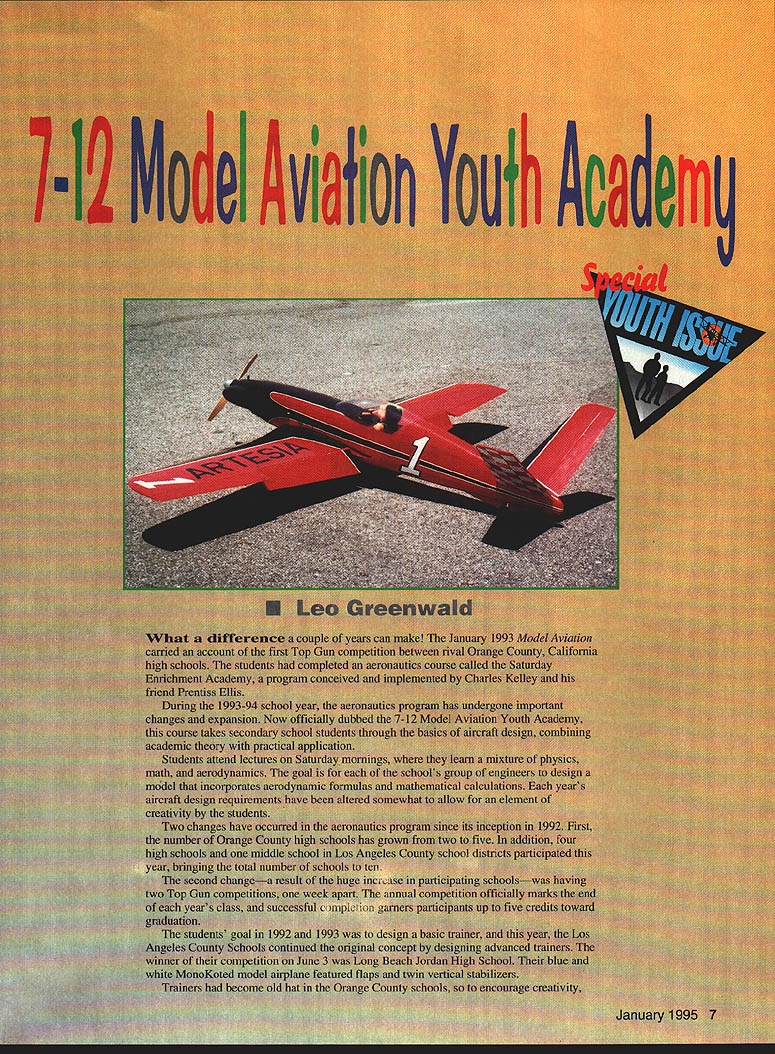
Rounding out the field was the Pioneer I, designed by students from the only new school in the Orange County competition this year, Artesia High School. The aircraft featured a mid-wing, race-plane design with a very thin airfoil and a V-tail.
With Larry Wolfe of Jet Hangar Hobbies at the sticks, the Pioneer I broke the century mark with a top speed of 105 mph. It is interesting to note that the low speeds of all the aircraft were within 10 mph.
Awards
- Fastest Model: Artesia High School — 105 mph
- Slowest Model: Savanna High School — 13 mph
- Most Creative: Cypress High School
- Top Gun (Best First-Year Flier): Magnolia High School
- Best Overall Design: Artesia High School
Conclusion and acknowledgments
I have attended all three Top Gun competitions and have watched this aeronautics program evolve from a fledgling experiment into a legitimate part of the California high school curriculum. It has resulted from the cooperation of educators, school administrators, RC club members, and local businessmen. One can safely say that it represents community in the truest sense of the word.
Although the program was founded by Charles Kelley and Prentiss Ellis, its success lies in the tireless efforts of the Anaheim Model Airplane Club, the support of local businesses like Jet Hangar Hobbies and Hobby Shack, and the professional experience of Larry Wolfe, John Duino, and other aeronautical design experts.
Everyone has come together to benefit young people, whose interest and enthusiasm carries them to school on Saturday mornings to expand their knowledge and learn what we hope may become a lifelong interest.
Hats off to all, and many, many thanks!
Transcribed from original scans by AI. Minor OCR errors may remain.

