
75th Anniversary of Air Racing
By Don Berliner
It all began in 1909, and in those 75 years a multitude of planes were raced that have become beloved subjects for modeling. Especially in the early days, racing provided the impetus for designing and building more-efficient airplanes. Part 1 covers the beginning to World War II.
Key milestones (brief)
- 1909 — Reims: birth of air racing, Gordon Bennett team trials, Glenn Curtiss wins.
- 1913 — Inaugural Schneider Trophy at Monaco; French dominance in prewar speed flying.
- 1920s — Rise of the Pulitzer Trophy and American military racers; streamlining and high horsepower produce rapidly increasing speeds.
- Late 1920s–1931 — Schneider Trophy pushes seaplane speeds past 300–400 mph; Britain ultimately retains the trophy.
- 1929–1939 — National Air Races, Thompson, Bendix, and Greve competitions define the Golden Age of air racing.
Reims, 1909 — the birth of air racing
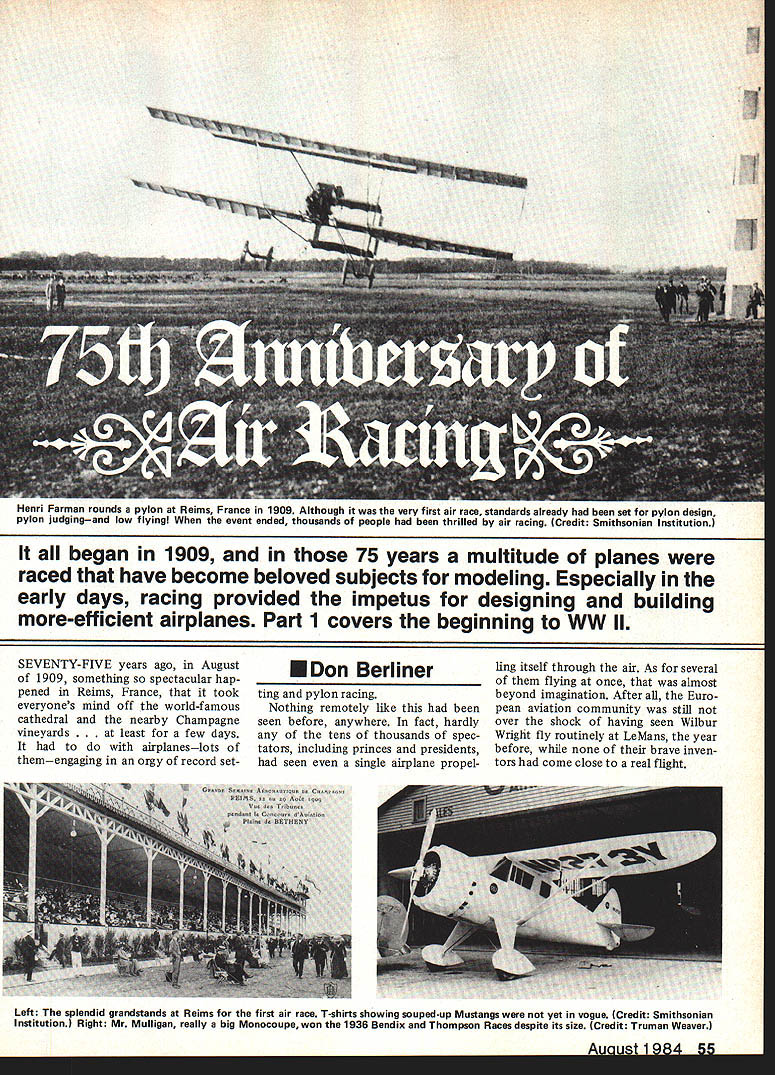
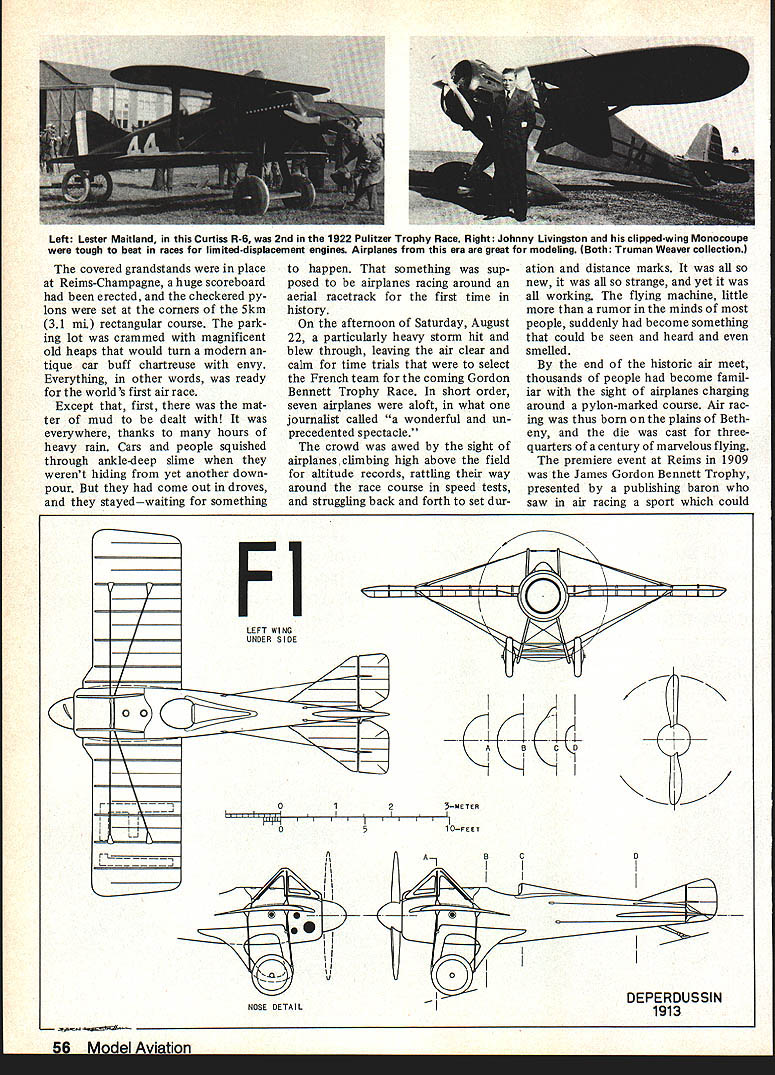
Seventy-five years ago, in August 1909, Reims, France, staged an event that captured the public imagination. Thousands—including princes and presidents—flocked to see airplanes performing in numbers and in competition for the first time. Mud and downpours failed to dampen enthusiasm; when the weather cleared, time trials and pylon racing on a 5 km rectangular course produced altitude and speed records and left spectators awed. Air racing had been born.
The winner of the first big race was American pioneer Glenn Curtiss. Flying his Reims Racer, he completed two laps in 15 minutes, 50.6 seconds, averaging 47.1 mph. Louis Blériot was next at 46.8 mph. The Gordon Bennett quickly became one of air racing’s classic trophies.
Pre–World War I: international competition
By 1912 the races were inspiring purpose-built racing airplanes and attracting international attention. In 1913 French Deperdussin monoplanes—bullet-nosed machines with 160-hp Gnome rotary engines—dominated: Maurice Prévost won that year and set a world speed record of 127 mph. The French led prewar speed flying and won the first Schneider Trophy at Monaco in 1913; the final prewar Schneider was taken by Briton Howard Pixton flying a Sopwith.
Post–World War I: revival and rapid gains
When World War I ended, wartime technical advances fueled a sudden jump in speed. The first postwar Gordon Bennett was won by Sadi Lecointe in a Nieuport-Delage 29V at better than 168 mph. After three consecutive French victories, the Gordon Bennett Trophy became France’s permanent prize.
The Schneider Races continued, though 1919 was spoiled by fog and the 1920 and 1921 events had only single finishers: Luigi Bologna in a Savoia S.12 at about 106 mph (1920), and Giovanni de Briganti in a Macchi M.7 at about 118 mph (1921).
The Pulitzer Trophy and America’s rise (1920s)
The Pulitzer Trophy, begun in 1920, stimulated American designers and builders. Highlights:
- 1920 (Mitchell Field): Army Capt. Corliss Moseley won in a Verville-Packard at 157 mph.
- 1921: Bert Acosta won in a Navy Curtiss CR-1 at better than 176 mph, signaling American adoption of streamlining and large-displacement engines.
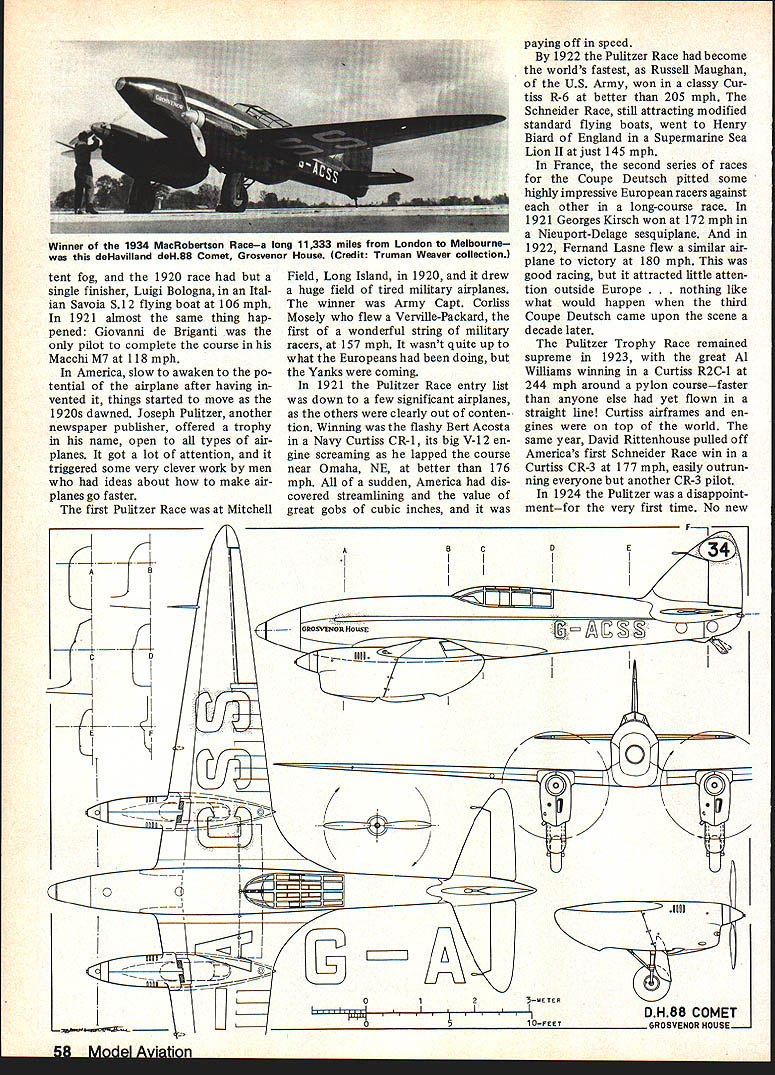
- 1922: Russell Maughan took the Pulitzer in a Curtiss R-6 at better than 205 mph.
- 1923: Al Williams won the Pulitzer in a Curtiss R2C-1 at 244 mph; the same year David Rittenhouse won America’s first Schneider in a Curtiss CR-3 at 177 mph.
- 1924: The Pulitzer suffered low-quality entries; a diving-start accident cost Burt Skeel his R-6 and Cyrus Bettis won in a Verville-Sperry R-3 at 216 mph.
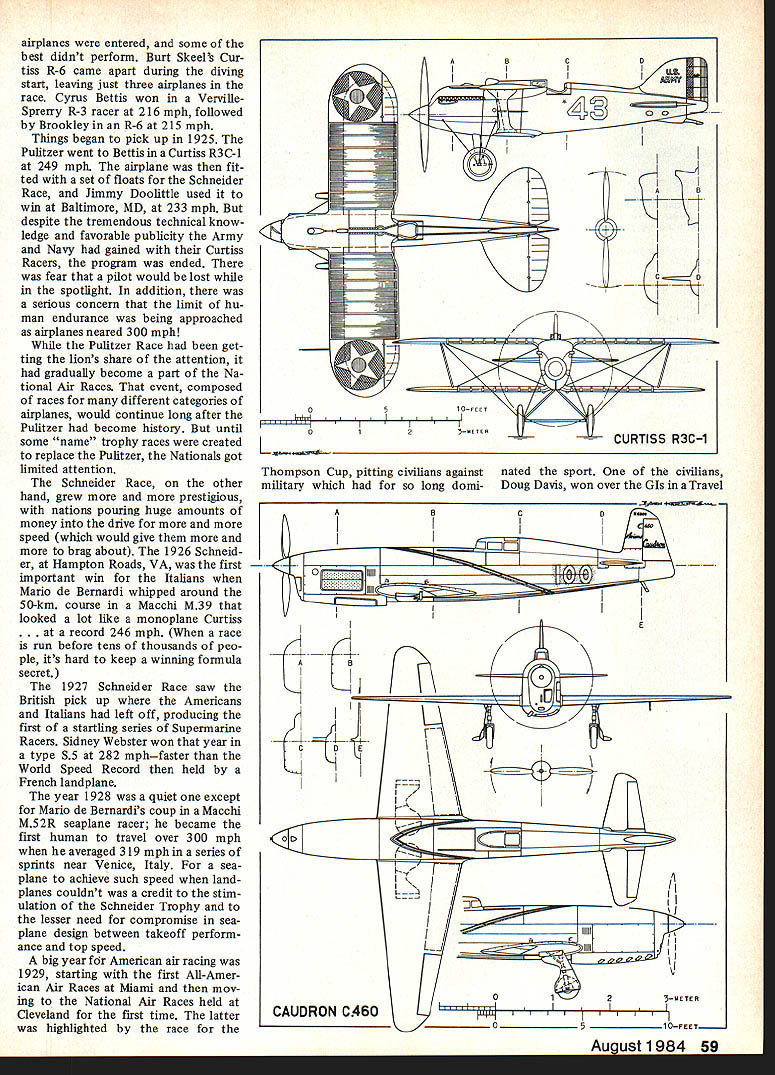
- 1925: Bettis won the Pulitzer in a Curtiss R3C-1 at 249 mph. Fitted with floats, the airplane (piloted by Jimmy Doolittle) won the Schneider at Baltimore at 233 mph. Concern over pilot safety and human endurance as speeds approached 300 mph led to termination of some military racing programs.
While the Pulitzer was subsumed into the National Air Races (a multi-event meet that continued for decades), the Pulitzer era had already pushed airframe and engine development forward.
Schneider Trophy and international rivalry
The Schneider Trophy became a national prestige contest that pushed seaplane design and speed to new heights:
- 1926 (Hampton Roads): Mario de Bernardi (Macchi M.39) — 246 mph.
- 1927: Sidney Webster (Supermarine S.5) — about 282 mph.
- 1928: Mario de Bernardi (Macchi M.52R) — first human to exceed 300 mph in seaplane sprints, averaging 319 mph.
- 1929: Henry Waghorn (Supermarine S.6A) — 329 mph.
- 1931: John Boothman (Supermarine S.6B) won the final Schneider race in British hands at 340 mph; soon after, George Stainforth broke the 400-mph barrier, averaging 407 mph over a 3 km course.
With the Schneider Trophy permanently retained by Great Britain in 1931, international focus shifted increasingly to other races, while the technological gains influenced military and civil aircraft design.
National Air Races, Thompson, Bendix and the Golden Age (late 1920s–1939)
The late 1920s and 1930s produced what is widely called the Golden Age of air racing, centered on the National Air Races, and featuring the Thompson Trophy (pylon racing), Bendix Transcontinental Derby (Los Angeles to Cleveland), Greve (engine-limited pylon race), and many other events.
Notable highlights:
- 1929: First All-American Air Races (Miami) and Cleveland Nationals. Doug Davis (Travel Air Mystery) won the Thompson over military entries, signaling the rise of civilian homebuilts. Supermarine continued to dominate Schneider events.
- 1930: Chicago Nationals — 'Speed' Holman won the Thompson in the Laird Solution at 202 mph.
- 1931: Bendix winner Jimmy Doolittle (Laird Super Solution) averaged 223 mph coast-to-coast; Lowell Bayles won the Thompson in a Gee Bee at 236 mph.
- 1932: Jimmy Haizlip won the Bendix at 245 mph in a Wedell-Williams; Doolittle won the Thompson in the Gee Bee Super Sportster at 253 mph (a record that stood four years).
- 1933–1935: European Coupe Deutsch races, Caudron and Potez entries, and continued U.S. developments. Jimmy Wedell, Roscoe Turner, and others set records and won major trophies; Wedell set a landplane record near 305 mph at one event.
- 1934: Cleveland featured strong Wedell-Williams performances. The MacRobertson London–Melbourne air race (11,333 miles) was won by the de Havilland Comet (Campbell-Black and Scott), averaging 159 mph.
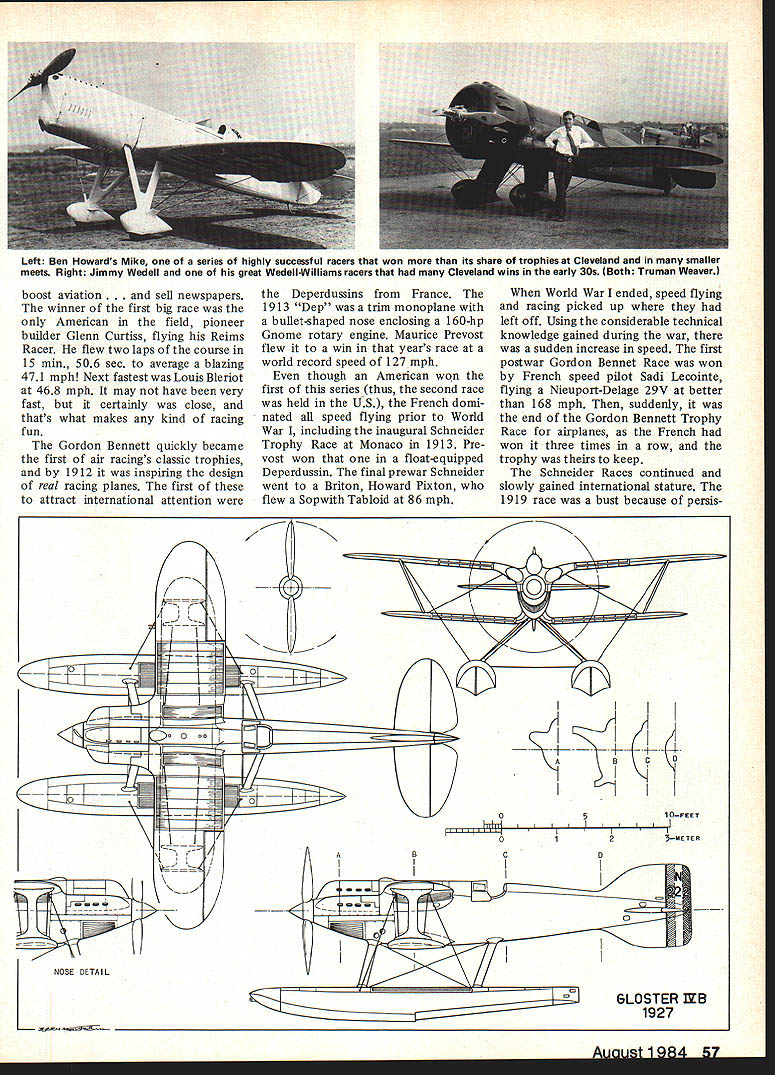
- 1935: Ben Howard’s designs dominated many events; his Mr. Mulligan won the Bendix at 239 mph. Harold Neumann and others won Thompson and Greve races in notable performances.
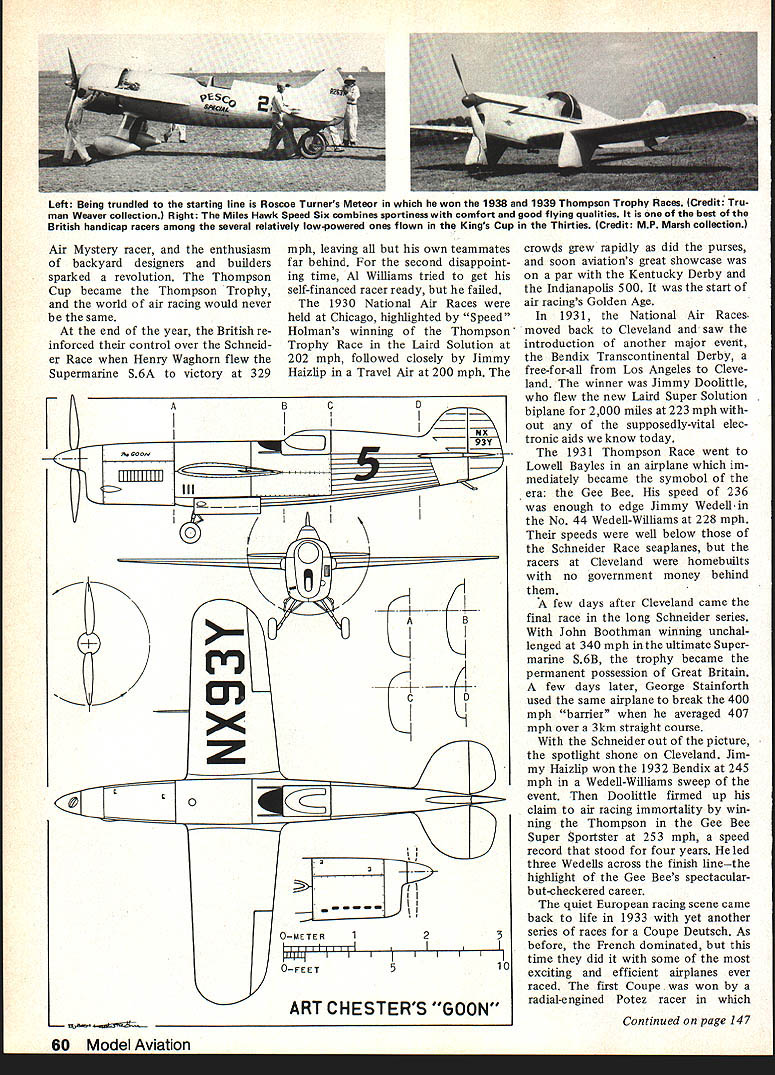
- 1936: Nationals at Los Angeles featured surprising wins by European Caudrons in U.S. races (Michael Detroyat won the Greve at 247 mph and the Thompson at 264 mph), demonstrating the Caudrons’ competitiveness even against larger American powerplants.
- 1937–1939: Continued high-speed competition. Frank Fuller won the Bendix in 1937 in a Seversky prototype at about 283 mph. The final prewar Nationals (Cleveland, Labor Day 1939) featured Frank Fuller’s second Bendix victory (282 mph), a Greve win by Art Chester at a record 263 mph, and Roscoe Turner’s Thompson victory at about 282 mph; LeVier, Ortman, and others posted spectacular speeds. Steve Wittman was penalized one lap for cutting a pylon despite true speeds closer to 250 mph.
The end of an era and the approach of World War II
By 1939 the Golden Age of air racing had reached an apex and was then cut short. The flow of new, competitive private designs was diminishing because the cost of developing machines capable of matching the most powerful entries became prohibitive. The sport might have faded had World War II not intervened—bringing a different kind of aviation acceleration and drawing the air-racing community into the war effort.
(End of Part 1: the beginning through World War II.)
Transcribed from original scans by AI. Minor OCR errors may remain.

