
75th Anniversary of Air Racing
Don Berliner — Part 2
When World War II ended in 1945, the great urge was to return to a normal way of life immediately, especially for the millions of GIs back home after years of living from minute to minute. Among the returnees were thousands of very skilled pilots—for whom the terrors of war had been tempered by the thrill of flying some of the finest airplanes in the world. Not all of them were ready to settle down to ordinary lives after so much excitement.
Fortunately for them, there was a great surplus of the airplanes they had grown to love: P-38 Lightnings, P-51 Mustangs, F4U Corsairs. With jets replacing them in the military, they could be bought for as little as $1,000. Many had been flown only a few hours and were worth more than that as scrap metal.
A lot of pilots bought them when they learned that the Cleveland National Air Races would be resumed on Labor Day weekend of 1946. Suddenly, the desperate shortage of competitive racers that had threatened to kill the sport in the late 1930s was erased by the availability of an unlimited supply of airplanes, all much faster and stronger than any previously seen on a race course.
Cleveland and the postwar scene (1946)
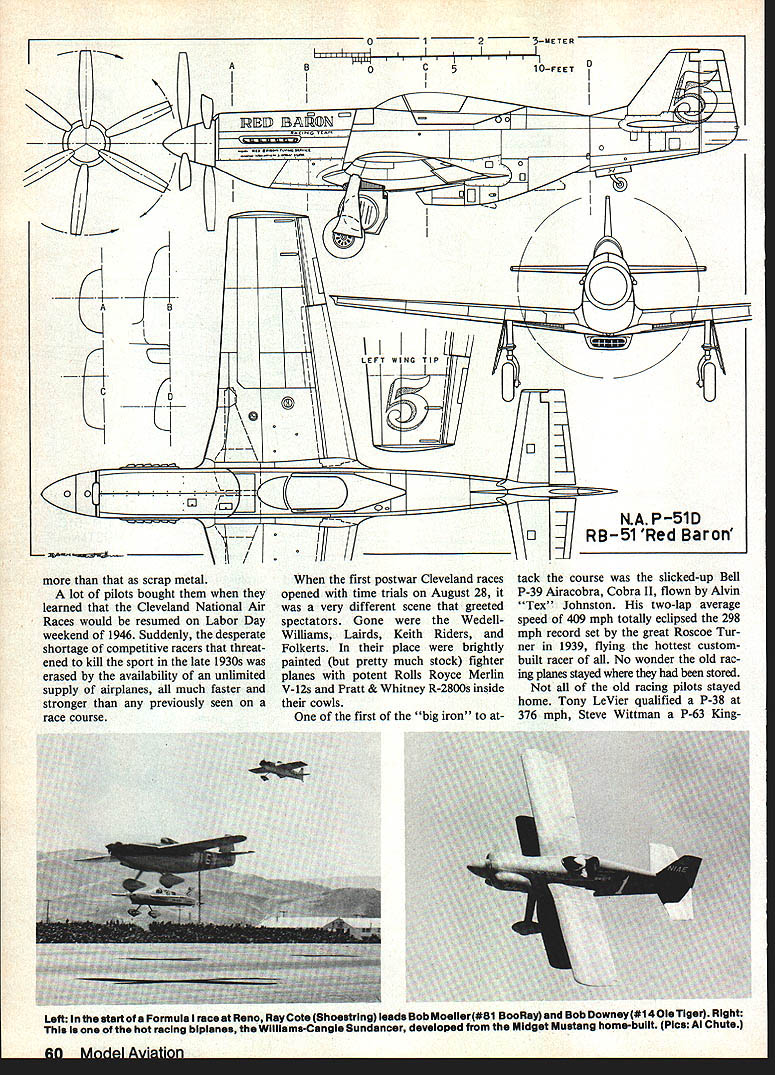
When the first postwar Cleveland races opened with time trials on August 28, it was a very different scene that greeted spectators. Gone were the Wedell-Williams, Lairds, Keith Riders, and Folkerts. In their place were brightly painted (but pretty much stock) fighter planes with potent Rolls-Royce Merlin V-12s and Pratt & Whitney R-2800s inside their cowls.
One of the first of the "big iron" to attack the course was the slicked-up Bell P-39 Airacobra Cobra II, flown by Alvin "Tex" Johnston. His two-lap average speed of 409 mph totally eclipsed the 298 mph record set by the great Roscoe Turner in 1939, flying the hottest custom-built racer of all. No wonder the old racing planes stayed where they had been stored.
Not all of the old racing pilots stayed away. Tony LeVier qualified a P-38 at 376 mph, Steve Wittman a P-63 Kingcobra at 358 mph, and Earl Ortman a Mustang at 344 mph. It wouldn't be completely strange to Cleveland racing fans, even if most of what they knew was gone.
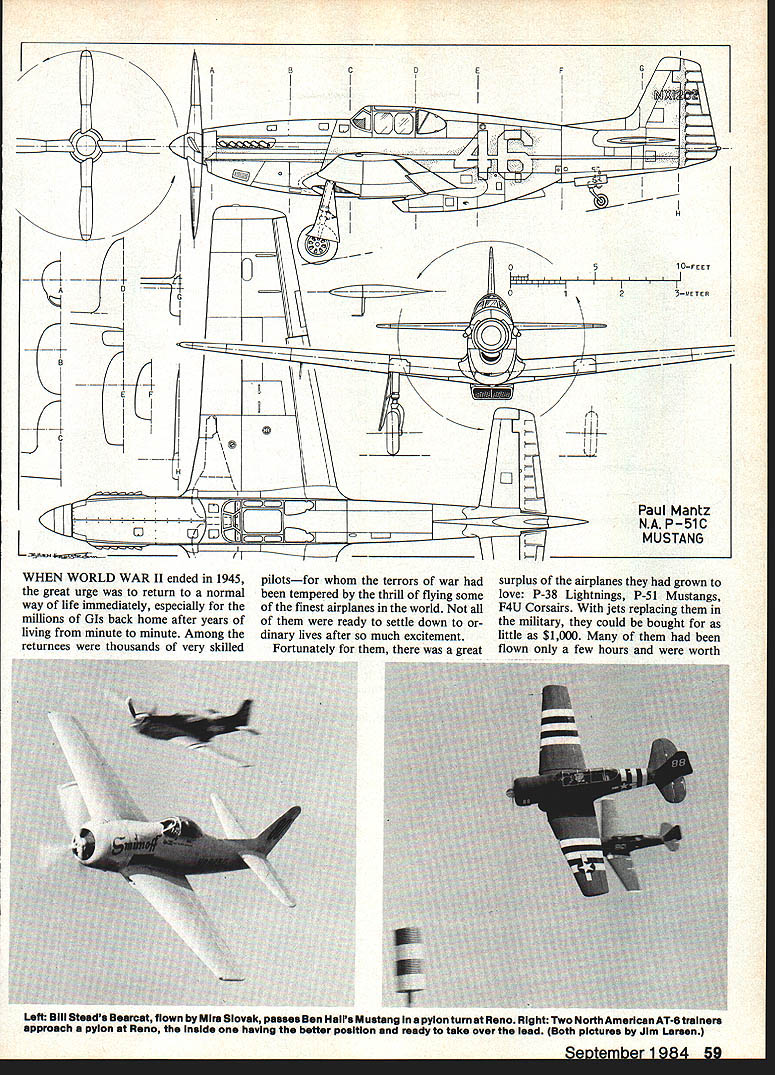
First event on the program was, traditionally, the Bendix Race starting at Los Angeles. It attracted the largest field ever: 15 P-38s, four P-51s, a Corsair, a P-63, and an A-26 Invader. The most experienced Bendix racers—Jackie Cochran and Paul Mantz—chose superbly cleaned-up, early-model P-51s, and it paid off. Mantz won the 2,046-mile haul at 436 mph to break Frank Fuller's old record of 282 mph by over 50%. Cochran was second at 421 mph, and the other two Mustangs followed. The remaining airplanes were simply outclassed in that type of race.
Other events were new to Cleveland. The Halle Trophy was for modified AT-6 trainers flown only by women (the old restrictions still applied); Marge Hurlburt won at 201 mph. The Sohio Trophy, for what are now called Unlimiteds, went to Dale Fulton in a P-51 at 353 mph; the race was for those not fast enough to qualify for the Thompson Trophy Race.
In the Weatherhead Speed Dash, a completely new sound was heard on the West Side of Ohio's largest city: the swish of jet-propelled airplanes. Limited to Army Air Force Lockheed P-80s, it was won by Lt. William Reilly at 578 mph, a speed never before dreamed of at Cleveland. On Labor Day, September 2, jets again took to the sky, this time flying around the pylon course. Maj. Gus Lundquist won the Jet Division of the Thompson at 516 mph, popping a lot of rivets as he barely stayed ahead of Maj. Robin Olds, second at 515 mph.
The Thompson and fans’ reaction
Then it was time for American air racing's greatest tradition: the Thompson Trophy Race. A dozen airplanes lined up side-by-side on the grass. They took the starter's flag, charged past the stands with a wonderful roar, pulled up their landing gears, and hauled tight around the scatter pylon. Top qualifier Johnston had the speed to stay out in front, tearing around smoothly for lap after lap. In second place was the big surprise: Thompson veteran Tony LeVier in the big and supposedly outclassed P-38. A few thousand hours of testing them had given him the knowledge to get the most out of the sweet-sounding Lightning.
Johnston cruised home the winner at a record 374 mph, with LeVier at 370 mph, and Earl Ortman at 368 mph. Even the last-place pilot broke Roscoe Turner’s old record by a solid 20 mph. The past, glorious as it may have been, was left so far behind that this seemed almost like a new sport. Oh, sure, the speed was there and so was the marvelous sound of engines exceeding their rational limits. But something was missing. As the fans began to file out of the bleachers, even before the Thompson had ended, it became apparent that they missed the individuality, the creativity, and the innovation that had been so much a part of the old National Air Races.
Not long after the last hot-dog wrappers had been swept up, a group of men sat down together to look into the future and see what could be done to rekindle the spark. The idea they came up with was one that had been under consideration in 1939 before the war stopped the races cold: small, inexpensive, carefully regulated and (they hoped) highly competitive "midget" racers. The old plans were reviewed and brought up to date, and a sponsor was found who was willing to invest in the future of air racing.
The Goodyear 190 cu. in. class (the midgets / Formula One)
The result was the Goodyear Trophy Race for the novel 190 cu. in. class. It was something genuinely different for pylon racing: a class with severe restrictions on not only engine size but also on airframe design. The rules required, among other things:
- No more than 190 cu. in. of stock airplane engine.
- No less than 66 sq. ft. of wing.
- No less than 500 lb. empty weight.
- Fixed-pitch propellers and fixed landing gear.
- Excellent visibility.
- Flight tests for pilots and airplanes.
Old-timers predicted a dismal failure, claiming air racers would turn their backs on such restrictions. But the word spread rapidly around the country, and in no time there were midget racers under construction in garages, barns, and workshops.
Cleveland 1947–1949: midgets established
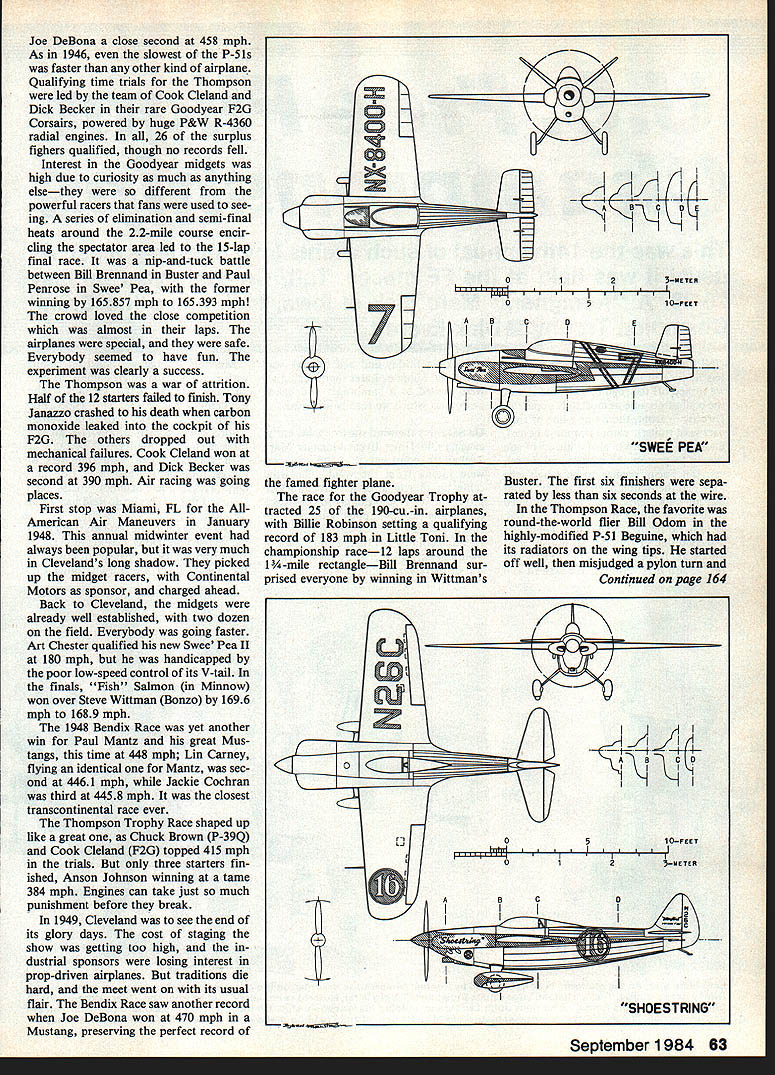
When the 1947 Cleveland Races rolled around, there were lots of Thompson/Bendix-class racers, some really modified AT-6s, and no fewer than 13 of the new midgets. A lot of them were the handiwork of experienced people, like Art Chester’s V-tailed Swee’ Pea, Steve Wittman’s Buster, and the neat twin Cosmic Wind Little Toni and Minnow built by a group at Lockheed headed by Tony LeVier. Others were completely new, and a few of them showed it.
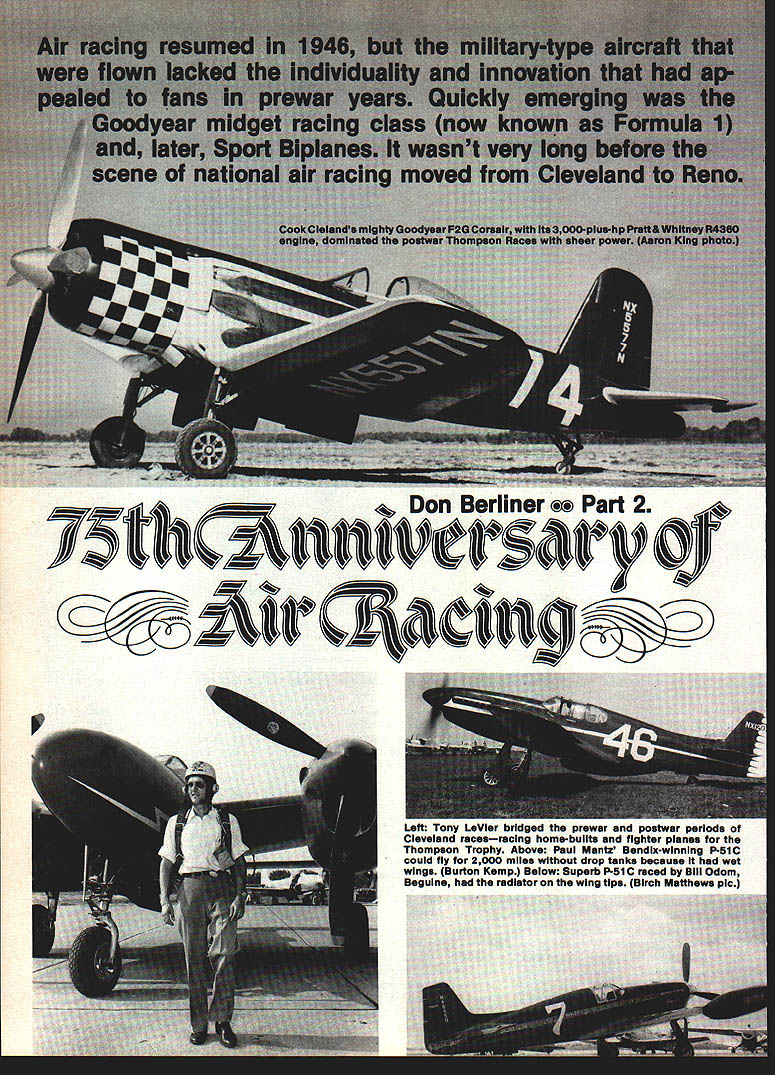
The races got off to a start with the Bendix, won again by Paul Mantz in his slick Mustang at a record 460 mph, with Joe DeBona a close second at 458 mph. As in 1946, even the slowest of the P-51s was faster than any other kind of airplane. Qualifying time trials for the Thompson were led by the team of Cook Cleland and Dick Becker in their rare Goodyear F2G Corsairs, powered by huge P&W R-4360 radial engines. In all, 26 of the surplus fighters qualified, though no records fell.
Interest in the Goodyear midgets was high due to curiosity as much as anything else—they were so different from the powerful racers that fans were used to seeing. A series of elimination and semi-final heats around the 2.2-mile course encircling the spectator area led to the 15-lap final race. It was a nip-and-tuck battle between Bill Brennand in Buster and Paul Penrose in Swee’ Pea, with the former winning by 165.857 mph to 165.393 mph! The crowd loved the close competition which was almost in their laps. The airplanes were special, and they were safe. Everybody seemed to have fun. The experiment was clearly a success.
The Thompson was a war of attrition. Half of the 12 starters failed to finish. Tony Janazzo crashed to his death when carbon monoxide leaked into the cockpit of his F2G. The others dropped out with mechanical failures. Cook Cleland won at a record 396 mph, and Dick Becker was second at 390 mph. Air racing was going places.
First stop was Miami, FL, for the All-American Air Maneuvers in January 1948. This annual midwinter event had always been popular, but it was very much in Cleveland's long shadow. They picked up the midget racers, with Continental Motors as sponsor, and charged ahead.
Back to Cleveland, the midgets were already well established, with two dozen on the field. Everybody was going faster. Art Chester qualified his new Swee’ Pea II at 180 mph, but he was handicapped by the poor low-speed control of its V-tail. In the finals, "Fish" Salmon (in Minnow) won over Steve Wittman (Bonzo) by 169.6 mph to 168.9 mph.
The 1948 Bendix Race was yet another win for Paul Mantz and his great Mustangs, this time at 448 mph; Lin Carney, flying an identical one for Mantz, was second at 446.1 mph, while Jackie Cochran was third at 445.8 mph. It was the closest transcontinental race ever.
The Thompson Trophy Race shaped up like a great one, as Chuck Brown (P-39Q) and Cook Cleland (F2G) topped 415 mph in the trials. But only three starters finished, Anson Johnson winning at a tame 384 mph. Engines can take just so much punishment before they break.
In 1949, Cleveland was to see the end of its glory days. The cost of staging the show was getting too high, and the industrial sponsors were losing interest in prop-driven airplanes. But traditions die hard, and the meet went on with its usual flair. The Bendix Race saw another record when Joe DeBona won at 470 mph in a Mustang, preserving the perfect record of the famed fighter plane.
The race for the Goodyear Trophy attracted 25 of the 190-cu. in. airplanes, with Billie Robinson setting a qualifying record of 183 mph in Little Toni. In the championship race—12 laps around the 3/4-mile rectangle—Bill Brennand surprised everyone by winning in Wittman's Buster. The first six finishers were separated by less than six seconds at the wire.
In the Thompson Race, the favorite was round-the-world flier Bill Odom in the highly modified P-51 Beguine, which had its radiators on the wingtips. He started off well, then misjudged a pylon turn and crashed into a house, killing the two occupants of the house as well as himself. Cook Cleland went on to win at a record 397 mph, and Ron Puckett, flying an F2G, was second at 394 mph.
The tragedy left everyone limp. It was obvious that it could have been prevented by relocating the prewar course out of populated land. But plans went ahead for the 1950 Cleveland Air Races—until the fighting began in Korea in June 1950, and the military pulled out its support. There was no way to hold racing at the usual site, as the bomber plant behind the stands had been put into use building tanks. The races were canceled, but not because of Odom's crash.
The 1950s: midgets continue; wider decline
Racing, at least for the midgets, continued under the sponsorship of Continental Motors. There were major races at Miami and Detroit and smaller, locally sponsored events elsewhere: Reading, PA; Chattanooga, TN; San Jose, CA; and Westchester, NY. The sport was in better shape than a lot of people thought it would be without Cleveland, but things weren't exactly great.
As the 1950s moved along, the scene shifted to such places as Dansville, NY; Oshkosh, WI; and Ft. Wayne, IN. The action was still hot, and the speeds kept getting higher. Names like Bill Falck and his Rivets, Tom Cassutt and his Cassutt Specials, and Jimmy Miller and his Little Gem became the symbols of the era. But they weren't known outside the inner circle of racing, and gradually the sport began to slip into obscurity. A midair collision at Ft. Wayne in 1960 ended this mini-era.
Reno revival (1964) and the new national meet
Then, in the most unlikely of places, a most unlikely person started things up again. Bill Stead, a world champion boat racer, decided to recreate the National Air Races in the desert near Reno, NV. Using a rare combination of racing experience and business know-how, he landed a contract with ABC-TV's Wide World of Sports and then convinced a bunch of hard-nosed gamblers that this was the way to draw some national attention from rival Las Vegas.
The atmosphere at the Sky Ranch in 1964 was about as much like Cleveland as the moon. It was a western desert plateau 5,000 ft. above sea level, surrounded by mountains, within spitting distance of a swinging gambling town. It had lots of wind and sand, but not a single hangar or runway. Still, it had what counted: racing planes, pilots, and fans—and enough checkered pylons, flags, and bunting to give the place the look and feel of an air race.
The Unlimiteds were in the spotlight as much as they had been at Cleveland. A bunch of young hotshot owners of Mustangs and Grumman Bearcats were out to show the world they could pick up where Doolittle and Turner and Cleland had left off, even though not one of them had ever raced around the pylons. The midgets were looked upon as something to fill empty slots in the program, as were the first official U.S. National Championships for aerobatics and ballooning. The new Sport Biplane and Ladies Stock Plane classes were responses to pleas from their owners.
When the nine-day operation had been completed and all the people had washed the sand out of their hair and eyes, they had to agree that it was a rousing success. OK, so it wasn't on a par with Cleveland, and it certainly didn't draw the crowd and press coverage that Cleveland had in its heyday. But it was the National Air Races after an absence of 15 years, and wasn't that enough?
The Harrah's Club Race from Jacksonville, FL, was hardly the Bendix, but it was transcontinental, and it was won by Wayne Adams at 341 mph in a Mustang. The best of the cute and competitive Sport Biplanes was Clyde Parsons' Knight Twister at 145 mph. The Stock Plane Race went to Irene Levertov in a Piper Cherokee at 144 mph. The Unlimited finals was a fine race between Bob Love in Chuck Lyford's P-51D and Mira Slovak in Bill Stead's Bearcat, with Love winning at 367 mph to Mira's 356 mph. Darryl Greenamyer was third in a modified Bearcat at 352 mph, but was disqualified for refusing to land on the short dirt strip after the race.
The midget race was small by Cleveland standards, but had participation by many veterans of earlier days: Steve Wittman, Bob Downey, and Bob Porter. Porter, flying Deerfly, won at a solid 193 mph, pressed for the first few laps by Wittman, then 60 years old and showing no signs of slowing. Jerry Quarton flew the first of the plans-built Cassutt Racers into fifth place.
Expansion, consolidation, and internationalization
Once Reno was recognized as a success, the country seemed to open up to air racing. In 1965 there were major races at Tampa, FL; Lancaster, CA; Boulder City, NV; and Palm Springs, CA—as well as Reno. Most of them included most of the newly active classes, but generally lacked the good planning and site preparation that made Reno such a standout. New airplanes and pilots were popping up everywhere, and it looked like the game was on the verge of another "Golden Age."
It takes more than enthusiasm to turn a trial run into a fixture on the schedule, and most of the promising events soon faded. Except for Reno, which was a civic promotion like Cleveland had been, the new races were get-rich-quick schemes that couldn't cope with first-year losses. The City of Reno, on the other hand, was fully behind its new attention-getter and happy to step up if more cash was needed.
As the sport faded in the West, it picked up in the East—first at Frederick, MD and then Cleveland, of all places! It may not have been on the old grand scale, but it was racing, even if it was at Lakefront Airport rather than busy Cleveland-Hopkins. It was Cleveland, and a lot of the old feeling was there, as if it had been in storage for all those years. There wasn't room over Lake Erie for a safe Unlimited race, but the newly named Formula Ones made a lot of people remember the old days. Stock Planes were raced by the likes of Judy Wagner and Elaine Loening, Sport Biplanes by Bruce McIntyre and Sid White. And in Formula One, Bill Falck continued his string of thrilling last-lap victories over Bob Downey.
At Reno and other West Coast races, the Unlimited class saw better and better modified Mustangs, Bearcats, and Hawker Sea Furys, with Darryl Greenamyer very much in charge with the #1 Bearcat he used to break the 30-year-old piston-engine world speed record by flying 482 mph in 1968. Modifications to his and other racers included clipped wings and tails, filled and slicked skins, tiny canopies, greatly boosted engines, turning huge propellers and sometimes the elimination of such "accessories" as electrical systems.
In 1969, the long-standing ban on women racing with men around the pylons came to an end when racer/aerobat Betty Skelton threatened legal action. A few women entered what had been men's classes (Judy Wagner and Bernie Stevenson in Formula One, Connie Marsh in Sport Biplanes), but most of them vanished from the sport when their Stock Plane class was opened to men.
Another historic change occurred in 1970 when the American grip on "real" racing was broken. A true Formula One race was held on the Isle of Man, off the southwest coast of Scotland, and the sport of class racing quickly caught on in Europe. Under the guidance of the Formula Air Racing Association in Great Britain, an annual series of F/1 races has been held ever since, with a steadily decreasing difference in speeds compared with American F/1s.
Accidents and their impact (1971–1972)
Postwar racing through the 1960s had been far safer than its prewar version, thanks to better airplanes and better pilots. An occasional serious accident had done little to affect the sport... until the Cape May, NJ races of 1971. In less than five minutes, there were two midair collisions in the AT-6 class, resulting in four deaths. Since no innocent bystanders had been endangered, the FAA wisely let the races continue. However, the emotional impact of the tragedy would be felt for years.
This pair of accidents was followed the next year by one in full view of more than 100,000 people at the giant Transpo 72 air show at Dulles Airport, near Washington, DC. The prototype American version of the Paris Air Show was marred by the near collision between two F/1 racers. While one of the pilots escaped with some serious injuries, the death of the other helped doom the promising show.
Reno’s dominance and the 1970s–80s outlook
As other races continued to appear and vanish with great rapidity, Reno moved steadily along. Speeds topped 425 mph in Unlimited, 230 mph in Formula One, 200 mph in the AT-6/SNJ Class, and 180 mph in the Sport Biplane class. Thanks to excellent operation, the safety record remained the best, with the first eight years completely free of serious accidents. While the size of the crowd was limited by Reno's location and housing capacity, the enthusiasm of a growing band of dedicated fans matched that of Cleveland's old days.
The Great Miami Air Race of 1973 showed tremendous promise, but shaky management kept it in the amateur class; a second installment never quite happened. Had it developed in that popular fashion and entertainment center, Reno could likely have been eclipsed sooner. As it turned out, Reno maintained its near-monopoly on big-time air racing.
By 1974 the American racing scene was mostly Reno and a few small races in the Midwest and on the West Coast which usually didn't last long enough to develop a following. In England, on the other hand, Formula One continued to grow on the wings of American-designed Cassutt Racers and purely English Betas. In 1976 the first International Formula One Grand Prix Air Race was held at Castellet, France. Heavy with British and French racers, it was nevertheless won by legendary State Senator Bill Sullivan in his scarlet tapering Cassutt, Anaconda. Not since the last of the Schneider Trophy Races had there been a truly international racing event of the sort.
After several years without any sort of racing, Cleveland returned to the fold in 1977, though with little prize money or attention from the management. FAA insistence on an air-start for the non-radio F/1s (mistakenly assumed to be safer than the usual racehorse start) may have played a role in the still-unexplained crash of veteran Bill Falck in his classic Rivet. Falck's loss led to the retirement of more than one top pilot. Throughout the postwar era, while most other aviation sports were enjoying boom times, air racing continued to struggle. It lacked the needed strong national organization. The U.S. Air Racing Association (USARA, the new name for the Professional Race Pilots Association formed in 1934) was the scene of class warfare, as pilots and owners fought for bigger shares of the available prize money.
In 1975, with USARA apparently dying, a group of activists formed the affiliated Eastern Region to stimulate races in the East for home-built racers. The result could be seen in races for F/1, Sport Biplanes, and finally the long-delayed Formula Vee at places like Sturgis, KY; Cincinnati, OH; and Flora, IL. Hardly anyone noticed.
The story was still Reno. Prize money topped $100,000 and then $200,000, with the bulk of it going to the crowd-pleasing (but not always competitive) Unlimiteds. The screaming Mustangs and Bearcats had become the stars of air racing, thanks to TV coverage of Reno and to their status as the world's fastest motor racers. Blown engines and forced landings were commonplace, yet not a single Unlimited pilot was lost in the first 19 years of very hairy racing at Reno.
As the 1980s rolled around, the Unlimiteds were knocking on 450 mph, and the appearance of the first true custom-built Unlimiteds since 1939 was just a matter of time. Those who had poured big bucks into jazzing up their Mustangs wouldn't like the way the first of the new breed replaces them in the hearts of the fans, but it's bound to happen. When it does, the class will get a big boost in the direction of creativity.
Formula One will no doubt continue to be the most successful class in the history of air racing, having survived with few changes for more than 35 years. Its popularity in Europe could lead to an International Grand Prix series and may even be an official FAI World Championship.
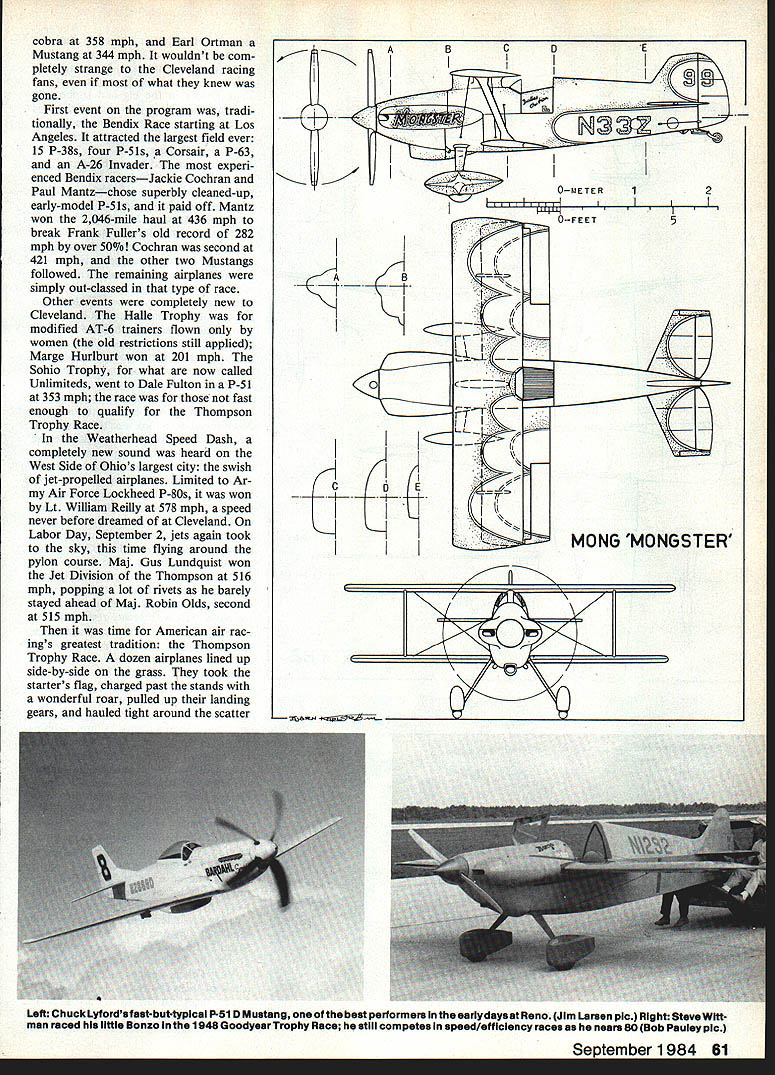
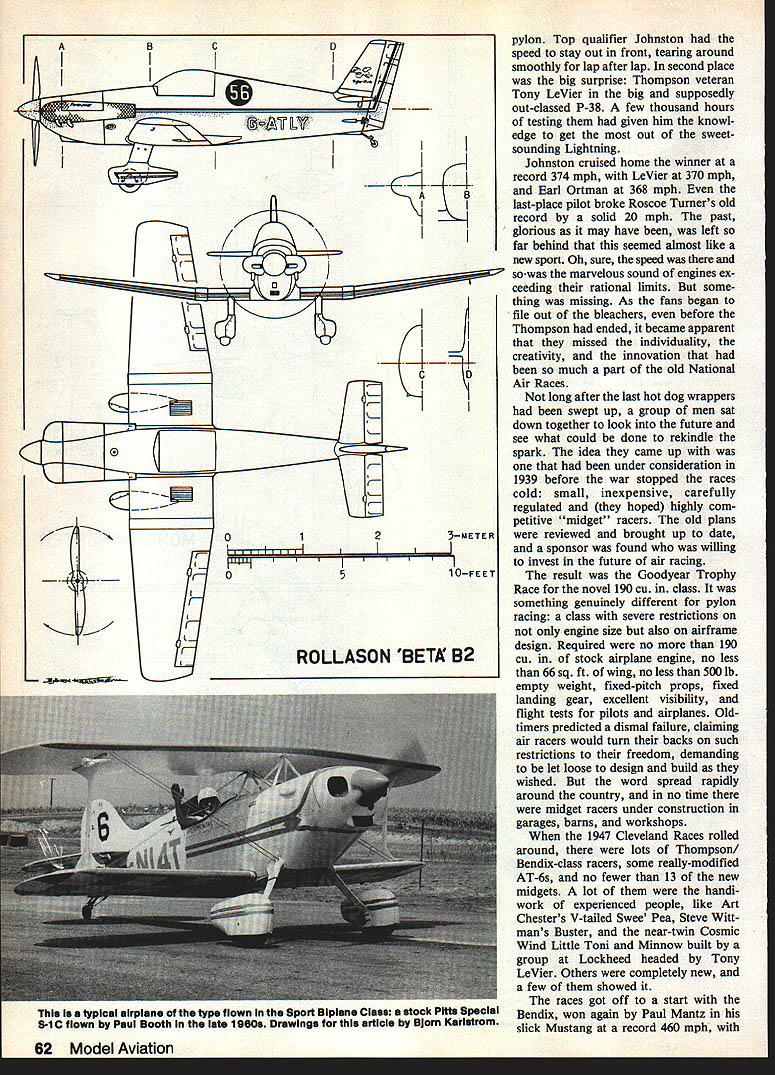
The Sport Biplane class saw its specialty-built airplanes separated into a new Racing Biplane class in 1982 so that the hot ones like Sorceress, Sundancer, and the Amsoil-Rutan Racer don't spoil the fun of the cleaned-up Pitts Specials and Mong Sports. Both should grow gradually, especially if some smaller races see the advantages of including them.
The AT-6/SNJ class, limited to mild clean-up of airframes and unable to eliminate the soup-ing-up of engines, will see some improvement in performance, though not enough to reduce the close competition (and the accompanying danger of massed turns).
At the small end of the scale is Formula Vee—racers powered by stock 1600cc Volkswagen engines and looking too much like Formula Ones. Their ability to set up on tiny short courses that can be placed on almost any airport has yet to lead to the rapid grass-roots growth once predicted. However, if the sport is to prosper, it will be on the wings of racers that can compete anywhere—at minimal expense to the owner and pilot.
Legacy
In 75 years of exciting, colorful airplanes tearing around pylons from Reims to Reno, aviation progress has been pushed ahead much faster than it otherwise might have been. More than this, the sight of racing planes at terrific speed and very close to each other and to the ground has inspired countless thousands to become emotionally involved in aviation as a hobby or a full-time profession.
For those who have followed it either close-up or at a distance, it has been, perhaps, the most colorful period in history. What the next 75 years may bring is anyone's guess.
Transcribed from original scans by AI. Minor OCR errors may remain.

