
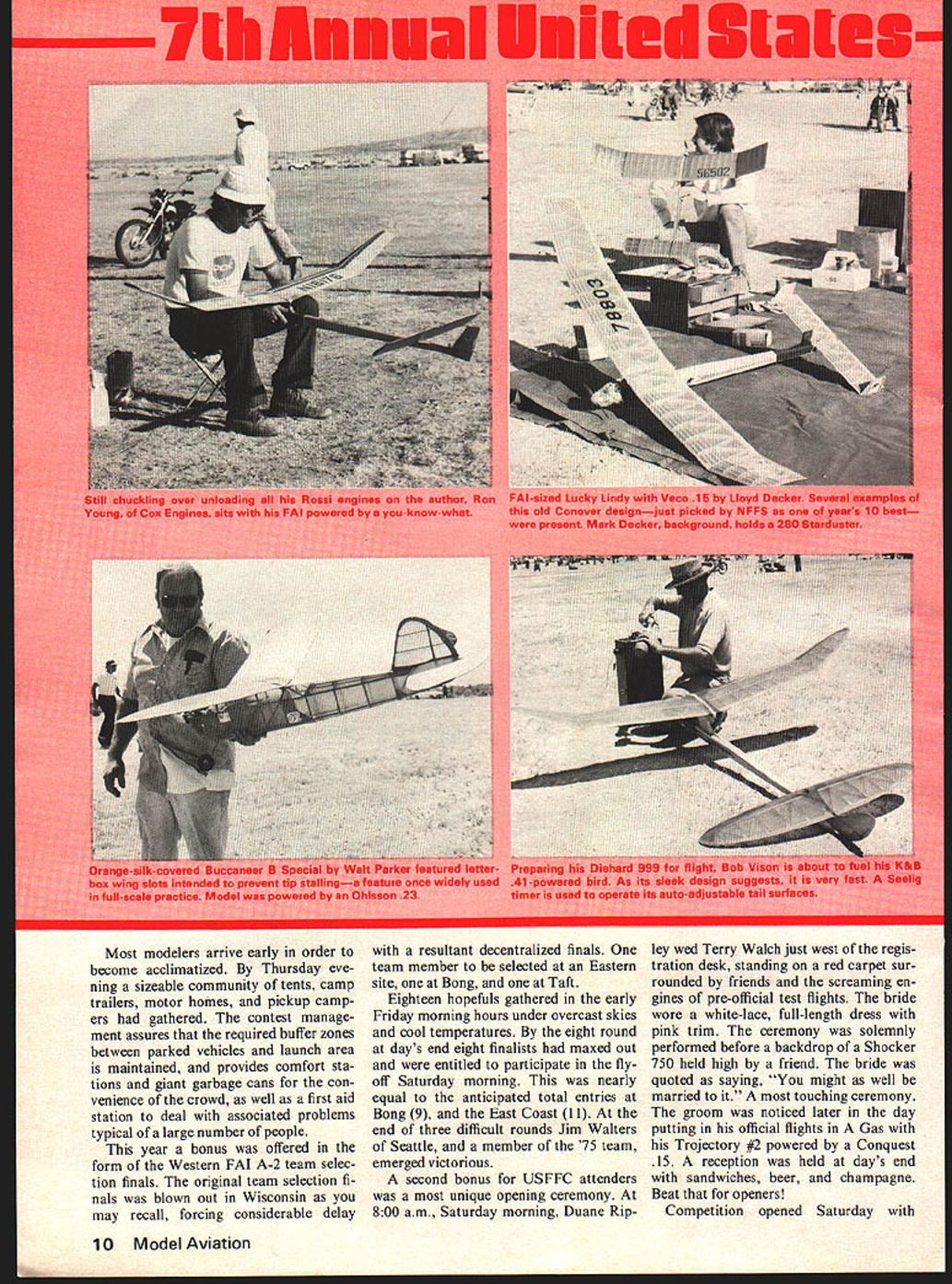
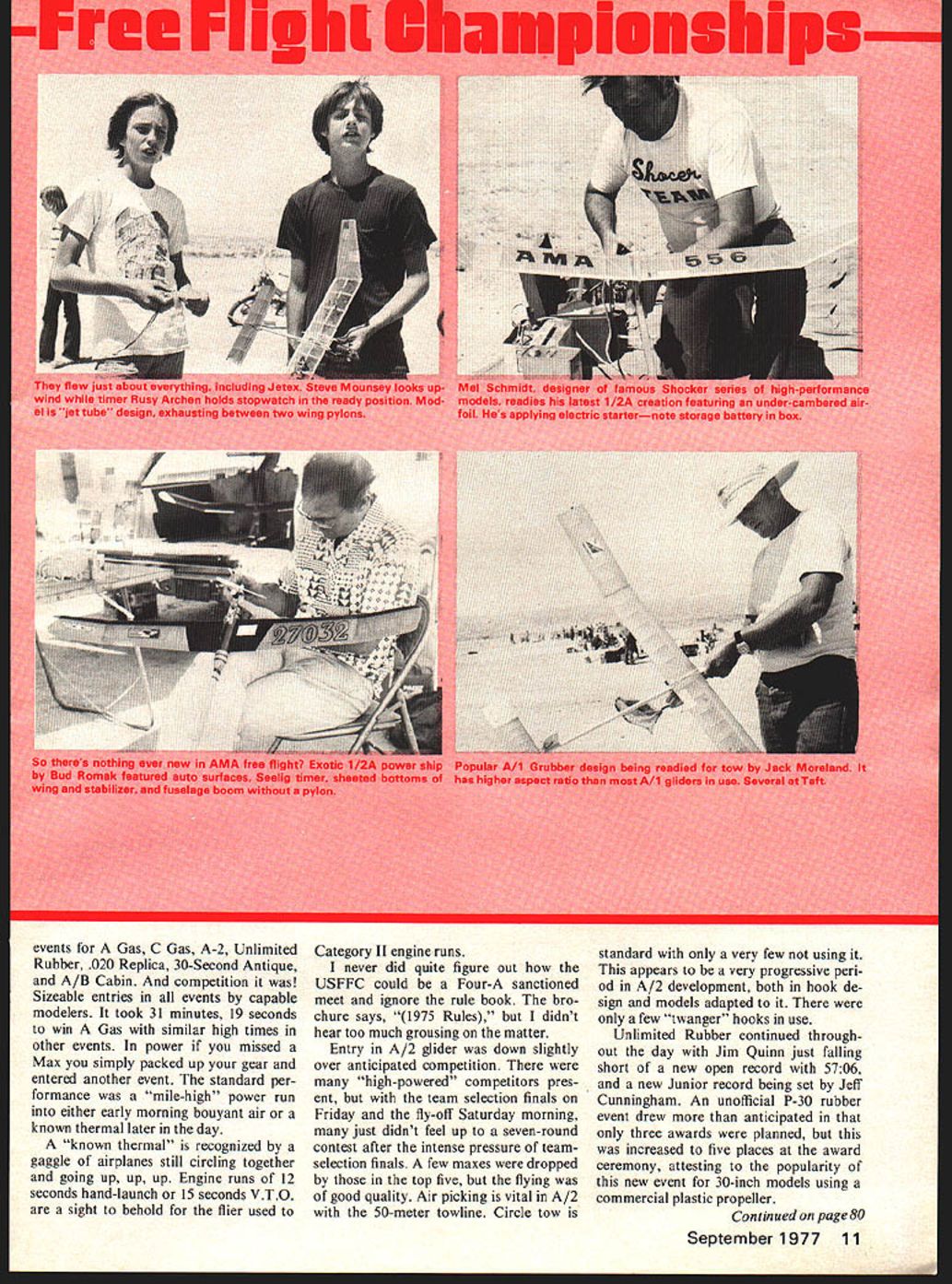
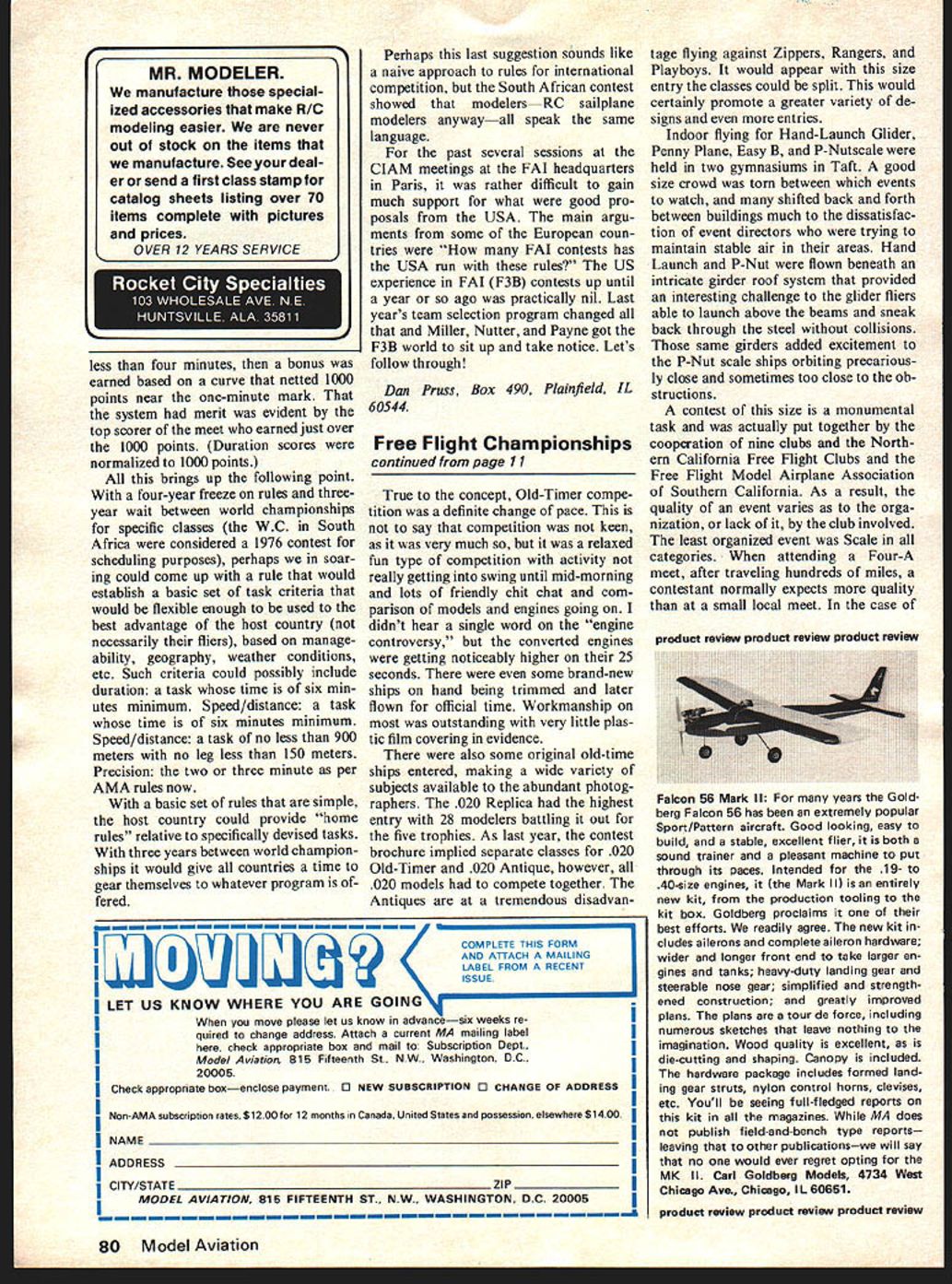
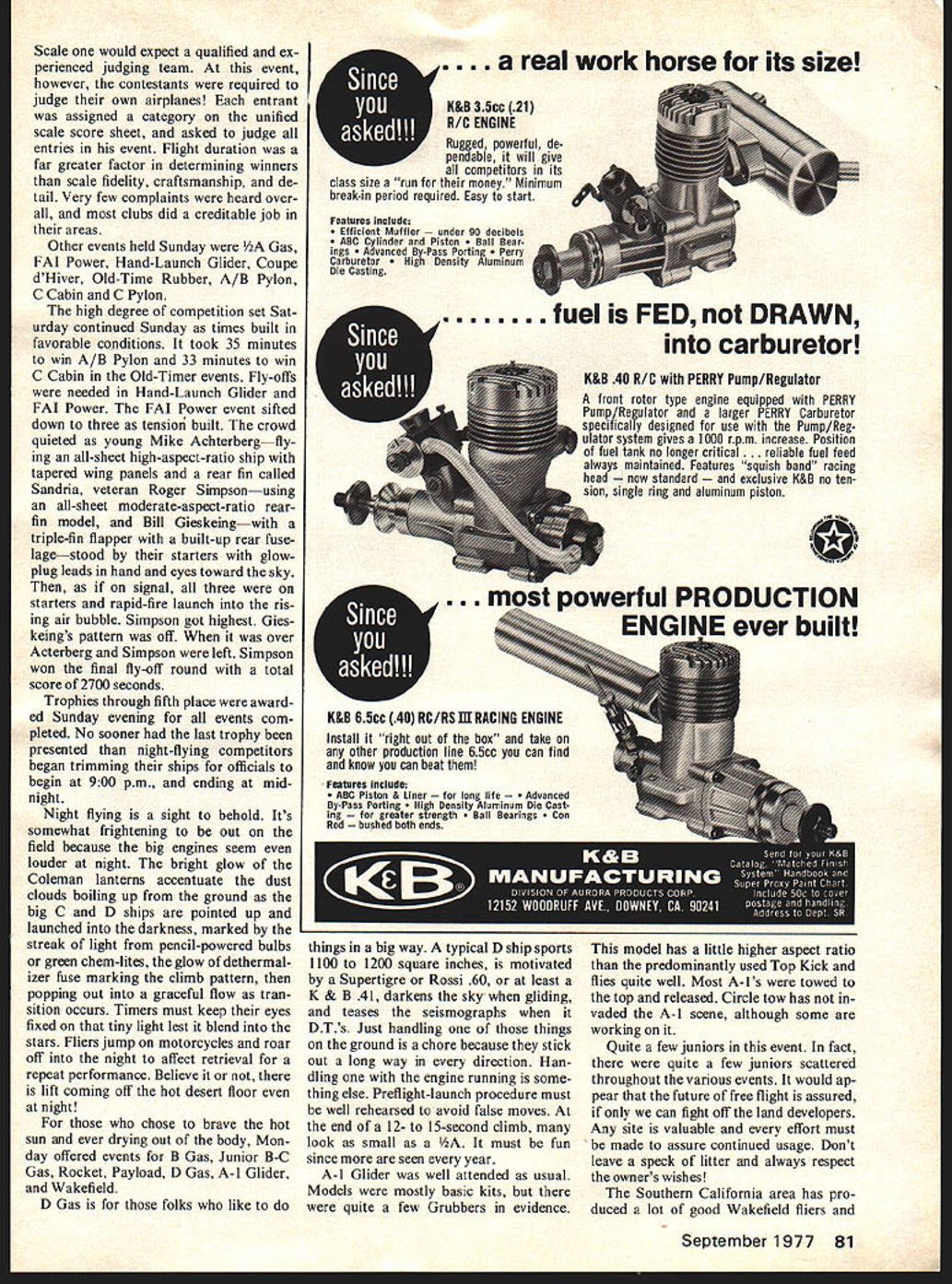
Say "Taft" and you've said it all. For there, over the Memorial Day weekend, this AAAA meet attracted 310 gifted competitors who really came to fly.
Clarence Haught
7th Annual United States Free Flight Championships
TAFT! A word guaranteed to excite the most composed of free-flight enthusiasts. The United States Free Flight Championships, an AAAA meet, is claimed by many to be the ultimate in free-flight competition.
Preparation for the Memorial Day Classic begins months before the magic weekend. Very few winners have come to Taft with untested models. The majority of the models entered show "seasoning" in the form of patches, new paint spots contrasting with faded finishes, and "handling rash." Flight testing, design alteration, experimentation with fuels, props, rubber or towing techniques, must all be sorted out in advance so that all that remains is a couple of test hops in local air.
Many modelers travel over 1000 miles one way to attend this event of events held miles from a hobby shop. Just the mere logistics of anticipating the need for and accumulating spare parts, tools, supplies, and related items is a formidable task, to say nothing of personal comfort items. Somehow it all seems to come together.
Upon arrival at this promised land of free flight, one's first impression may be slightly disappointing. Anticipating a vast level area free of obstructions, obstacles, and hazards, the sight of oil derricks and pumps immediately to the north and west, plus an industrial installation to the south-west — which you quickly learn is the infamous Kitty Litter factory with its very special dry bog fields and abandoned crude oil pipes routed through 3-foot-high sage brush — is anything but encouraging.
After leaving the pavement and negotiating a quarter-mile dirt obstacle course and crossing a small stream, you arrive at the launching site proper, which is a totally clear area 2 by 3 miles, swept clean by the famous Taft "trash movers." These are the periodic whirlwind-dust devils that traverse the area and teach you to never have more than one model assembled at a time, and under no circumstances left unattended. All this would lead one to believe that this is certainly not a 5-minute field. Experience will bear out, however, that it is indeed a Category I site as drift is usually mild with most models dethermalizing within a mile of the launch area, and an occasional model coming down a few feet from the launcher. Most modelers arrive early in order to become acclimatized. Thursday evening a sizeable community of tents, camp trailers, motor homes, pickups and campers had gathered. Contest management assures the required buffer zones between parked vehicles and the launch area and provides comfort stations and giant garbage cans for convenience. A well-stocked first-aid station handled the typical problems associated with a large number of people.
One bonus offered this year was the Western FAI A-2 team selection finals. The original team selection finals had been blown out in Wisconsin, many will recall, forcing considerable delay and resulting in decentralized finals. Team selection at Taft drew eighteen hopefuls early Friday morning under overcast skies and cool temperatures. After several difficult rounds, eight finalists were determined to participate in the Saturday morning flyoff. After the three tough flyoff rounds, Jim Walters of Seattle emerged victorious.
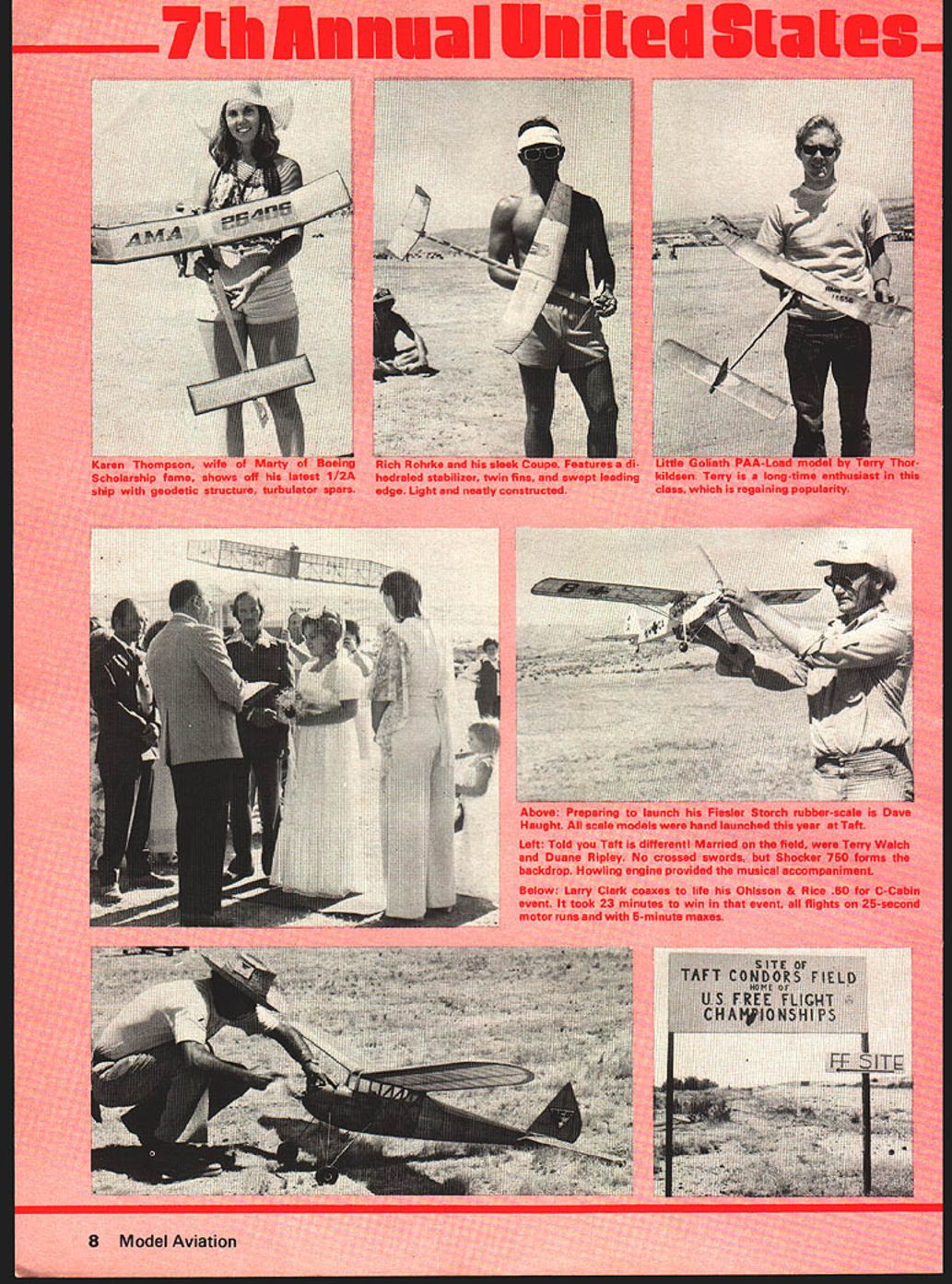
A second bonus for USFFC attenders was a unique opening ceremony at 8:00 a.m. Saturday morning when Duane Ripley wed Terry Walch just west of the registration desk. Standing on a red carpet and surrounded by friends and the screaming pre-official-test-flight engines, the bride wore a white-lace full-length dress with pink trim. The ceremony was solemnly performed before the backdrop of a Shocker 750 held high by a friend. The groom was seen later in the day putting in official flights on his Gas Trajectory #2 powered Conquest .15. A reception was held at day's end with sandwiches, beer and champagne.
Competition opened Saturday with events in Gas C, Gas A-2, Unlimited Rubber, .020 Replica, 30-Second Antique A/B and Cabin. Sizeable entries in several events produced long flights; in one event capable modelers posted times of 31 minutes 19 seconds to win. Similar high times were seen in other events. When power failed, some competitors simply packed up and entered another event. Standard performance in power events was often a mile-high power run — either in the buoyant early-morning air known for thermals or later in the day when conditions had changed. Most modelers arrive early in order to become acclimatized. Thursday evening a sizeable community of tents, camp trailers, motor homes, pickups and campers had gathered. Contest management assures required buffer zones between parked vehicles and the launch area and provides comfort stations, giant garbage cans and a first-aid station to deal with the problems associated with a typical large number of people.
A bonus was offered in the form of Western FAI A-2 team selection finals. The original team selection finals, blown out in Wisconsin, forced considerable delay and resulted in decentralized finals; team members were selected at the Eastern site and at Taft. Eighteen hopefuls gathered early Friday morning under overcast skies and cool temperatures. After eight rounds the eight finalists were maxed out and entitled to participate in the flyoff Saturday morning. This was nearly equal to the anticipated total entries at Bong (9), and the East Coast (11). At the end of three difficult rounds Jim Walters of Seattle, and a member of the '75 team, emerged victorious.
A second bonus for USFFC attenders was a most unique opening ceremony. At 8:00 a.m., Saturday morning, Duane Ripley wed Terry Walch just west of the registration desk, standing on a red carpet surrounded by friends and the screaming engines of pre-official test flights. The bride wore a white-lace, full-length dress with pink trim. The ceremony was solemnly performed before a backdrop of a Shocker 750 held high by a friend. The bride was quoted as saying, "You might as well be married to it." A most touching ceremony. The groom was noticed later in the day putting in his official flights in A Gas with his Trajectory #2 powered by a Conquest .15. A reception was held at day's end with sandwiches, beer, and champagne. Beat that for openers!
Competition opened Saturday with Gas C, Gas A-2, Unlimited Rubber, 020 Replica, 30-Second Antique A/B, and Cabin events. Sizeable entries in all events by capable modelers. It took 31 minutes, 19 seconds to win A Gas with similar high times in other events. In power if you missed a Max you simply packed up your gear and entered another event. The standard performance was a "mile-high" power run into either early morning buoyant air or a known thermal later in the day.
A "known thermal" is recognized by a gaggle of airplanes still circling together and going up, up, up. Engine runs of 12 seconds hand-launch or 15 seconds V.T.O. are a sight to behold for the flier used to Category II engine runs.
I never did quite figure out how the USFFC could be a Four-A sanctioned meet and ignore the rule book. The brochure says, "(1975 Rules)," but I didn't hear too much grousing on the matter.
Entry in A/2 glider was down slightly over anticipated competition. There were many "high-powered" competitors present, but with the team selection finals on Friday and the fly-off Saturday morning, many just didn't feel up to a seven-round contest after the intense pressure of team-selection finals. A few maxes were dropped by those in the top five, but the flying was of good quality. Air picking is vital in A/2 with the 50-meter towline. Circle tow is standard with only a very few not using it. This appears to be a very progressive period in A/2 development, both in hook design and models adapted to it. There were only a few "twanger" hooks in use.
Unlimited Rubber continued throughout the day with Jim Quinn just falling short of a new open record with 57:06, and a new Junior record being set by Jeff Cunningham. An unofficial P-30 rubber event drew more than anticipated and only three awards were planned, but this was increased to five places at the awards ceremony, attesting to the popularity of this new event for 30-inch models using a commercial plastic propeller.
Free Flight Championships
True to the concept, Old-Timer competition was a definite change of pace. This is not to say that competition was not keen, as it was very much so, but it was a relaxed fun type of competition with activity not really getting into swing until mid-morning and lots of friendly chit chat and comparison of models and engines going on. I didn't hear a single word on the "engine controversy," but the converted engines were getting noticeably higher on their 25 seconds. There were even some brand-new ships on hand being trimmed and later flown for official time. Workmanship on most was outstanding with very little plastic film covering in evidence.
There were also some original old-time ships entered, making a wide variety of subjects available to the abundant photographers. The .020 Replica had the highest entry with 28 modelers battling it out for the five trophies. As last year, the contest brochure implied separate classes for .020 Old-Timer and .020 Antique; however, all .020 models had to compete together. The Antiques are at a tremendous disadvantage flying against Zippers, Rangers, and Playboys. It would appear with this size entry the classes could be split. This would certainly promote a greater variety of designs and even more entries.
Indoor flying for Hand-Launch Glider, Penny Plane, Easy B, and P-Nut scale were held in two gymnasiums in Taft. A good size crowd was torn between which events to watch, and many shifted back and forth between buildings much to the dissatisfaction of event directors who were trying to maintain stable air in their areas. Hand Launch and P-Nut were flown beneath an intricate girder roof system that provided an interesting challenge to the glider fliers able to launch above the beams and sneak back through the steel without collisions. Those same girders added excitement to the P-Nut scale ships orbiting precariously close and sometimes too close to the obstructions.
A contest of this size is a monumental task and was actually put together by the cooperation of nine clubs and the Northern California Free Flight Clubs and the Free Flight Model Airplane Association of Southern California. As a result, the quality of an event varies as to the organization, or lack of it, by the club involved. The least organized event was Scale in all categories. When attending a Four-A meet, after traveling hundreds of miles, a contestant normally expects more quality than at a small local meet. In the case of Scale one would expect a qualified and experienced judging team. At this event, however, the contestants were required to judge their own airplanes! Each entrant was assigned a category on the unified scale score sheet, and asked to judge all entries in his event. Flight duration was a far greater factor in determining winners than scale fidelity, craftsmanship, and detail. Very few complaints were heard overall, and most clubs did a creditable job in their areas.
Other events held Sunday were: 1/2A Gas, FAI Power, Hand-Launch Glider, Coupe d'Hiver, Old-Time Rubber, A/B Pylon, C Cabin and C Pylon.
The high degree of competition set Saturday continued Sunday as times built in favorable conditions. It took 35 minutes to win A/B Pylon and 33 minutes to win C Cabin in the Old-Timer events. Fly-offs were needed in Hand-Launch Glider and FAI Power. The FAI Power event sifted down to three as tension built. The crowd quieted as young Mike Achterberg - flying an all-sheet high-aspect-ratio ship with tapered wing panels and a rear fin called Sandria, veteran Roger Simpson - using an all-sheet moderate-aspect-ratio rear-fin model, and Bill Gieseking - with a triple-fin flapper with a built-up rear fuselage - stood by their starters with glow-plug leads in hand and eyes toward the sky. Then, as if on signal, all three were on starters and rapid-fire launch into the rising air bubble. Simpson got highest. Gieseking's pattern was off. When it was over Achterberg and Simpson were left. Simpson won the final fly-off round with a total score of 2700 seconds.
Trophies through fifth place were awarded Sunday evening for all events completed. No sooner had the last trophy been presented than night-flying competitors began trimming their ships for officials to begin at 9:00 p.m., and ending at midnight.
Night flying is a sight to behold. It's somewhat frightening to be out on the field because the big engines seem even louder at night. The bright glow of the Coleman lanterns accentuate the dust clouds boiling up from the ground as the big C and D ships are pointed up and launched into the darkness, marked by the streak of light from pencil-powered bulbs or green chem-lites, the glow of dethermalizer fuse marking the climb pattern, then popping out into a graceful flow as transition occurs. Timers must keep their eyes fixed on that tiny light lest it blend into the stars. Fliers jump on motorcycles and roar off into the night to affect retrieval for a repeat performance. Believe it or not, there is lift coming off the hot desert floor even at night!
For those who chose to brave the hot sun and ever drying out of the body, Monday offered events for B Gas, Junior B-C Gas, Rocket, Payload, D Gas, A-1 Glider, and Wakefield.
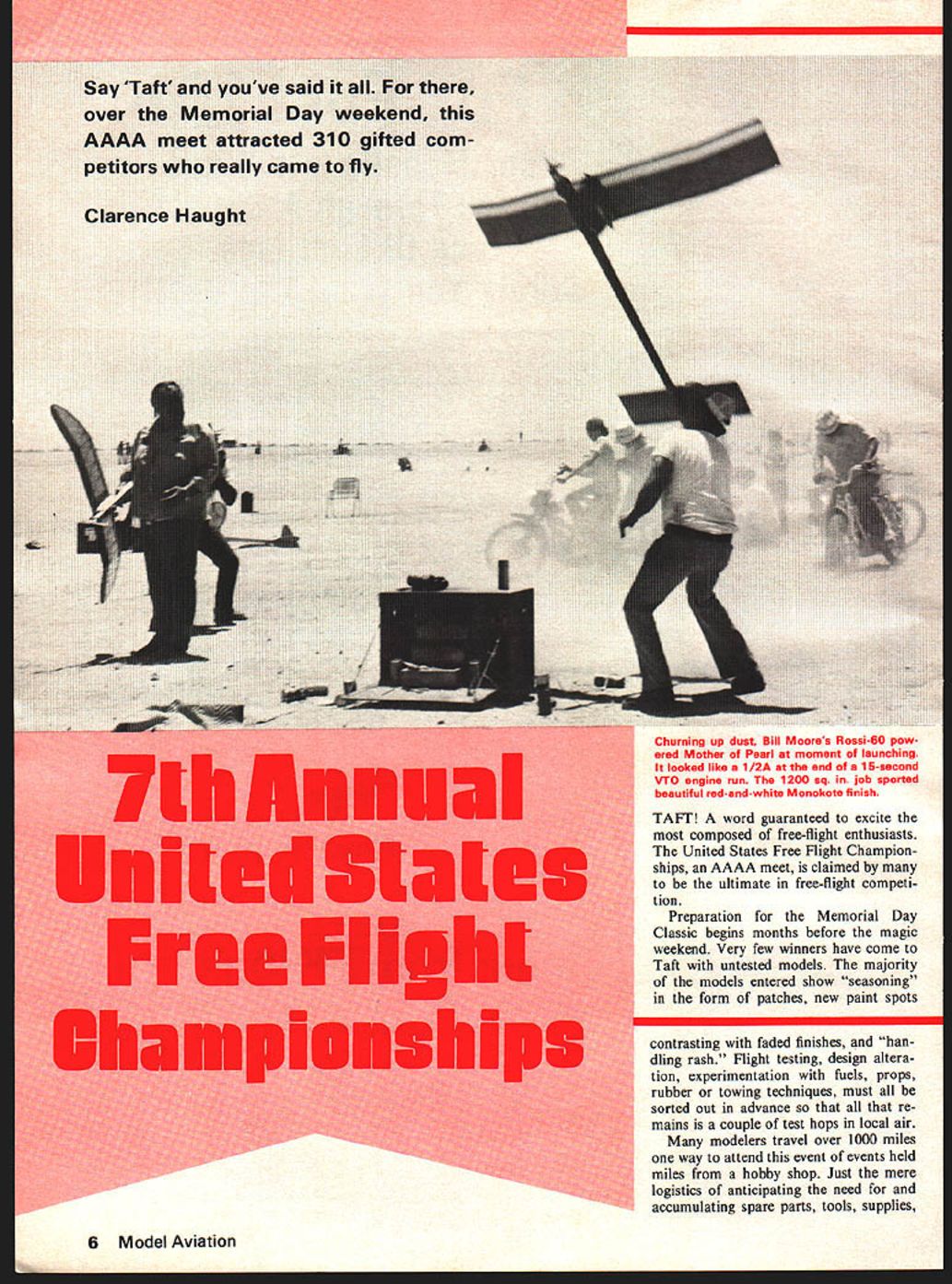
D Gas is for those folks who like to do things in a big way. A typical D ship sports 1100 to 1200 square inches, is motivated by a SuperTiger or Rossi .60, or at least a K & B .41, darkens the sky when gliding, and teases the seismographs when it D.T.'s. Just handling one of those things on the ground is a chore because they stick out a long way in every direction. Handling one with the engine running is something else. Preflight-launch procedure must be well rehearsed to avoid false moves. At the end of a 12- to 15-second climb, many look as small as a 1/2 A. It must be fun since more are seen every year.
A-1 Glider was well attended as usual. Models were mostly basic kits, but there were quite a few Grubbers in evidence. This model has a little higher aspect ratio than the predominantly used Top Kick and flies quite well. Most A-1's were towed to the top and released. Circle tow has not invaded the A-1 scene, although some are working on it.
Quite a few juniors in this event. In fact, there were quite a few juniors scattered throughout the various events. It would appear that the future of free flight is assured, if only we can fight off the land developers. Any site is valuable and every effort must be made to assure continued usage. Don't leave a speck of litter and always respect the owner's wishes!
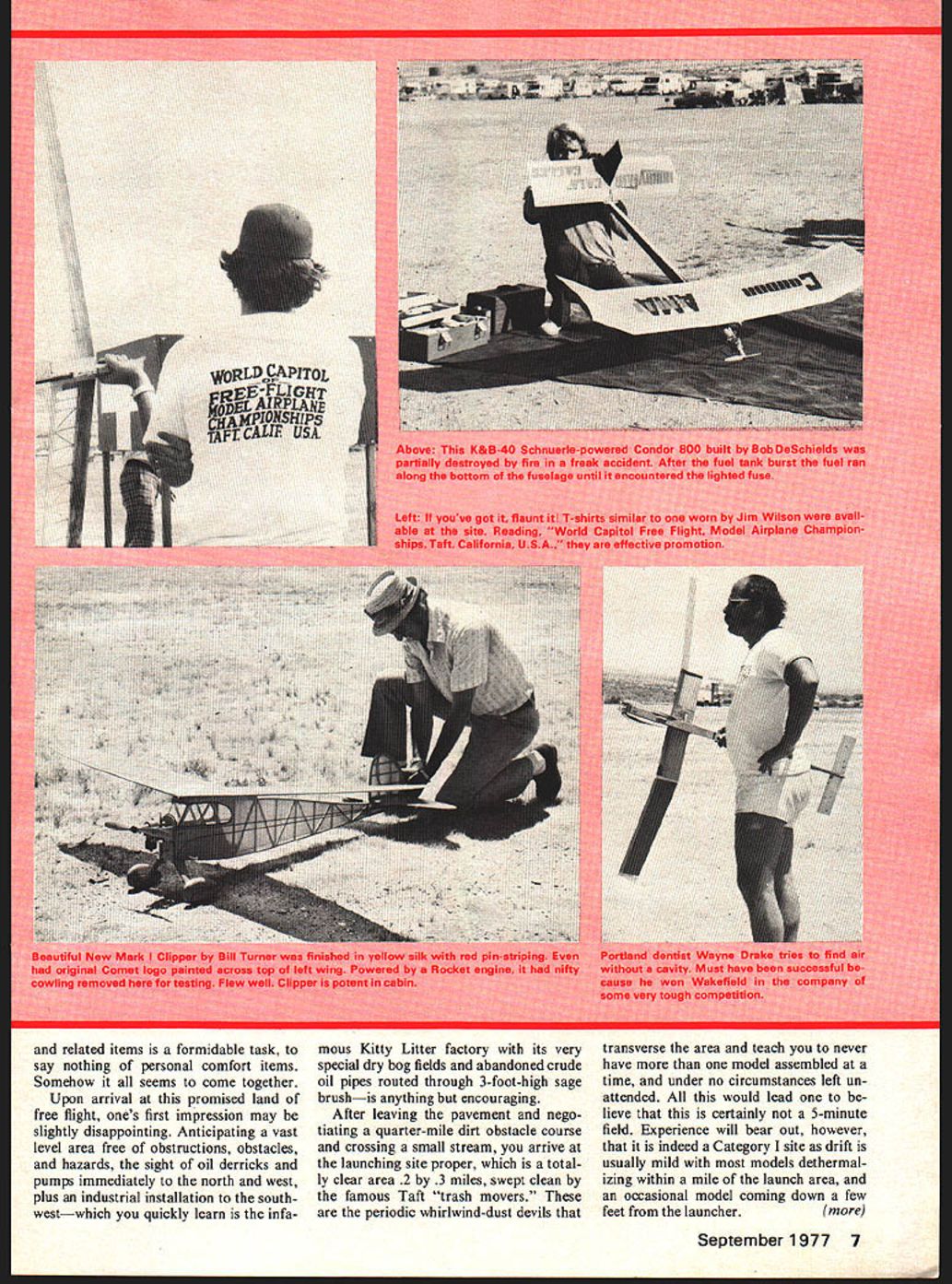
The Southern California area has produced a lot of good Wakefield fliers and the entry in Wake read like a Who's Who in rubber power. World Team members past and present were in attendance as well as National Champions. Wakefield is a tough event, make no mistake about that. There are probably more variables in this event than any other. Air picking is of prime importance. Bubble machines, cattail fluff, thermisters, Mylar streamers, and just plain old physical awareness were in evidence everywhere. As in the other FAI events, Wake was flown in one 1-1/2-hour round and six 1-hour rounds. Maxes were dropped early in the rounds, but the competition went on. The surprise of the day came when a relatively unknown flier from Portland, Oregon, Wayne Drake, emerged victorious with six maxes in a row, plus a seventh flight that fell short of the magic 180.
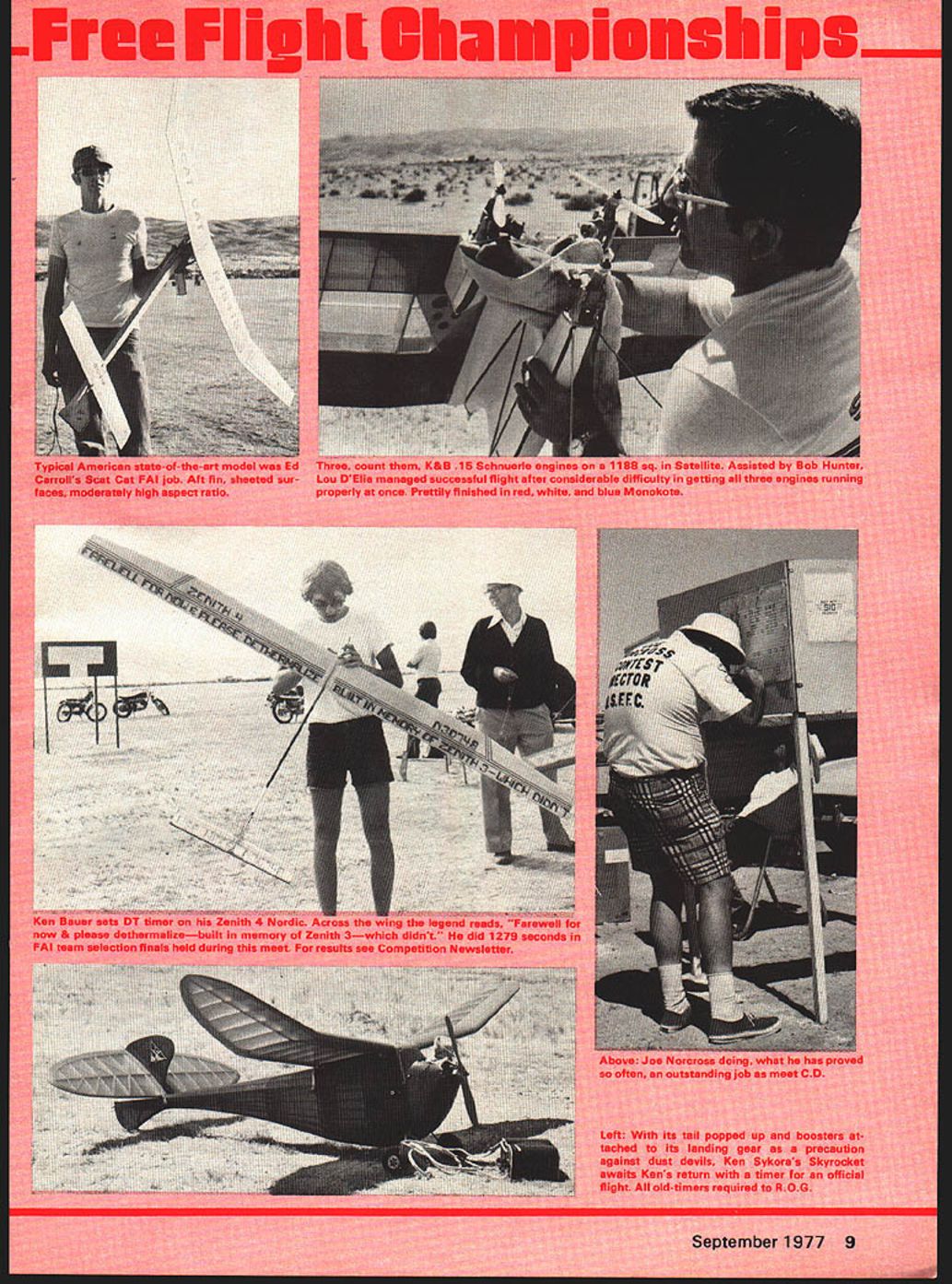
As with many meets some modelers come to observe and do some sport flying. One such modeler, Lou D'Elia, brought his tri-motor. Not a Ford or a Fokker, but a Satellite! Three K&B Schnuerle .15 engines were mounted, one in the usual place, and two on a wide wing platform at the top of the pylon of an 1188-sq.-in. version of the Satellite. The three engines were pressure fed from a common tank located in the fuselage. Engine cut-off was affected by a pressure dump valve above the tank. The ship was put up on one engine to check for any undesirable characteristics. None were evident and considerable time was spent trying to get all three engines going at once. This was not attained Saturday, but Sunday evening a dream was realized and all engines were finally running after going through innumerable glow plugs. The sound of three high rpm engines running together on the same model has to be heard to be appreciated. The closest thing is the sound of a control-line Goodyear race.
Lou launched his masterpiece for a successful flight! The beam on his face said it all!
Anytime a crowd of this magnitude (over 1000) assembles a few mishaps are bound to happen. Two are noteworthy for their educational value. Motorbikes are a standard retrieval equipment and any free flighter knows the hazards of watching his model while riding. In fact, most will tell you to stop to look or go in two's, with one to watch and the other to ride. The two modelers on a three-wheel Honda ATV were apparently both watching the model as they rode over a 12-foot embankment. Fortunately, they were only badly shaken.
The other mishap was a bit more unusual. Bob DeSheilds was preparing to test his new Condor 800 when the pacifier tank burst, allowing the fuel to run down the bottom of the fuselage to the burning DT fuse. Poof! Bob says, "If your pacifier breaks, get the nose down quick!".
Contest Director Joe Norcross is to be commended for a great job in keeping the 310 contestants happy in this contest of contests, the 7th Annual United States Free Flight Championships.
The community of Taft made everyone feel welcome. Signs painted on store windows greeted modelers, and restaurants ran special meal offers.
As Joe Norcross asked at the closing ceremony: "Where are you going to be next Memorial Day?" Who said Indianapolis?
Transcribed from original scans by AI. Minor OCR errors may remain.

