
7th CL Scale World Championships
By Dick Byron
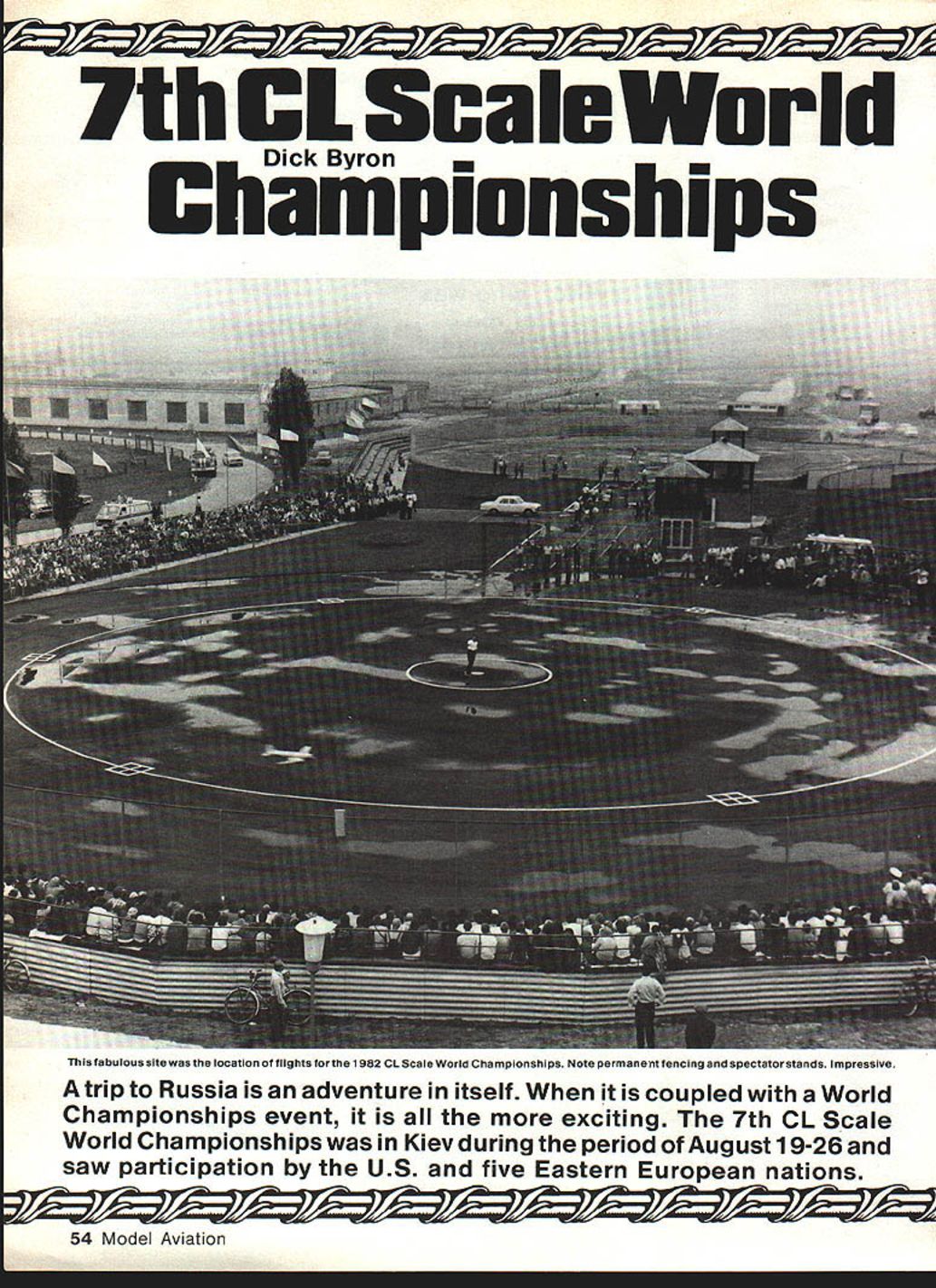
A trip to Russia is an adventure in itself. When it is coupled with a World Championships event, it is all the more exciting. The 7th CL Scale World Championships was in Kiev during the period of August 19–26, 1982, and saw participation by the U.S. and five Eastern European nations.
It was an event to remember. We gathered in Chicago on Friday, the 13th of August, 1982 (does that sound ominous?). The group consisted of Team Manager John Preston and team members Steve Ashby, Jeff Perez, and Dick Byron. We were getting excited about the forthcoming trip overseas.
Since CL Scale had not had a World Championship in six years, we were all apprehensive as to whether we would have one this year. It seemed that the Russians did not wish to inform anybody on such things as visas, flight confirmations, lodging arrangements, etc., until the last possible second. This proved to be a great discomfort; however, it was not insurmountable, as the visas did come through while we were attending the Nats in Lincoln.
We were fortunate in Chicago to have a very understanding sales clerk at the Air France ticket counter, and we were able to ship our boxes quite economically to Kiev ($70 per box). When we arrived in Kiev, U.S.S.R. customs was somewhat of a hassle, taking several hours.
The scene was somewhat James Bond-ish, with the Soviet guards behind bulletproof glass very carefully staring at the picture on the passport. They would look you straight in the eye and then observe from left ear to right ear (and back again) to determine whether you were actually the person shown in the passport and visa—very scary, but very interesting.
Once through customs, we finally discovered there was somebody waiting for us. Until the customs officer discovered we were the U.S. team, we had absolutely no warm feeling. Once he discovered who we were, things started to happen very quickly; we then went through the rest of the customs examination very quickly.
There was some confusion over a piece of paper. John Preston stated what dollar value duty-free goods could be brought back into the United States. It seems other customs officers wanted to know: could you bring back $600? Virgin Islands $300? Other places? We explained the situation away. A gentleman greeted us—his complete name I did not learn—whom I called Fyodor, a very pleasant, hard-working, sincere individual. He informed us that our large-size model boxes had been delayed several hours. A truck to transport the boxes was finally hired and the boxes arrived at the hotel at 1:15 in the morning. We went straight to sleep.
Sunday we arose, and after eating some very strange breakfasts we started some sightseeing. Kiev is a beautiful city; it has beautiful people who—when your eyes meet them—will smile. The people seemed interested in Americans and seemed to enjoy having us visit shops. Although most printed materials were in Russian, the three-views and reference material available were reasonably decent.
Arrival at Chaika and Static Judging
On Monday we were greeted by Fyodor and another truck driver who wanted to take our boxes to the competition site known as Chaika. Upon arrival in Chaika, which is the Soviet Technical Sports Center, we were all overwhelmed with the beauty and outstanding model flying area.
Chaika is located on the outskirts of Kiev. It is where the full-scale aerobatics contest was held in 1966, and it houses many Soviet acrobatic aircraft—Yak-18s, Yak-50s, AN-2s—gliders, and a small museum with a MiG-17.
We locked our models in a hangar after spending a few hours cleaning, inspecting, and generally preparing them for static judging. Upon return to the hotel, we went sightseeing again.
On Wednesday morning we were again greeted by Fyodor—and our English-speaking interpreter, Raisa. Her English was quite good; she had been a teacher for many years at the university, and she was there to give us cultural background on the Soviet Ukraine.
The people of the Soviet Ukraine are extremely proud of their heritage, and since this was the year Kiev celebrated its 1,500th anniversary along with the 60th anniversary of the Soviet revolution, we were treated to quite a tour of the city and its cultural points. It was a very interesting and beautiful tour, and one I will never forget.
We made plans that day to visit a Soviet aircraft display at the Exhibition of Economic Achievements. They have many displays similar to our Smithsonian—only the EEA is located on an area of 950 acres!
Static judging began Friday, August 20. Static judging and registration were done according to a schedule. This was somewhat complicated, but it proceeded with quite a bit of smoothness, as there were many people there who could assist us. As the aircraft were processed, static judging timetables were posted, and everybody was prepared when their time came. Jeff Perez was the first U.S. team member to have his model judged on the first day. On the second day, Steve Ashby's model was second in line, followed by Dick Byron's, the fifteenth of the day.
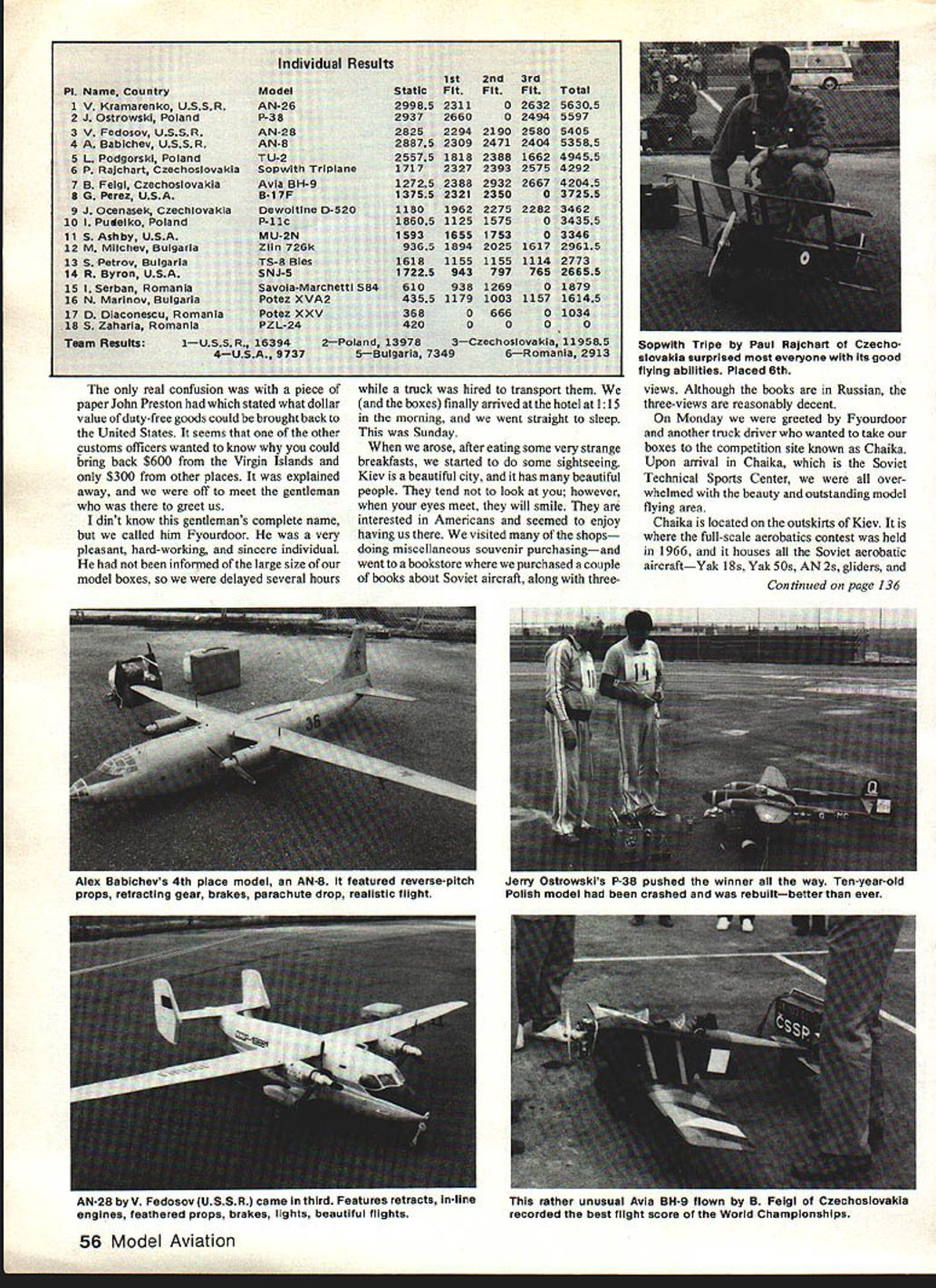
The U.S. team's static scores were: Byron, 1722.5; Ashby, 1593; and Perez, 1375.5. The leader after static judging was Kramarenko with 2998.5. At that time we did not know what the flight scores would be, but that is how the field was set.
Opening Ceremonies and Flying Rounds
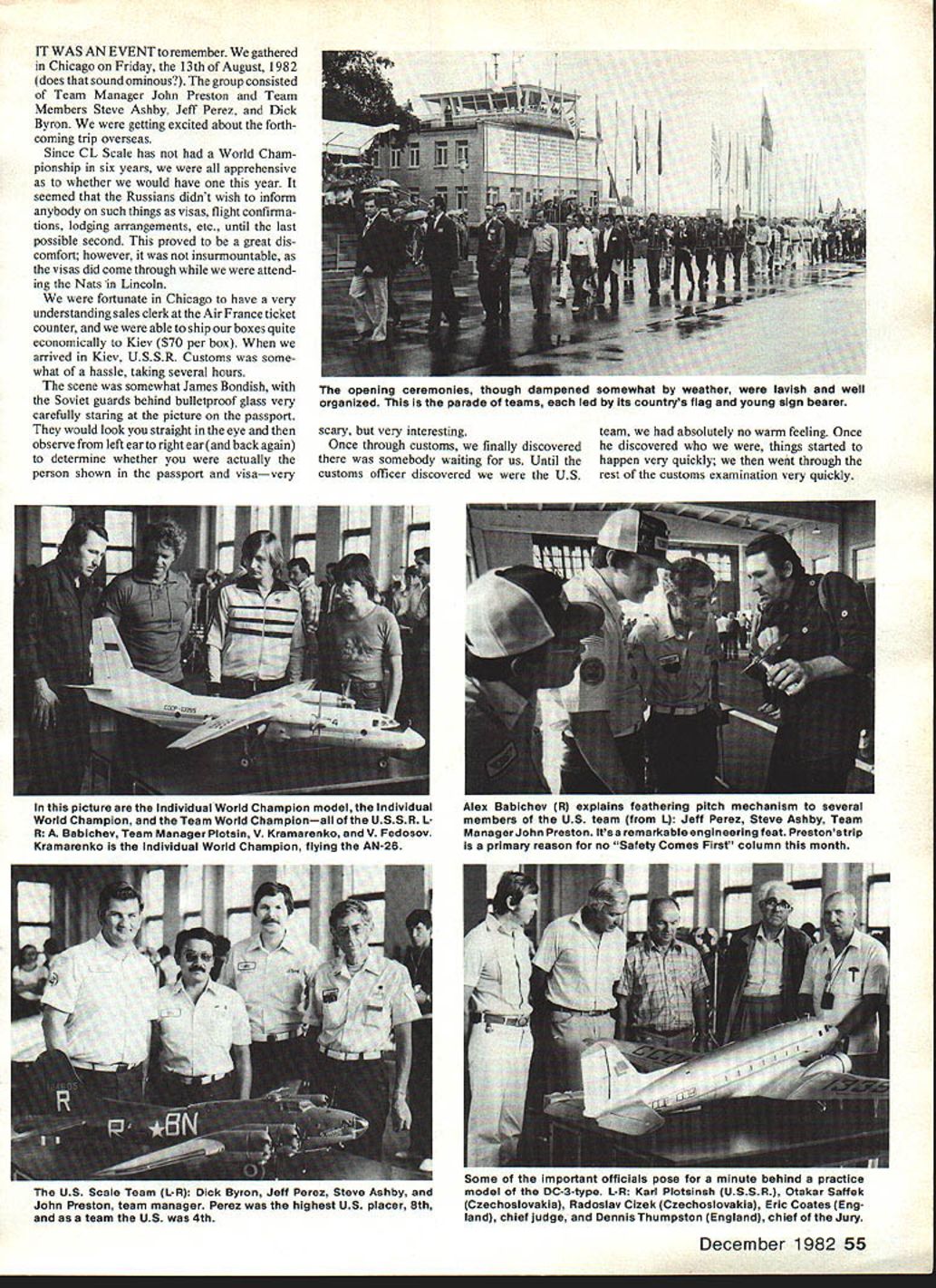
Sunday was the first scheduled day of flying. The opening ceremonies held at the field were the most impressive I have ever seen short of a presidential inauguration. The Russian organizing committee went absolutely all out to impress us with their hospitality. There were many military dignitaries present. It was a truly breathtaking sight. We paraded in front of the people; there were many thousands present to attend the air show which was scheduled prior to the opening flying round.
It was a very dismal day for weather. It was cold with sprinkles throughout the morning. When we were parading, however, the rain stopped, and we were able to see a portion of the air show. The paratroopers, skydivers, aerial aerobatics, and full-scale aircraft were cancelled due to the low ceiling—probably about 400 feet. We were treated to some model flying—combat, stunt, RC scale, RC pattern, some banner towing—an impressive display. Even though the weather was bad, there were approximately 75,000 to 100,000 spectators at the flying site to see this show, an overwhelming display of public interest (although probably 30% were Soviet troops used as guards, since there were many VIPs present).
As the opening flying round started, the very first aircraft was a Sopwith Triplane flown by Paul Rajchart of Czechoslovakia. After this flight, the rains came and the rest of the day's flying was canceled. An absolutely torrential downpour ensued, and we were all caught very wet and very cold.
When Monday dawned, the weather was about perfect. Temperatures were in the mid-60s. It was overcast and cloudy, but not cold. There was no wind—an absolutely terrific day (or as the Poles put it, "absolutely fantastic").
The first round continued. Jeff Perez's B-17 definitely was a crowd-pleaser with its four engines; however, there were some slight problems with the retracts not having sufficient air capacity. Overall, the flight went very well.
As the flying went on, the quality of aircraft was simply amazing. The flying abilities of the Russians were remarkable. The Poles were fantastic! Jerry Ostrowski and Lesh Podgorski, both of Poland, had fantastic aircraft that had seen World Championships before. Jerry's P-38 had been crashed due to picking up the handle upside down, but it had been rebuilt—and it was even better rebuilt than it had been previously.
The second American to fly was Steve Ashby. Once we got the engine problems ironed out, Steve's flight went very well. The aircraft flew very impressively, but upon landing, due to water on the runway, one of the engines quit. His inability to taxi cost him flight points and possibly a better position.
The third American to fly, Dick Byron, had a very smooth first flight, but as he increased engine speed to enter the 45-degree-elevation flight, the engine overheated and died. The model landed with no damage.
As the second round started, it was obvious that the Russian aircraft were the ones to beat, with Jerry Ostrowski challenging them for first place. The Russian aircraft incorporated the in-line-cylinder engines seen in the 1974 aircraft built by Kramarenko. They worked quite well, and this year they also featured variable-pitch propellers that they actually flew on. All the Russian models featured reversible-pitch propellers, brakes, lighting systems, and an absolutely remarkable number of technology options. These models received very high points for special ingenuity, quite justifiably, as they were vastly superior.
It should be noted that everybody at the contest, including Russian bystanders, indicated to us that the Russians were professionals. Their job for four years was to build these models. In one sense it is unfortunate that the United States government does not back modeling in this way. In another sense, we enjoy modeling much more because it is not a live-or-die situation. It is a hobby with us, and it is a must-win situation for the Russians.
When the scores were posted after the first round, it was quite obvious where the leaders were and where the American team stood. We vastly needed to improve our flying performance. Unfortunately, that was not to happen significantly, although Jeff Perez did finish in 8th place. Considering the other models on hand, that is very respectable. Steve Ashby finished 11th, and Dick Byron finished 14th. The enthusiasm that the World Championships brings should show an improvement in U.S. models for the 1984 World Championships (tentatively scheduled for France).
At the completion of two full rounds on Monday, Ostrowski (Poland) was in the lead, followed by Kramarenko (U.S.S.R.).
Tuesday was another beautiful day—mostly cloudy skies, temperatures about the same as Monday, and with only a slight breeze in the morning. We had to mix some more fuel in order to complete our flying. The Russians provided us fuel with nitromethane in it; however, I would have preferred that we each have our own fuel that we were accustomed to, as the fuel may have been the source of some of our engine problems.
The third round saw some juggling in flight order due to unsuccessful flight attempts, apparently so that the Russians could enjoy the glamour of the last flights. As the third round finished, Kramarenko (U.S.S.R.) was first and Jerry Ostrowski (Poland) was second. It should be noted that the scoring in the third round did balloon for the Russian fliers by the Russian judge. Most people felt that it was a draw—both airplanes were equally good.
After the contest was over, the Russians put on a display of flying their models in front of Mr. Antonov himself, the "owner" of the factory where all the Russian team members work. Mr. Antonov was very interested in their models, and he also requested to see the U.S. models. However, ours were back in the hangar, and he couldn't make it to that area. Many dignitaries were on hand, and there was much filming going on. The extent of the PR work the Russians did on this event was absolutely amazing. Airplane modeling in Europe is highly regarded, a technical sport, and highly endorsed by the Soviet government.
Return Trip and Shipping Problems
Our trip back was quite eventful. On leaving Kiev, we were to stop over in Moscow for a few days of sightseeing. The flight boxes always presented a problem in transportation. Aeroflot Airlines is not your Cadillac of the industry; however, they can get you from one point to another if you are willing to ride with the chickens, ducks, and heads of cabbage. Our boxes finally arrived in Moscow, and we just left them hoping that nobody would steal them. We could not get anybody to accept them for storage until our flight departed.
Sightseeing in Moscow was a bit disappointing. They use a lot of "gray food coloring" on the buildings and most everything in sight.
When we attempted to depart Moscow the real bomb was dropped when it was discovered that Aeroflot was going to charge us $1,350 to transport our boxes from Moscow to London. Our best efforts to obtain a more favorable rate were hampered by the language problem, and finally they demanded payment of this amount, or the boxes would have to be left behind. The picture of Dick, Jeff, and Steve standing in the exit visa line, with John Preston trying to get them to accept a more reasonable figure, was very frustrating. The sigh of relief when we left the ground was very audible.
While sightseeing in London, we simply left our model boxes in customs. Upon leaving for Chicago, we were hit with another $500 bill for transporting the boxes. It seems to me that someone should make advance arrangements for shipping models to and from World Championships. I feel we were definitely railroaded into paying these exorbitant fees.
Individual Results
- Pl. Name, Country — Model — Static — 1st Flt. — 2nd Flt. — 3rd Flt. — Total
- 1. V. Kramarenko, U.S.S.R. — AN-26 — 2998.5 — 2311 — 0 — 2632 — 5630.5
- 2. J. Ostrowski, Poland — P-38 — 2937 — 2660 — 0 — 2494 — 5597
- 3. V. Fedosov, U.S.S.R. — AN-28 — 2825 — 2294 — 2190 — 2580 — 5405
- 4. A. Babichev, U.S.S.R. — AN-8 — 2887.5 — 2309 — 2441 — 2404 — 5358.5
- 5. L. Podgorski, Poland — TU-2 — 2557.5 — 1818 — 2388 — 1662 — 4955.5
- 6. P. Rajchart, Czechoslovakia — Sopwith Triplane — 1717 — 2327 — 2393 — 2575 — 4292
- 7. B. Feigl, Czechoslovakia — Avia BH-9 — 1272.5 — 2388 — 2932 — 2667 — 4204.5
- 8. G. Perez, U.S.A. — B-17F — 1375.5 — 2321 — 2350 — 0 — 3725.5
- 9. J. Ocenasek, Czechoslovakia — Dewoitine D-520 — 1180 — 1962 — 2275 — 2282 — 3462
- 10. I. Pudelko, Poland — P-11c — 1860.5 — 1125 — 1575 — 0 — 3435.5
- 11. S. Ashby, U.S.A. — MU-2N — 1593 — 1655 — 1753 — 0 — 3346
- 12. M. Milchev, Bulgaria — Zlin 726k — 936.5 — 1894 — 2025 — 1617 — 2961.5
- 13. S. Petrov, Bulgaria — TS-8 Bies — 1618 — 1155 — 1155 — 1114 — 2773
- 14. R. Byron, U.S.A. — SNJ-5 — 1722.5 — 943 — 797 — 765 — 2665.5
- 15. I. Serban, Romania — Savoia-Marchetti S.84 — 610 — 938 — 1269 — 0 — 1879
- 16. N. Marinov, Bulgaria — Potez XV A2 — 435.5 — 1179 — 1003 — 1157 — 1614.5
- 17. D. Diaconescu, Romania — Potez XXV — 368 — 0 — 666 — 0 — 1034
- 18. S. Zaharia, Romania — PZL-24 — 420 — 0 — 0 — 0 — 0
Team Results
- 1 — U.S.S.R., 16,394
- 2 — Poland, 13,978
- 3 — Czechoslovakia, 11,958.5
- 4 — U.S.A., 9,737
- 5 — Bulgaria, 7,349
- 6 — Romania, 2,913
Final Remarks
All in all, attending the CL Scale World Championships was an experience I will never forget. There were some problems, as already enumerated, and there were some personality conflicts between team members. The brightest side of all was the fantastic modelers that we met. The Russians treated us with great warmth, and it was honest and sincere. The Poles—the same way. The Czechs—just as well. The Bulgarians and Romanians—all the same. These modelers are absolutely an outstanding bunch of people. I just wish governments could think the same way the modelers do.
One final note: in the evenings when we sat around trying to communicate, an interesting pattern developed. Dick Byron was crowned the World Champion Cork Popper by Lesh from Poland! Much bubbly and friendship flowed. It was great!
Transcribed from original scans by AI. Minor OCR errors may remain.

