
7th Soaring Nationals
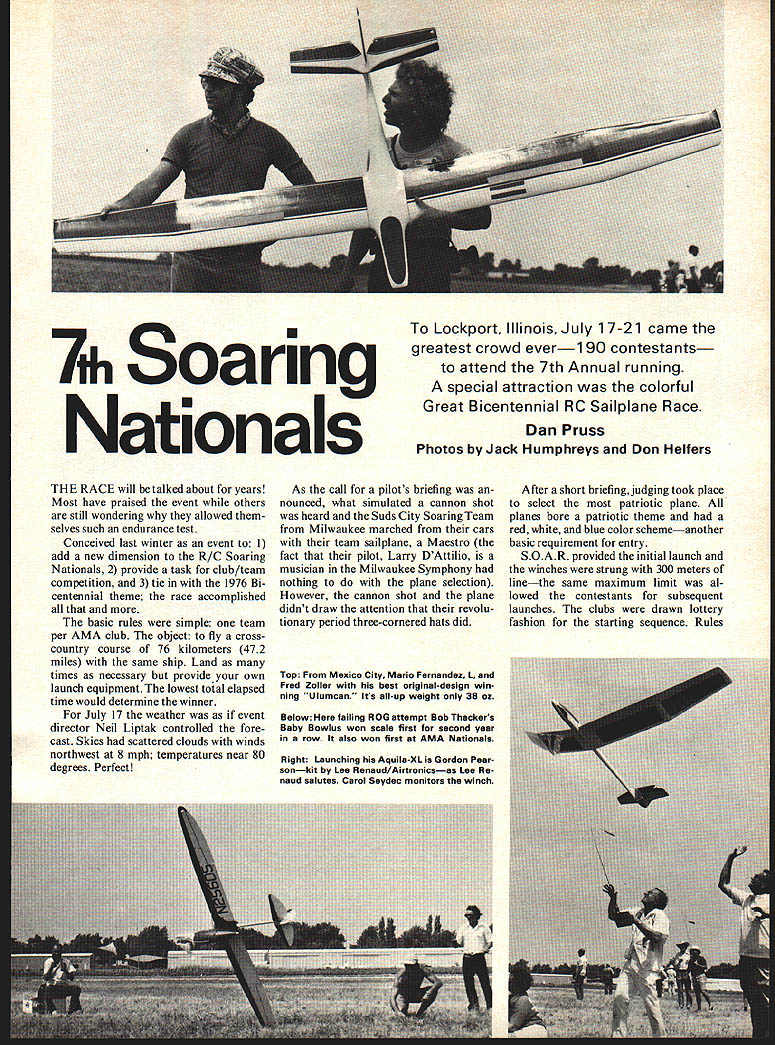
To Lockport, Illinois, July 17-21 came the greatest crowd ever—190 contestants—to attend the 7th Annual running.
A special attraction was the colorful Great Bicentennial RC Sailplane Race.
Dan Pruss
Photos by Jack Humphreys and Don Helfers
THE RACE will be talked about for years! Most have praised the event while others are still wondering why they allowed themselves such an endurance test.
Conceived last winter as an event to: 1) add a new dimension to the R/C Soaring Nationals, 2) provide a task for club/team competition, and 3) tie in with the 1976 Bicentennial theme; the race accomplished all that and more.
The basic rules were simple: one team per AMA club. The object: to fly a cross-country course of 76 kilometers (47.2 miles) with the same ship. Land as many times as necessary but provide your own launch equipment. The lowest total elapsed time would determine the winner.
For July 17 the weather was as if event director Neil Liptak controlled the forecast. Skies had scattered clouds with winds northwest at 8 mph; temperatures near 80 degrees. Perfect!
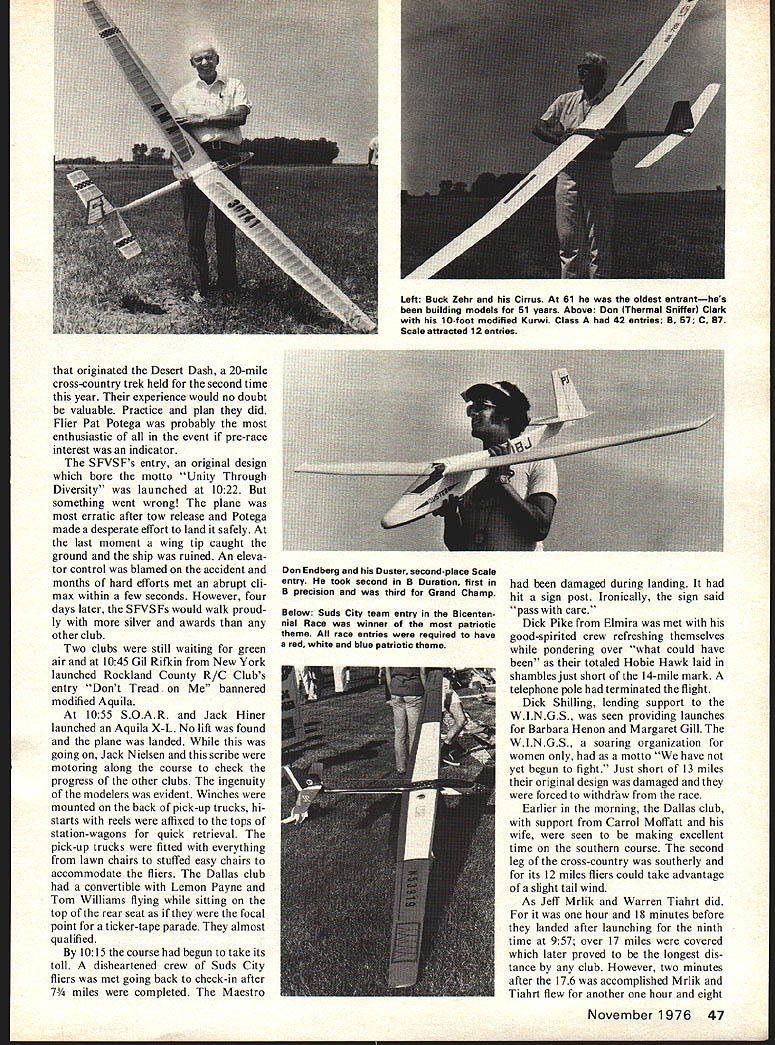
As the call for a pilot's briefing was announced, what simulated a cannon shot was heard and the Suds City Soaring Team from Milwaukee marched from their cars with their team sailplane, a Maestro (the fact that their pilot, Larry D'Attilio, is a musician in the Milwaukee Symphony had nothing to do with the plane selection). However, the cannon shot and the plane didn't draw the attention that their revolutionary-period three-cornered hats did.
After a short briefing, judging took place to select the most patriotic plane. All planes bore a patriotic theme and had a red, white, and blue color scheme—another basic requirement for entry.
S.O.A.R. provided the initial launch and the winches were strung with 300 meters of line—the same maximum limit allowed the contestants for subsequent launches. The clubs were drawn lottery fashion for the starting sequence. Rules again were simple. When your number was called you could launch or pass. If you passed, you would not be called until all of the clubs after you were given a chance to launch. This sequence of call-up was done twice. Those that passed then had an open winch and could launch whenever they felt the time was right.
A club's time for the event began at the moment of hook-up to the towline. But, if a flier launched and landed on the launching site, he could relaunch; however, the time continued to run.
At 9:04 a.m. Tom Christian of the Redwood Silent Flyers (California) and Jack Alten launched a Legionaire for the opening flight. Right behind them at 9:08 was the Greater Detroit Soaring & Hiking Society (GDS&HS) launching their "Free as a Bird," an Astro-Jeff piloted by Jeff Mrlik and Warren Tiahrt.
From the quarter-mile-square sod farm, teams from California—there were three—Wisconsin, Texas, Michigan, New York, Indiana, Missouri, and Illinois were launching or waiting it out. The strategies varied from launch and go, take what you can, to wait it out, and let the morning air warm up.
It should be noted here that a phenomenon in this area during July and August—especially—no doubt occurs elsewhere—has been nicknamed the "noon balloon." As the morning air warms, some "spotty" lift is experienced until about 10 a.m. Somewhere between 10:00 and 12 noon the lift area is vast, as if a large mushroom of rising air is suddenly generating over the earth. This seems to mature in about an hour's time, producing very generous lift and then breaking loose with a "you had your chance" attitude. For the remainder of the day, lift at the lower altitudes can be spotty, and long flights are then usually most challenging.
As the other clubs launched, the S.O.A.R. club elected to wait it out. At 9:16 GDS&HS relaunched 1.3 miles into the course. A half-mile later they were on the ground and a relaunch was again made. By 9:32 a.m. they were making their fifth start, having covered only four miles.
A few minutes earlier the Dallas League of Silent Flight's entry — a 100" Legionaire — had launched and was flown by Lemon Payne.
By 9:34 a.m. the St. Louis Eagles' "Don't Tread on Me" Astro-Jeff had covered 2.3 miles and the fourth launch was made with Bob Gill at the stick.
The San Fernando Valley Silent Flyers was a team to be watched. This is the club that originated the Desert Dash, a 20-mile cross-country trek held for the second time this year. Their experience would no doubt be valuable. Practice and plan they did. Flier Pat Potega was probably the most enthusiastic of all in the event if pre-race interest was an indicator.
The SFV/SF's entry, an original design which bore the motto "Unity Through Diversity" was launched at 10:22. But something went wrong! The plane was most erratic after tow release and Potega made a desperate effort to land it safely. At the last moment a wing tip caught the ground and the ship was ruined. An elevator control was blamed on the accident and months of hard efforts met an abrupt climax within a few seconds. However, four days later, the SFV/SF's would work proudly with more silver and awards than any other club.
Two clubs were still waiting for green air and at 10:45 Gil Rifkin from New York launched Rockland County R/C Club's entry "Don't Tread on Me" bannered, modified Aquila X-L. No lift was found and the plane was landed. While this was going on, Jack Nielsen and his scribe were motoring along the course to check the progress of the other clubs. The ingenuity of the modelers was evident. Winches were mounted on the back of pick-up trucks, hi-starts with reels were affixed to the tops of station-wagons for quick retrieval. The pick-up trucks were fitted with everything from lawn chairs to stuffed easy chairs to accommodate the fliers. The Dallas club had a convertible with Lemon Payne and Tom Williams flying while sitting on the top of the rear seat as if they were the focal point for a ticker-tape parade. They almost qualified.
By 10:15 the course had begun to take its toll. A disheartened crew of Suds City fliers was met going back to check-in after 7¾ miles were completed. The Maestro had been damaged during landing. It had hit a sign post. Ironically, the sign said "pass with care."
Dick Shilling, lending support to the W.I.N.G.S., was seen providing launches for Barbara Henson and Margaret Gill. The W.I.N.G.S., a soaring organization for women only, had as a motto "We have not yet begun to fight." Just short of 13 miles their original design was damaged and they were forced to withdraw from the race.
Earlier in the morning, the Dallas club, with support from Carrol Moffatt and his wife, were seen to be making excellent time on the southern course. The second leg of the cross-country was southwesterly and for its 12 miles fliers could take advantage of a slight tail wind.
As Jeff Mrlik and Warren Tiahrt did. For it was one hour and 18 minutes before they landed after launching for the ninth time at 9:57; over 17 miles were covered which later proved to be the longest distance by any club. However, two minutes after the 17.6 was accomplished Mrlik and Tiahrt flew for another one hour and eight minutes. By this time they were so far ahead of their closest competition that many others that were checking the progress of the fliers thought the Detroit crew had run into difficulties and went back to the check-in area. As Nielsen and I came upon the Detroit club, we understood what part of the reason was for their team's progress.
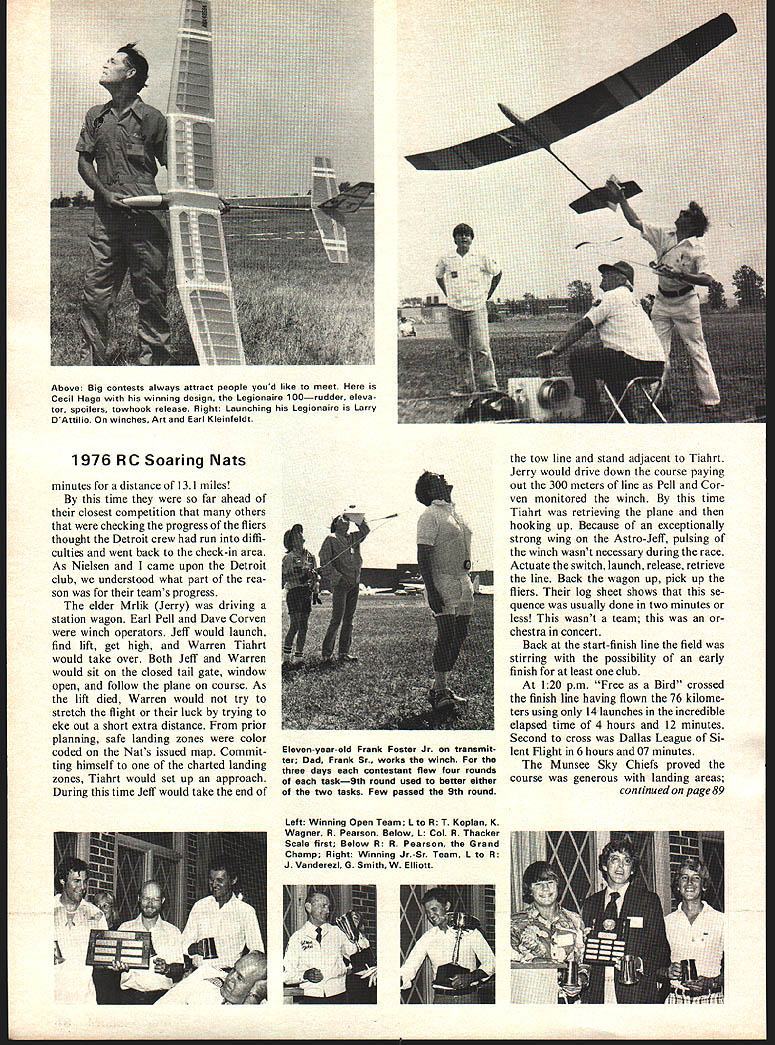
The elder Mrlik (Jerry) was driving a station wagon. Earl Pell and Dave Corven were winch operators. Jeff would launch, find lift, get high, and Warren Tiahrt would take over. Both Jeff and Warren would sit on the closed tailgate, window open, and follow the plane on course. As the lift died, Warren would not try to stretch the flight or their luck by trying to eke out a short extra distance. From prior planning, safe landing zones were color-coded on the Nats' issued map. Committing himself to one of the charted landing zones, Tiahrt would set up an approach. During this time Jeff would take the end of the tow line and stand adjacent to Tiahrt. Jerry would drive down the course paying out the 300 meters of line as Pell and Corven monitored the winch. By this time Tiahrt was retrieving the plane and then hooking up. Because of an exceptionally strong wing on the Astro-Jeff, pulsing of the winch wasn't necessary during the race. Actuate the switch, launch, release, retrieve the line. Back the wagon up, pick up the fliers. Their log sheet shows that this sequence was usually done in two minutes or less! This wasn't a team; this was an orchestra in concert.
Back at the start-finish line the field was stirring with the possibility of an early finish for at least one club.
At 1:20 p.m. "Free as a Bird" crossed the finish line having flown the 76 kilometers using only 14 launches in the incredible elapsed time of 4 hours and 12 minutes. Second to cross was Dallas League of Silent Flight in 6 hours and 07 minutes. They made 52. Over 200 safe landings were made by the different clubs which indicated that, although the course was challenging, it was safe. The maps that were issued by S.O.A.R. were most detailed by the Detroit and Dallas clubs. Their results indicate they did their homework well.
July 19-20-21
On Monday promptly at 8 a.m. Chris Adams launched his Windsock and the first of nearly 600 flights for that day was on its way. The tasks: 2-minute precision or 6-minute duration; you made a choice within the first minute after release. For three days each contestant would fly four rounds of each task. The ninth round would be used to better either of the two tasks but the contestant would have to declare which task before launching for the ninth round. If a contestant felt the score was good enough the ninth round could be passed. Few did. For the big difference between the 1975 R/C Soaring Nationals and 1976 was wind—and there was enough for everybody.
While in 1975 the 8-10 mph offered little trouble, the 22-30 mph on the second day this year did make six-minute maxes challenging. However, Scale—all 12 entries—flew. And mishaps in that event were minor. At the end of the second day a record rain fell in the area and the third day was a bit soggy—and rain still threatened. But the 190 contestants—largest crowd ever for a thermal soaring contest—cooperated and the three days went as scheduled.
This was the first year three classes were recognized. Class A had 42 entries; Class B, 57; and Class C, 87. Scale had 12 entries (four of these flew Scale only). Contestants competed within their respective classes for awards in the separate tasks; however, all scores were combined for the Grand Champion award.
Rick Pearson, flying a Craft-Air "Sailaire," passed the ninth round and tried to act relaxed as others attempted to "wild-card" their way into the Grand Champion slot. All failed and Rick's 3,480 points out of a possible 3,680 gave him the honors of the 1976 R/C Soaring Nationals Champion.
Some repeats this year: The San Fernando Valley Silent Flyers with Terry Koplan, Rick Pearson, and Ken Wagner took home the Open-age class trophies. This was the second year in a row for the SFVSFs as it was for the Junior-Senior team of Greg Smith, Bill Elliott, and Jim Vanderzyl of the Rocket City Radio Controllers, of Huntsville, Alabama.
In Scale Col. Bob Thacker won for the second time in as many years with his Baby Bowlus. His 391 points out of a possible 500 were highest in static judging while Don Edberg's 350 flight points out of 500 were highest in flying tasks.
Twenty-four states were represented with California nosing out Michigan 33 to 32 in the "we had more than you" category. Five from Canada and, for the first year, five from Mexico competed. This was the fourth year that Lewis University let the soaring fraternity have use of their facilities and their generosity helped make the '76 R/C Nationals the biggest and best ever.
Transcribed from original scans by AI. Minor OCR errors may remain.

