
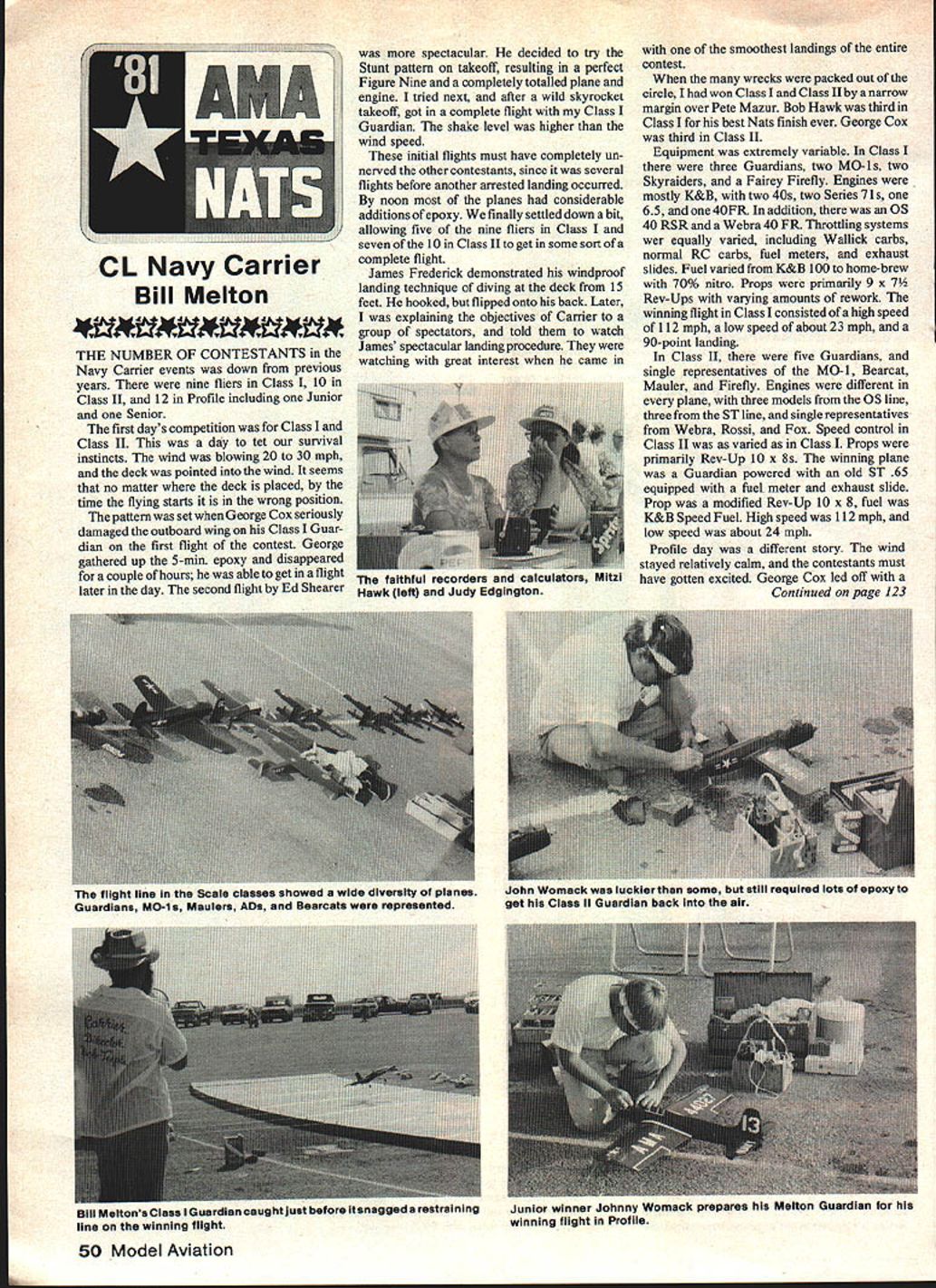
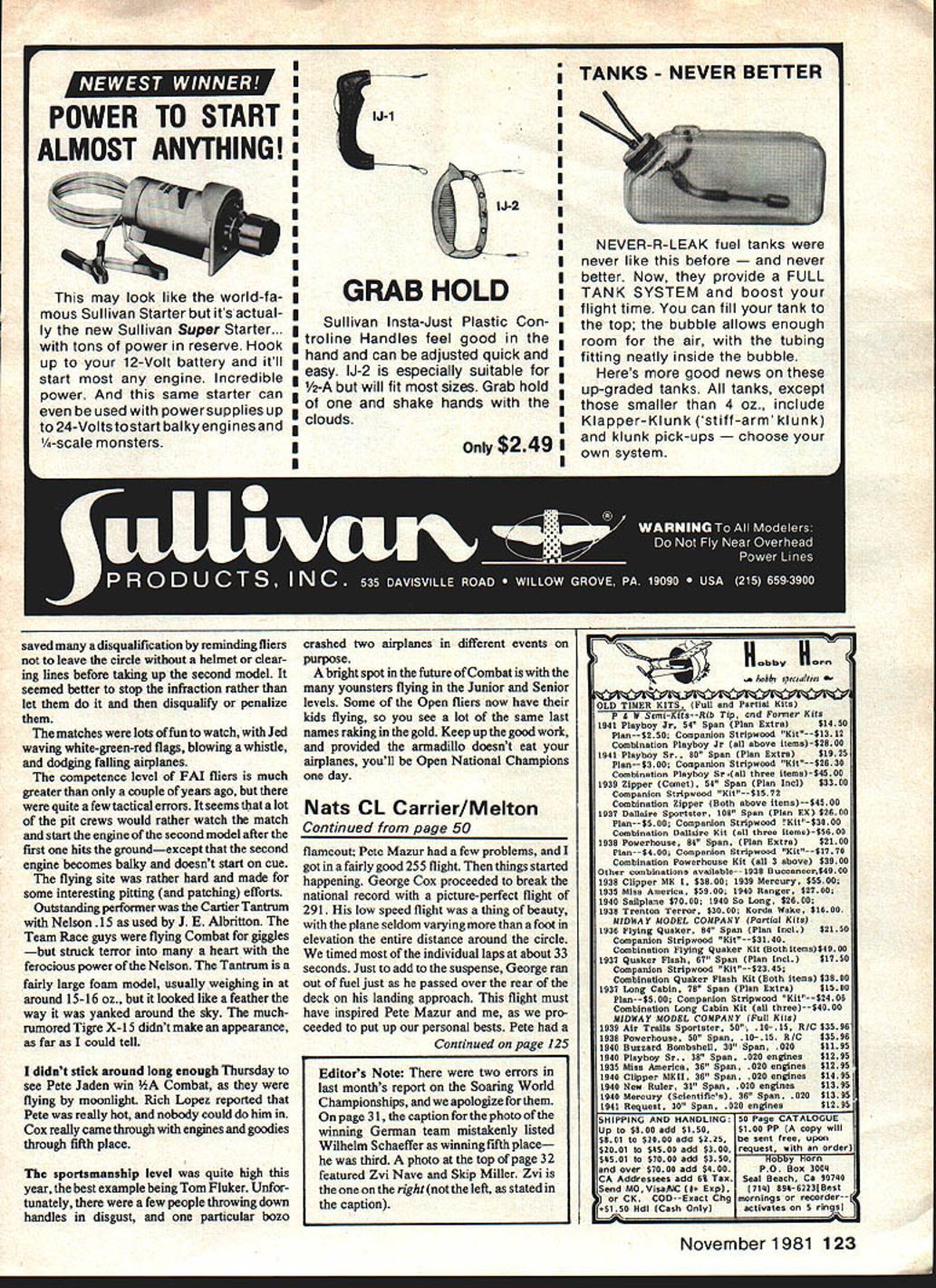
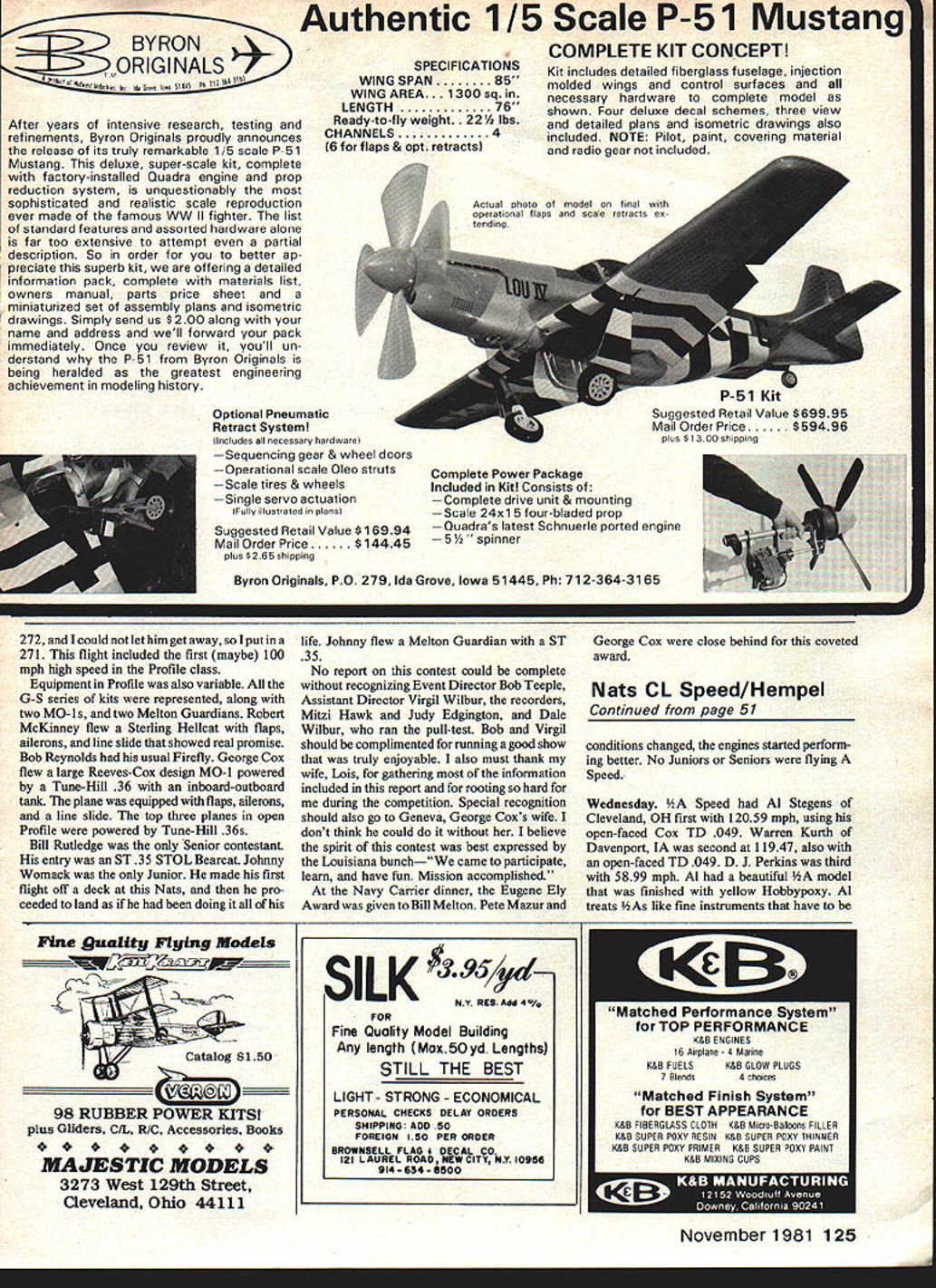
'81 AMA Texas Nats: CL Navy Carrier
Bill Melton
Overview
The number of contestants in the Navy Carrier events was down from previous years. There were nine fliers in Class I, ten in Class II, and 12 in Profile, including one Junior and one Senior.
The first day's competition (Class I and Class II) was a day to test our survival instincts. The wind was blowing 20 to 30 mph, and the deck was pointed into the wind. It seems that no matter where the deck is placed, by the time the flying starts it is in the wrong position.
Class I and Class II
The pattern was set early when George Cox seriously damaged the outboard wing on his Class I Guardian on the first flight of the contest. George gathered up the 5-minute epoxy and disappeared for a couple of hours; he was able to get in a flight later in the day. The second flight by Ed Shearer was more spectacular. He decided to try the stunt pattern on takeoff, resulting in a perfect figure nine and a completely totaled plane and engine. I tried next, and after a wild skyrocket takeoff got in a complete flight with my Class I Guardian. The shake level was higher than the wind speed.
Those initial flights must have unnerved the other contestants, since it was several flights before another arrested landing occurred. By noon most of the planes had considerable additions of epoxy. We finally settled down a bit, allowing five of the nine fliers in Class I and seven of the ten in Class II to get in some sort of complete flight.
James Frederick demonstrated his windproof landing technique of diving at the deck from 15 feet. He hooked, but flipped onto his back. Later, I was explaining the objectives of Carrier to a group of spectators and told them to watch James' spectacular landing procedure. They were watching with great interest when he came in with one of the smoothest landings of the entire contest.
When the many wrecks were packed out of the circle, I had won Class I and Class II by a narrow margin over Pete Mazur. Bob Hawk was third in Class I for his best Nats finish ever. George Cox was third in Class II.
Class I equipment and details:
- Airframes: three Guardians, two MO-1s, two Skyraiders, one Fairey Firefly.
- Engines: mostly K&B — two .40s, two Series 71s, one .06.5 (6.5?), one .40 FR; plus an OS .40 RSR and a Webra .40 FR.
- Throttle control: varied — Wallick carbs, normal RC carbs, fuel meters, and exhaust slides.
- Fuel: ranged from K&B 100 to home-brew mixes with up to 70% nitro.
- Props: primarily 9 x 7 Rev-Ups with varying amounts of rework.
- Winning flight (Class I): high speed ~112 mph, low speed ~23 mph, and a 90-point landing.
Class II equipment and details:
- Airframes: five Guardians, and single representatives of the MO-1, Bearcat, Mauler, and Firefly.
- Engines: every plane had a different engine — three OS models, three ST models, and single representatives from Webra, Rossi, and Fox.
- Speed control: as varied as in Class I.
- Props: primarily Rev-Up 10 x 8s (modified).
- Winning plane: Guardian powered by an older ST .65 with a fuel meter and exhaust slide; fuel was K&B Speed Fuel.
- Winning flight (Class II): high speed ~112 mph, low speed ~24 mph.
Profile
Profile day was a different story. The wind stayed relatively calm, and the contestants must have gotten excited. George Cox led off with a flameout; Pete Mazur had a few problems, and I got in a fairly good 255 flight. Then things started happening.
George Cox proceeded to break the national record with a picture-perfect flight of 291. His low-speed flight was a thing of beauty, with the plane seldom varying more than a foot in elevation the entire distance around the circle. We timed most of the individual laps at about 33 seconds. Just to add to the suspense, George ran out of fuel as he passed over the rear of the deck on his landing approach.
That flight must have inspired Pete Mazur and me, as we proceeded to put up our personal bests. Pete had a 272, and I could not let him get away, so I put in a 271. My flight included what may have been the first 100 mph high speed in the Profile class.
Profile equipment and pilots:
- Airframes: all the G-S series kits were represented, along with two MO-1s and two Melton Guardians.
- Notable entries: Robert McKinney flew a Sterling Hellcat with flaps, ailerons, and line slide that showed real promise; Bob Reynolds flew his usual Firefly.
- George Cox flew a large Reeves-Cox design MO-1 powered by a Tune-Hill .36 with an inboard-outboard tank; the plane had flaps, ailerons, and a line slide.
- The top three planes in open Profile were powered by Tune-Hill .36s.
- Senior contestant: Bill Rutledge — ST .35 STOL Bearcat.
- Junior contestant: Johnny Womack — Melton Guardian with an ST .35. Johnny made his first flight off a deck at this Nats and landed as if he had been doing it all his life.
Results (highlights)
- Class I winner: Bill Melton (narrow margin over Pete Mazur).
- Class I third: Bob Hawk.
- Class II winner: Bill Melton (narrow margin over Pete Mazur).
- Class II third: George Cox.
- Profile: George Cox set a new national record with 291; Pete Mazur 272; Bill Melton 271.
Acknowledgments and Awards
No report on this contest could be complete without recognizing the event staff and helpers:
- Event Director: Bob Teeple
- Assistant Director: Virgil Wilbur
- Recorders: Mitzi Hawk and Judy Edgington
- Pull-test: Dale Wilbur
Bob and Virgil should be complimented for running a good show that was truly enjoyable. Special thanks to my wife, Lois, for gathering most of the information included in this report and for rooting so hard for me during the competition. Special recognition should also go to Geneva, George Cox's wife — I don't think he could do it without her.
I believe the spirit of this contest was best expressed by the Louisiana bunch: "We came to participate, learn, and have fun. Mission accomplished."
At the Navy Carrier dinner, the Eugene Ely Award was given to Bill Melton. Pete Mazur and George Cox were close behind for this coveted award.
Transcribed from original scans by AI. Minor OCR errors may remain.

