

'81 AMA Texas Nats: Nats 81
It started with a letter about three years ago. Charles Parish of the San Antonio model club—the Alamo R/C Society—wrote to AMA headquarters and suggested that his area might have what it takes to put on a National Model Airplane Championships. He specifically noted that Brooks Air Force Medical Center was available as the keystone of a package of facilities that could be used for a Nats.
AMA’s Nats Executive Committee investigated and concluded that while Brooks was not suitable for holding enough events, a separate site for Free Flight—Randolph Auxiliary Air Field, about 35 miles away at Seguin, TX—appeared ideal for accommodating most R/C events and all Control Line events, in addition to the Free Flight contests.
The committee noted that the Seguin site offered a return to what many perennial Nats contestants seemed to want: a main Nats base with most events on the same airfield. The last time this had been possible was 1978 at Lake Charles, LA. Seguin also offered advantages—mainly a lack of trees and buildings that interfere with Free Flight model retrieval. There were some disadvantages, but these were felt to be outweighed by the superior layout for most events.
The site did lack a suitable Nats headquarters building. Two alternatives were considered acceptable: use the modern coliseum or convention-type building in Seguin, about four miles away, or use rented trailers on the main site. The main drawback, however, was more serious: the need to use an indoor site at a different time and much farther away than ever before.
Looking back at the previous year, when the Nats Committee in Ohio had opted for a relatively near indoor site rather than the superior but more distant West Baden, IN site, it was clear that convenience should not outweigh the quality of the site. Thus the committee decided a better site at a different time and place was preferable to an unsatisfactory but nearer location. For the first time the Indoor Nats were held almost as an independent operation—nearly two months earlier, in June, at West Baden. Attendance was good (higher than had been typical) and most attendees spoke favorably afterward about using West Baden again regardless of where the rest of the Nats was held. The indoor event paid its own way, covering costs without the usual subsidy from other Nats income.
Many who attended the Seguin events were disappointed that they could not see the Indoor flying, even though they did not fly that category; they enjoyed watching it. Aside from that disappointment, the 1981 Outdoor Nats was a very happy experience for most participants.
Weather helped. Although it was very hot during the whole Nats period, it didn’t rain and winds were generally moderate. Most Free Flight models stayed on the field, and when they did not, retrievals were usually easy. Many Free Flighters called it the best Nats site they had ever flown on, with only a few instances of models being retrieved in troublesome conditions.
Control Line fliers were generally pleased as well—good surface and plenty of extra space for practice circles. Having Combat right in the same area also helped, contrasting with the isolated locations used at past Nats.
Some problems occurred but were quickly handled. Speed pylons coming loose in the ground caused initial consternation but were remedied by pouring new concrete to improve anchoring. Radio control event fliers got flights as usual: Pattern, for example, ran six full rounds for everybody instead of the four rounds that have been typical at recent Nats. Pylon fliers enjoyed the usual 18 heats (Quarter, Mid, Final) and 13 Formula.
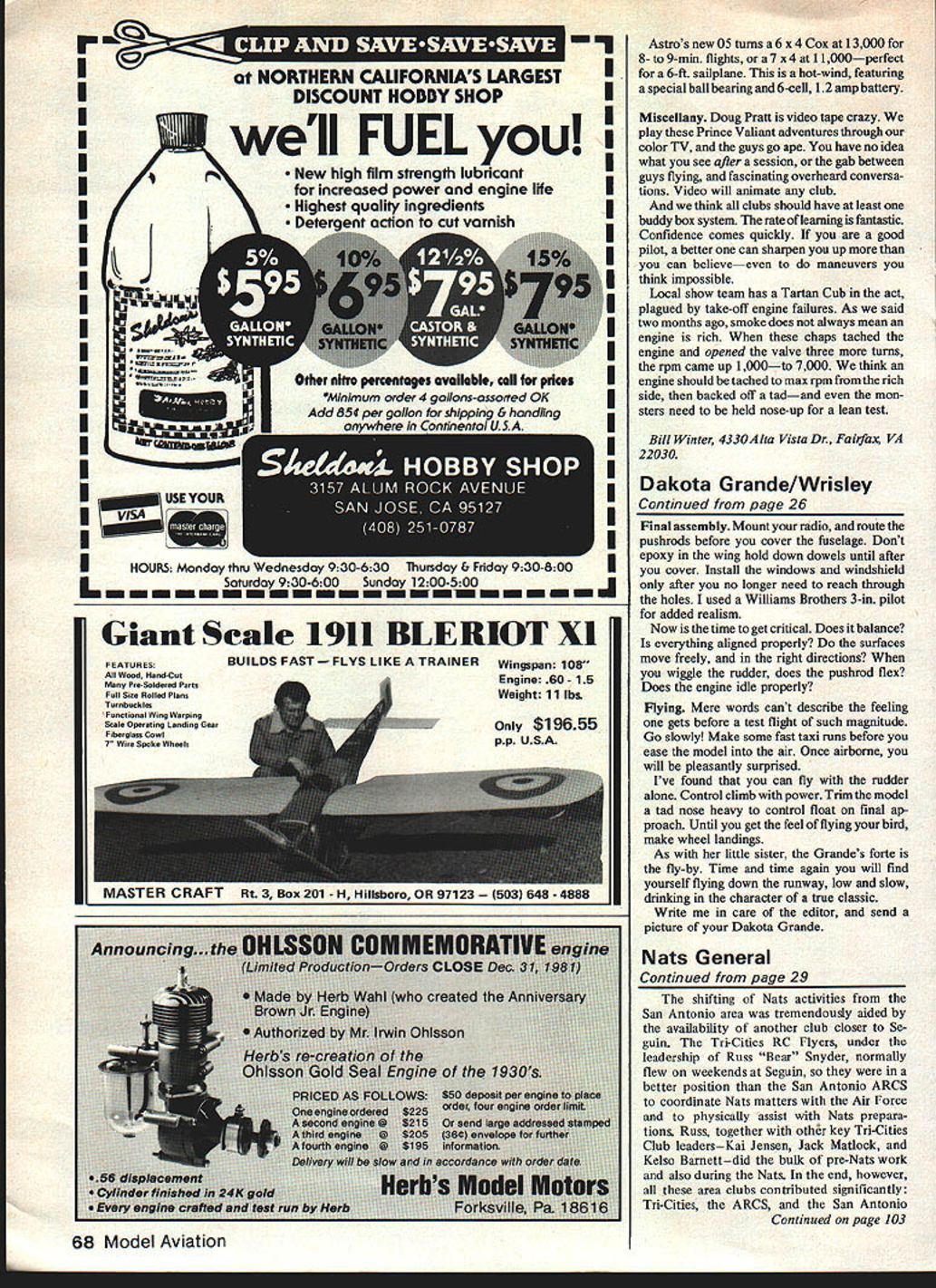
RC Soaring had four fine days and proved to be a good site, although there were anxious moments the weekend before Nats flying began. After several months of searching for an ideal site within reasonable distance, a compromise location chosen days before the Nats began turned out to be unsuitable—the high grass and straw had to be mowed. A last-minute scramble turned up a much better site a little nearer Seguin, and the Soaring event proceeded happily. Several sites equivalent to the new site, however, had previously been rejected as not being long enough or as being too narrow. The lot-searching effort and last-minute panic could have been avoided if acceptance standards had been clearly defined at the start.
Because of logistics and personnel-staffing problems, the Soaring site decision was made mid-Nats week. The RC Helicopter site was the Soaring location 15 miles away, with a Seguin school site five miles away. That proved a happy decision: many more people got to see the Helicopter activity than would have been likely at the remote Soaring site. In fact, many observed that Soaring could have been held where the Helicopters were flown—the site was even better than the one finally used for Soaring. Ironically, that site had previously been rejected for Soaring because it supposedly did not meet the criteria for that activity. As a result of the wasted effort and hundreds of miles driven to search for suitable Soaring sites, the criteria for Soaring at the next Nats are being revised.
Prop Busters
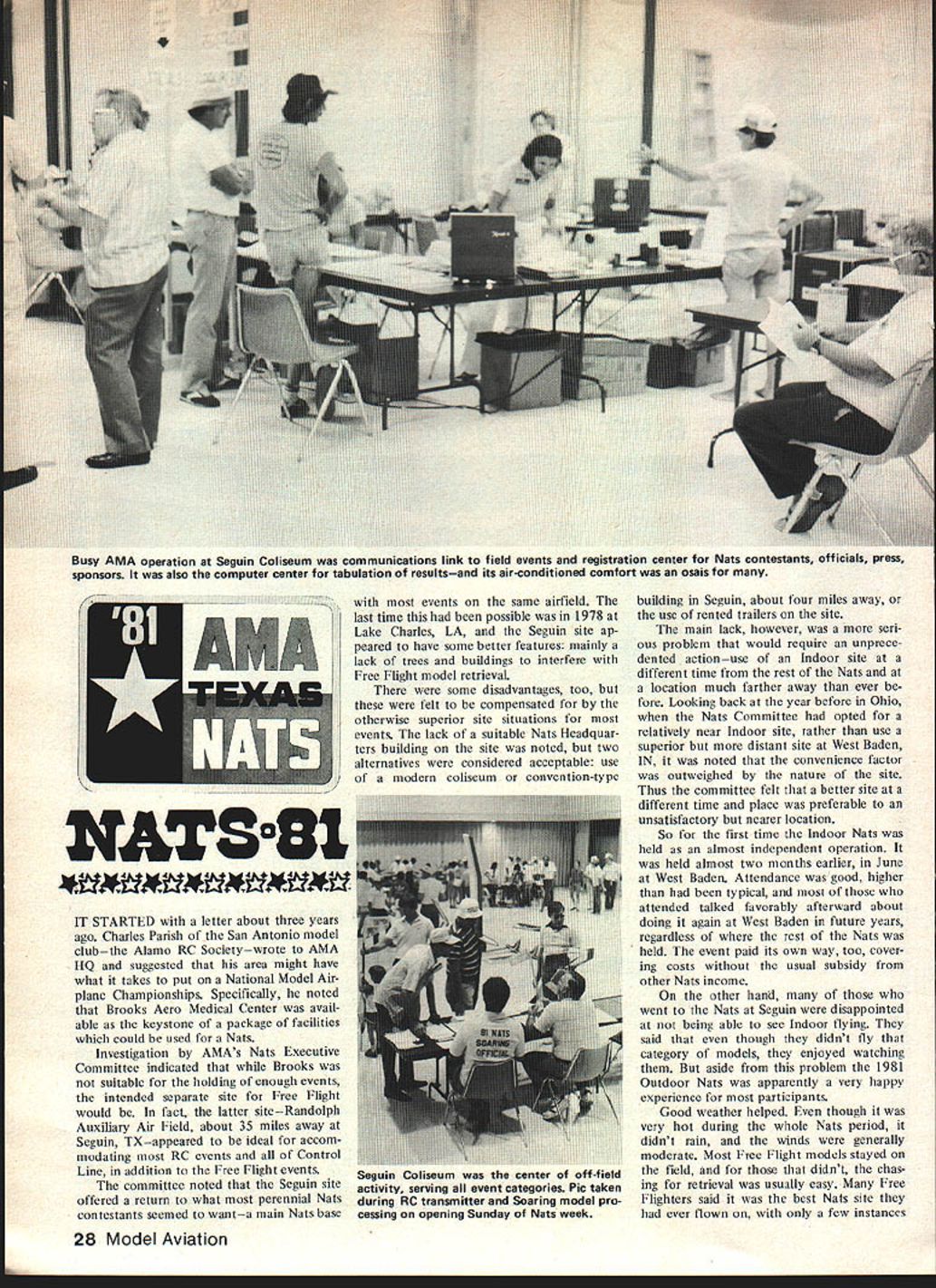
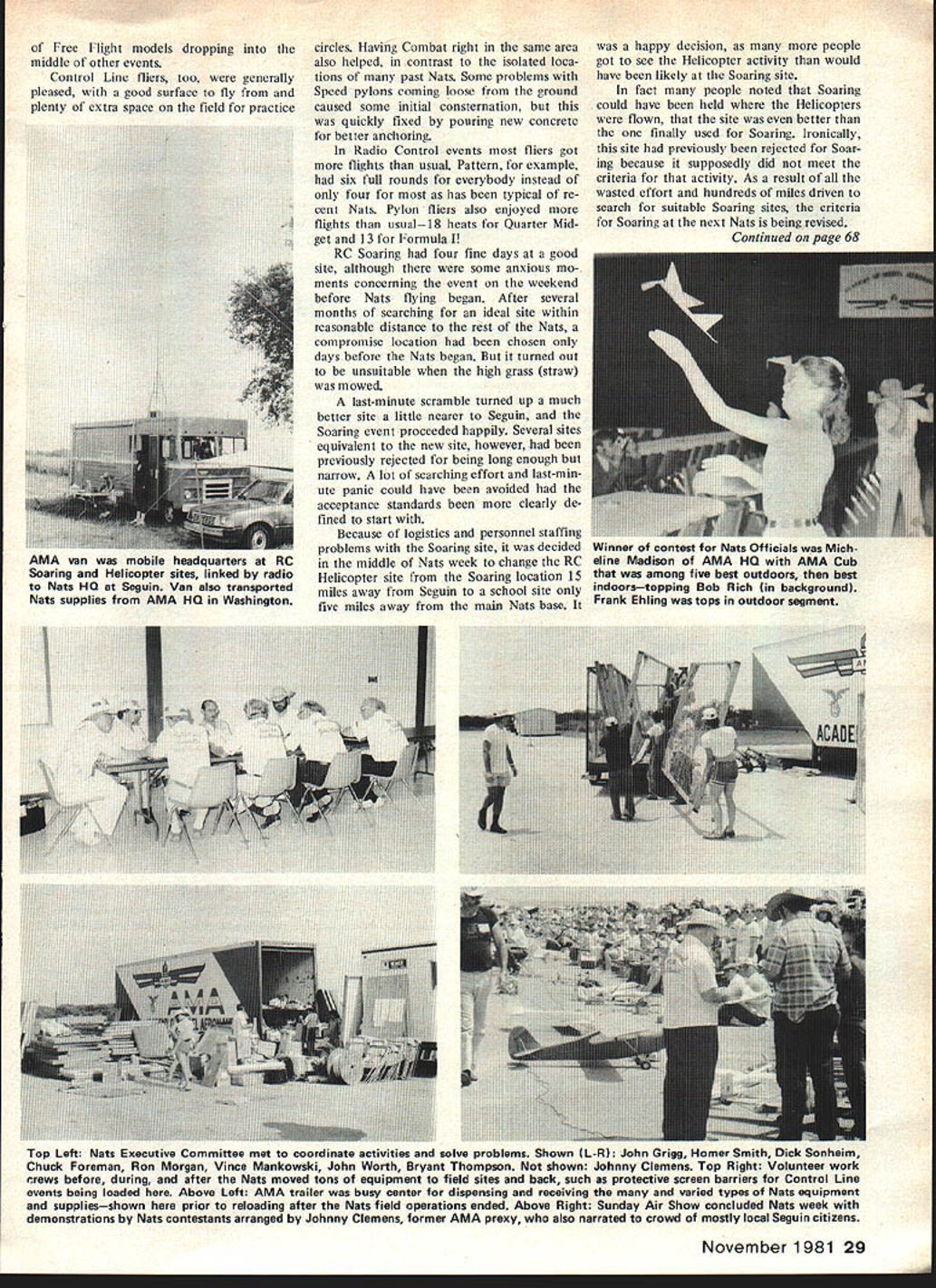
Different from the usual Nats situation this year was the off-site HQ operation. Located about four miles from the main airfield activity and right in the town of Seguin, the headquarters operation worked out very well. The modern convention-type building, the Seguin Coliseum, was used. With ample parking and adequate space inside, the clean, new, and fully air-conditioned facility was a dramatic contrast to the old deteriorated military buildings of many previous Nats.
The HQ building was a welcome oasis for fliers and officials seeking relief from the very hot field events. It became a gathering place much like the Nats hangars of old, a center for many different activities. Besides the usual Nats HQ office operation, the coliseum housed the Scale models for display and judging and served as the model processing center for all categories. At one time it was full of Control Line Precision Aerobatics models being judged for appearance points, then filled with RC Formula I Pylon Racing models.
Meetings for MACA, PAMPA, and other special-interest groups were held in the coliseum, as was the annual AMA Open Meeting. It housed the Nats Hobby Shop, Trophy Pickup, and Souvenir Sales operations, as well as the Press Headquarters and the Nats computer tabulation operation. From 8 a.m. until 10 p.m. it was the constant hub of off-field activity. It worked so well that serious thought is being given to future Nats operations designed around the same concept.
Availability of the Seguin Coliseum was arranged by its manager, Lloyd Strott. He and the head of the Seguin Chamber of Commerce, Stan Ledbetter, were extremely helpful throughout the Nats. They welcomed us, cooperated in solving problems, and helped promote the Nats throughout the Seguin area. The coliseum staff were constantly helpful in arranging seating and tables, operating the building’s food and drink concession, and keeping the coliseum clean and comfortable. Special thanks to Maria Resendez, Pinkie Applewhite, Juan Garcia, Cecil Todd, and Willie Applewhite, Jr.
Obtaining trophies at this year’s Nats was much better than last year. A short-cut manual system was used to work around day differences involving computer tabulation of event winners. Many trophies were awarded at field events right after they ended. Although the computer operation still had problems (not as bad as the previous year), these issues did not affect the Nats operation as seriously as before.
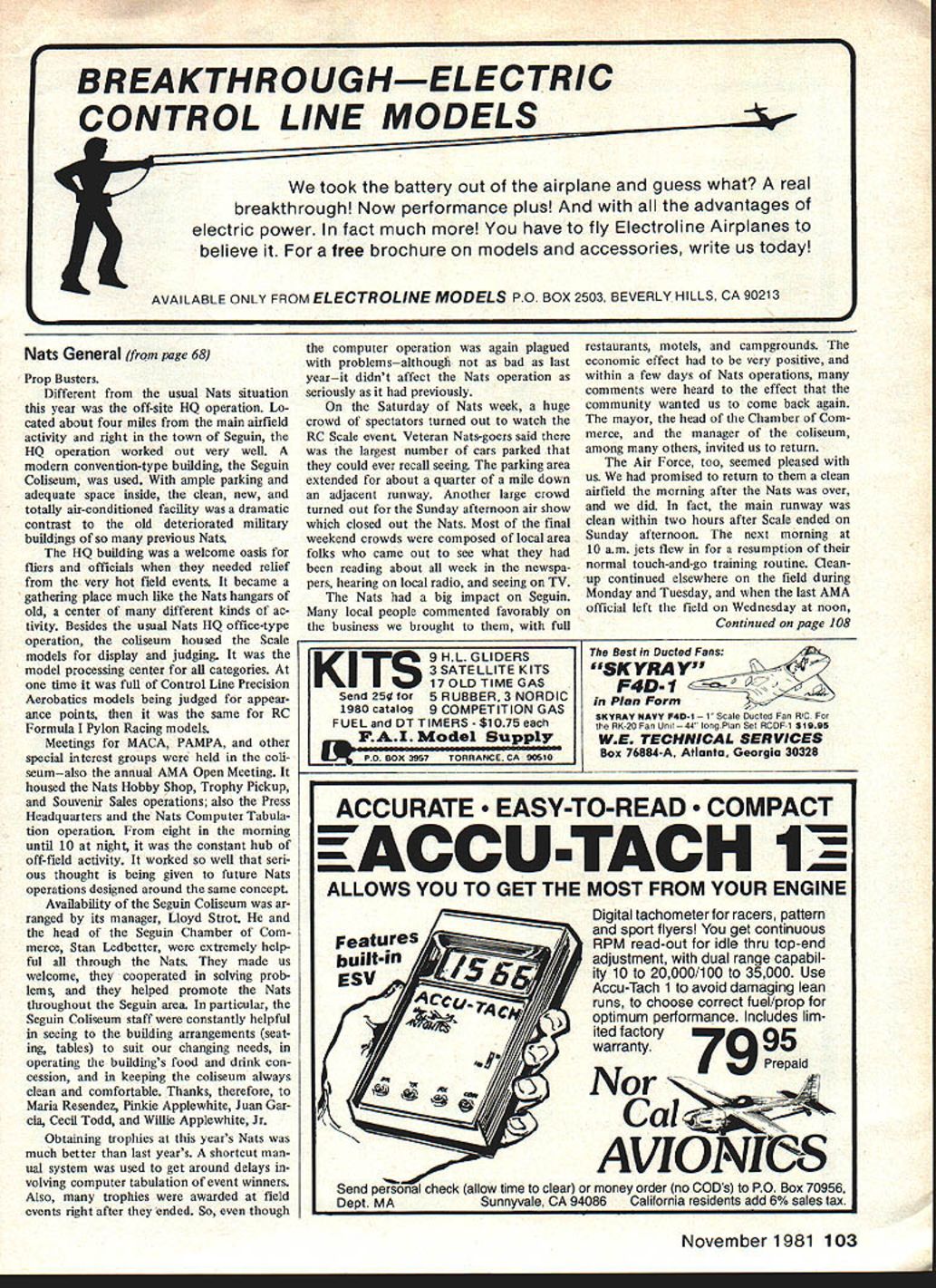
On the Saturday of Nats week, a huge crowd of spectators turned out to watch the RC Scale event. Veteran Nats-goers said there were the largest number of cars parked that they could recall—the parking area extended about a quarter of a mile down an adjacent runway. Another large crowd turned out for the Sunday afternoon air show that closed out the Nats. Most of the final weekend crowds were local people who had heard about the event on the radio, read about it in newspapers, and seen it on TV.
The Nats had a big economic impact on Seguin. Many local people commented favorably on the business brought to restaurants, motels, and campgrounds. Within a few days many community members said they wanted us to come back. The mayor, the head of the Chamber of Commerce, and the manager of the coliseum, among others, invited us to return.
The Air Force was pleased as well. We had promised to return the airfield clean the morning after the Nats ended, and we did. The main runway was clean within two hours after Scale ended on Sunday afternoon. Jets resumed touch-and-go training the next morning at 10 a.m. Cleanup continued elsewhere on the field during Monday and Tuesday, and when the last AMA official left the field on Wednesday at noon there wasn’t a sign—except for some white circles on the ground—that there had ever been a Nats at Seguin. The same was true at the coliseum—no signs of our presence remained.
Seguin won’t be forgotten, and the Nats will undoubtedly return there someday. It was largely a very happy Nats, probably with the best facilities ever. Too bad more people did not come to enjoy it along with those who did—they missed a good one.
About 700 contestants participated, along with about 150 mechanics and about 300 officials:
- Contestants: ~700
- Mechanics: ~150
- Officials: ~300
During the AMA Open Meeting someone commented that more contestants would have come if entry fees had been lower, but it was noted that lower fees would have created greater logistical problems. Twice as many contestants at half the price would have produced the same income while increasing the service and effort required to handle them.
Regardless, it was a great Nats despite the heat and lower-than-expected turnout. With good sites and no interruptions due to weather, most people got to fly as much as they wanted. History should record the 1981 Nats as one of the best ever.
Looking Ahead
Considerable discussion at the Nats centered around two strong possibilities for next year: Lakehurst, NJ and Lincoln, NE. Both have problems regarding Free Flight, and there is talk about a separate Free Flight Nats. If that happens, Lake Charles, LA could be a good site to accommodate both indoor and outdoor events, or outdoor alone. As part of the Lakehurst offer, the dirigible hangar there can take care of indoor events, but many in the Free Flight fraternity prefer indoor and outdoor events to be at the same location.
A decision is expected from the AMA Executive Council when it meets in Washington, DC on November 4. Until then, memories of Seguin from the ’81 Nats are strong and favorable. We’ll probably be back there again in a few years.
—John Worth, AMA Executive Director
Transcribed from original scans by AI. Minor OCR errors may remain.

