

'81 AMA Texas Nats: RC Pattern
Ron Van Putte
Overview
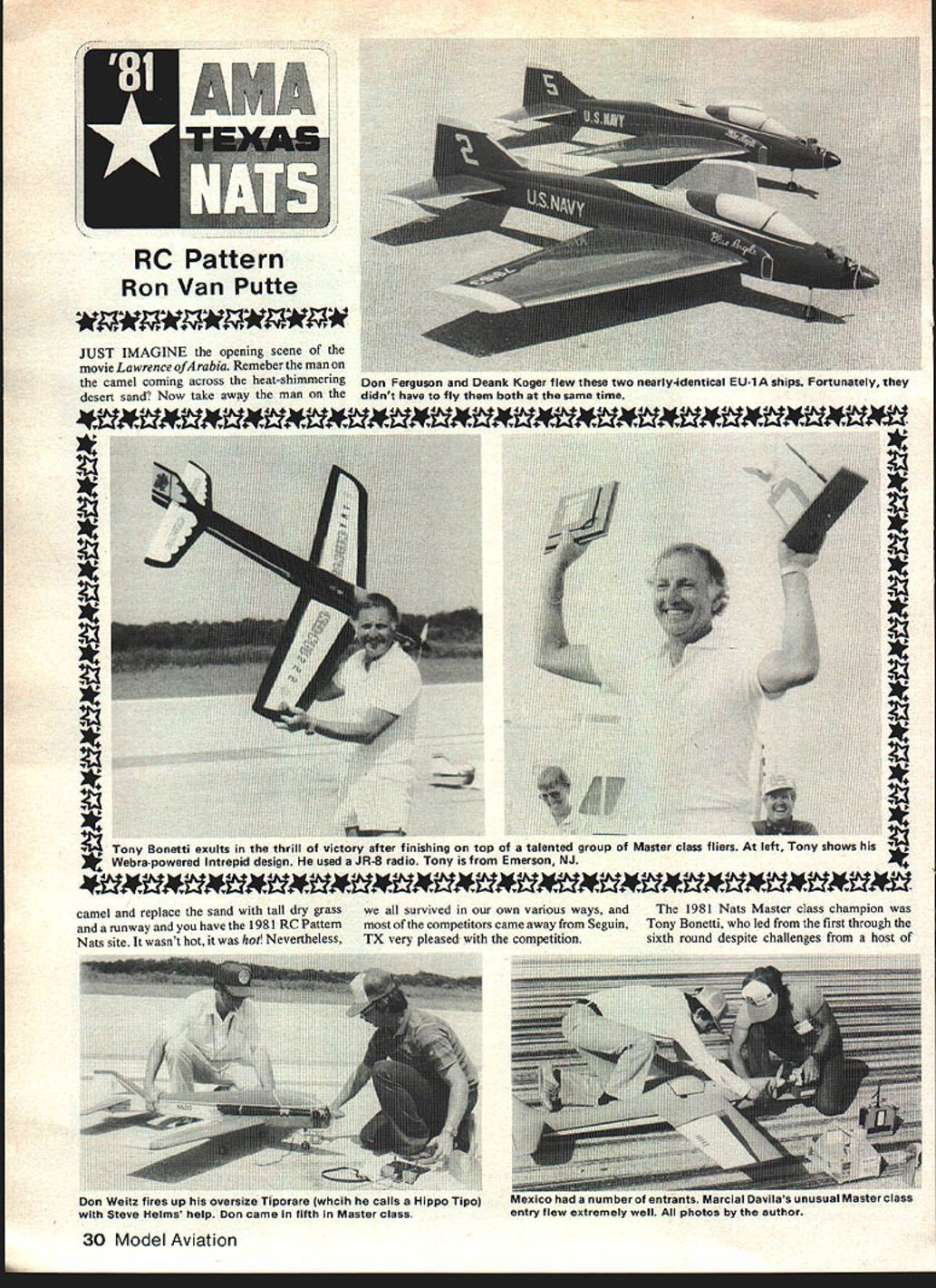
Just imagine the opening scene of the movie Lawrence of Arabia — the man on the camel crossing heat-shimmering sand. Now take away the man on the camel, replace the sand with tall dry grass and a runway, and you have the 1981 RC Pattern Nats site. It wasn't just warm — it was hot. Nevertheless, we all survived in our own various ways, and most competitors came away from Seguin, TX very pleased with the competition.
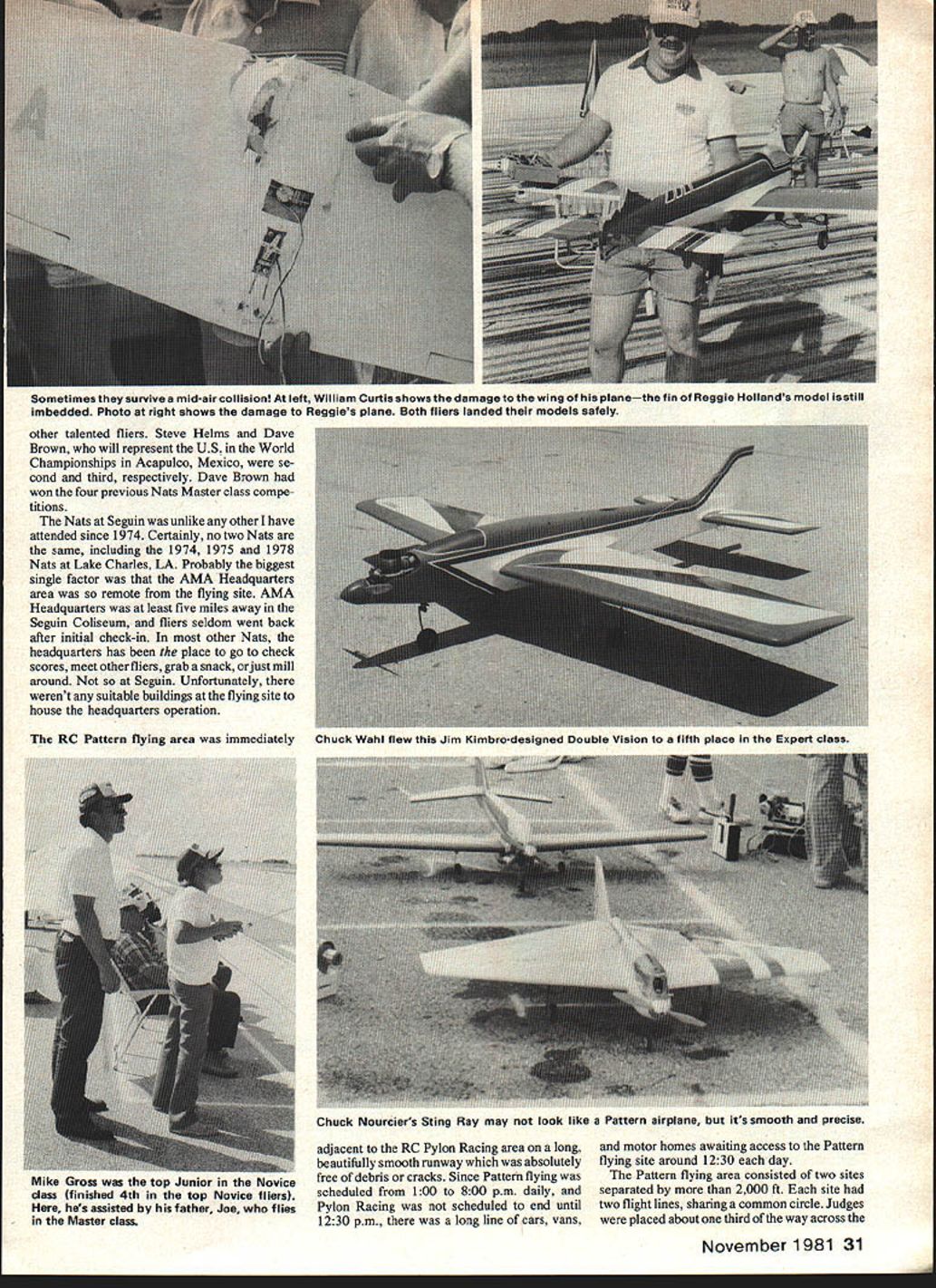
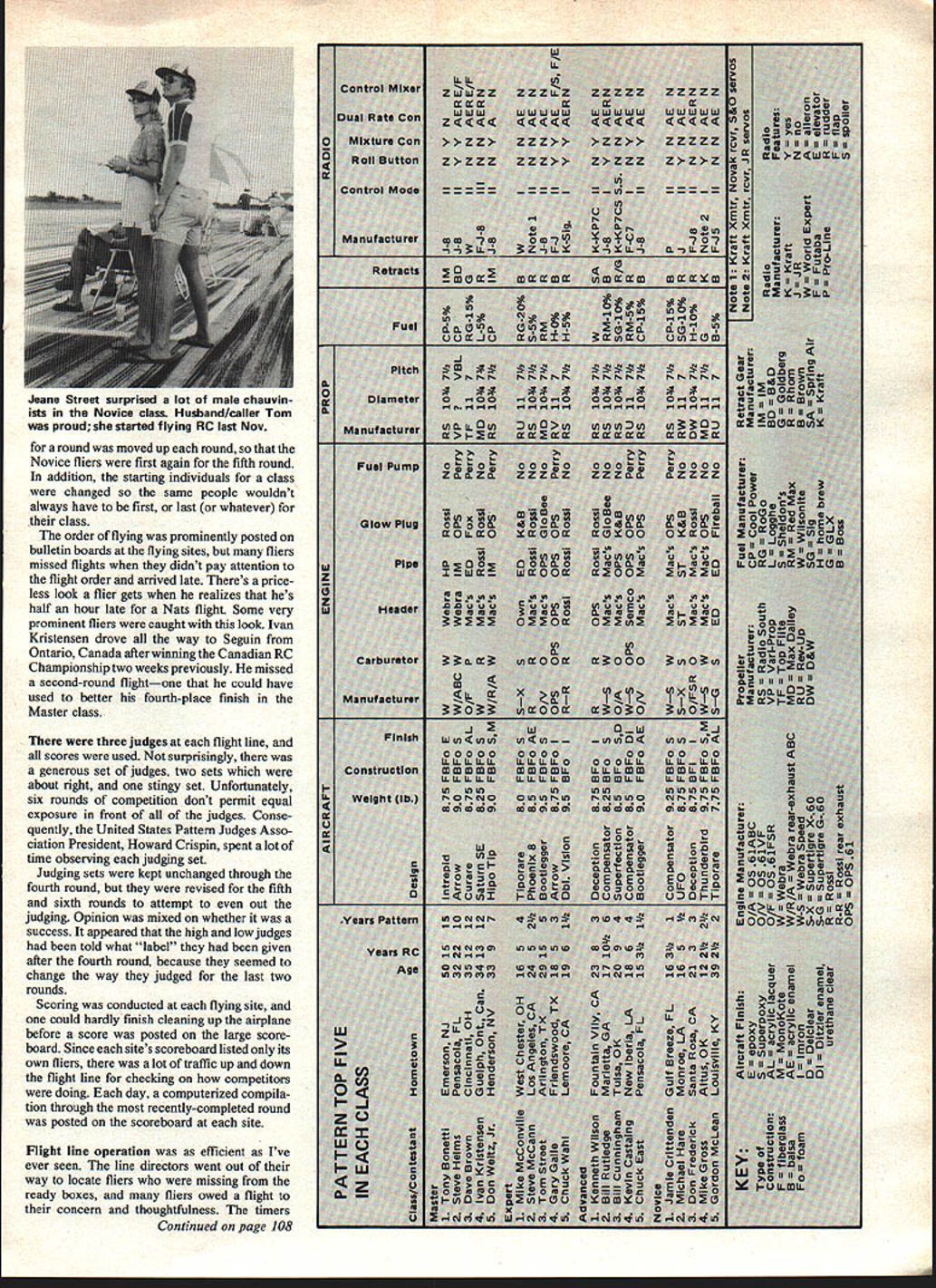
The 1981 Nats Master class champion was Tony Bonetti, who led from the first through the sixth round despite challenges from a host of other talented fliers. Steve Helms and Dave Brown, who will represent the U.S. in the World Championships in Acapulco, Mexico, finished second and third, respectively. Dave Brown had won the four previous Nats Master class competitions.
Site and conditions
The Nats at Seguin was unlike any other I have attended since 1974. One big factor was that AMA Headquarters was remote from the flying site — at least five miles away in the Seguin Coliseum — and fliers seldom returned after initial check-in. In most other Nats, headquarters is where people check scores, meet others, grab a snack, or just mill around. Not so at Seguin. Unfortunately, there weren't any suitable buildings at the flying site to house the headquarters operation.
The RC Pattern flying area was immediately adjacent to the RC Pylon Racing area on a long, beautifully smooth runway absolutely free of debris or cracks. Because Pattern flying was scheduled from 1:00 to 8:00 p.m. daily while Pylon Racing ran until 12:30 p.m., there was a long line of cars, vans, and motor homes awaiting access to the Pattern flying site around 12:30 each day.
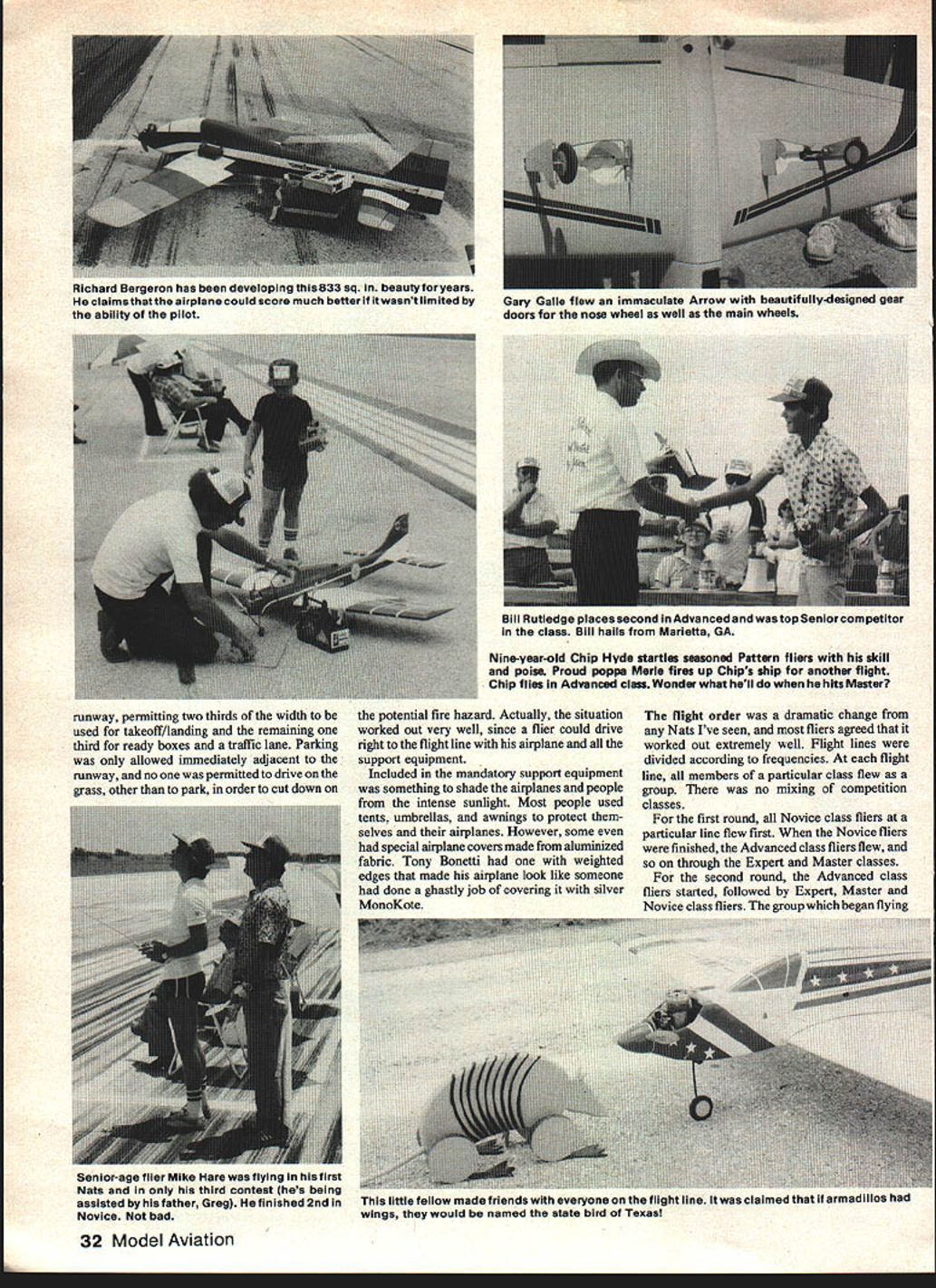
The Pattern flying area consisted of two sites separated by more than 2,000 ft. Each site had two flight lines sharing a common circle. Judges were placed about one third of the way across the runway, permitting two thirds of the width to be used for takeoff/landing and the remaining one third for ready boxes and a traffic lane. Parking was only allowed immediately adjacent to the runway; no one was permitted to drive on the grass other than to park, to reduce fire hazard. The setup worked well, since a flier could drive right to the flight line with airplane and support equipment.
Included in mandatory support equipment was something to shade the airplanes and people from the intense sunlight. Most people used tents, umbrellas, or awnings. Some had special airplane covers made from aluminized fabric — Tony Bonetti had one with weighted edges that made his airplane look as if someone had done a ghastly job of covering it with silver MonoKote.
Flight lines and order
Flight lines were divided according to frequencies. At each line, all members of a particular class flew as a group — there was no mixing of competition classes.
The flight order rotated each round so starting positions moved up, and starting individuals for a class were changed so the same people wouldn't always be first or last. The rotation worked as follows:
- Round 1: Novice → Advanced → Expert → Master
- Round 2: Advanced → Expert → Master → Novice
- Round 3: Expert → Master → Novice → Advanced
- Round 4: Master → Novice → Advanced → Expert
- Round 5: Novice → Advanced → Expert → Master (rotation repeats)
The order of flying was posted prominently on bulletin boards at the flying sites, but many fliers missed flights by not paying attention. There's a priceless look a flier gets when he realizes he's half an hour late for a Nats flight. Some very prominent fliers were caught with that look. Ivan Kristensen, who drove from Ontario after winning the Canadian RC Championship two weeks earlier, missed a second-round flight — one that he could have used to better his fourth-place finish in the Master class.
Judging and scoring
There were three judges at each flight line, and all scores were used. Across judging sets there tended to be one generous set, two about right, and one stingy set. Because six rounds don't permit equal exposure in front of all judges, United States Pattern Judges Association president Howard Crispin spent a lot of time observing each judging set.
Judging sets were kept unchanged through the fourth round, then revised for the fifth and sixth rounds to try to even out judging. Opinion was mixed on whether this succeeded. It appeared that the high and low judges had been told what "label" they had been given after the fourth round, because they seemed to change how they judged for the last two rounds.
Scoring was conducted at each flying site, and you could hardly finish cleaning up your airplane before a score was posted on the large scoreboard. Since each site's scoreboard listed only its own fliers, there was a lot of traffic up and down the flight line checking how competitors were doing. Each day, a computerized compilation through the most recently completed round was posted on the scoreboard at each site.
Flight line operation was as efficient as I've ever seen. Line directors went out of their way to locate fliers missing from their ready boxes, and many fliers owed a flight to their concern and thoughtfulness. Timers gave each flier a countdown during the 1-minute grace period after the previous flier completed his flight and continued through the 3-minute starting period. It was obvious the line operations people were anxious that every flier have a chance to compete — that was really appreciated.
Results and equipment trends
Tony Bonetti's win was largely due to flying extremely well — much better than at the Masters Tournament a month earlier. Both Steve Helms and Dave Brown flew different airplanes than at the Masters Tournament, for different reasons: Steve flew an Arrow instead of his Bootlegger because it had the Vari-Prop variable-pitch system installed and he wanted competition experience with it before the World Championships. Dave Brown flew his three-year-old backup Curare instead of his Tiporare because he didn't want to risk flying his best airplane too much before the World Championships. Whether either could have beaten Tony with other airplanes was much discussed; most thought not.
Notably, very few top finishers in the Expert, Advanced, or Novice classes were over 25 years old — the future looks strong. It was also apparent that every one of the top finishers had an airplane with a tuned pipe and retractable landing gear. In my next column I plan to discuss this fact, since many fliers stopped me to argue against my claim that neither were prerequisites for success in the Novice or Advanced classes.
A first-time Nats competitor
Early on the first day, Don Tillery, the timer on my line, suggested I ask a first-time Nats competitor for his impressions. The model room next to mine belonged to 16-year-old Mike Hare and his father from Monroe, LA. Mike had competed in only two contests before entering the Novice class at the Nats. What follows is a slightly edited version of what he wrote:
"When my dad and I left home for the '81 Nats, we did not know what to expect. This was to be my first large contest, and I'm not ashamed to say that my stomach was full of butterflies.
"My first encounter with the AMA officials was at the Sunday check-in. Never have I seen such good organization.
"As I stood in the transmitter processing line and talked to some of the other contestants, I became aware of the fact that some of the seasoned fliers were just as nervous as I, and it was then that I calmed down.
"I always knew that people in model aviation were friendly, but after the treatment I received from other contestants at the Nats — they are the greatest. If it had not been for one of the Master fliers, Tony Frackowiak, who rebuilt my Super Tigre X-60 from his spare parts after it failed in the first round, I would have been out of the competition.
"Officials, judges and other contestants helped me have a wonderful time that I will long remember."
Mike had a lot of good reasons to remember the 1981 Nats. After he wrote the above, he went on to finish second in the Novice class.
Personal note
As usual, I have an excuse for not finishing higher in the Expert class. I crashed my Phoenix 8 two days before leaving for the Nats due to an aileron servo failure. Bill Johnston, Kraft's Eastern Region Sales Manager, loaned me his backup Super Curare. After four test flights I felt as comfortable with it as with the Phoenix, so the airplane wasn't the excuse. The airplane and engine performed flawlessly at the Nats, so that wasn't the excuse. My friend and caller Frank Prestwood handled the airplane and call sheet perfectly, so that wasn't the excuse either. The truth is that a lot of fliers flew better than I did again this year — and that's my excuse.
Transcribed from original scans by AI. Minor OCR errors may remain.

