
'81 AMA Texas Nats: RC Scale
Bob & Dolly Wischer
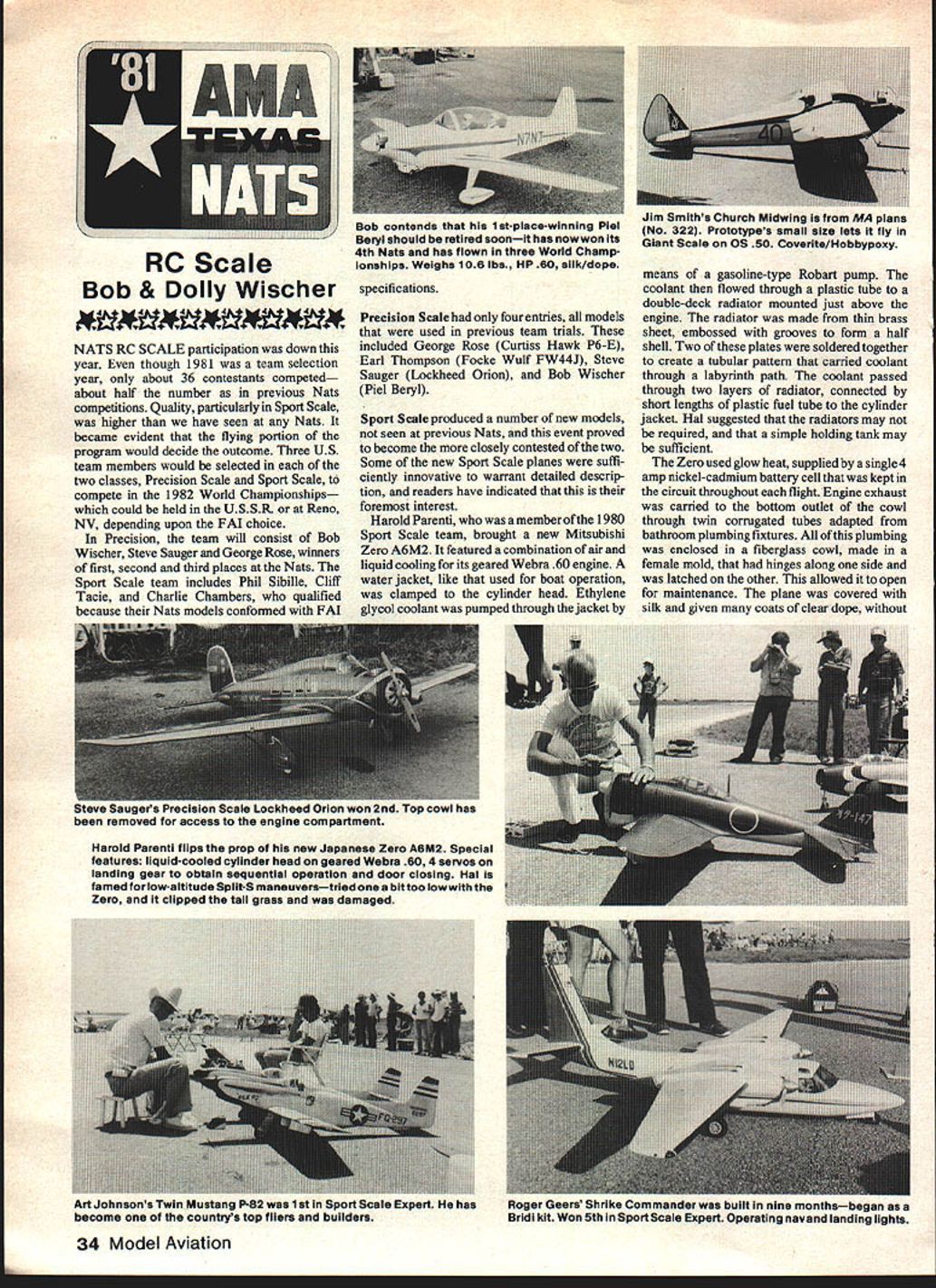
NATS RC Scale participation was down this year. Even though 1981 was a team selection year, only about 36 contestants competed—about half the number in previous Nats competitions. Quality, particularly in Sport Scale, was higher than we have seen at any Nats. It became evident that the flying portion of the program would decide the outcome. Three U.S. team members would be selected in each of the two classes, Precision Scale and Sport Scale, to compete in the 1982 World Championships, which could be held in the U.S.S.R. or at Reno, NV, depending upon the FAI choice.
Team selections
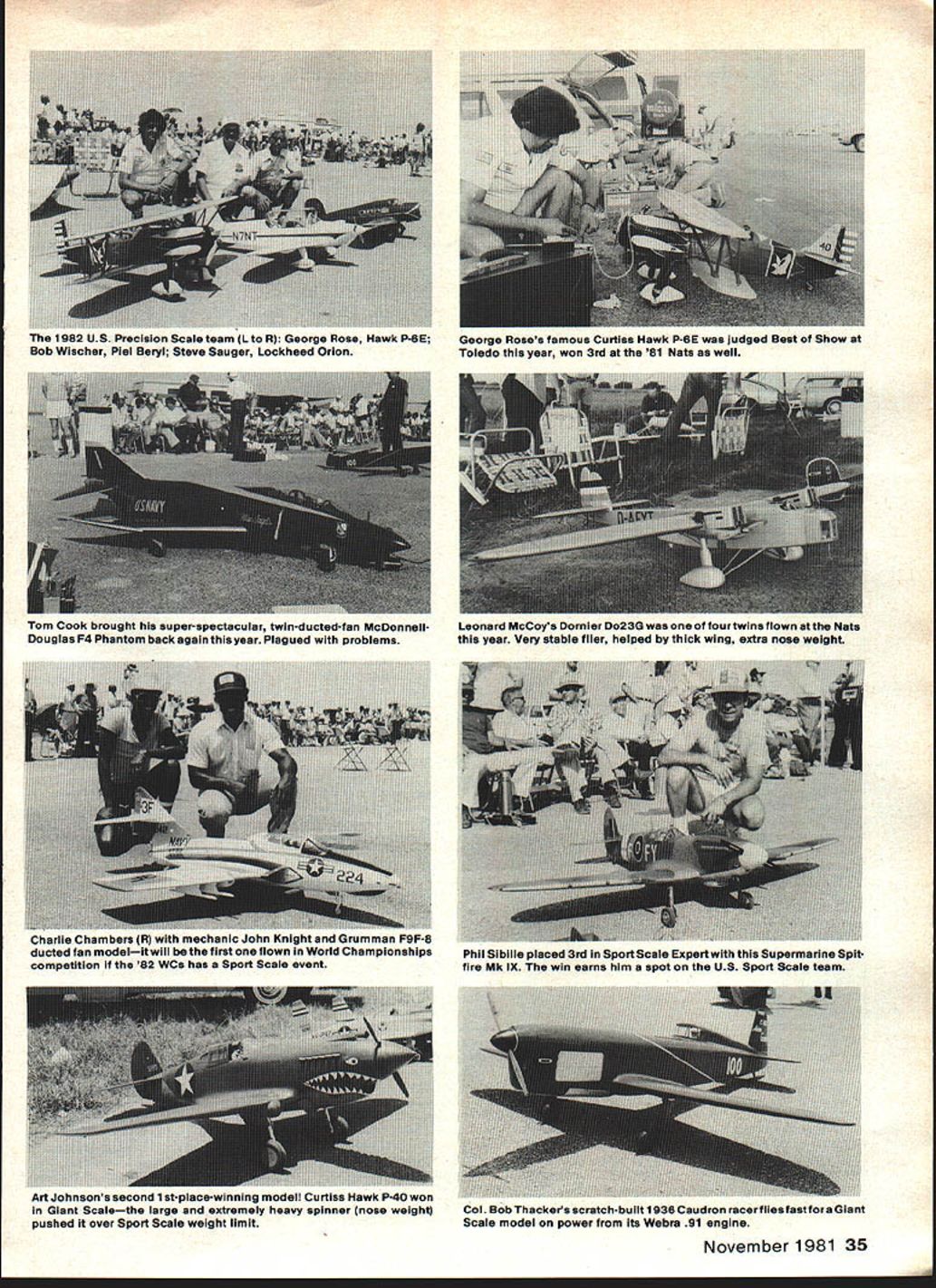
- Precision Scale team: Bob Wischer, Steve Sauger, George Rose (first, second and third places at the Nats).
- Sport Scale team: Phil Sibille, Cliff Tacie, Charlie Chambers (qualified because their Nats models conformed with FAI specifications).
Precision Scale
Precision Scale had only four entries, all models that were used in previous team trials:
- George Rose — Curtiss Hawk P6-E
- Earl Thompson — Focke Wulf FW44J (Stieglitz)
- Steve Sauger — Lockheed Orion
- Bob Wischer — Piel Beryl
Sport Scale
Sport Scale produced a number of new models, not seen at previous Nats, and this event proved to be the more closely contested of the two. Some of the new Sport Scale planes were sufficiently innovative to warrant detailed description.
Harold Parenti (1980 Sport Scale team) brought a new Mitsubishi Zero A6M2. It featured a combination of air and liquid cooling for its geared Webra .60 engine. A water jacket, like that used for boat operation, was clamped to the cylinder head. Ethylene glycol coolant was pumped through the jacket by means of a gasoline-type Robart pump. The coolant then flowed through a plastic tube to a double-deck radiator mounted just above the engine. The radiator was made from thin brass sheet, embossed with grooves to form a half shell. Two of these plates were soldered together to create a tubular pattern that carried coolant through a labyrinth path. The coolant passed through two layers of radiator, connected by short lengths of plastic fuel tube to the cylinder jacket. Hal suggested that the radiators might not be required and that a simple holding tank may be sufficient.
The Zero used glow heat, supplied by a single 4-amp nickel-cadmium cell that was kept in the circuit throughout each flight. Engine exhaust was carried to the bottom outlet of the cowl through twin corrugated tubes adapted from bathroom plumbing fixtures. All of this plumbing was enclosed in a fiberglass cowl, made in a female mold, that had hinges along one side and was latched on the other to allow opening for maintenance. The plane was covered with silk and given many coats of clear dope, without filler, scraped between coats to produce a metallic surface. Aluminum epoxy was the base coat with a final finish of polyurethane, rubbed at wear points to give a worn and weathered appearance.
Because panel lines must be somewhat exaggerated in a Sport Scale model to make them visible from the 15-ft static viewing distance, Hal made them from fishing line epoxied in place. The 11.5-lb Zero featured a drop tank for scale operations and had modified Pro-Line landing gear retraction. The Zero was damaged when it caught the deep grass at the bottom of a split-S maneuver.
Bob Karlsson (1980 U.S. team) flew a new Grumman FM-2 Wildcat with an authentically operating retract system that is as slow as the prototype—requiring 20 seconds. Bob modified a servo to get 2-1/2 revolutions of the output shaft with limit switches. The sprung gear mechanism is mostly fabricated from stainless steel tubing, silver-soldered. The engine is a geared Webra .60. The model is close to the FAI weight limit of 6 kilograms (13+ lb.). The Wildcat fuselage is covered with 4-oz. fiberglass cloth over a foam shell, while wings and tail surfaces are silk and dope. The overall finish is authentic Randolph butyrate dope, weathered to simulate a well-worn, battle-weary fighter. Split flaps are spring loaded so they will not extend until speed has diminished. A similar system is used on the cowl cooling flaps so they remain open on the ground and close automatically when speed increases, without an additional servo. Bob has molded his tires using Flexane 80-durometer material. Because model weight is close to the limit, Bob uses a large aluminum beer can for his fuel tank to save a few ounces.
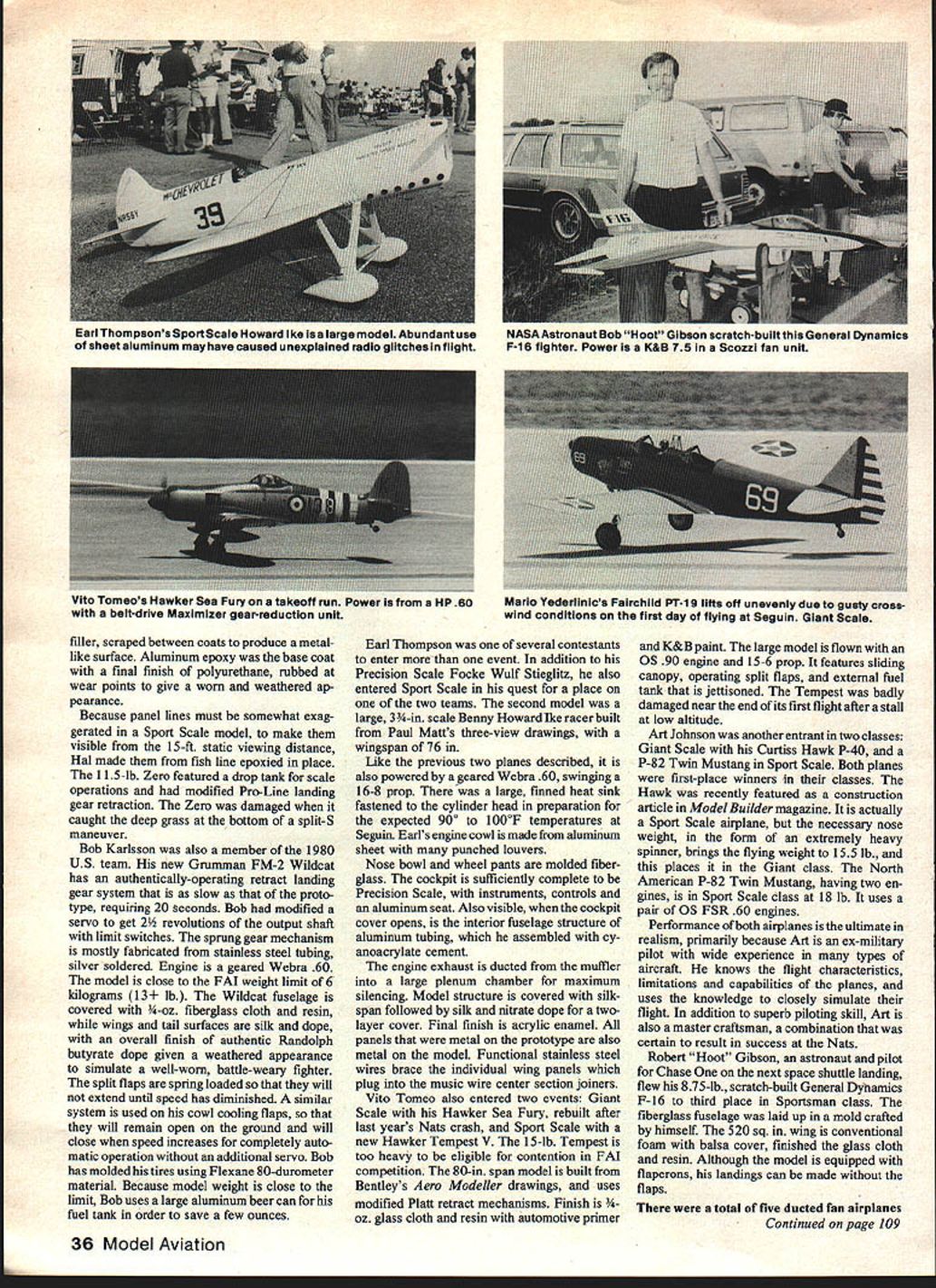
Earl Thompson entered more than one event. In addition to his Precision Scale Focke Wulf Stieglitz, he entered Sport Scale with a large, 3-3/4-in. scale Benny Howard "Ike" racer built from Paul Matt's three-view drawings, with a wingspan of 76 in. It is powered by a geared Webra .60, swinging a 16-8 prop. A large, finned heat sink is fastened to the cylinder head for the expected high temperatures at Seguin. Earl's engine cowl is made from aluminum sheet with many punched louvers. Nose bowl and wheel pants are molded fiberglass. The cockpit is sufficiently complete to be a Precision Scale, with instruments, controls and an aluminum seat. Also visible, when the cockpit cover opens, is the interior fuselage structure of aluminum tubing, assembled with cyanoacrylate cement. The engine exhaust is ducted from the muffler into a large plenum chamber for maximum silencing. Model structure is covered with silk and doped with nitrate dope for a two-layer cover; final finish is acrylic enamel. All panels that were metal on the prototype are metal on the model. Functional stainless steel wires brace the individual wing panels which plug into the music wire center-section joiners.
Vito Tomeo entered two events: Giant Scale with his Hawker Sea Fury (rebuilt after last year's Nats crash), and Sport Scale with a new Hawker Tempest V. The 15-lb Tempest is too heavy to be eligible for FAI contention. The 80-in span model is built from Bentley's AeroModeller drawings and uses modified Pratt retract mechanisms. Finish is 3/4-oz glass cloth and resin with automotive primer and K&B paint. The large model is flown with an OS .90 engine and 15-6 prop. It features a sliding canopy, operating split flaps, and an external fuel tank that is jettisoned. The Tempest was badly damaged near the end of its first flight after a stall at low altitude.
Art Johnson entered two classes: Giant Scale with his Curtiss Hawk P-40, and Sport Scale with a P-82 Twin Mustang. Both planes were first-place winners in their classes. The Hawk was recently featured as a construction article in Model Builder magazine. It is actually a Sport Scale airplane, but the necessary nose weight—a very heavy spinner—brings the flying weight to 15.5 lb., placing it in the Giant class. The P-82 Twin Mustang, having two engines, is in Sport Scale at 18 lb and uses a pair of OS FSR .60 engines.
Performance of both airplanes is the ultimate in realism—primarily because Art is an ex-military pilot who knows the flight characteristics, limitations and capabilities of the aircraft, and uses that knowledge to closely simulate their flight. In addition to superb piloting skill, Art is a master craftsman, a combination that was certain to result in success at the Nats.
Robert "Hoot" Gibson, an astronaut and pilot for Chase One on the next space shuttle landing, flew his 8.75-lb., scratch-built General Dynamics F-16 to third place in the Sportsman class. The fiberglass fuselage was laid up in a molded craft by himself. The 520 sq. in. wing is conventional foam with balsa cover, finished with glass cloth and resin. Although the model is equipped with flaperons, his landings can be made without the flaps.
There were a total of five ducted-fan airplanes at the Nats. Tom Cook returned with his remarkable McDonnell-Douglas F4 Phantom. Tom was plagued by problems on all of his flights; of the four rounds, only two flights were reasonably successful, and the drogue landing parachute (the outstanding feature of his landings) was not deployed. Spectator reaction told the story—he was cheered on each flight. The large, twin-engined model was most popular with the crowd.
Charlie Chambers returned with a Grumman F9F-8 Cougar eligible for a place on the FAI team. Charlie will be the first modeler to fly a ducted fan in international championship competition.
George Rose entered his famous Hawk P6-E Precision Scale craft to be flown in the 1982 World Championships. His second model was a Sport Scale Lockheed P-38 Lightning. George had modified the engine to rotate in the opposite direction, as on the prototype, and found that the feature was really helpful. He carefully peaked his engines with a tachometer before takeoff.
Col. Bob Thacker appeared at the Nats with a Giant Scale model of the 1936 Caudron racer powered by a Webra .91. The 10.4-lb model is covered in FabriKote, finished with K&B epoxy. He used a metal filler scraped between coats to produce a metallic finish. He also used a Williams Brothers plastic model as part of his scale documentation. Flights were spectacular and faster than is usually expected in Giant class.
Roger Geers flew a Rockwell Shrike Commander built from a Bridi kit—one of four twins at the Nats. The model is finished in high gloss with K&B Superpoxy. Roger's flights were very fast, a necessity for safe flying of the 16.5-lb, 79.5-in wingspan plane. Engines are OS .40 FSRs. He used landing and navigational lights as a scale operation. The plane was taxied to takeoff position, turned to face the judges, and the lights were turned on momentarily while being stopped by the Du-Bro nose wheel brake.
Second place in Sport Scale Expert class was won by Leonard McCoy and his twin-engined Dornier Do 23G, built from Don Srull's plans. In contrast with some previous Nats, when twin engines were a detriment due to unreliability, all twins this year were successful.
Nats RC Scale / Wischers
Mike had only competed in two contests prior to entering the Novice class at the Nats. What follows is a slightly edited version of what he wrote:
"When my dad and I left home for the '81 Nats, we did not know what to expect. This was to be my first large contest, and I'm not ashamed to say that my stomach was full of butterflies.
"My first encounter with the AMA officials was at the Sunday check-in. Never have I seen such good organization.
"As I stood in the transmitter processing line and talked to some of the other contestants, I became aware of the fact that some of the seasoned fliers were just as nervous as I, and it was then that I calmed down.
"I always knew that people in model aviation were friendly, but after the treatment I received from other contestants at the Nats—they are the greatest. If it had not been for one of the Master fliers, Tony Frackowiak, who rebuilt my Supertigre X-60 from his spare parts after it failed in the first round, I would have been out of the competition.
"Officials, judges and other contestants helped me have a wonderful time that I will long remember."
Mike had a lot of good reasons to remember the 1981 Nats. After he wrote what you've seen here, he went on to finish second in the Novice class!
As usual, I have an excuse for not finishing higher in the Expert class. I crashed my Phoenix 8 two days prior to leaving for the Nats due to an aileron servo failure. Bill Johnston, Kraft's Eastern Region Sales Manager, loaned me his backup Super Curare. After four test flights I felt as comfortable with it as with the Phoenix, so the airplane wasn't the excuse. The airplane and engine performed flawlessly at the Nats, so that wasn't the excuse. My friend and caller Frank Prestwood handled the airplane and call sheet perfectly, so that wasn't the excuse. The truth is that there were a lot of fliers who flew better than I did again this year—that's my excuse.
Transcribed from original scans by AI. Minor OCR errors may remain.

