
'81 AMA Texas Nats: RC Soaring
Dan Pruss
First off, there is no truth to the rumor that awning salesmen, ice‑chest vendors, and the Gatorade folks had a hand in designing the World Champs in Sacramento and the AMA Nationals in Seguin. The fact is that 100‑degree heat lasted through both contests, prompting a few contestants to ask whether Detroit's annual SnoFli dates were available.
The site
RC Soaring at the Nats was a big success—although it could have turned out otherwise. The site was changed at the last minute (the Saturday before the Nats began) because the officially approved field was found to be a disaster area. Some contestants were disappointed that Seguin was not used for Soaring while the main Nats events were held at Brooks AFB in San Antonio. Whatever the reasons, it just didn't work out that way.
Events
This was a four‑day contest:
- Days 1–3: Standard, Modified Standard, and Unlimited classes. Each day: one 5‑minute max round followed by two 10‑minute max rounds. Graduated 25‑ft tapes allowed 100‑point bonuses for landing. Maximum scoring potential for the three days in the air was 5,400 points.
- Day 4: Two‑Meter and Scale, run man‑on‑man over three rounds using a matrix scoring system developed by Larry Jolly, John Brown, and Tom Jones of California. The matrix proved an equitable way to score a short, three‑round event and exposed many competitors to this system for the first time.
- Scale was judged per the AMA rule book (see article 52, 1980–81 rule book).
Launching and organization
- Three pairs of winches were set up; spares and batteries were available. The narrow field dimensions prevented a wider spread of launching equipment.
- Retrieving was assigned to a local Boy Scout troop; when that did not work out, contestants retrieved their own lines successfully.
- Don Chancey of the Dallas League of Silent Flight served as Contest Director (CD) for the three‑day event. Along with his group, he quickly addressed early organization problems so that by the end of the first day things were running smoothly.
Day‑by‑day highlights and results
- After the first day:
- Junior Standard leader: Randy Sheldon (Colorado) — 1,126 points.
- Junior Modified Standard leader: Frank Metzger (South Carolina) — 1,229 points.
- Open leader: Tom Jones (California) — 1,667 points.
- Unlimited class produced mixed impressions of the lift—some pilots found booming lift, others fell into contrasting sink. Larry Jolly witnessed everything from a 132‑foot flight to a 10‑minute max attempt.
- By the end of the second day:
- Matt Sheldon had taken the lead in his class.
- Maurice Kaiser had posted 3,070 points out of a possible 3,600.
- John Gunsaullus led Open/Unlimited scorers with 3,159 points.
- Richard Simpson led Senior Modified Standard.
- Day three anecdotes:
- Tom Williams of Texas provided some comic relief, saying when asked why he was coloring early in the morning, “The afternoon sun melts my crayons”—he was saving himself for day four.
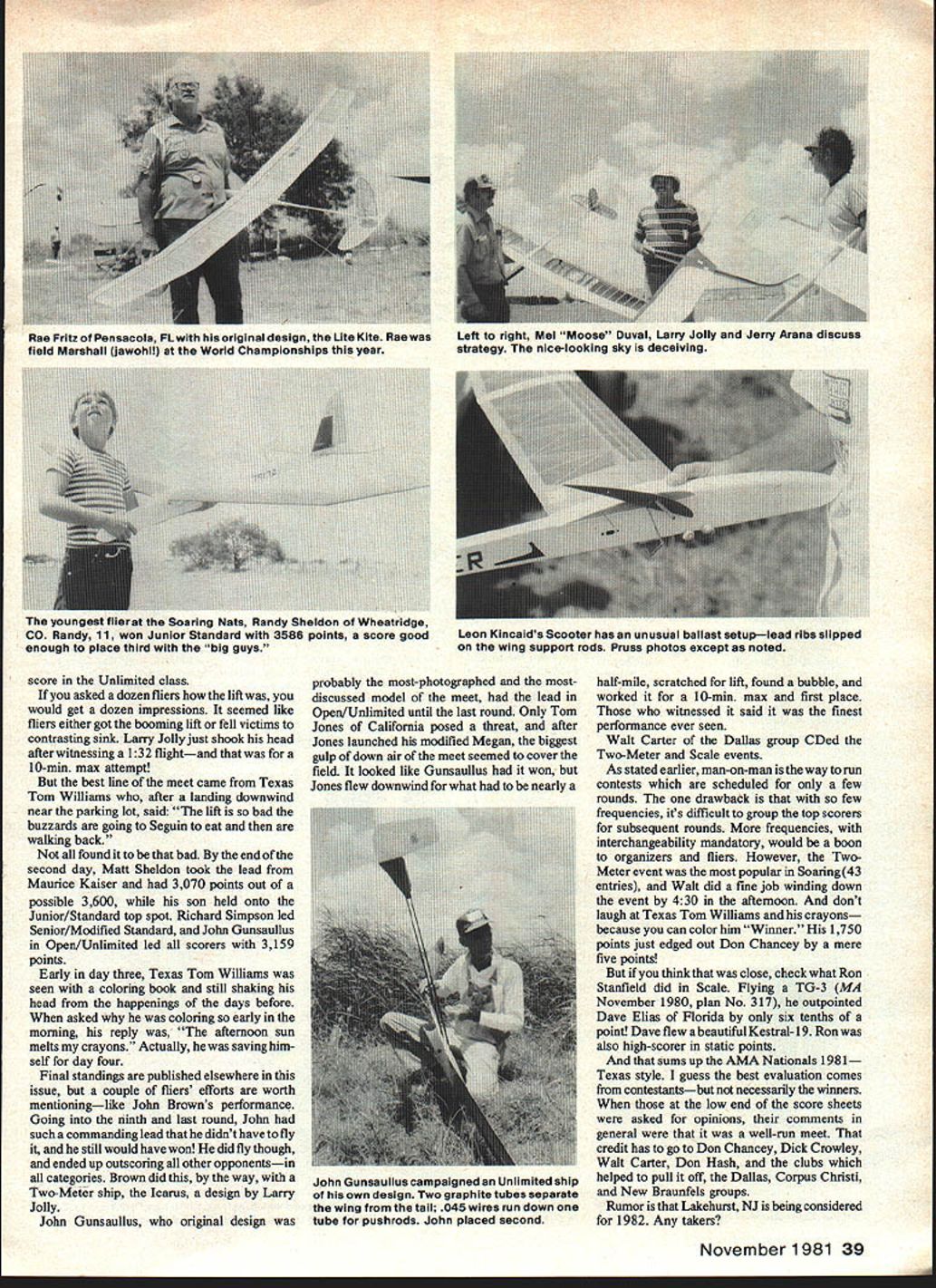
- John Brown’s performance was notable: going ninth in the last round, he had such a commanding lead that he didn't have to fly his last round to win—but he did, and ended up outscoring all opponents in all categories. Brown flew a Two‑Meter Icarus, a design by Larry Jolly.
- In Open/Unlimited, John Gunsaullus led until the last round. Tom Jones (CA), flying a modified Megan, suffered a big gulp of sink early but then worked a bubble of lift for a 10‑minute max to take first place—a recovery many called the finest performance seen at the meet.
Two‑Meter and Scale (Day 4)
- Walt Carter of the Dallas group CD’ed the Two‑Meter and Scale events.
- Man‑on‑man matrix scoring worked well for the short, three‑round Two‑Meter event. One drawback of man‑on‑man is the limited number of frequencies, making it hard to group top scorers in subsequent rounds; more interchangeable frequencies would benefit organizers and fliers.
- Two‑Meter was the most popular soaring event with 43 entries. Walt Carter wrapped the event up by 4:30 p.m.
- Winner: Tom Williams (Texas) — 1,750 points, edging Don Chancey by five points.
- Scale:
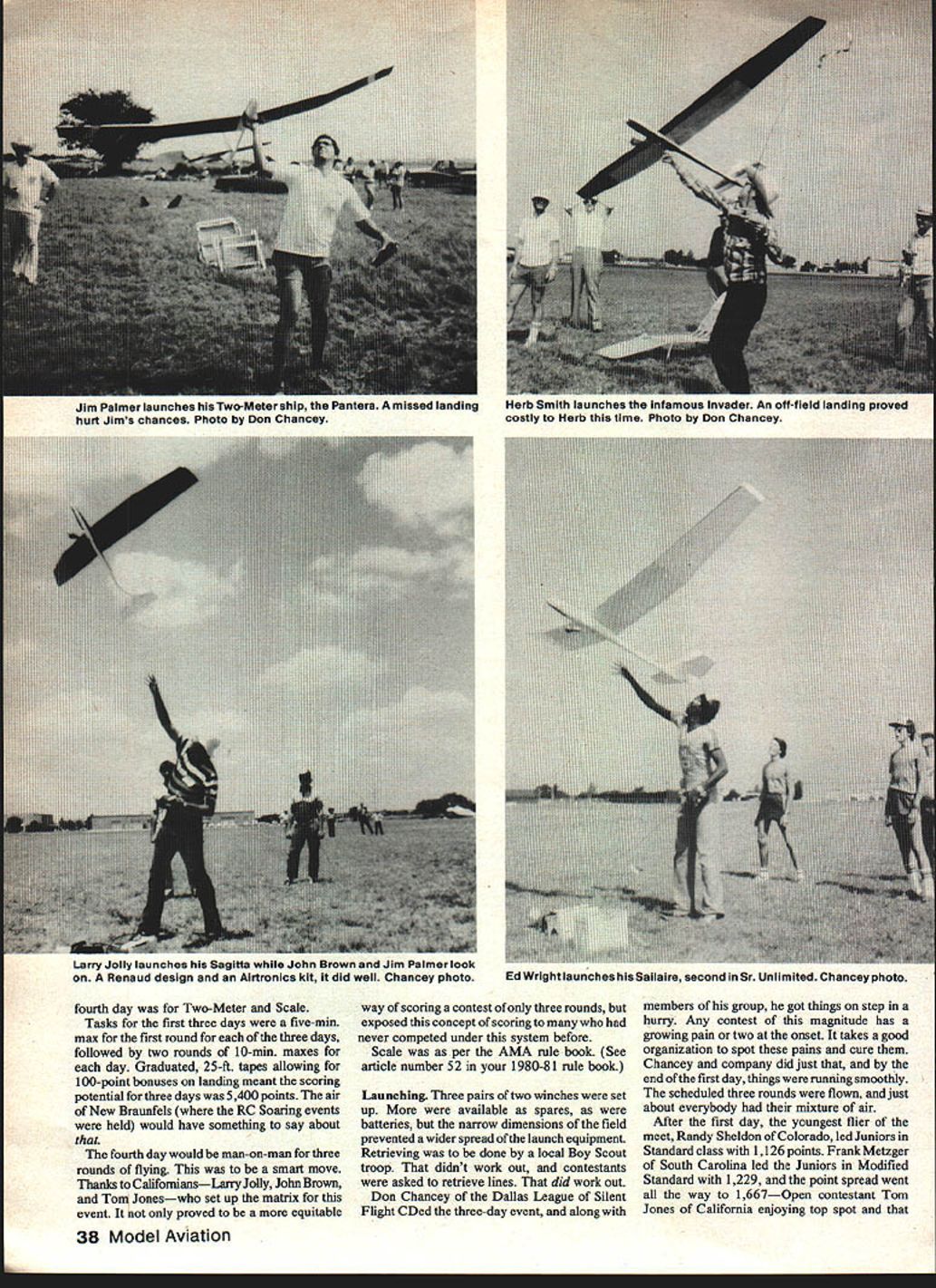
- Winner: Ron Stanfield, flying a TG‑3 (MA Nov. 1980, plan No. 317). He outpointed Dave Elias (Florida), who flew a Kestrel‑19, by only six‑tenths of a point. Stanfield was also high scorer in static points.
Acknowledgements and closing
When contestants at the lower end of the score sheets were asked for opinions, their general comments were that it was a well‑run meet. Much of the credit goes to Don Chancey, Dick Crowley, Walt Carter, Don Nash, and the clubs that helped—Dallas, Corpus Christi, and New Braunfels.
Rumor is that Lakehurst, NJ is being considered for 1982. Any takers?
Transcribed from original scans by AI. Minor OCR errors may remain.

