
'88 Aerobatics World Champs
Overview
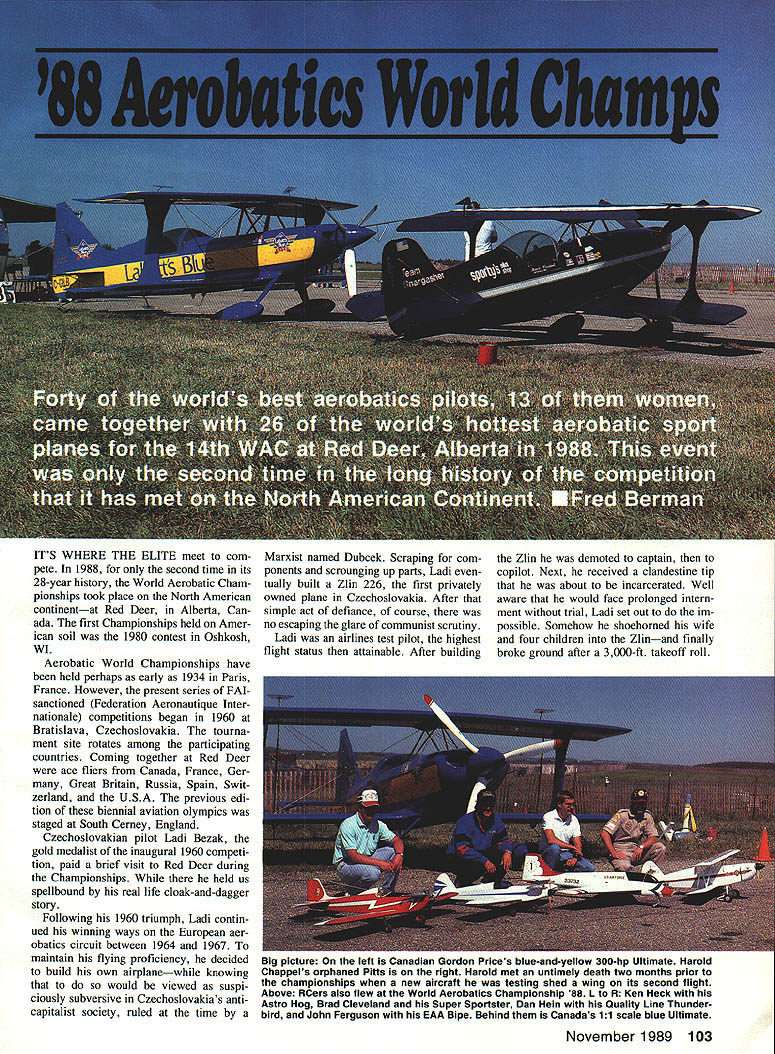
Forty of the world's best aerobatics pilots, 13 of them women, came together with 26 aerobatic sport planes for the 14th World Aerobatic Championships (WAC) at Red Deer, Alberta, in 1988. This was only the second time in the competition's history that it was held on the North American continent.
History and context
- The present series of FAI-sanctioned (Fédération Aéronautique Internationale) competitions began in 1960 at Bratislava, Czechoslovakia. The tournament site rotates among participating countries.
- The 1988 competitors came from Canada, France, Germany, Great Britain, Russia (USSR), Spain, Switzerland, and the United States. The previous edition was staged at South Cerney, England.
- Aerobatic world championships may trace roots as far back as 1934 in Paris, though the modern series dates from 1960.
Ladi Bezak — a dramatic visit
Czechoslovakian pilot Ladi Bezak, the gold medalist of the inaugural 1960 competition, visited Red Deer and recounted his escape story:
- After continued success in European aerobatics, Ladi built a Zlin 226 privately to maintain proficiency — the first privately owned plane in Czechoslovakia at the time.
- Facing demotion and likely incarceration under the repressive regime, he clandestinely loaded his wife and four children into the Zlin and took off after a 3,000-ft takeoff roll.
- The family escaped to Austria and now resides in Ontario, Canada.
Aircraft and logistics
- Most overseas competitors shipped their aircraft via the almost-ready-to-fly (ARF) route: wings and gear detached, packed into boxes, flown to Calgary, then reassembled.
- The Russians arrived in one of their Ilyushin transports.
- Many pilots used cigar-shaped auxiliary fuel tanks (usually in pairs) slung under the fuselage for cross-country transit; these tanks were removed for competition flying.
- All competing aircraft were tail-draggers with fixed gear. None had flaps; biplanes had ailerons on both wings.
- The nearest mishap was a Sukhoi that ran out of fuel on the runway just after touchdown.
Aircraft types at the contest (approximate counts):
- 9 Pitts
- 5 Cap models
- 4 Extras
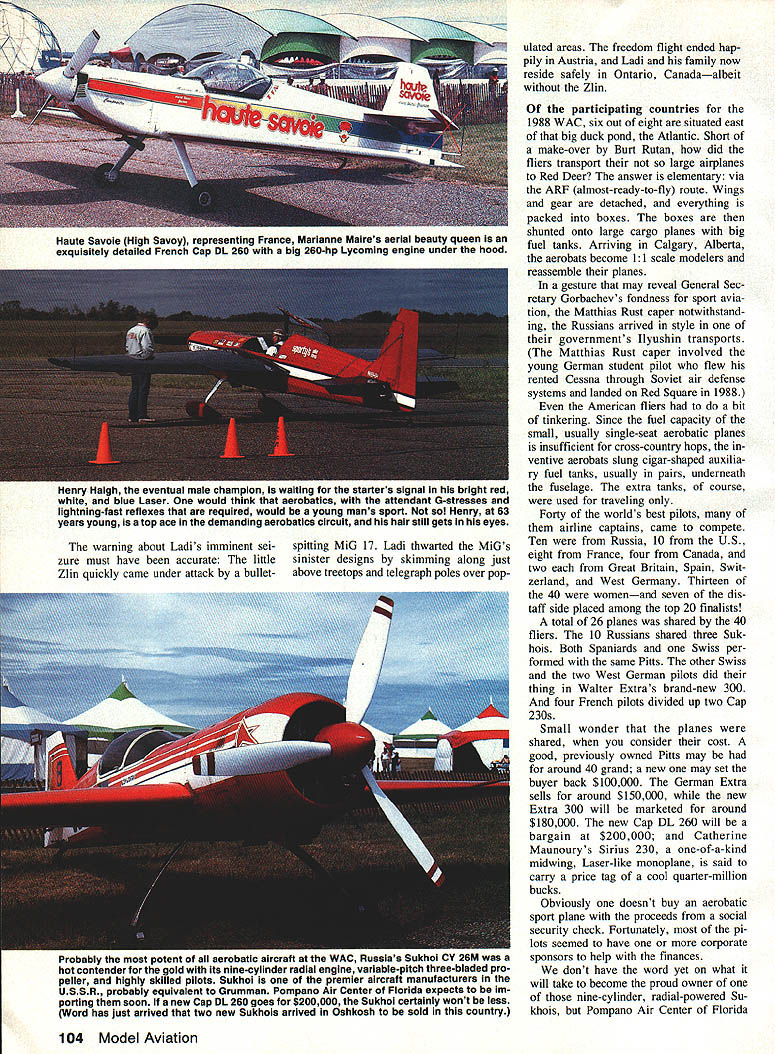
- 3 Sukhois
- 3 midwings
- 1 Weeks Solution
- 1 Ultimate
(Note: the Weeks Solution and Ultimate are biplanes.)
Engine and equipment trends:
- Engines on all but the Sukhois were Avco Lycomings.
- There was a growing use of variable-pitch, three-blade propellers.
Price context (circa 1988 estimates):
- Used Pitts: ≈ $40,000
- New Pitts: ≈ $100,000
- German Extra: ≈ $150,000
- Extra 300: ≈ $180,000
- Cap DL 260: ≈ $200,000
- Sirius 230 (one-of-a-kind midwing): ≈ $250,000
Sukhoi notes:
- Sukhois are major Russian aircraft products and were quiet due to geared-down propellers. Pompano Air Center of Florida expected to import them soon.
Participants and teams
- Competitors: 40 pilots (10 from USSR, 10 from the USA, 8 from France, 4 from Canada, and 2 each from Great Britain, Spain, Switzerland, and West Germany).
- Thirteen of the 40 were women; seven women placed among the top 20 finalists.
- Twenty-six planes were shared among 40 fliers (several teams divided aircraft: Russians shared Sukhois, Spaniards and a Swiss shared a Pitts, four French pilots divided two Cap 230s, etc.).
- Most pilots had corporate sponsorship to help with the high costs.
Tragic losses
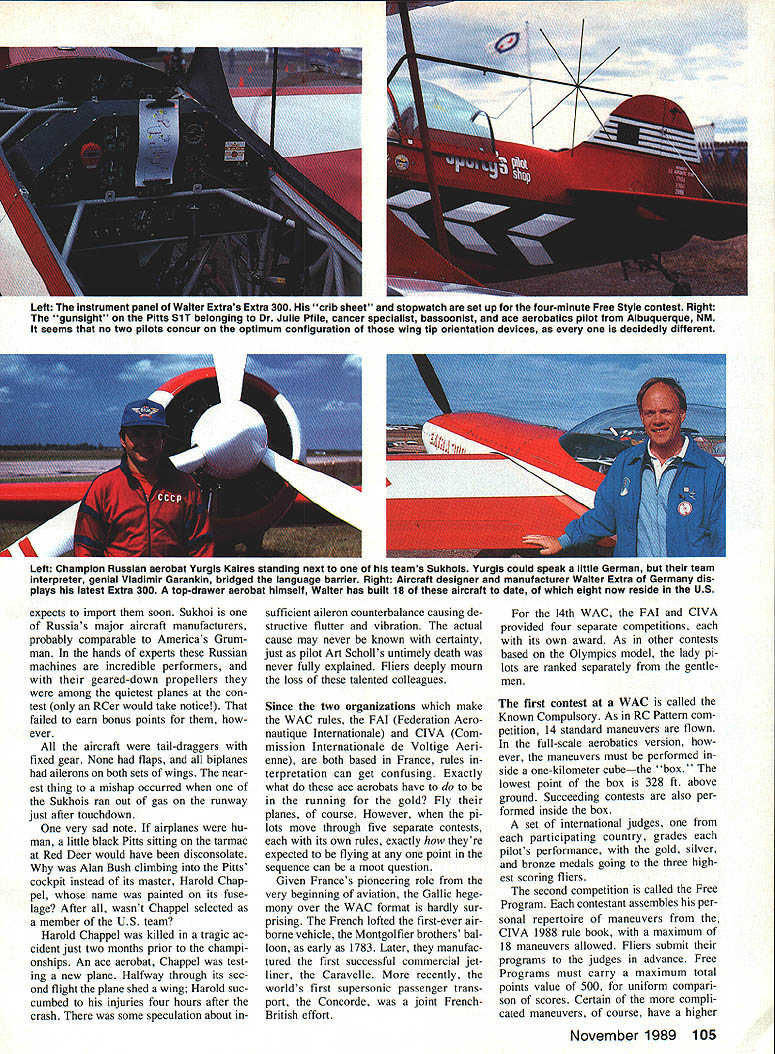
- Harold Chappel, a member of the U.S. team whose name was painted on a Pitts at Red Deer, had been killed in a test-flight accident two months prior to the championships. He died after his test plane shed a wing on its second flight. The cause was uncertain; insufficient aileron counterbalance causing destructive flutter was speculated.
- The aerobatics community also mourned Art Sholl; his untimely death was similarly not fully explained.
Competition format
The FAI and its aerobatics commission CIVA provided multiple contests across the championship. Individual medals and separate ladies' rankings were awarded.
- Known Compulsory
- 14 standard maneuvers flown inside a one-kilometer "box" whose lowest point is 328 ft above the ground.
- Judged by an international panel (one judge from each participating nation).
- Free Program
- Pilots submit a personal sequence of maneuvers from the CIVA rule book (maximum 18 maneuvers).
- Programs carry a maximum total points value of 500 for score comparability.
- Maneuvers have assigned difficulty factors; more complex maneuvers count for more points.
- Unknown Compulsory (also called the Unknown)
- Teams may select maneuvers from the CIVA book intended to challenge opponents.
- Selected maneuvers are practiced by the pickers; other teams receive the sequence only 18 hours before flying.
- Tests pilots’ quick-learning ability and airmanship.
- Aggregated score
- The individual (male and female) with the highest points total across the preceding contests becomes the overall champion.
- Team scores are calculated by combining the three best scores from each country.
- Four-minute Free Style (final)
- A highly theatrical, four-minute program where pilots have full liberty to design original flights emphasizing creativity, showmanship, and skill.
- A 30-point penalty is applied for each second under or over the four-minute limit. Precision timing is crucial.
- Many competitors invent new maneuvers for this event (e.g., Lomcevac, torque-roll).
Example of scoring difficulty:
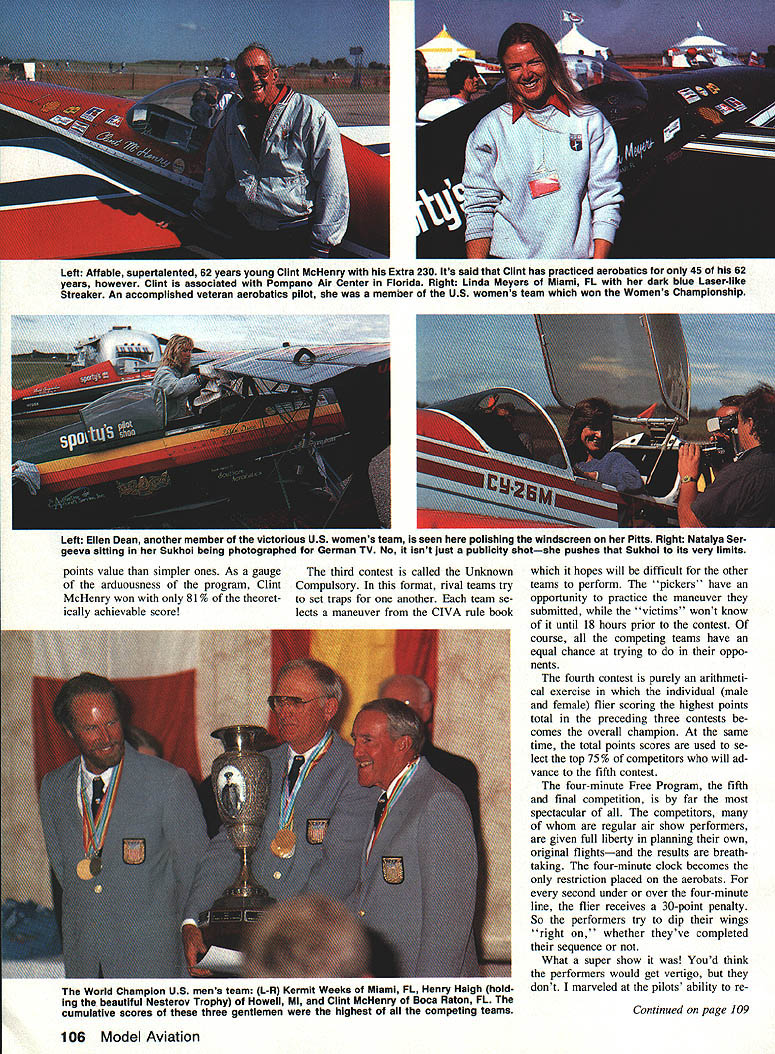
- The programs are demanding; as a gauge, Clint McHenry won an event with only 81% of the theoretically achievable score, illustrating how hard it is to earn perfect marks.
Judging
- Judges come from participating countries. National bias is a potential issue, so score analysis software (designed by Russian judge Mr. Tarasov) examined judges' scoresheets to detect outlier judging.
- Protests are reviewed by a jury; the jurist from the protesting pilot's country is excluded from that jury's deliberations.
- Judging criteria differ by contest:
- Compulsory and Free Program: straight lines, symmetry, precision.
- Free-Style: originality, smoothness, rhythm, and blending of maneuvers. The box limits are enforced less rigidly for this event.
Notable performances and people
- Overall champion: Henry Haigh (the article refers to him as "Kid" Henry Haigh).
- The U.S. teams — both men's and ladies' — placed first.
- The USSR won the team event; France took second; the United States was third.
- Standout pilots included former champion Patrick Paris and Russia's Yurgis Kairis.
- Several notable women competitors: Natalya Sergeeva, Elena Klimovitch, Ellen Dean, Lynn Gehringer, Patti Wagstaff, and Dr. Julie Pfile.
- Patti Wagstaff was highlighted for her fearless, high-profile airshow career and off-duty hobbies (motorcycling, driving a Corvette, and cooking).
- Dr. Julie Pfile balanced a medical career with competitive flying.
Age and experience:
- Henry Haigh was noted as a seasoned competitor at 63; Clint McHenry was mentioned as practicing aerobatics for 45 years at age 62. Swiss champion Eric Mueller is an established veteran and author (Flight Unlimited).
Media, RC modeling, and event support
- German TV covered the event: cameraman Paul Schmidt and interviewer Francis Best (Francis is a woman's name in German).
- Announcing was done by Stu Holloway, a Canadian with 22 years' experience; his van functioned as a mobile control/observation unit.
- RC (radio-controlled) modeling presence:
- Stanley McCarter (Shelby, MT) displayed a scale Sukhoi model.
- Dave Beise (Comox, BC) brought a scratch-built Extra 230 model replicating Clint McHenry's plane.
- The Central Alberta Radio Fun Fliers (CARFF) flew on the final day; the club had recently purchased a 10-acre flying site for C$5,000.
Final notes and future
- The next World Aerobatic Championships were expected in 1990 in western Switzerland.
- A light-hearted closing: in their idle time, the Russians play chess.
Transcribed from original scans by AI. Minor OCR errors may remain.

