

8th Annual United States Free Flight Championships
Memorial Day weekend is the time, and Taft, California is the place, for the annual gathering of the clans. By the time the three-day meet is over, every event in the free flight galaxy has been flown. — Dick Mathis
MEMORIAL DAY weekend means Taft, California to us, and this past February we made our plans to go to our sixth USFFC.
It is hard to believe there have been eight since we attended the first in 1971. The event has grown—this one was the largest—and deserves its AAAA status. In three days every free flight event in the galaxy is flown.
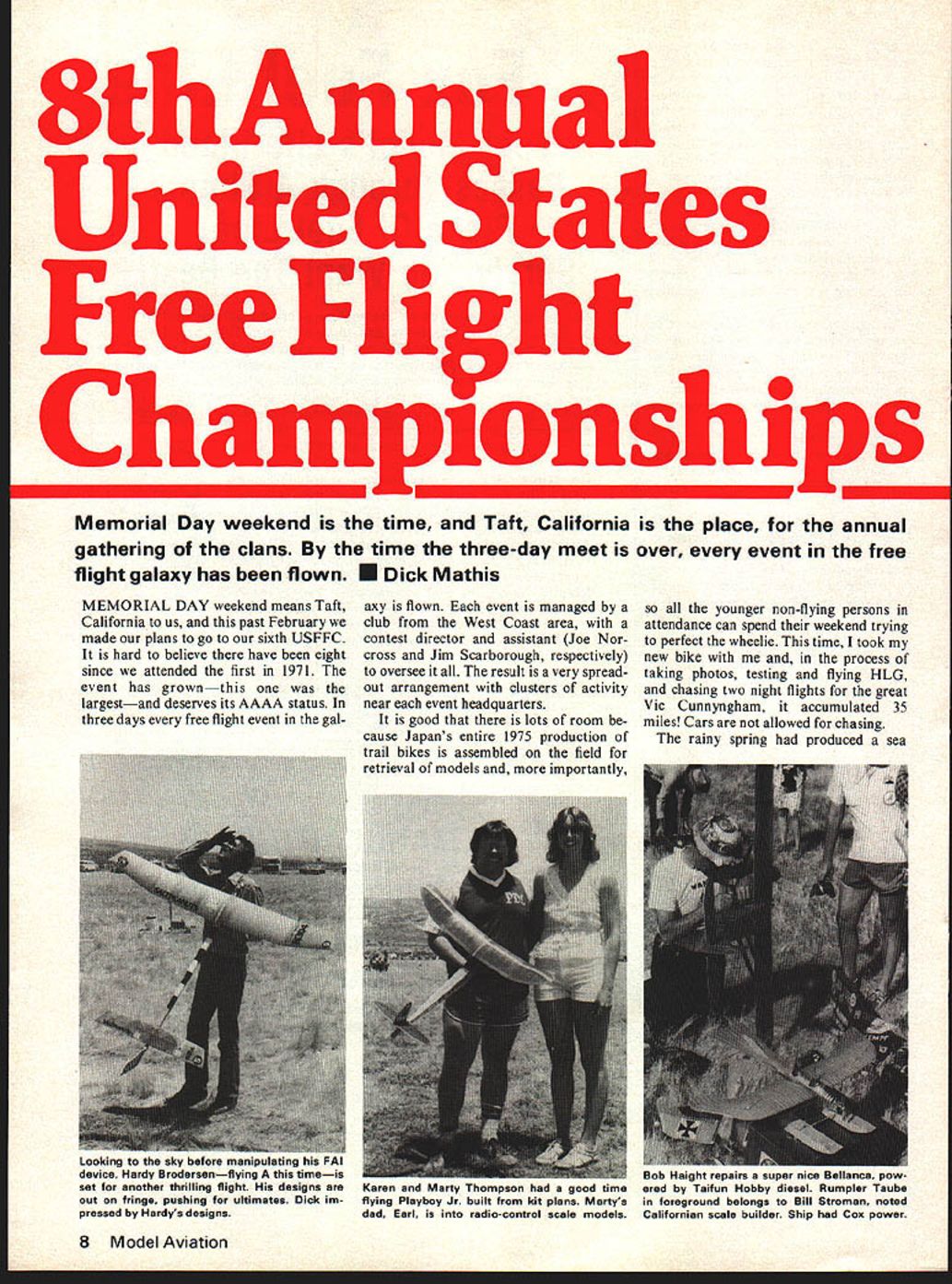
Each event is managed by a club from the West Coast area, with a contest director and assistant (Joe Norcross and Jim Scarborough, respectively) to oversee it all. The result is a very spread-out arrangement with clusters of activity near each event headquarters.
It is good that there is lots of room because Japan's entire 1975 production of trail bikes is assembled on the field for retrieval of models and, more importantly, so all the younger non-flying persons in attendance can spend their weekend trying to perfect the wheelie. This time, I took my new bike with me and, in the process of taking photos, testing and flying HLG, and chasing two night flights for the great Vic Cunningham, it accumulated 35 miles! Cars are not allowed for chasing.
The rainy spring had produced a sea of grass about eight inches tall which was now dead—and burned vigorously when set afire by a rocket plane which cratered near a row of campers, causing a considerable flap during which the modelers themselves managed to extinguish the blaze. Another fire was set by a motorcycle downwind (next to the kitty litter plant) and had to be put out by the Taft fire department. This is bad business for our sport and stronger measures need to be taken by the modelers to prevent such situations, and, if they do occur, to be able to take effective measures to extinguish grass fires.
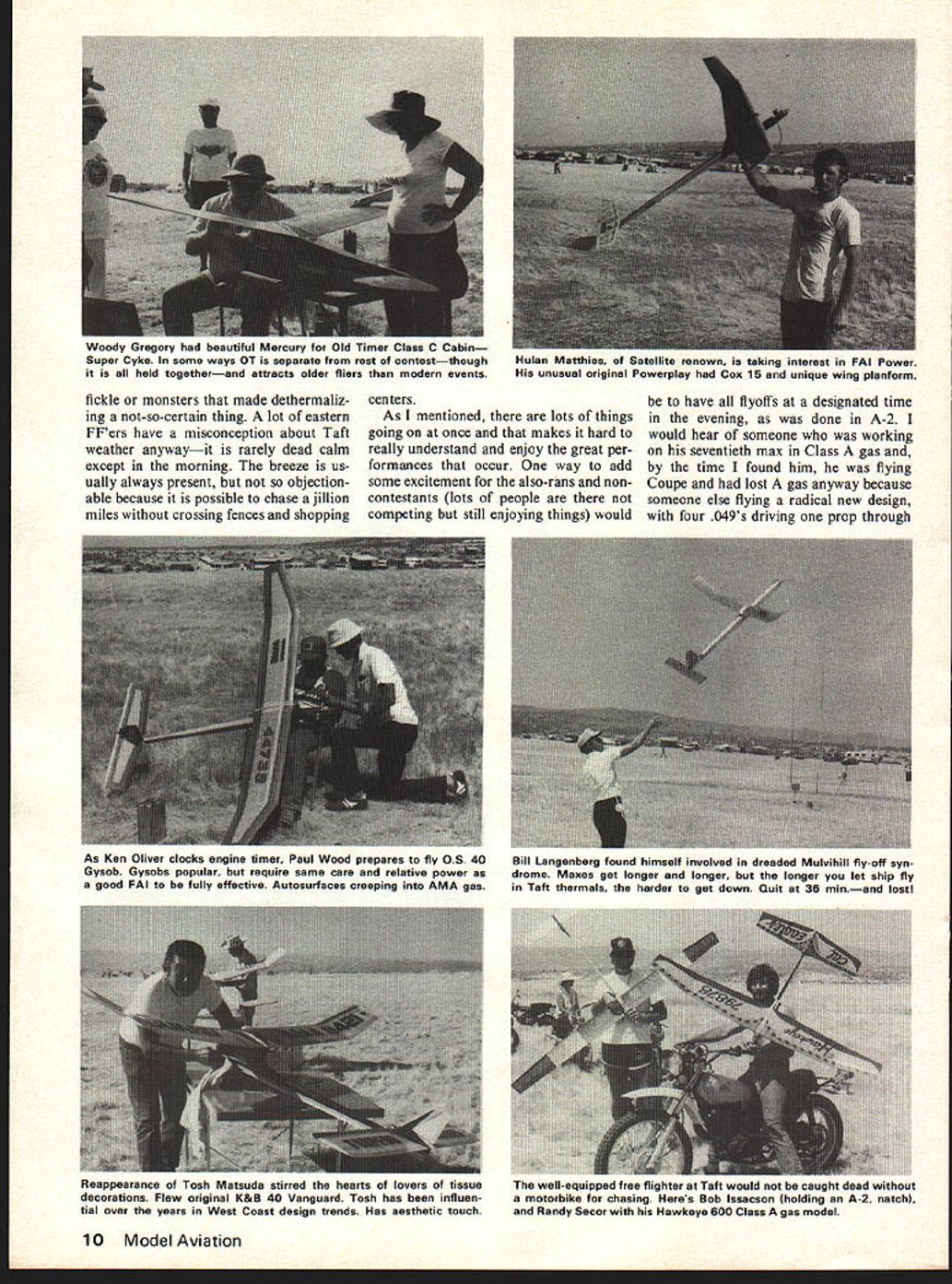
The famed Taft "air" was not its usual self this year. It was cooler than normal and the thermals were either spotty and fickle or monsters that made dethermalizing a not-so-certain thing. A lot of eastern FF'ers have a misconception about Taft weather anyway—it is rarely dead calm except in the morning. The breeze is usually always present, but not so objectionable because it is possible to chase a jillion miles without crossing fences and shopping centers.
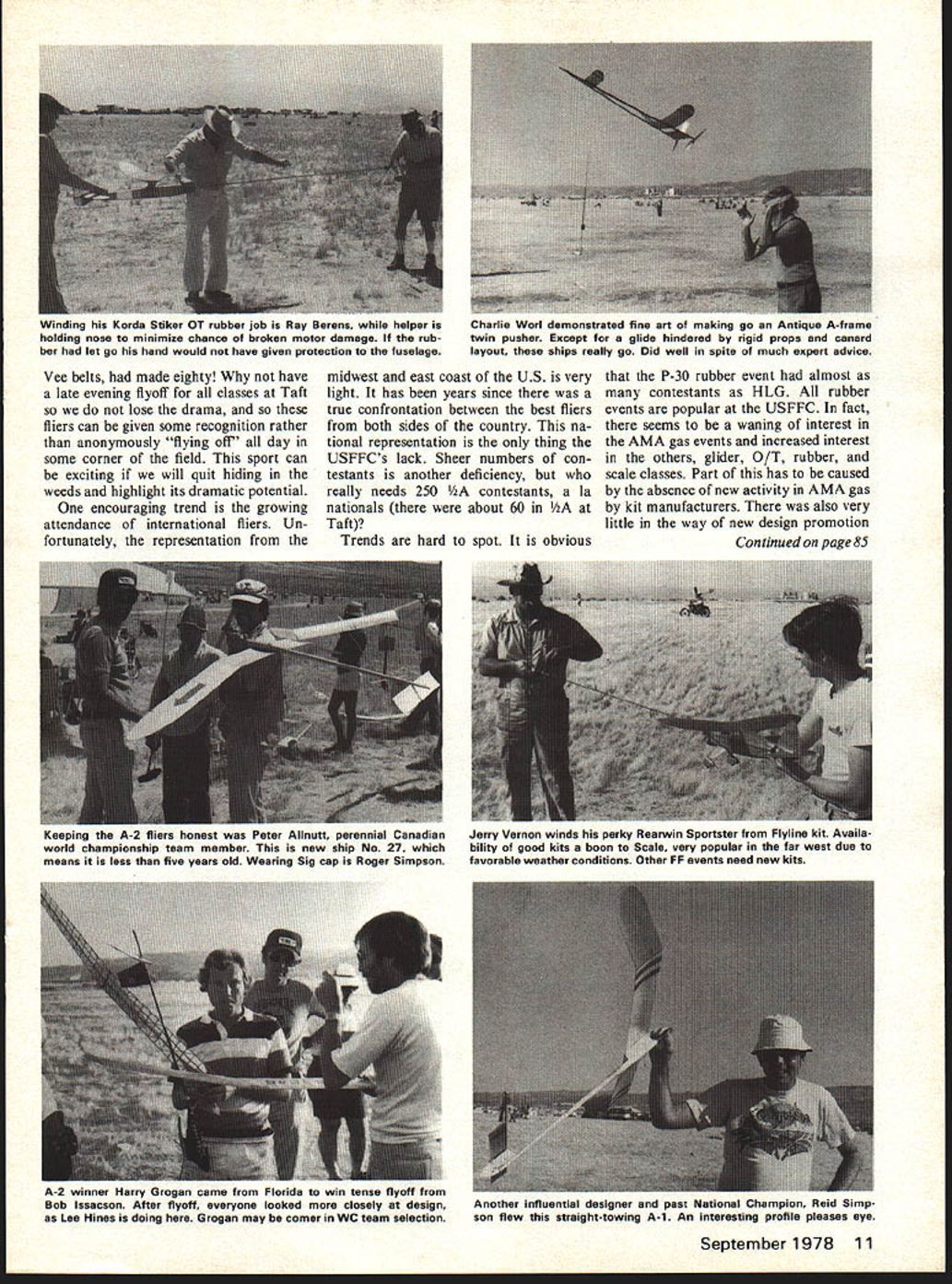
As I mentioned, there are lots of things going on at once and that makes it hard to really understand and enjoy the great performances that occur. One way to add some excitement for the also-rans and non-contestants (lots of people are there not competing but still enjoying things) would be to have all flyoffs at a designated time in the evening, as was done in A-2. I would hear of someone who was working on his seventieth max in Class A gas and, by the time I found him, he was flying Coupe and had lost A gas anyway because someone else was flying a radical new design, with four .049's driving one prop through. He'd made eighty! Why not have a late evening flyoff for all classes at Taft so we do not lose the drama, and so these fliers can be given some recognition rather than anonymously "flying off" all day in some corner of the field. This sport can be exciting if we will quit hiding in the weeds and highlight its dramatic potential.
One encouraging trend is the growing attendance of international fliers. Unfortunately, the representation from the midwest and east coast of the U.S. is very light. It has been years since there was a true confrontation between the best fliers from both sides of the country. This national representation is the only thing the USFFC's lack. Sheer numbers of contestants is another deficiency, but who really needs 250 1/2A contestants, a la nationals (there were about 60 in 1/2A at Taft)?
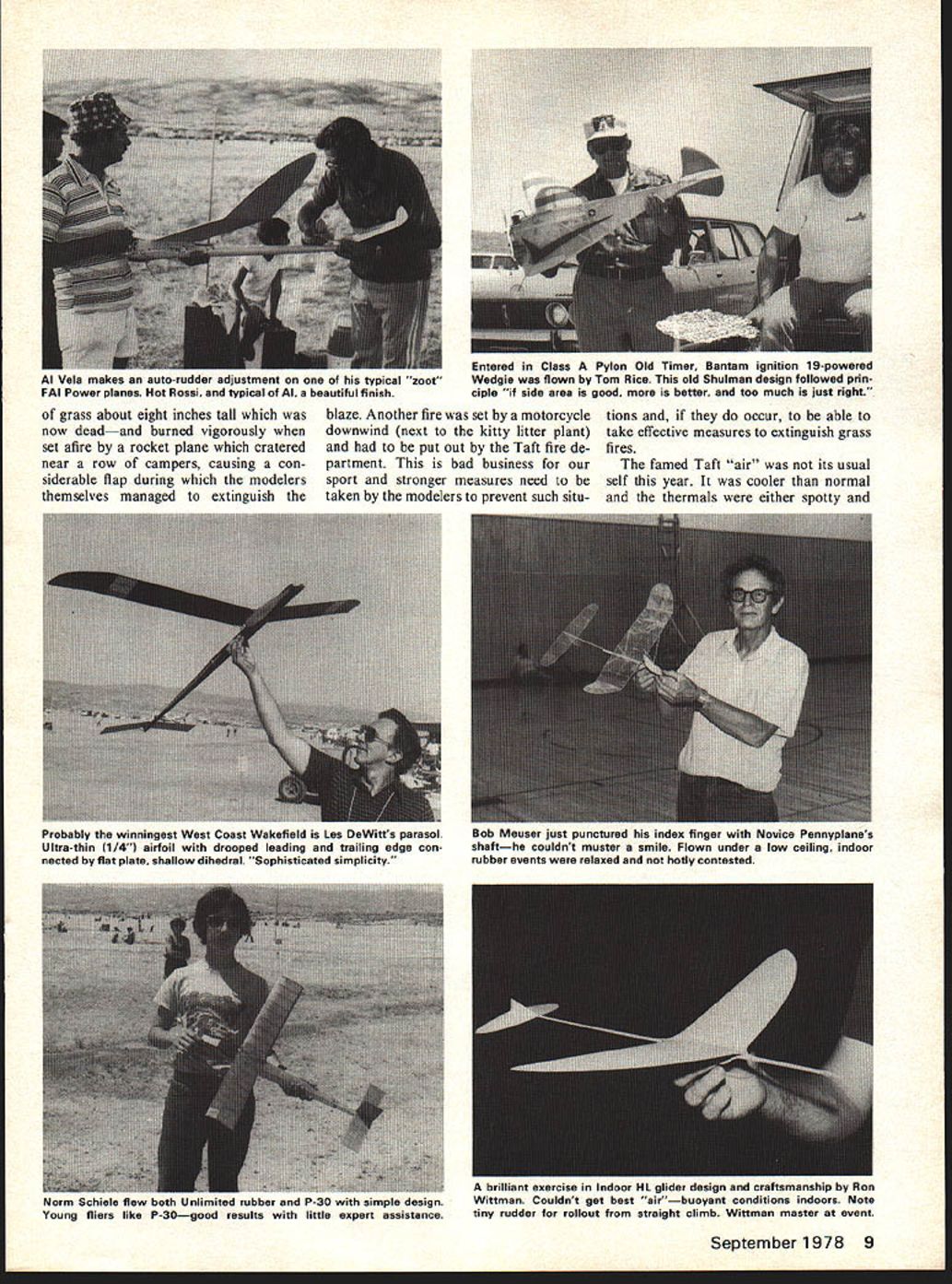
Trends are hard to spot. It is obvious that the P-30 rubber event had almost as many contestants as HLG. All rubber events are popular at the USFFC. In fact, there seems to be a waning of interest in the AMA gas events and increased interest in the others, glider, O/T, rubber, and scale classes. Part of this has to be caused by the absence of new activity in AMA gas by kit manufacturers. There was also very little in the way of new design promotion and rivalry. If the troops don't get going, Tommy-T and Fast Richard are going to have to bring back the ShoBiz act to liven things up!
Since it looks like the USFFC is here to stay, maybe it's time to add some more perpetual awards. I hope to put up a perpetual award for outdoor HLG, and I hope others will come up with similar trophies for other events—it really adds something to an event.
I should state that I know of no cases where the winner did not earn his victory with an outstanding performance. It is great that we still have the opportunity to try to be excellent and to be recognized for it. In the final analysis, having the best score in Class C O/T Pylon is not really too important in the universal scheme of things. However, part of the idea of modeling is to get away from the universal scheme of things—which is why it is so nice to spend three days at Taft in the late spring.
Transcribed from original scans by AI. Minor OCR errors may remain.

