
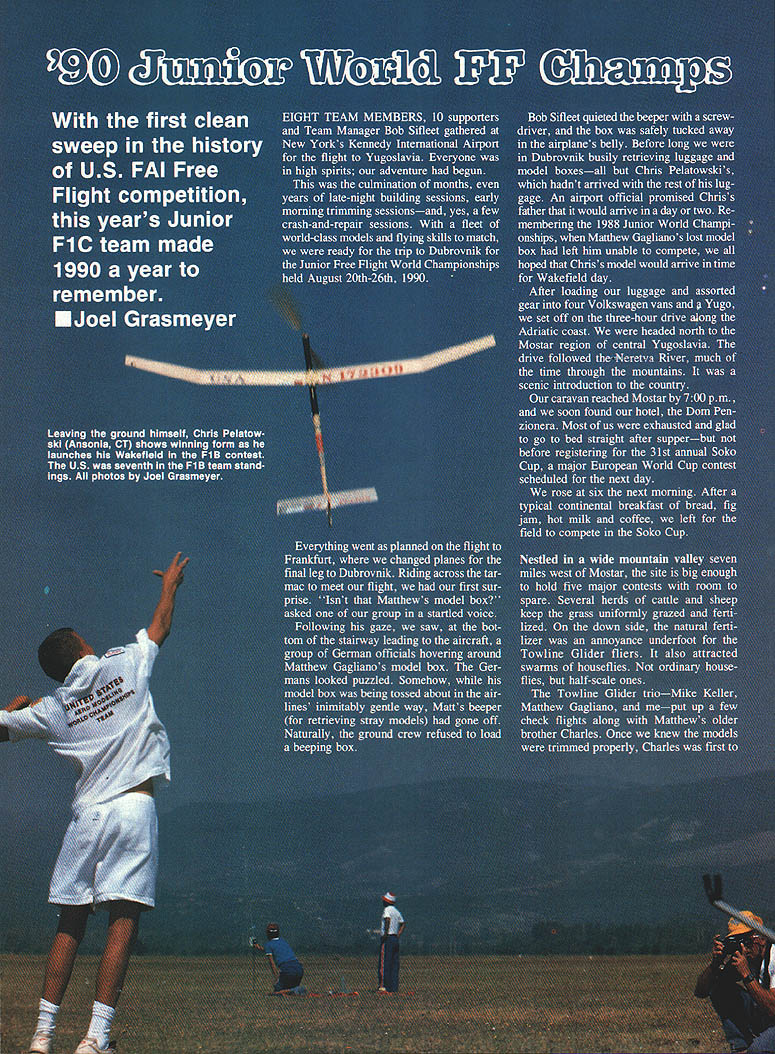
'90 Junior World FF Champs
By Joel Grasmeyer
With the first clean sweep in the history of U.S. FAI Free Flight competition, this year's Junior F1C team made 1990 a year to remember. Eight team members, 10 supporters and Team Manager Bob Sifleet gathered at New York's Kennedy International Airport for the flight to Yugoslavia. This was the culmination of months—often years—of late-night building sessions, early-morning trimming sessions and a few crash-and-repair sessions. With a fleet of world-class models and flying skills to match, we were ready for the trip to Dubrovnik and the Junior Free Flight World Championships held August 20–26, 1990.
Arrival and travel to Mostar
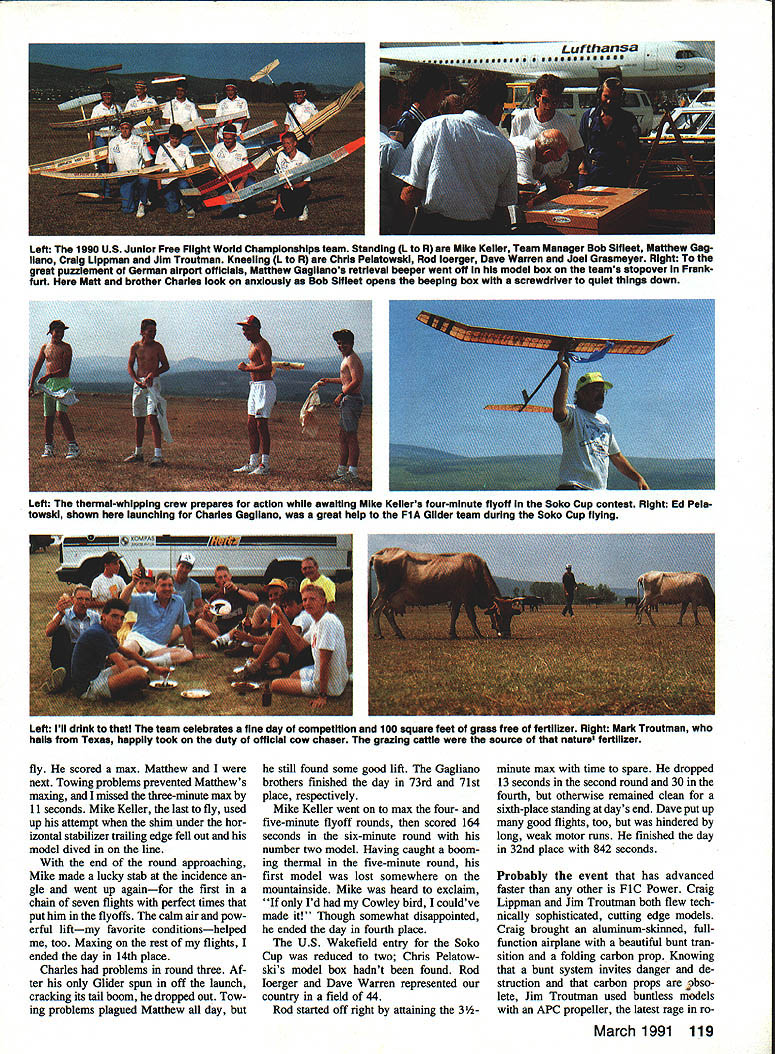
Everything went as planned on the flight to Frankfurt, where we changed planes for the final leg to Dubrovnik. Riding across the tarmac we had our first surprise: a group of German officials hovering around Matthew Gagliano's model box. Matthew's beeper had gone off while the airline handlers were tossing the box about. The ground crew refused to load a beeping box until Team Manager Bob Sifleet quieted the beeper with a screwdriver. The box went into the airplane belly and we continued.
In Dubrovnik we retrieved luggage and model boxes—all but Chris Pelatowski's, which hadn't arrived. An airport official promised it would arrive in a day or two. Remembering 1988, when Matthew Gagliano's lost model box left him unable to compete, we all hoped Chris's models would arrive in time for Wakefield day.
We loaded gear into four Volkswagens and a Yugo and set off on the three-hour drive along the Adriatic coast and then north to the Mostar region. The scenic trip followed the Neretva River through the mountains. We reached Mostar by evening and checked into the Dom Penzionera. After supper we registered for the 31st annual Soko Cup, a major European World Cup contest scheduled for the next day.
The Soko Cup site
Nestled in a wide mountain valley seven miles west of Mostar, the field is large enough to hold several major contests. Grazing cattle and sheep kept the grass short but left a natural fertilizer underfoot that was an annoyance for Towline Glider fliers and attracted swarms of houseflies. The site’s morning conditions were excellent for Free Flight: calm patches and buoyant air from about 7:00–9:00 a.m., with light variable, thermal-feeding winds building until around noon and a prevailing valley wind through the afternoon. That pattern held roughly ninety percent of the time and shaped our practice and contest tactics.
Soko Cup — Towline Glider and Wakefield
The Towline Glider trio—Mike Keller, Matthew Gagliano and me—put up a few check flights along with Matthew's older brother Charles to trim models and verify handling. Once trimmed, Charles was first to fly a maximum. Matthew had towing problems and missed a three-minute max by 11 seconds. Mike had a scare when a shim under the horizontal stabilizer trailing edge fell out and the model dove; on the line end he made a lucky correction, and then flew a chain of seven perfectly timed flights that put him into the flyoffs. Calm air and powerful lift helped; I also maxed my remaining flights. Charles had trouble in round three when his glider spun off the launch and cracked its tail boom and dropped out. The Gagliano brothers finished the Soko Cup Towline Glider event 73rd and 71st; I ended that event in 14th place.
The U.S. Wakefield entry at the Soko Cup was reduced when Chris Pelatowski's box hadn't arrived. Rod Loerger and Dave Warren represented the country in a field of 44. Rod started well, attaining a 3½-minute max and otherwise remaining clean, finishing the day sixth. Dave posted several good flights but was hindered by long, weak motor runs and finished 32nd with 842 seconds.
Soko Cup — F1C Power
F1C Power has probably advanced faster than other classes. Craig Lippman and Jim Troutman both flew technically sophisticated, cutting-edge models. Craig brought an aluminum-skinned, full-function airplane with a beautiful bunt-transition folding carbon prop. Knowing that bunt systems threaten folding carbon props, Jim Troutman used buntless models with APC props. Coupled with powerful Nelson engines and other high-tech features, Craig and Jim had outstanding climbs, though the thermal gods still took some models. Craig finished 21st after sacrificing a number of models; Jim finished 20th.
After days of flying we attended the awards ceremony at dusk, listening to a mix of European and American music. The Soko Cup gave us a chance to evaluate models and conditions ahead of the World Championships. Sunday and Monday were team practice days to fine-tune trim and get to know the field's thermal characteristics.
Practice and weather
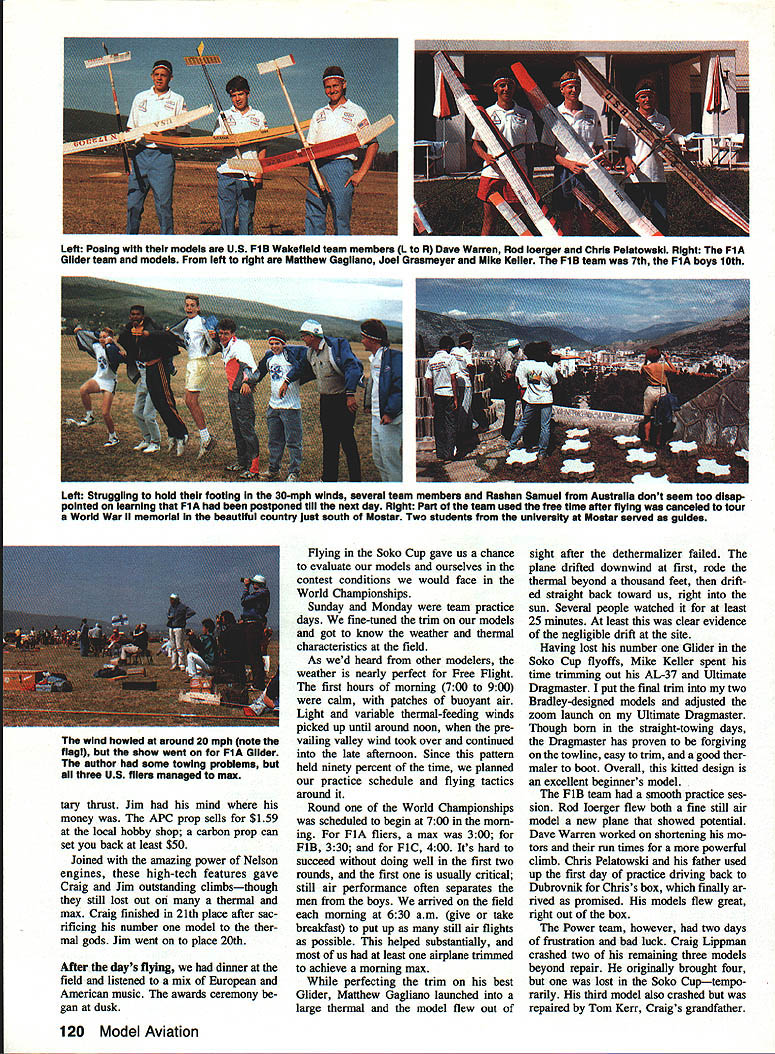
Practice confirmed the weather pattern we'd heard about: calm, buoyant air in the early morning (about 7:00–9:00 a.m.), light variable, thermal-feeding winds building until noon, then a steady valley wind through late afternoon. We planned practice and flying tactics around those predictable conditions, focusing on still-air performance in the early rounds.
World Championships overview
The World Championships were scheduled to begin at 7:00 a.m. for the three classes: F1A (300-second max), F1B (330 seconds) and F1C (400 seconds). It's hard to succeed without doing well in the first two rounds; still-air performance often separates the men from the boys. We arrived at the field around 6:30 a.m., had breakfast and put up still-air flights whenever possible to set morning trim.
F1A competition (gliders)
Day Two began with F1A. Winds were strong—15–25 mph—so towing was difficult. We stationed Tom Kerr and his thermistor upwind to find the best air. In the opening rounds we had a mix of towing troubles and good luck. Mike Keller launched early and missed a thermal; Matt Gagliano and I had a series of towing issues and missed several maxes, though I managed to switch models and find lift in a lull for a max in round three. Over the rounds Matt finished 36th and I finished 38th; Mike accumulated 948 seconds and placed 23rd in the F1A standings.
Detailed rounds included:
- Round 1: variable results; towing problems affected several flyers.
- Round 2: Matt found good air and maxed; I spun in off the launch.
- Round 3: I switched models and maxed; Matt landed at just over a minute.
- Rounds 4–7: mixed conditions produced a variety of outcomes; Tom Kerr’s selection of air helped many of our best flights.
F1C competition (power) — the sweep
Day Three brought strong winds and gusts. Overrun timing problems in round two led to replacement of the original timekeepers with Yugoslav power fliers; each competitor shortened engine runs to avoid further penalties.
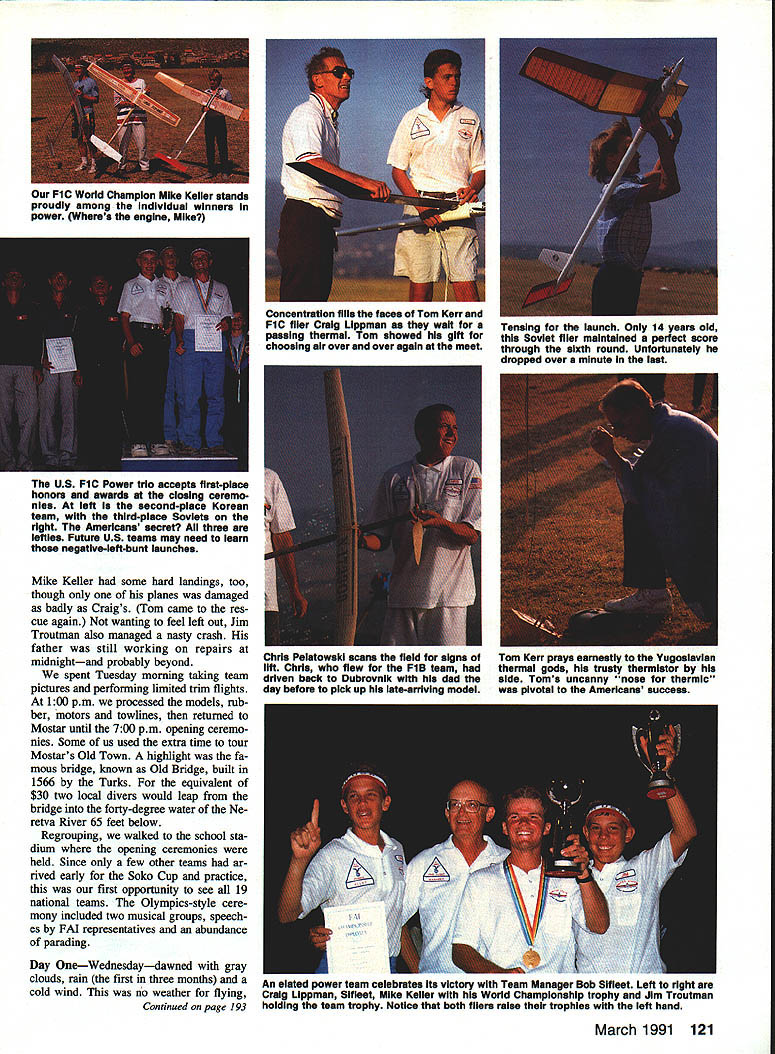
Craig Lippman and Jim Troutman had dramatic flights and some crashes, but by mid-contest the U.S. F1C team locked in excellent performances. By the final rounds the team maxed repeatedly. In the critical seventh round Craig produced a beautiful straight climb to a max, Mike followed with another, and Jim released a perfect launch that climbed higher and higher in a buffeting wind. That flight sealed the day. The U.S. won the F1C team championship, and Mike Keller became the new Junior World Champion in F1C. Jim Troutman finished fourth individually and Craig Lippman seventh.
This F1C sweep—individuals and team—is unprecedented in U.S. Free Flight competition, adult or junior. Contributing factors included the flyers’ shared skill set (all three are left-handed and fly a similar negative-left-bunt style) and Tom Kerr’s ability to find lift. Tom was honored by the team for his discerning selection of thermals.
F1B (Wakefield) — World Championships
Chris Pelatowski’s model box eventually arrived in time for the World Championships, and the Wakefield team had a solid contest. Highlights from Wakefield rounds:
- Rod Loerger started with a perfect max and added several more good flights; he finished 14th overall.
- Dave Warren posted several maxes and climbed to 12th place in the final standings.
- Chris Pelatowski overcame early problems to finish 28th.
The closing ceremonies featured trophies, medals, national anthems and flag presentations. The Soviet Union claimed first place in the combined three events; the U.S. celebrated its notable F1C sweep.
Off-field activities and farewell
Between contest days we visited historical and cultural sites. A memorable stop was Buna, where an underground river emerges from a rocky cliff that shelters raptors. A local Muslim family lives in a cliffside dwelling near a water-powered bread mill and fish hatchery. These visits deepened our appreciation of Yugoslav culture and history.
After the contest we drove south to Buna for the post-contest banquet, feasted on fresh fish and listened to a Yugoslav music group. Teams exchanged shirts, souvenirs and modeling items. After many friendly good-byes, U.S. team members departed from Dubrovnik and separated at Kennedy International Airport.
Equipment notes and model trimming
- The Ultimate Dragmaster proved forgiving in towline, easy to trim and a good thermal seeker—an excellent beginner’s model.
- Bunt systems with folding carbon props produce outstanding climbs but risk damaging expensive carbon props; buntless designs with APC props are a viable alternative.
- High-tech features and powerful Nelson engines increased climb performance for F1C, but thermal selection remained decisive.
Acknowledgements
The United States team wishes to acknowledge the following contributors:
- The AMA, for providing team uniforms, patches and funds and handling paperwork. (On F1A day we would have frozen without the team jackets.)
- Doug Galbreath, for printing the team cards.
- Bob and Bill Hunter of Satellite City, for donating Hot Stuff.
- Jim Bradley of Bradley Model Products, for carbon fiber and F1A accessories.
- Betty Kerr, for the beautiful knitted team sweaters.
- Tom Kerr, for the excellent lift he selected.
- Bob Sifleet, for his outstanding work as Team Manager.
Final thoughts
Flying at the Junior World Championships was a once-in-a-lifetime experience that took years of preparation. None of the U.S. team members could have done it alone. I encourage the AMA, the NFFS and individual modelers nationwide to fully support the Junior Free Flight World Championships program. Participating in the program changes lives: young people grow as modelers, learn about other cultures and take pride in representing their country. Continued support for junior programs is an investment in the future of model aviation. Junior participation in international Control Line and Radio Control competition would similarly benefit the U.S. modeling community.
Transcribed from original scans by AI. Minor OCR errors may remain.

