
'91 All American Nationals: CL Aerobatics
Frank McMillan
Overview
Every Nationals seems to take on its own character. Some fight the elements, some the surroundings, some just fight. But '91 was blessed with a good site and a run of wonderful weather—better than any recent Nationals. Everyone was pushing to get in lots of practice flights and thoroughly enjoying themselves.
The real '91 Nationals was all neon. There were planes that literally glowed, with the competitors costumed to match. I don't think the glow made them fly or look any better, but it was a lot of fun to watch.
Overall the caliber of flying was genuinely impressive. Perhaps it was the good weather or just the obvious fact that flying skill has risen significantly. The scores reflected that rise—numbers stayed above 500 for the largest number of fliers I can recall.
As the week went on, many stories unfolded. Of course, flying dominated the activities, but people renewing old friendships with long-time competitors also became a large part of the Nationals, and rightly so.
After observing Sunday's practice there wasn't much doubt competition would be very tough. Paul Walker appeared dominant and remained so throughout the week. Bob Hunt was approaching world-class form again, and Ted Fancher had his successful O.S. .40 VMAX with pipe setup working extremely well. It was a real surprise that Bill Rich had his St.60 and SV-1 running like a clock. So the stage was set.
Old-Time Stunt
Actual competition began Monday with Old-Time Stunt. With this event growing in popularity, it was neat to see all the designs from yesteryear take wing again. Fortunately there didn't seem to be one dominant design, so we were treated to a wide variety of airplanes and expert flying. Since there was neither a builder-of-the-model rule nor appearance points, the emphasis was on the fun of flying the way it was.
Allen Brickhaus had a good-flying Stuntwagon and was leading by a narrow margin after the first round. Unfortunately, on the second round there was a little wind and the Stuntwagon just didn't make the bottom of the Vertical Eight. Allen thanked the judges afterwards.
The most gorgeous of the Old-Timers was Warren Tiahrt's Rocket. It finished up front in a contest that was anybody's to win and flies as good as it looks. Windy Urtnowski took a crack at it this year and, with his well-known skill, finished third. In the extremely tough competition the old pro Jack Sheeks won by a narrow margin.
Nostalgia
Nostalgia was flown for the first time this year as an unofficial event, with Warren Tiahrt volunteering as director. Rollie, Bob McDonald, and Jerry Phelps served as judges and did an excellent job. Since we fly the current pattern, we can compare how older designs performed. As we get a few years into the Nostalgia event we are starting to see some first-class airplanes surface—fliers are building designs that haven't yet been recreated—just for the fun of it.
Don McClave experimented with a Stock Smoothie powered by an old Fox .35 to see how it would fare. The plane, with a yellow tissue finish, was probably the best-flying Smoothie I've ever seen. Don's flying was on target and he finished a very close fifth in Nostalgia.
Another Adamson was pushing hard: young Art Adamson had an exceptional Talon (a Kim Kostecky design) powered by one of Big Jim's modified St.60s.
Concours and Judging
The heavyweights kicked off Tuesday afternoon with appearance judging and the pilots' meeting, along with the contestants' selection of the Concours winners. Highlights singled out included:
- Windy Urtnowski's Cardinal
- Bill Simon's Shoestring
- Mike Rogers' tasteful silver-and-blue Pattern Master
- The McDonalds' stylish Piped Birds
- Bill Rich's SV-1, which showed significant improvement in craftsmanship
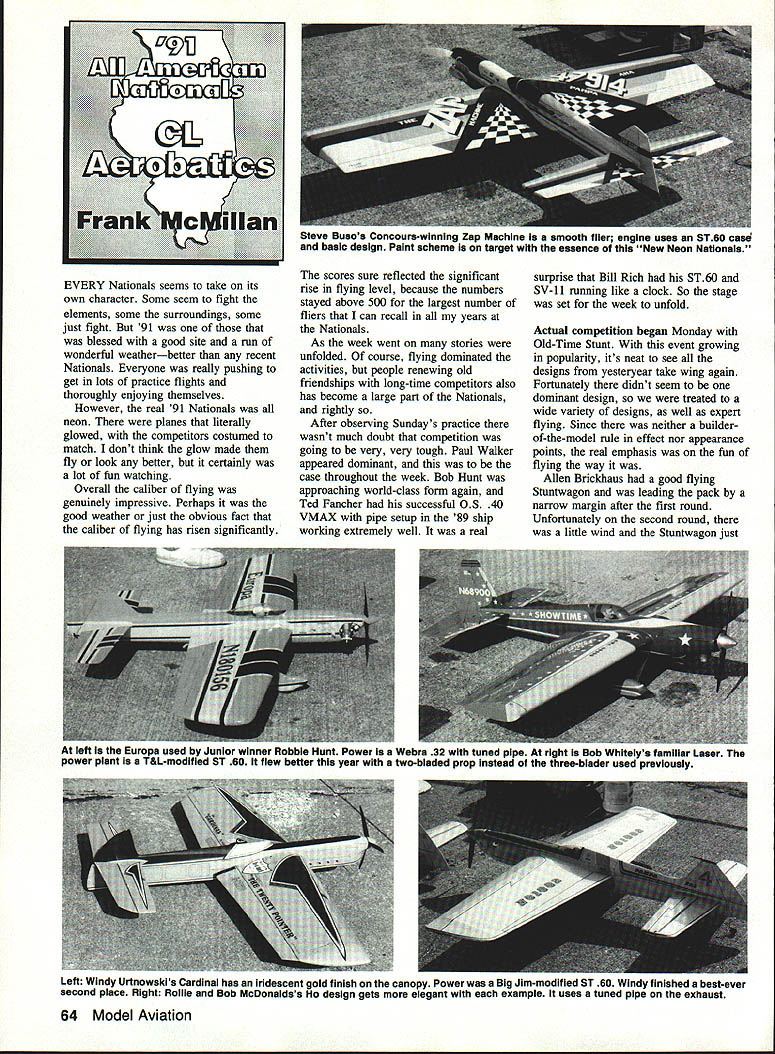
The hit of the meet was Steve Buso's Zap—the craftsmanship was flawless and the paint scheme captured the essence of this "New Neon Nationals." Congratulations to Steve—for both the work and the flying.
While the aircraft were being judged, Chief Judge Dave Cook briefed us on what to expect. Dave has put in many unselfish hours supporting the solid judging that has evolved at the Nationals over the years. For Dave, Big Art Adamson, and all the judges who gave their time and dedication—thanks. We of the community appreciate your long hours in the sun watching us go round and round.
Randy Smith's Magnum
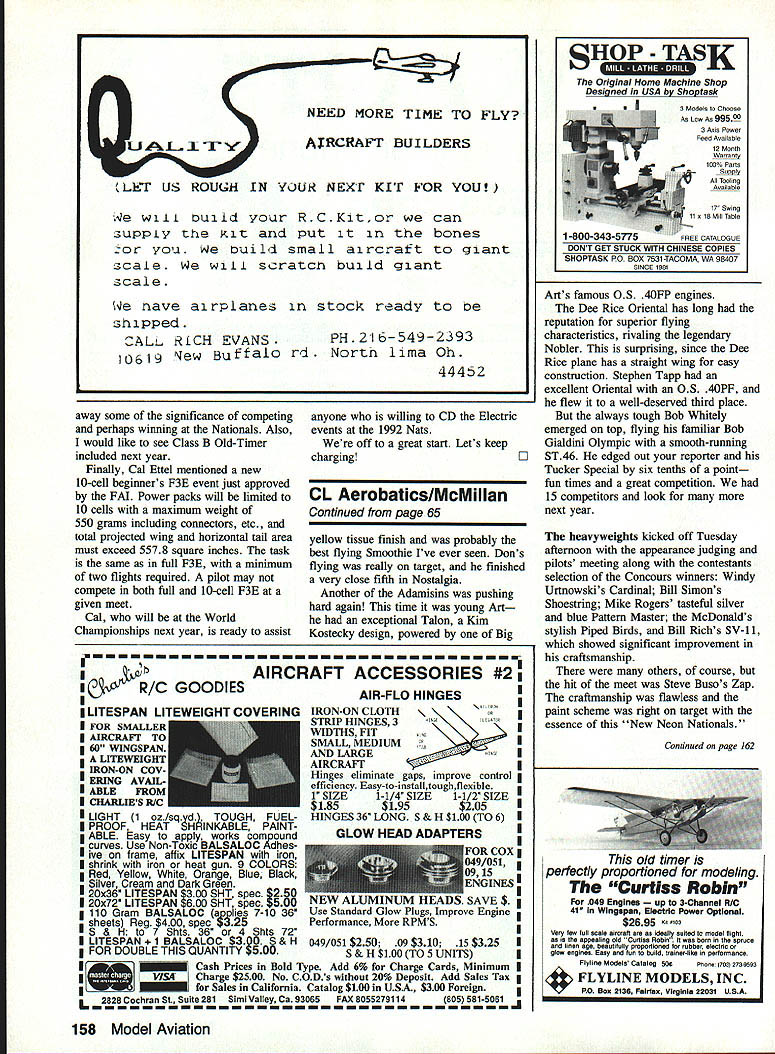
If we were still awarding a prize for technology, Randy Smith's Magnum with contra-rotating props would have won hands down. The airplane itself is a fine Magnum, but the engine-prop combination is thrilling. The power plant is a home-built .65 with twin plugs that runs very well.
The second contra-rotating two-blade Bolly carbon prop was free to rotate on a ball bearing and, through fluid coupling, revolved in the opposite direction. The sound was unique and unearthly, and the plane flew very well. Randy says the setup counteracts P-factor and is very docile. This is an impressive achievement—conceptually interesting and practically reliable.
Qualifying
Qualifying began Wednesday with continued mild weather and hot flying. As expected, the seeded fliers led in the four-circle mix; the main changes occurred in the 4th, 5th, and 6th slots as the rounds progressed through Wednesday and Thursday.
Only the first five advanced from each circle, so tension mounted as the final qualifying round on Thursday progressed. On the last flight on circle four, Frank Williams needed a big score to get in safely and came through to advance a close fourth on the circle. On that same circle, one of the Neon contingent, Mike Pratt, was all smiles as he finally made it into the top 20—congratulations, Mike!
Over on circle three, Donnie Melanson barely edged out Steve Buso by four points to grab the last spot. Mike Rogers and Bill Rich fought through the rounds to end a third of a point apart in the number two and three slots.
The visiting Japanese fliers Sadahiko Yoshimura and Mitsuru Yokoyama were flying almost as well as their host Kaz Minato, and they moved into the finals rather easily. On circle one, Allen Brickhaus flew well all week but fell three points short, just out of the money.
Finals
Friday was a scoreboard-watcher's dream: close, high scoring, and no throwaway flights—anyone could win. One of the circles seemed to score slightly higher, so nothing was settled until near the end of the second rotation. This year the weather was consistent and the judges held their ground, so the competitors slugged it out.
The final tally revealed only 14 points out of a thousand-point spread covering places four through eleven, and only a 2.25-point spread over fourth through sixth place. This was the tightest final selection I can recall, with at least 11 fliers having a genuine shot at the final five.
Final placements included:
- 6th: Bob Whitely and his Laser—rock solid all week
- 7th: Kaz Minato with his '88 Blue Max in a solid second flight
- 8th: Mike Rogers with his Pattern Master
- 9th: Your reporter, flying his '89 Magna "for the last time" in a close battle
- 10th: Suarez, finishing a great week
This was truly a great finals.
Walker Cup Day
Walker Cup Day started on a strange note when finalist Ted Fancher destroyed his aircraft. Just after entering the wingover his engine abruptly stopped, leaving him no option but to watch a highly competitive plane hit the tarmac. Despite that, Ted passed all rounds to finish a well-deserved fifth.
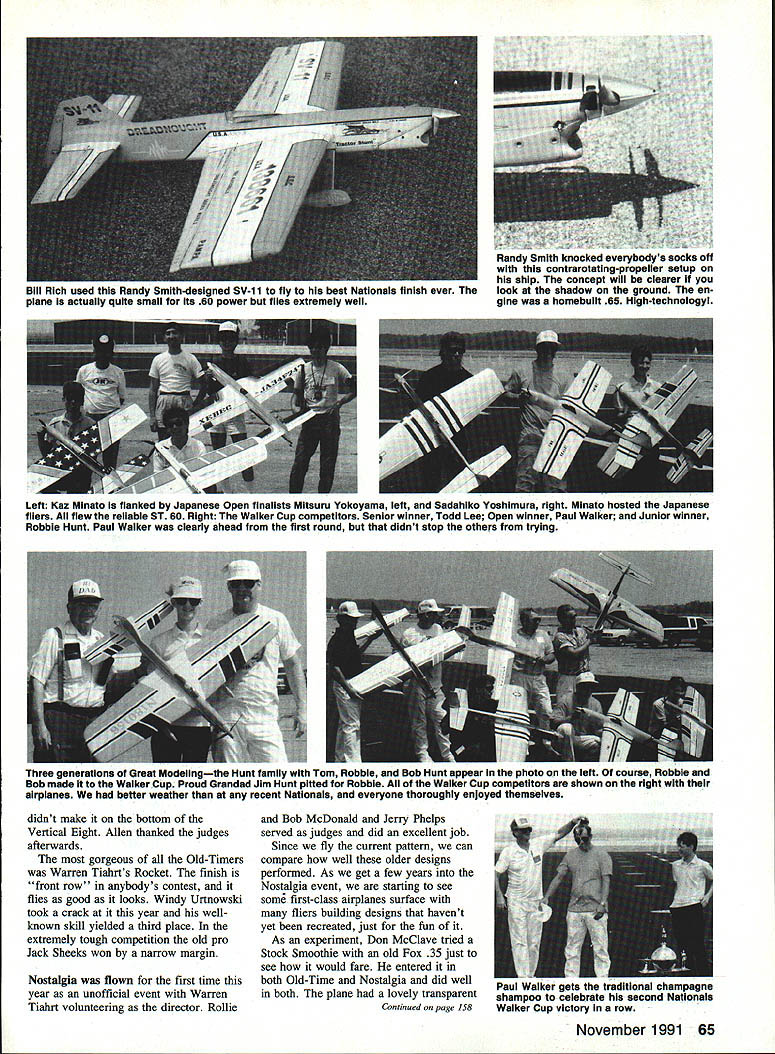
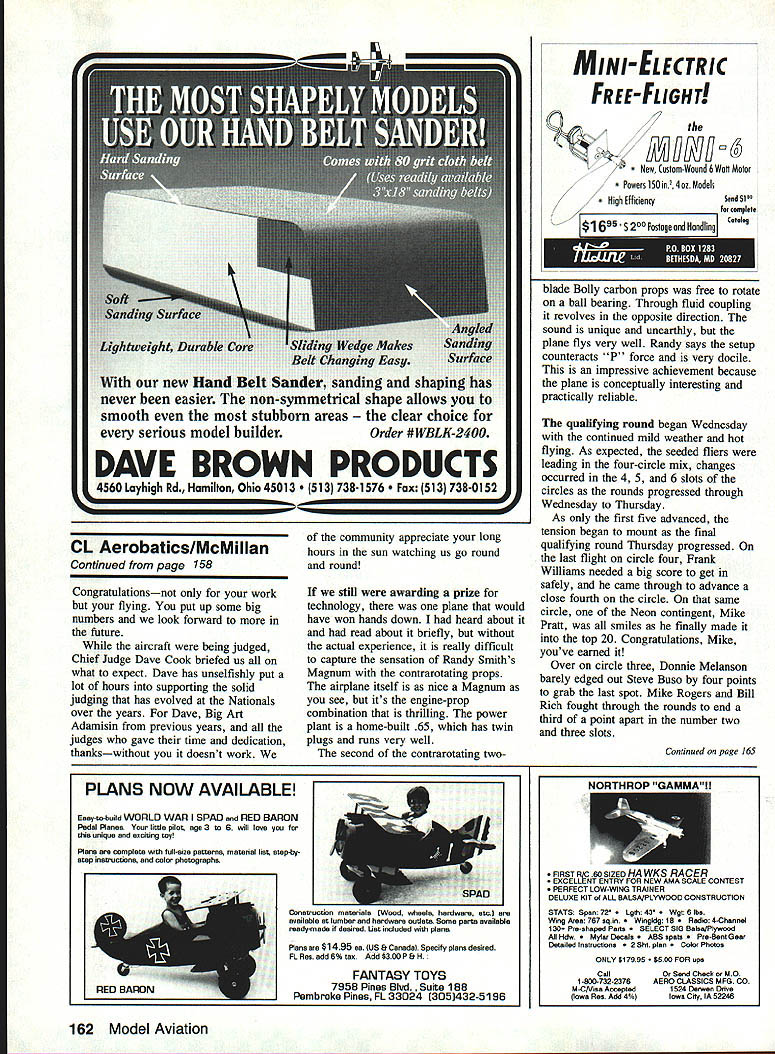
There was another noteworthy point: for the first time a father-and-son team competed. Bob Hunt was back in his usual form and his son Robbie earned his way as the Junior winner over last year's champ Derek Berry. Proud grandad Jim Hunt was in the pits.
From the first round, Paul Walker was clearly the winner. His .40 VF just dove through the variable wind conditions, even at the 5.5-second lap times he was flying. To top off the victory, he stormed to the high flight on the last flight of the day—well-deserved congratulations.
Despite damaging the tips of two propellers on his last flights, Windy Urtnowski finished his best-ever second place. The piped St.60 was docile and behaved perfectly in the Cardinal all week.
Newcomer to the top five, Bill Rich deserved his solid third place. He came with a purpose and really worked hard. Bob Hunt was fourth; the six-point margin between second and fourth showed how close the competition was.
Paul Walker won the Walker trophy for the second year in a row. The Senior winner, Todd Lee, was second in that competition and flew extremely well. All the Open fliers should watch out—both he and Robbie Hunt have talent and youth on their side. Congratulations to both.
Closing Remarks
It was one of the best Nationals ever. Everyone earned their placing with hard-fought, well-supported competition, and we couldn't have enjoyed it without the quiet yet enthusiastic support of many volunteers. Gifford again ran a professional, world-class event. Thanks to Shareen Fancher, all the tabulators, and, of course, our solid, patient judges—we recognize your efforts with our sincere thanks.
'Til we meet again next year, our Stunt community is filled with wonderful people!
Transcribed from original scans by AI. Minor OCR errors may remain.

