
'91 All American Nationals: CL Racing
John Ballard
Overview
Another AMA Nationals is now history. The 1991 contest was held a few miles from Vincennes, Indiana, at the Mid-American Air Center of Lawrenceville, Illinois, which hosted both the '90 and '91 National Championships. The hospitality of the Vincennes area was excellent; local newspapers ran photographs and articles highlighting Control Line Racing, and an entire page was devoted to the Racing events.
Circle condition and repairs
My team and I arrived Saturday night and proceeded immediately to the Control Line Speed/Racing area. Early rumors had indicated the circles for Speed, Racing, and Carrier would be resurfaced with new asphalt. Upon arrival, only the Stunt area had new asphalt; the other circles (Carrier, Speed, and Racing) had not been resurfaced since July. A small hangar for sailplanes had also been installed, which caused the old circle markings to be unacceptable.
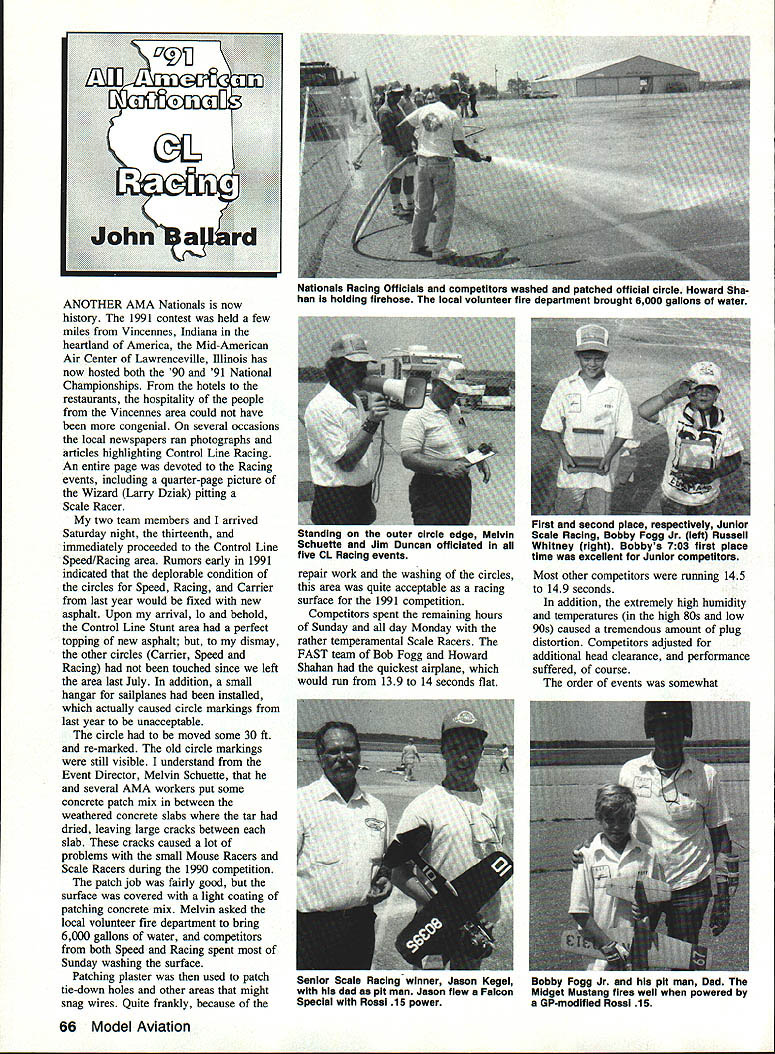
The circle had to be moved about 30 ft. and re-marked; old markings remained visible. Event Director Melvin Schuette and several AMA workers filled gaps between weathered concrete slabs with concrete patch mix to address large cracks that had caused problems for small Mouse and Scale Racers in 1990. The patch job was fairly good, but the surface was covered with a light coating of patching mix. Melvin arranged for the local volunteer fire department to bring 6,000 gallons of water, and competitors from Speed and Racing spent most of Sunday washing the surface.
Patching plaster was used to fill tie-down holes and other snag points. Because of the repair work and washing, the area was acceptable as a racing surface for the 1991 competition.
Scale Racing
Competitors spent the remaining hours of Sunday and all day Monday on the temperamental Scale Racers. High humidity and temperatures in the high 80s and low 90s caused plug distortion; competitors adjusted for additional head clearance, and performance suffered.
- Juniors
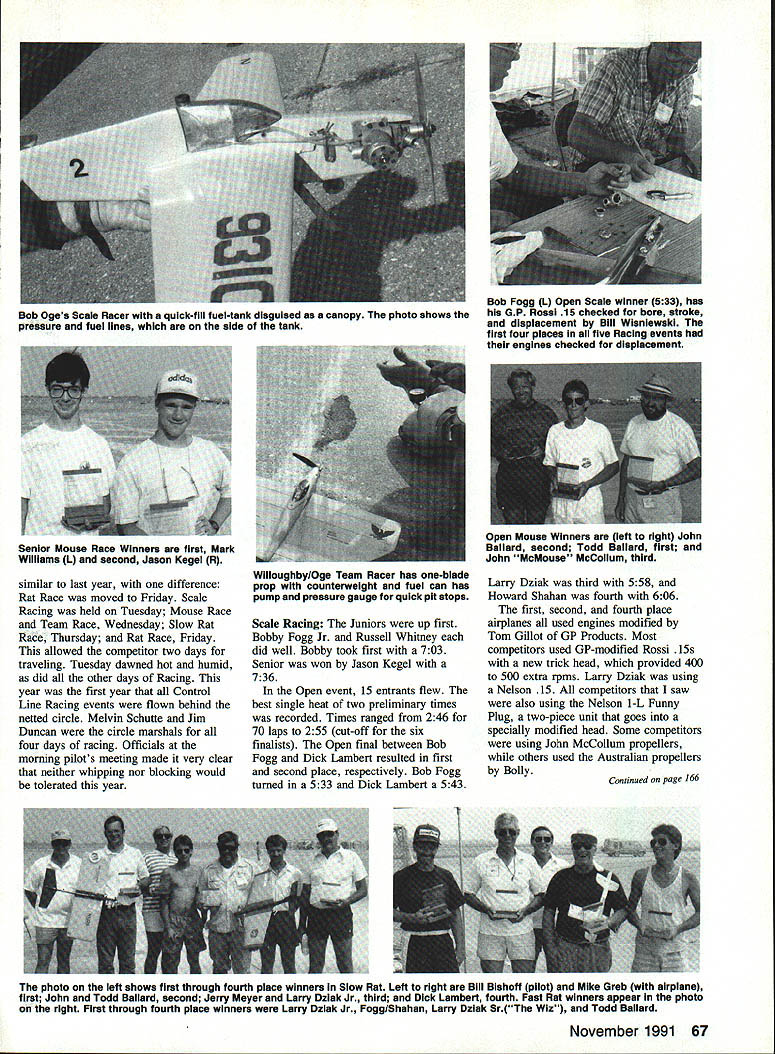
- 1st: Bobby Fogg Jr. — 7:03
- 2nd: Russell Whitney
- Senior
- 1st: Jason Kegel — 7:36
- Open (15 entrants; best single heat of two preliminary times considered for qualification)
- Preliminary times ranged from 2:46 for 70 laps to cut-off times around 2:55 for the six finalists.
- Open final results:
- 1st: Bob Fogg — 5:33
- 2nd: Dick Lambert — 5:43
- 3rd: Larry Dziak — 5:58
- 4th: Howard Shahan — 6:06
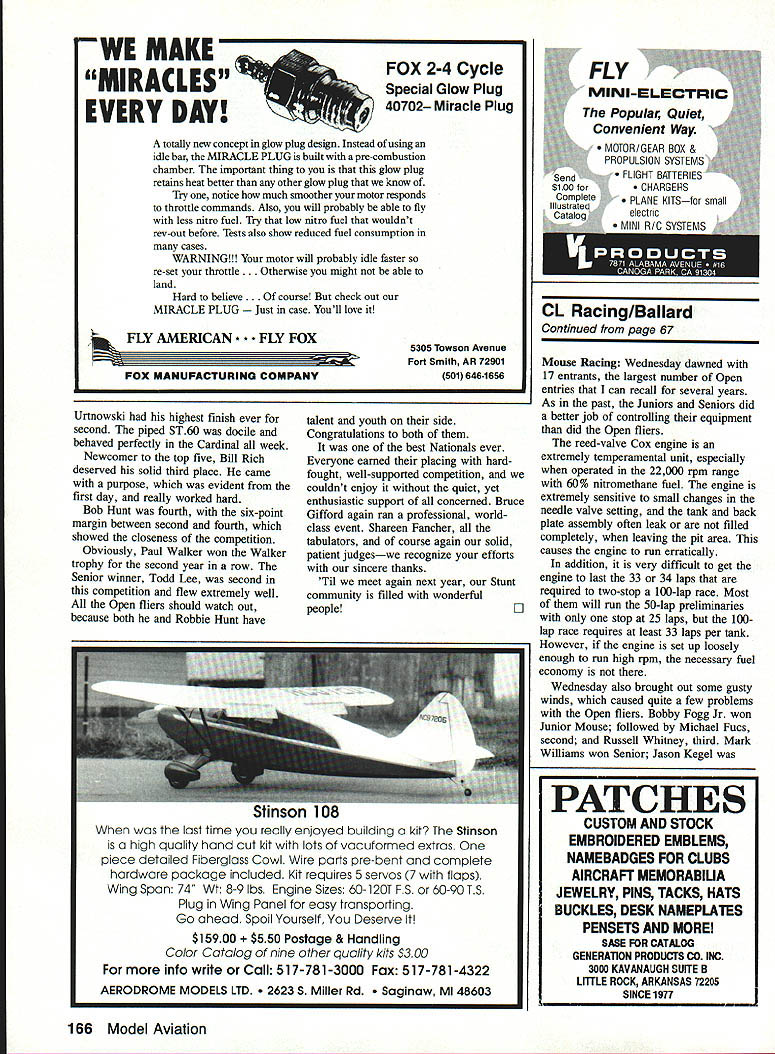
Most competitors used GP-modified Rossi .15s with a new trick head (400–500 extra rpm). Larry Dziak used a Nelson .15. Many used the Nelson 1-E Funny Plug (a two-piece unit for a specially modified head). Propeller choices included John McCollum props and Australian Bolly props. Engines in the five Racing events were checked for bore, stroke, and displacement.
Additional notes: Urtnowski achieved his highest finish (second) using a piped St.60 in the Cardinal. Newcomer Bill Rich earned a solid third in his class. Paul Walker again won the Walker trophy for the second year in a row. The Senior winner Todd Lee (second in another competition) and Robbie Hunt are noted as strong young fliers.
Mouse Racing
Wednesday dawned with 17 entrants, the largest number of Open entries in several years. Juniors and Seniors generally controlled their equipment better than the Open fliers.
The reed-valve Cox engine is temperamental when run at ~22,000 rpm on 60% nitromethane. The engine is extremely sensitive to needle-valve setting; tank and back-plate assemblies often leak or are not fitted completely, causing erratic running. It is difficult to get these engines to last the 33–34 laps needed for two stops in a 100-lap race. Engines set up loosely to run high rpm lack the fuel economy required for long stints. Gusty winds on Wednesday caused additional problems for Open fliers.
- Junior Mouse
- 1st: Bobby Fogg Jr.
- 2nd: Michael Fucs
- 3rd: Russell Whitney
- Senior Mouse
- 1st: Mark Williams
- 2nd: Jason Kegel
Two three-up final races were taken from preliminary times (one excellent preliminary time was 2:18 for a 50-lap heat). The final race produced an assortment of torque rolls, broken crankshafts, blown plugs, and other failures.
Final (top five):
- 1st: Todd Ballard — 4:58
- 2nd: John Ballard — 5:20
- 3rd: John McCollum
- 4th: Howard Shahan
- 5th: Gabe Manfredi
(Some Mouse Racing results and additional CL Racing event details were printed but are obscured in the scan.)
Team Race
Following Mouse Racing, two top teams competed: John McCollum (pitted by Bill Lee) and Stewart Willoughby (pitted by Bob Oge). Both teams had airplanes that did 33 laps in approximately 19 seconds. For the first time, Dick Lambert and John Ballard tried the event; the Asher team from California assisted them with setup (compression, needle valve, fuel blending).
There were excellent qualifying times. In the three-up 200-lap final:
- 1st: McCollum–Lee — 7:51
- Close finish: Willoughby–Oge
- Lambert–Ballard qualified but torque-rolled at the pit stop after the initial tank.
It is hoped Team Racing enthusiasts will prepare for the upcoming Team Trials in the fall.
Slow Rat
Thursday featured the 300-sq.-in. Slow Rat Racers. After a few years of decline, 14 Open fliers entered and 12 flew, showing a resurgence.
New equipment included the Nelson Big Block .36 (available in front- and rear-intake versions). Mike Greb and Bill Bischoff of the Biscuits-and-Gravy team used a front-intake version; the Ballard–Lambert team used a rear-intake version. Bear Products is finalizing a deal with a Polish prop supplier; those props have an eight-inch blade length and tips pitched around 6.5–7 and are ideal for Slow racers.
Historically the SuperTiger X .40 (bore reduced to .36) was preferred; the Nelson .36 produced the most horsepower this year. The Fast Action racing team from Maryland arrived with a competitive Slow Rat running about 14.1–14.3 seconds, using a Fox .36 Combat engine — notable as an off-the-shelf engine running with the fast modified engines. Burned plugs caused preliminary-heat problems for that team.
Event Director Schuette used a combined 70-lap time and took six to the final, meaning competitors needed two decent back-to-back 70-lap heats. Qualifying ranged from Bob Oge’s 2:36 to a cut-off of 2:50 (historically three minutes was the cut-off).
Final results:
- 1st: Mike Greb (Biscuits-and-Gravy) — 5:32
- 2nd: John Ballard — 5:34
- 3rd: Jerry Meyer — 5:38 (had a bad pit stop)
- 4th: Dick Lambert — 5:49
- 5th: Bill Bischoff — 6:09
Most competitors used Nelson one-piece heavy-duty glow plugs with ~10% nitro; these plugs were not prone to breakage. Quick pit-stop teams used two men in the pit (fueller/flipper and battery/valve operator).
Rat Race
Thursday afternoon and Friday morning featured the premier Rat Race. The FAST team (Bob Fogg and Howard Shahan) again had the quickest equipment, using a K&B .40 with their own tank and airframe, running consistently at 11 seconds flat. Their tank allowed choice of early or late pit. Upside-down engine-mounted Rat Racers with partial pans were common, though Ballard used a conventional straight-up Rat Racer.
FAST’s strategy: stagger pit timing to exploit other teams’ pit-down periods. That tactic worked in Scale Racing but not in Rat Race.
With eight entries, a single 140-lap final was held. Final results:
- 1st: Larry Dziak Jr. and his father — 4:49
- 2nd: Bob Fogg — 4:51
- 3rd: the Wizard (Larry Dziak Sr.) — 5:04
- 4th: Todd Ballard — 5:16
FAST’s equipment advantage remained evident. Bob Fogg suffered several pit fires during one stop; despite promptly extinguishing them, a hot fiberglass cowling caused a flare-up when refueling. Dziak Sr. completed three one-flip pit stops. Most engines in Rat Race were K&B .40s with a few SuperTigre X.40s.
Officials, inspections, and awards
- Engines in the five Racing events were checked for bore, stroke, and displacement. K&B provided fuel and sent Bill Wisniewski to measure the first four place winners in all Racing events.
- The Fireman of the Year award (for pit fires) went to Bob Fogg. Previously that award had been held by Jerry Meyer.
Thanks and requests
This was one of the best Nationals ever — hard-fought competition supported by many volunteers. Special thanks to Event Director Bruce Gifford for running a professional, world-class event; Sharen Fancher and the tabulators; and the patient judges.
I would like to ask AMA to update the timing equipment used at the Nationals. Several stopwatches intermittently stopped and restarted despite tinkering or battery changes. Accurate stop watches are critical in Control Line Racing, where times often differ by fractions of a second. I observed races in which one watch stopped or gave a faulty time, but only one time was taken. This was not the fault of the officials or timers, who spent long hours on the field. It should be possible to find sponsors to provide a new set of watches.
As always, comments and photographs are solicited.
Transcribed from original scans by AI. Minor OCR errors may remain.

