
'91 All American Nationals: CL Scale
Mike Welshans
Overview
It's back! For the first time since the 1988 National Championships in Virginia Beach, two days were needed for Control Line Scale in 1991. This was due in part to the fact that the U.S. Scale Team selection, although a separate contest, was held in conjunction with the AMA Nationals. Because the team selection used a different sanction number, contestants were allowed to enter the same model in the AMA portion of the Nationals either in the same (FAI Scale) or a different event.
Of the 13 entries in the FAI Scale team-selection portion of the contest, eight also elected to enter the Nationals in either FAI or AMA Precision Scale. With this format the 35 models entered made up 45 entries. That led to a first round of competition that featured 45 flights and did not end until after 5:00 p.m. on Wednesday.
Judging and logistics
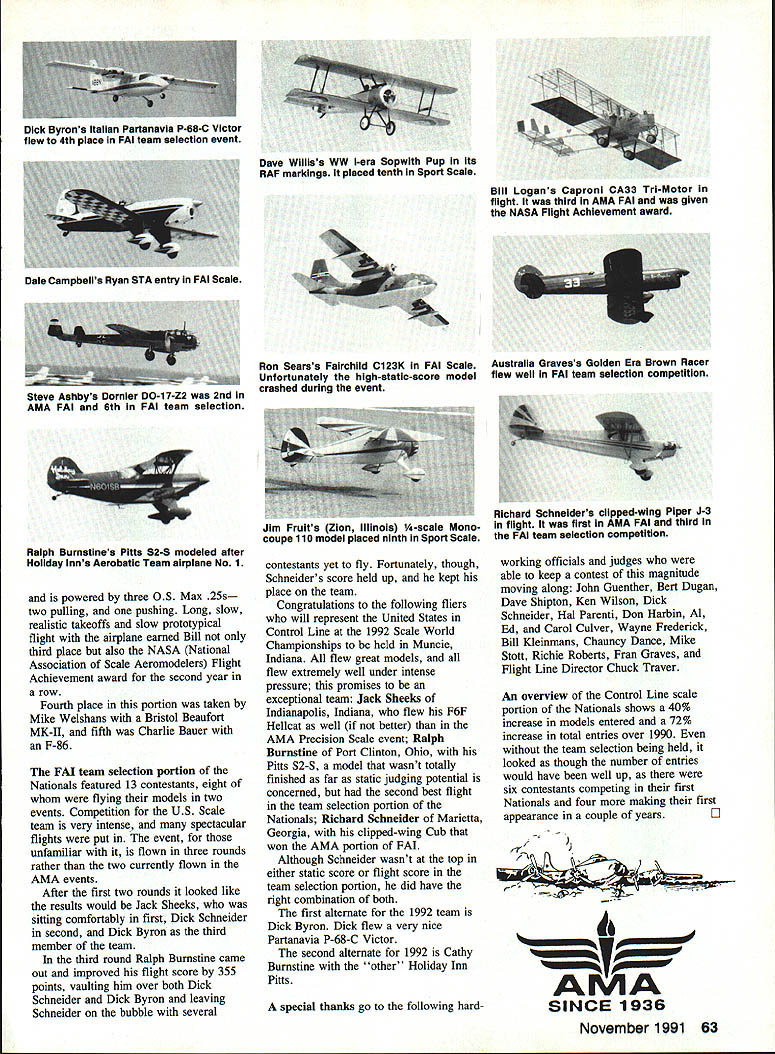
Static judging was held in a full-scale sailplane hangar which AMA officials obtained permission to use at the last minute. This certainly beat being outside in an open tent—or just plain outside. Judging of AMA Scale and Sport Scale went smoothly and was completed by mid-afternoon.
FAI Scale was a different matter. Because of the complexity of the rules, the number of models (15 overall), and because the judges were working very hard to assure that all models were given equal treatment, judging lasted until 8:00 p.m. on Tuesday and started again early Wednesday morning, ending about 9:30 a.m. This put flying off to a late start on Wednesday, since all models had to be judged before flying could begin, but it was the only fair way to proceed. Hats off to Al Culver, Wayne Frederick, and Bill Kleinmans; this hard-working crew of judges went the extra mile.
Of the 35 models entered, 12 were using some type of electronic control system to operate flying options. This seems to be the direction more and more Control Line Scale builders are taking. The only problem was that of the 12 models using these systems, only five had consistent, trouble-free flights. It looks like there is still a way to go before electronic systems become totally reliable.
AMA Precision Scale results
- Bill Logan (London, Ontario, Canada) — 1/2-scale Fly Baby (Pete Bowers' original). This model was a throwback to the golden days of Control Line Scale models: both rudder pedals and stick moved and operated rudder, elevator, and ailerons.
- Jack Sheeks — F6F Hellcat. Jack's Hellcat used one of the electronic control systems that worked very well; it operated retractable gear that turned and folded back, and flaps that extended and retracted.
- Ralph Burnstine (Port Clinton, Ohio) — third place. Ralph entered a simple model compared to the fighter types; his electronic control system performed to perfection.
- (not specified)
- (not specified)
Note: Three "Plus Specials" entered the contest; two were painted in the Holiday Inn Aerobatic Team color scheme. Ralph's daughter Cathy also flew a Holiday Inn Pitts with a different registration number—equally well done.
Control Line Sport Scale results
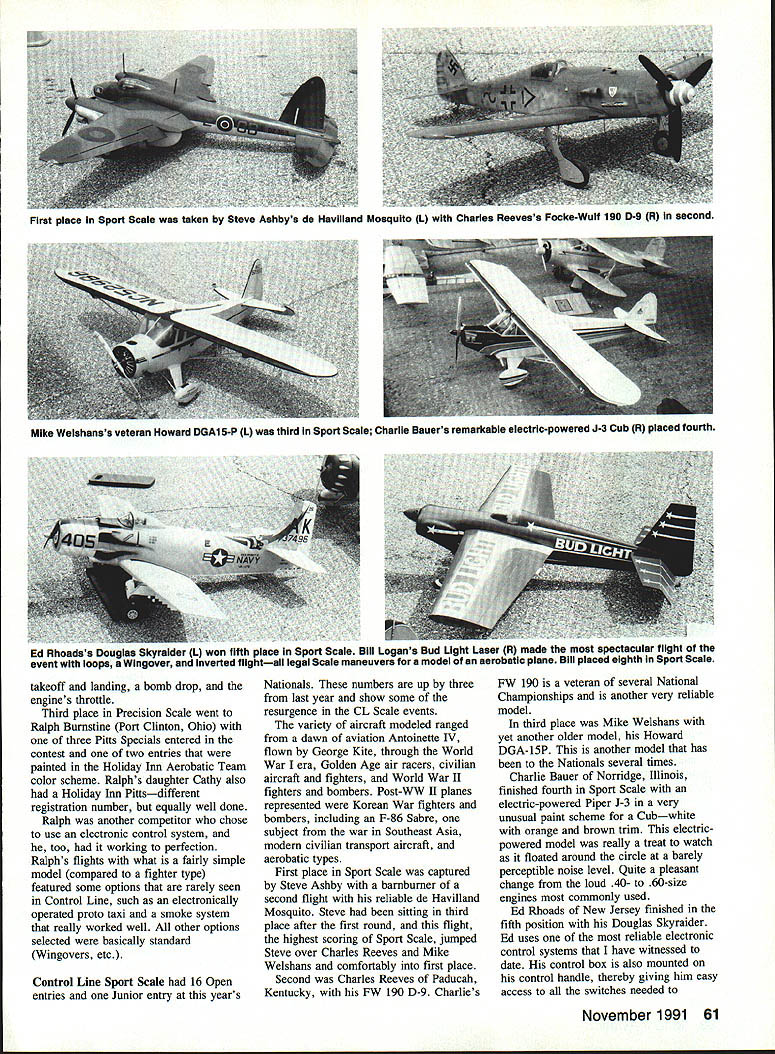
Control Line Sport Scale had 16 Open entries and one Junior entry this year. Nationals numbers are up—three more than last year—which shows some resurgence. CL Scale events covered a wide variety of aircraft modeled, from dawn aviation (an Antoinette IV flown by George Kite) through World War I-era and Golden Age air racers, civilian aircraft, World War II fighters and bombers, post-WWII planes, Korean War fighters and bombers (including the F-86 Sabre), modern civilian transports, and aerobatic types.
Top finishers:
- Steve Ashby — de Havilland Mosquito. Steve, sitting third after the first round, jumped over Charles Reeves and Mike Welshans with a barn-burner second flight to take first place.
- Charles Reeves (Paducah, Kentucky) — FW 190 D-9. Charlie's FW 190 is a veteran of several National Championships and is a very reliable model.
- Mike Welshans — Howard DGA-15P. Another older model that has been to the Nationals several times.
- Charlie Bauer (Norridge, Illinois) — electric-powered Piper J-3 Cub. Dressed in an unusual white with orange and brown trim, this electric model floated around the circle at a barely perceptible noise level—a pleasant change from the loud .40–.60-size engines most commonly used.
- Ed Rhoads (New Jersey) — Douglas Skyraider. Ed uses one of the most reliable electronic control systems seen to date. His control box is mounted on his handle, giving him easy access to all switches needed to operate the various options; this mounting also keeps the switches in his field of view and helps him complete his flight reliably.
Of the top five models in Sport Scale, the newest is Charlie Bauer's three-year-old Piper J-3. This illustrates that a reliable, reasonably high-static-score airplane that is flown often can be very competitive. A model that doesn't do well at its first contest can improve over time as it is refined and the pilot becomes accustomed to its flying characteristics.
The most exciting flight in Sport Scale took place in the second round and was made by Bill Logan of London, Ontario. Bill was having trouble getting the engine in his Bud Light Laser 300 to idle down, making ground maneuvers such as touch-and-goes or taxi laps almost impossible to complete. To compensate, Bill chose the aerobatic route—a perfectly legal option with this type of model. His flight included a true stunt-type wingover, an inside loop, three laps of inverted flight, and an outside loop. The surprised crowd and most of the modelers were on their feet and applauding before the flight ended. This flight garnered Bill an 85 flight score, the third highest of the event.
FAI Scale results (AMA portion)
The FAI Scale portion of the contest was broken into two events: the AMA Nationals competition and the Scale-team selection.
AMA portion top finishes:
- Dick Schneider (Marietta, Georgia) — clipped-wing Piper J-3 Cub. Extremely well done with a very high static score and the second-best flight in the AMA portion of FAI; he flew consistently to a well-earned first place.
- Steve Ashby — Dornier Do-17-Z2. Steve had the highest static score in this portion (1752.4 vs. Schneider's 1731.8) but could not get the flight score needed to win. He was having problems with his electronic control system and did not get a high-enough team-selection flight to earn a place on the team.
- Bill Logan — Caproni CA-33 biplane (WWI vintage, currently at the Air Force Museum). The model spans eight feet, weighs 13 pounds, and is powered by three O.S. Max .25s—two pulling and one pushing. Long, slow, realistic takeoffs and prototypical flight earned Bill third place and the NASA (National Association of Scale Aeromodellers) Flight Achievement award for the second year in a row.
- Mike Welshans — Bristol Beaufort Mk. II.
- Charlie Bauer — F-86.
FAI Team selection
The FAI team-selection portion featured 13 contestants, eight of whom were also flying their models in the AMA events. Competition for the U.S. Scale team is very intense, and many spectacular flights were put in. The team event is flown in three rounds rather than the two used in the AMA events.
After the first two rounds it looked like the team would be:
- Jack Sheeks — sitting comfortably in first
- Dick Schneider — in second
- Dick Byron — as the third member
In the third round Ralph Burnstine improved his flight score by 355 points, vaulting him over both Dick Schneider and Dick Byron and leaving Schneider on the bubble with several contestants yet to fly. Fortunately for Schneider, his score held up and he kept his place on the team.
U.S. Team for the 1992 Scale World Championships
Congratulations to the fliers who will represent the United States in Control Line at the 1992 Scale World Championships in Muncie, Indiana:
- Jack Sheeks (Indianapolis, Indiana) — F6F Hellcat. Flew as well or better than in AMA Precision Scale.
- Ralph Burnstine (Port Clinton, Ohio) — Pitts S-2S. A model that wasn't totally finished for static judging but produced the second-best flight in the team selection.
- Richard (Dick) Schneider (Marietta, Georgia) — clipped-wing Cub that won the AMA portion of FAI.
Alternates:
- Dick Byron — Partenavia P-68-C Victor (first alternate).
- Cathy Burnstine — Holiday Inn Pitts (second alternate).
Officials and judges
Special thanks to the following hard-working officials and judges who kept a contest of this magnitude moving along:
- John Guenther
- Bert Dugan
- Dave Shipton
- Ken Wilson
- Dick Schneider
- Hal Parenti
- Don Harbin
- Al, Ed, and Carol Culver
- Wayne Frederick
- Bill Kleinmans
- Chauncy Dance
- Mike Stott
- Richie Roberts
- Fran Graves
- Flight Line Director Chuck Traver
Event summary and statistics
An overview of the Control Line Scale portion of the Nationals shows a 40% increase in models entered and a 72% increase in total entries over 1990. Even with the team selection being held, it looked as though the number of entries would have been well up; there were six contestants competing in their first Nationals and four more making their first appearance in a couple of years.
Transcribed from original scans by AI. Minor OCR errors may remain.

