
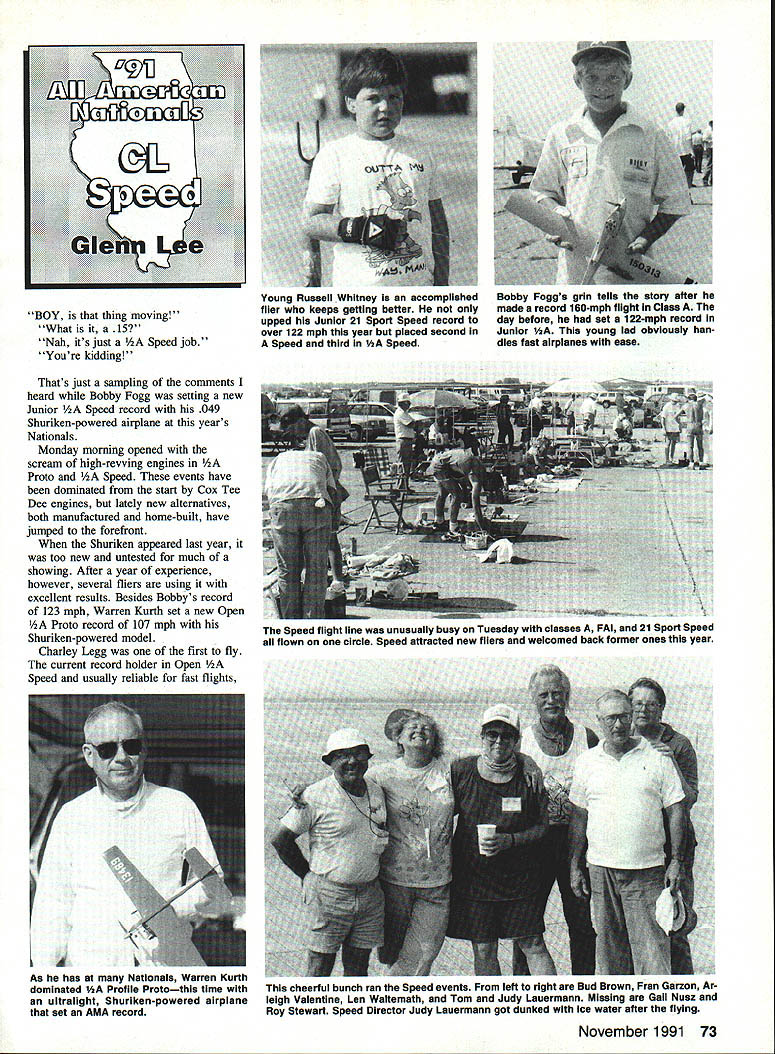
'91 All American Nationals: CL Speed
Glenn Lee
"BOY, is that thing moving!" "What is it, a .15?" "Nah, it's just a 1/2A Speed job." "You're kidding!"
That's just a sampling of the comments I heard while Bobby Fogg was setting a new Junior 1/2A Speed record with his .049 Shuriken-powered airplane at this year's Nationals.
Monday — 1/2A Proto and 1/2A Speed
Monday morning opened with the scream of high-revving engines in 1/2A Proto and 1/2A Speed. These events have been dominated from the start by Cox Tee Dee engines, but lately new alternatives, both manufactured and home-built, have jumped to the forefront.
When the Shuriken appeared last year it was too new and untested for much of a showing. After a year of experience, however, several fliers are using it with excellent results. Besides Bobby Fogg's Junior 1/2A Speed record of 123 mph, Warren Kurth set a new Open 1/2A Proto record of 107 mph with his Shuriken-powered model.
Charley Legg was one of the first to fly. Charley — the current Open 1/2A Speed record holder and usually reliable for fast flights — powered his sidewinder FAI-type model with a homemade engine. The airplane took off okay, the pipe kicked in, and Charley managed to get his handle in the pylon — not an easy feat with the short lines and high speeds. But halfway through the flight the engine sagged, and he ended up with a speed of 118 mph. Investigation revealed that the crankpin in Charley's engine had broken, calling for major repair work. He finally got the engine going fast again later but hit the ground at high speed. Line length will be increased next year; it should be easier to keep up with these little whizzers.
Al Stegens and Chris Montagino teamed and flew an open-faced Cox-powered airplane (no tuned pipe). Since they were without a takeoff dolly, I hand-launched the model after Al started the engine and set the needle. Their 131-mph flight was good enough for second place. These little airplanes are easy to hand-launch; it's just like throwing darts.
Using a CS .049 engine with a full tuned pipe, our annual Nationals visitor from Japan, Akeshi Kusumoto, turned 140 mph for first place. Made in China, the CS shows good promise of becoming another readily available 1/2A engine.
Tuesday — Class AA, FAI and 21 Sport Speed
Junior and Senior turnout was deplorable. While the flying site was a little better than last year's — thanks to local modeler Bud Brown spending about a week filling cracks and holes with mortar — it was still a far cry from the newly paved area that the Stunt fliers enjoyed. With only one circle available, we flew from 8:00 a.m. until 6:00 p.m. on Tuesday, without a lunch break. Class AA, FAI, and 21 Sport Speed had a total of 40 fliers, so we were really busy getting in all the flights.
Most of us flew 21 Sport Speed first, and fast times were turned right away:
- Frank Garzon Jr. put in a 147-mph flight.
- Frank Garzon Sr. did 154 mph.
- Current record holder Carlos Aloise beat Frank by a fraction of a mile-per-hour.
- After Carlos used up his attempts, Frank got a good setting and turned 155.11 mph to win the event.
- Connie Branca, Carlos's fiancée, was third at 150.69 mph. (According to the rules, an entrant may either fly his model or start and regulate the engine and launch the model. Carlos flies and Connie starts; she says she'll be flying next year.)
Sport Speed has grown popular. The reasonable speeds allow most people to fly, and the 10% nitro fuel doesn't burn up the engines. It's a real fun event and probably the best choice for anyone interested in getting started in Speed.
The Class A fliers got busy later in the day. Because of cranky engines, entrants used up lots of attempts trying for good flights. Carlos Aloise quickly showed that his equipment was up to snuff with a fast 185-mph flight, just under the record. Flying one of his FAI airplanes, Carl Dodge took second place at 168 mph using low-nitro fuel.
Two rounds of FAI Speed were flown, one in the morning and one in the afternoon, with two attempts each time as specified in the FAI rules. Carl Dodge showed his World Champion technique with a 184.48-mph flight using his hand-built engine in a sidewinder flying boomerang-type airplane. If he'd backed it up, this would have beaten the AMA record that he currently holds, but Carl decided to save wear and tear on his engine and airplane by letting the flight stand.
Past U.S. Speed team member Bill Hughes flew a sidewinder model powered by a CS .15 engine. This reasonably priced engine shows promise, and I'm sure more modelers will be using it. Bill has achieved over 170 mph in practice.
Of the Junior and Senior class fliers who did turn out, several set new AMA records:
- Bobby Fogg set a Junior Class A record of 160.94 mph using one of his dad's worn-out Scale racing engines. For an unpiped engine on two control lines, 160.94 mph is an excellent speed.
- Russell Whitney raised his Junior 21 Sport Speed record to 122 mph.
- Jim Buxton set a Senior 21 Sport Speed record of 134 mph.
Everyone was tuckered out after such a long day. We really need two circles to separate AMA Speed from FAI. The second circle could be used for test flying as well. We'll have to bug the Nationals Committee next year for a better layout.
Wednesday — B Speed and Formula 40
With only B Speed and Formula 40 scheduled, Wednesday was a comparatively easy day, though entries were fairly high: 16 in B Speed and 17 in Formula 40.
In B Speed, Carlos Aloise ripped off a 211-mph flight right away with his SuperTiger .29-powered ship. He had converted a .40 engine to a .29 by making his own sleeve and piston. The sleeve wall ends up almost 3/16 in. thick, producing a rigid, stable assembly. Ports can be machined to direct gases into the cylinder as desired. Carlos has long been known for his reliable engines and precise, accurate parts.
Santo Rizzotto, fifth-place finisher in Class B, returned to Speed flying about five years ago after a 20-year hiatus. The Nationals Committee convinced him to help run the Speed events for the past three years, but this year he said he was going to fly. The Nationals trophy he earned for his 174-mph flight was his first in a long time—and he was very proud.
Santo builds nice-looking airplanes with vee-shaped stabs made by laminating 1/8" plywood clamped in a mold during gluing.
In Formula 40, the usual keen competition produced many fast times. Current record holder Bill Wisniewski flew his K&B-powered Pink Lady at 164 mph and let the rest of us try to catch him. Would you believe that Bill has used this engine for 12 years? The only changes he's made have been replacing a broken crankcase last year and replacing the head when the glow plug threads became worn. Bearings, rod, sleeve, and piston are all original. Bill uses a metal tank that runs on crankcase pressure and holds about an ounce of fuel—just enough for 14 laps.
The weather that week was about the best I can remember: light breezes and temperatures just above 90° allowed excellent speeds and were not uncomfortable.
Thursday — Jets and Class D
On Thursday the "blowtorches" (jets) and big Class D jobs came out. Charley Davis flew his jet at 206 mph early in the day. No one else topped 200 in jet, but several fliers climbed into the 190s. I tried an old Hoyt-designed sidewinder model but couldn't get a decent run. When the plane was damaged on one attempt, I switched to my all-aluminum upright job and managed 187 mph—good enough for last place, but it was sure fun flying it.
The Class D flying was an entirely different story — talk about a shoot-out! Eighteen fliers battled it out on a field that saw a slowest time of 180 mph. Results included:
- Carlos Aloise: 208.25 mph early in the day.
- Akeshi Kusumoto: 208.73 mph, then 208.98 mph.
- George Brown: 209.46 mph (final leader).
- Frank Garzon: 203 mph (sixth place).
- Larry Stockstad (Minneapolis): 202.39 mph.
- Bob Franklin and Tom Blankman (Saint Louis team): 199.26 mph.
Bob and Tom hadn't flown for several years, but it didn't take long for them to get going fast again. Bob helped me fly my K&B .65-powered job, and I turned a respectable 198.6 mph—good enough for 11th place. I'm already planning some new tricks and a new airplane to get the next 10 mph.
Officials, volunteers and hospitality
Let's not forget the Speed officials — those dedicated, unpaid volunteers who run the show for us. Many people pitched in and did a fine job:
- Event Director: Judy Lauermann
- Timers: Tom Laumann, Bud Brown, Roy Stewart
- Tabulators: Fran Garzon, Gail Nusz
- Runner: Arleigh Valentine
- Pull-test: Len Waitemath
Other notable helpers included Bill Hughes, the BAM Speed Team (Bill Capinola and Mike Couts), Bill Nusz, the Browns, and many others who helped start or fly models.
A special thank-you to Dave Williams (California) and his wife, who during the Class D and Jet events drove into the country, brought back watermelons, cantaloupe, and tree-ripened peaches, and sliced them up for everyone. What a delicious treat on a hot afternoon!
Speed banquet and High Point awards
The Speed banquet and High Point awards presentation took place on Thursday night. After a sumptuous meal, Frank Garzon presented the Open, Junior, and High Speed champion trophies:
- Open champion: Carlos Aloise
- Junior champion: Bobby Fogg
- High Speed champion: Carl Dodge
The High Speed Championship goes to the fastest "record ratio" Open contestant; Carl was the only contestant to exceed an existing Open record. Warren Kurth's mark didn't count since no previous record had been established in 1/2A Proto.
After the presentations, everyone bid "Good night, see you next year!"
Transcribed from original scans by AI. Minor OCR errors may remain.

