
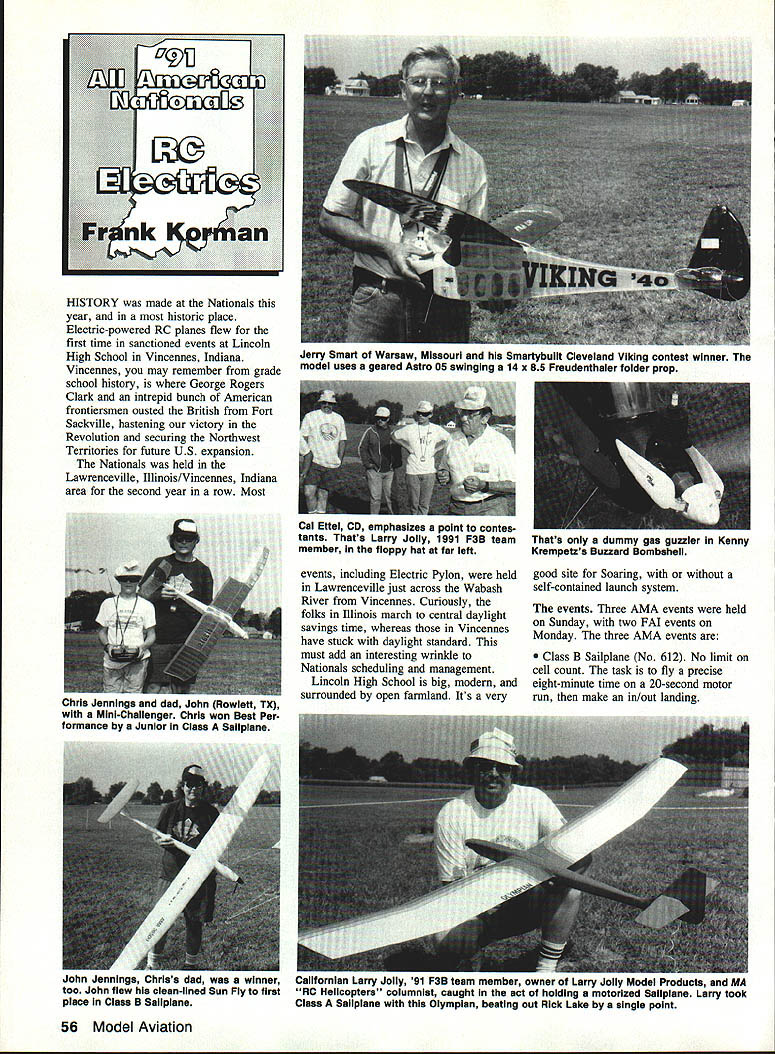
'91 All American Nationals: RC Electrics
Frank Korman
HISTORY was made at the Nationals this year, and in a most historic place. Electric-powered RC planes flew for the first time in sanctioned events at Lincoln High School in Vincennes, Indiana. Vincennes, you may remember from grade school history, is where George Rogers Clark and an intrepid bunch of American frontiersmen ousted the British from Fort Sackville, hastening our victory in the Revolution and securing the Northwest Territories for future U.S. expansion.
The Nationals were held in the Lawrenceville, Illinois / Vincennes, Indiana area for the second year in a row. Most events, including Electric Pylon, were held in Lawrenceville just across the Wabash River from Vincennes. Curiously, the folks in Illinois march to Central Daylight Time, whereas those in Vincennes have stuck with Daylight Standard. This added an interesting wrinkle to Nationals scheduling and management.
Lincoln High School is big, modern, and surrounded by open farmland. It's a very good site for soaring, with or without a self-contained launch system.
The events
Three AMA events were held on Sunday, with two FAI events on Monday.
The three AMA events were:
- Class B Sailplane (No. 612): No limit on cell count. The task is to fly a precise eight-minute time on a 20-second motor run, then make an in/out landing.
- Class A Old-Timer (No. 618): Seven-cell limit; timed for eight minutes on a 40-second motor run. Fliers make an in/out landing. Models must be pre-1943 vintage designs.
- (Other AMA/limited-motor events were staged as listed in official results.)
The two FAI events were:
- F3E Motor Glider: Three-part task — speed, five-minute precision duration and landing using concentric circles. Maximum flying surface loading ~24.6 oz/sq ft. Maximum motor battery weight 1.1 kg (practically 27 × 900 mA Sanyo cells).
- Speed task: launch and complete as many transits of a 150 m course as possible in a three-minute window. After the speed run, the pilot has up to one minute to pass below a three-meter limbo bar and begin the five-minute precision duration.
- Duration task: five minutes; points are deducted for each second of motor run during this slot.
- Landing task: inner 15 m circle = 30 points; outer 30 m circle = 15 points. All landing points are lost at 30 seconds past the five-minute precision time. Model must land within 60 seconds after the five-minute time or duration points are lost.
- F3E Seven-Cell Motor Glider: Identical to full F3E except for the seven-cell limit on motor batteries.
Models, motors and equipment
A wide variety of airplanes was seen, from stick-and-tissue Old-Timers to F3E designs using the latest composite construction. Most fliers used Sanyo battery packs, commonly 900 mA. A few flew SR packs and Jay Burkart used Fine Design cells. Astro cobalts were widespread; a few used Ultras and Plettenbergs. Folding props were used exclusively, with Freudenthaler blades the most popular.
The Unlimited F3E models and most Class B sailplanes used electronic speed controllers (ESCs). The 60-size motors draw over 50 A from 27 cells for power outputs of 1,500–2,000 W. Class A sailplanes and Old-Timers running on seven cells commonly used electromechanical on/off switches (Graupner Power Switch, High Sky switch). A few Class A ships used speed controllers; only one surveyed plane used a BEC.
Twelve original designs were represented in the survey results. Unlimited F3E ships tended to be 70–80 in. span, smaller than the 90–100 in. models seen at the 1988 World Championships. The smaller, faster wings suggest competitors regarded F3E as predominantly a speed task rather than a thermal one.
(Note: Some small details and a few entries were illegible on the scan; wording and abbreviations have been corrected where apparent from context.)
1991 Nationals Electric Soaring — Aircraft Specs
F3E (FAI)
- Jerry Bridgeman & Brian Chan — Plane: SE5 — Prop: (Homemade) 14/7.25 (original) — Motor: Ultra 2000 — Controller/Switch/BEC: Becker Cont., STW 85 amp cont. — Battery: 27 × Sanyo 900 mA — Span: 80 in — Area: 525 ± 50 sq in — Airfoil: RG12A — Wt: 92 oz — Construction: foam/glass, Kevlar, carbon spar
- John Jennings — Plane: Fr Surprise II — Prop: Freudenthaler 12.75/7 — Motor: Plettenberg — Controller/Switch/BEC: C & UT (?) — Battery: 27 × Sanyo 900 mA — Span: 74 in — Area: 527 ± 62 sq in — Airfoil: N/A — Wt: 92 oz — Construction: fiberglass, Kevlar, carbon
- Steve Neu — Plane: SE10 (original) — Prop: original — Motor: Astro 60 (FAI) — Controller/Switch/BEC: original controller — Battery: 27 × Sanyo 900 mA — Span: 80 in — Area: 520 ± 60 sq in — Airfoil: RG12A — Wt: 90 oz — Construction: foam, fiber, Kevlar
- Abe Schwartz — Plane: Sinus — Prop: Freudenthaler 9/5 — Motor: Ultra 900 — Controller/Switch/BEC: N/A — Battery: 12 × Sanyo 900 mA — Span: 54 in — Area: 450 sq in — Airfoil: Eppler-modified — Wt: 52 oz — Construction: wood, foam, Kevlar, glass
- Bob Siliff — Plane: SE6 (original) — Prop: Hom 12/7 — Motor: Astro 60 (FAI) — Controller/Switch/BEC: Astro 205 controller — Battery: 27 × Sanyo 900 mA — Span: 71 in — Area: 525 sq in — Airfoil: RG12A — Wt: 100 oz — Construction: foam, Kevlar, carbon/fiber
F3E — 7 Cell
- Jerry Bridgeman — Plane: Cad Cat F3E — Prop: Freudenthaler 8/5 — Motor: Astro 05 (FAI) — Controller/Switch/BEC: Becker Cont. — Battery: 7 × Sanyo 900 mA — Span: 36 in — Area: 230 sq in — Airfoil: RG12A — Wt: 34 oz — Construction: foam, fiber, carbon fiber
- Jay Burkart — Plane: Snipe — Prop: Freudenthaler 8/5 — Motor: Astro 05 (FAI) — Controller/Switch/BEC: Graupner PS 20 switch — Battery: 7 × Fine Design 600 mA — Span: 68 in — Area: 220 sq in — Airfoil: RG15 — Wt: 32 oz — Construction: Kevlar & glass
- Wayne Fredette — Plane: Sinus — Prop: Freudenthaler 9/5 — Motor: Astro 05 (FAI) — Controller/Switch/BEC: N/A — Battery: 7 × Sanyo 900 mA — Span: 76 in — Area: 450 sq in — Airfoil: Eppler-modified — Wt: 68 oz — Construction: foam & glass
- Mike Lachowski — Plane: (original) — Prop: Freudenthaler 7.75/5 — Motor: Astro 05 (FAI) — Controller/Switch/BEC: On/Off switch — Battery: 7 × Sanyo 900 mA — Span: 86 in — Area: 420 sq in — Airfoil: SD-8000 — Wt: 36 oz — Construction: wood, plywood, foam, balsa, Kevlar, glass
- Bob Siliff — Plane: Snipe — Prop: K&W 96 (modified) — Motor: Astro 05 — Controller/Switch/BEC: Becker Cont. — Battery: 7 × Sanyo 900 mA — Span: 77 in — Area: 300 sq in — Airfoil: RG12A — Wt: 34 oz — Construction: foam, glass, Kevlar
Sailplane B
- Jay Burkart — Plane: Fire Fox (original) — Prop: Freudenthaler 8/5 — Motor: Plettenberg — Controller/Switch/BEC: Graupner PS 25 — Battery: 10 × Fine Design 600 mA — Span: 68 in — Area: 518 sq in — Airfoil: SD 3021 — Wt: 32 oz — Construction: built-up, balanced
- John Jennings — Plane: Sun Fly — Prop: Freudenthaler 12.75/7 — Motor: Astro 60 (FAI) — Controller/Switch/BEC: Astro 205 — Battery: 27 × Sanyo 900 mA — Span: 86 in — Area: 604 sq in — Airfoil: SD 387 — Wt: 109 oz — Construction: wood, foam, glass
- Mike Lachowski — Plane: Sun Fly — Prop: 11/7 — Motor: Ultra 1600 — Controller/Switch/BEC: Astro 205 controller — Battery: 16 × Sanyo 900 mA — Span: 95 in — Area: (illegible) — Airfoil: E 387 — Wt: 100 oz — Construction: wood, foam, glass
- Grant Messinger — Plane: SE5 — Prop: homemade 11/7 — Motor: Astro 60 — Controller/Switch/BEC: Astro 205 controller — Battery: 27 × Sanyo 900 mA — Span: 90 in — Area: 600 sq in — Airfoil: RG12 — Wt: 100 oz — Construction: glass, Kevlar, carbon fiber, epoxy
Sailplane A
- Christer Broman — Plane: (original) — Prop: Freudenthaler 8/5 (modified) — Motor: Astro 05 (FAI) — Controller/Switch/BEC: N/A — Battery: 7 × (Mat.) 600 mA (9 in B?) — Span: 68 in — Area: 462 sq in — Airfoil: SD 037 — Wt: 28 oz — Construction: built-up wing, 60% top/bottom spar
- Jay Burkart — Plane: Fire Fox 7 (original) — Prop: Freudenthaler 8/5 — Motor: Plettenberg — Controller/Switch/BEC: Graupner PS 20 — Battery: 7 × Fine Design 600 mA — Span: 60 in — Area: 457 sq in — Airfoil: SD 3021 — Wt: 29 oz — Construction: built-up, balanced
- Paul Carlson — Plane: Spectra — Prop: B 4/4 — Motor: Astro 05 — Controller/Switch/BEC: Dialed Racing Prod. — Battery: 7 × Sanyo 800 mA — Span: 76 in — Area: 650 sq in — Airfoil: SD 3021 — Wt: 43 oz — Construction: built-up, balanced
- Wayne Fredette — Plane: Ultra MK IV — Prop: K&S 11/7 — Motor: Astro 05 (geared) — Controller/Switch/BEC: High Sky on-off — Battery: 7 × Sanyo 900 mA — Span: 84 in — Area: 725 sq in — Airfoil: Eppler 211 — Wt: 44 oz — Construction: built-up, balanced
- Tom Gates — Plane: Ultra MK IV — Prop: K&S 11/6 — Motor: Astro 05 (geared) — Controller/Switch/BEC: On-off switch — Battery: 7 × Sanyo 900 mA — Span: 64 in — Area: 625 sq in — Airfoil: Eppler 211 — Wt: 44 oz — Construction: built-up, balanced
- C. D. Holland — Plane: Spectra (wing/original) — Prop: K&S 11/7 — Motor: Astro 05 (FAI, geared) — Controller/Switch/BEC: Graupner PS 20 — Battery: 7 × Sanyo 900 mA — Span: 74 in — Area: 700 sq in — Airfoil: Eppler 205 — Wt: 66 oz — Construction: built-up, balanced
- Dale House — Plane: Terminator — Prop: Freudenthaler 9/5 — Motor: Astro 05 (FAI, geared) — Controller/Switch/BEC: On-off switch — Battery: 7 × SR Max 1100 mA — Span: 83 in — Area: 720 sq in — Airfoil: Clark Y — Wt: 48 oz — Construction: built-up, balanced
- Bill Jenkins — Plane: Clip Wing Elec — Prop: Freudenthaler 9/5 — Motor: Hobby-Lobby (on-off) — Controller/Switch/BEC: Hobby-Lobby on-off — Battery: 7 × Sanyo 900 mA — Span: 88 in — Area: 740 sq in — Airfoil: Eppler 205 — Wt: 50 oz — Construction: built-up, balanced
- Larry Jolly — Plane: Olympian — Prop: Freudenthaler 8/5 — Motor: JR NFA 230 — Controller/Switch/BEC: Robbe — Battery: 7 × Sanyo 900 mA — Span: 90 in — Area: 570 sq in — Airfoil: WA 01 — Wt: 36 oz — Construction: foam, Kevlar, wood
- Mike Lachowski — Plane: Waco 570-07 — Prop: 8/5 — Motor: Astro 05 — Controller/Switch/BEC: Robbe — Battery: 7 × Sanyo 900 mA — Span: 88 in — Area: 420 sq in — Airfoil: WA 01 — Wt: 35 oz — Construction: balsa, spruce, plywood, built-up
- John McCullough — Plane: ONOI (original) — Prop: Graupner — Motor: (illegible) — Controller/Switch/BEC: On-off switch — Battery: 7 × Sanyo 900 mA — Span: 84 in — Area: 680 sq in — Airfoil: (illegible) — Wt: 40 oz — Construction: built-up, balanced
- Tom Williams — Plane: Mini Challenger — Prop: Freudenthaler 8/7 — Motor: Astro 05 (FAI) — Controller/Switch/BEC: High-Sky on-off — Battery: 7 × Sanyo 900 mA — Span: 87 in — Area: 600 sq in — Airfoil: Eppler 205 — Wt: 33 oz — Construction: built-up, balanced
7-Cell Old Timer
- Jay Burkart — Plane: Playboy — Prop: Freudenthaler 13/8 — Motor: Astro 05 (FAI, geared) — Controller/Switch/BEC: Graupner PS 20 — Battery: 7 × Fine Design 600 mA — Span: 68 in — Area: 544 sq in — Airfoil: N/A — Wt: 44 oz — Construction: built-up, balanced
- Tom Gates — Plane: Playboy Cabin — Prop: K&S 11/8 — Motor: Astro 05 (geared) — Controller/Switch/BEC: Graupner PS 20 — Battery: 7 × Sanyo 900 mA — Span: 86 in — Area: 548 sq in — Airfoil: N/A — Wt: 45 oz — Construction: built-up, balanced
- C. D. Holland — Plane: Playboy — Prop: Freudenthaler 13/7 — Motor: Astro 05 (geared) — Controller/Switch/BEC: On-off switch — Battery: 7 × Sanyo 900 mA — Span: 62 in — Area: 545 sq in — Airfoil: N/A — Wt: 41 oz — Construction: built-up, balanced
- Stan Koch — Plane: Leisure Playboy — Prop: (illegible) — Motor/Controller: Graupner PS 20 — Battery: 7 × SR Max 1100 mA — Span: 70 in — Area: 598 sq in — Airfoil: N/A — Wt: 41 oz — Construction: built-up, balanced
- Kenny Krempetz — Plane: Buzz Bombshell — Prop: Freudenthaler 12/7 — Motor: Astro 05 (FAI, geared) — Controller/Switch/BEC: Futaba w/ BEC — Battery: 7 × Sanyo 900 mA — Span: 59 in — Area: 58 sq in (likely OCR error) — Airfoil: N/A — Wt: 45 oz — Construction: built-up with can, fiberglass
- Jerry Smart — Plane: 1940 Civil Viking — Prop: Freudenthaler 14/8.5 — Motor: Astro 05 (FAI, geared) — Controller/Switch/BEC: High-Sky on-off — Battery: 7 × Sanyo 1200 mA — Span: 62 in — Area: 600 sq in — Airfoil: original — Wt: 45 oz — Construction: built-up, balanced
The competition — highlights
A weak norther moved through Saturday night, leaving Sunday mild and sunny. Monday was a little warmer. Winds rarely exceeded 10 mph, and lift—though not always boomer quality—was there to be worked.
Class B Sailplane (11 contestants) started the day's action at about 9 a.m. In round one, Bob Siliff flew a three-meter Gnome to a perfect eight-minute time and landing points. John Jennings placed third in round one with 7:57 and no landing points; William Jenkins finished sixth. Larry Jolly had a power failure with his Class B sailplane and used his Class A model for the remaining rounds.
Round two saw John Jennings and Grant Messinger tie for first (both one second off eight minutes and with landing points). William Jenkins was second in that round. Bob Siliff missed a landing that cost him the ultimate standings.
Round three: John Jennings, flying his Sun Fly, won the round with 7:55 and landing points. Final results (best two of three rounds): 1st John Jennings (984 points), 2nd Bob Siliff (974), 3rd William Jenkins (973).
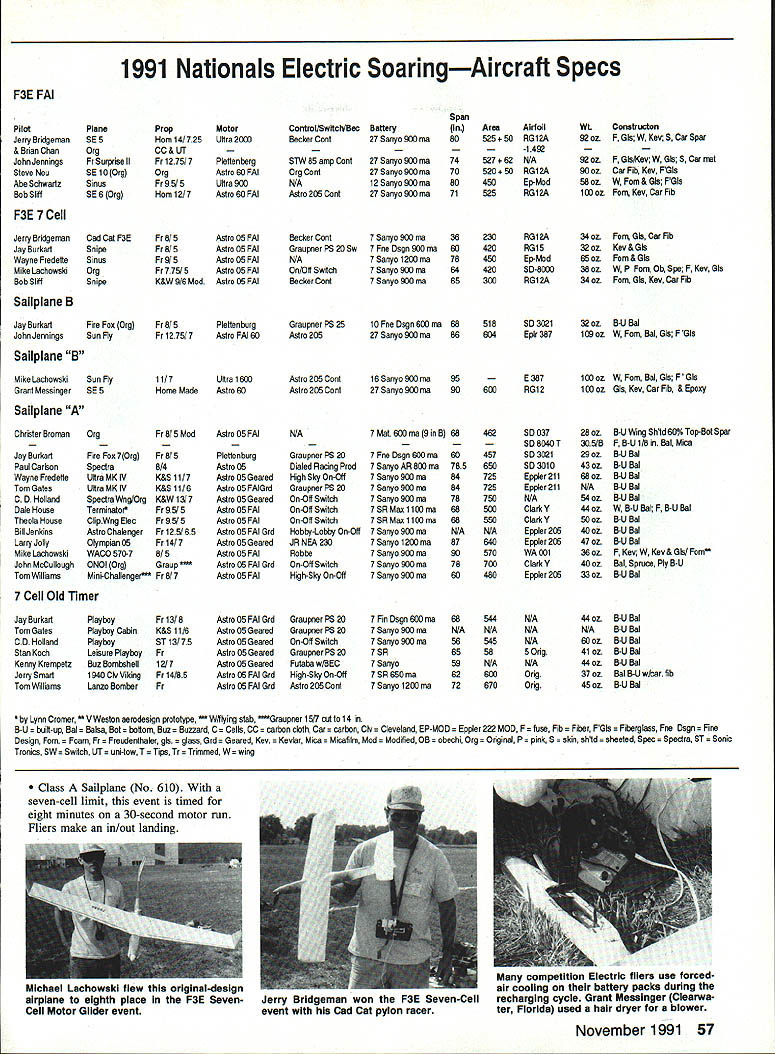
Class A Sailplane (24 fliers) was close. The top four had a total of 900 points, with only eight points separating 1st and 4th. Larry Jolly and Mike Lachowski tied for first in round one with perfect scores. Rick Lake, eventual second-place finisher, came in 12th in round one but posted perfect scores in round two. Round three saw Rick put up an 8:01 plus landing points, challenging Larry. Final results: 1st Larry Jolly (990), 2nd Rick Lake (989), 3rd Mike Lachowski (986), 4th Paul Carlson (982).
Class A Old-Timer (11 participants) flew three rounds plus a throwaway. Round one's best time was Grant Messinger at 5:52; Jerry Smart was close with 5:47. Final results favored Jerry Smart as the winner.
F3E (Unlimited) had seven entrants, including several past F3E World Championship team members. The F3E speed runs and limbo dives were spectacular; models accelerated and climbed with tremendous sound and rate. Only two rounds were possible because the field was shared with F3B glider on Monday.
Round one results: Steve Neu led with 24 laps and a 4:47 duration; Jerry Bridgeman had 22 laps and 4:50; Brian Chan 21 laps and 4:47. Round two: Jerry Bridgeman posted 25 laps, 4:53 duration and nailed a 30-point landing. Final standings: 1st Jerry Bridgeman (1,348), 2nd Steve Neu (1,327), 3rd Grant Messinger (1,195), 4th Brian Chan (1,185), 5th John Jennings (1,115).
F3E Seven-Cell attracted eight pilots. The top two flew strikingly different models: 1st Jerry Bridgeman (Cad Cat pylon racer) and 2nd Paul Carlson (Spectra glider). Final standings: 1st Jerry Bridgeman (918), 2nd Paul Carlson (894), 3rd Christer Broman (880), 4th Jay Burkart (876).
Organization, officials and suggestions
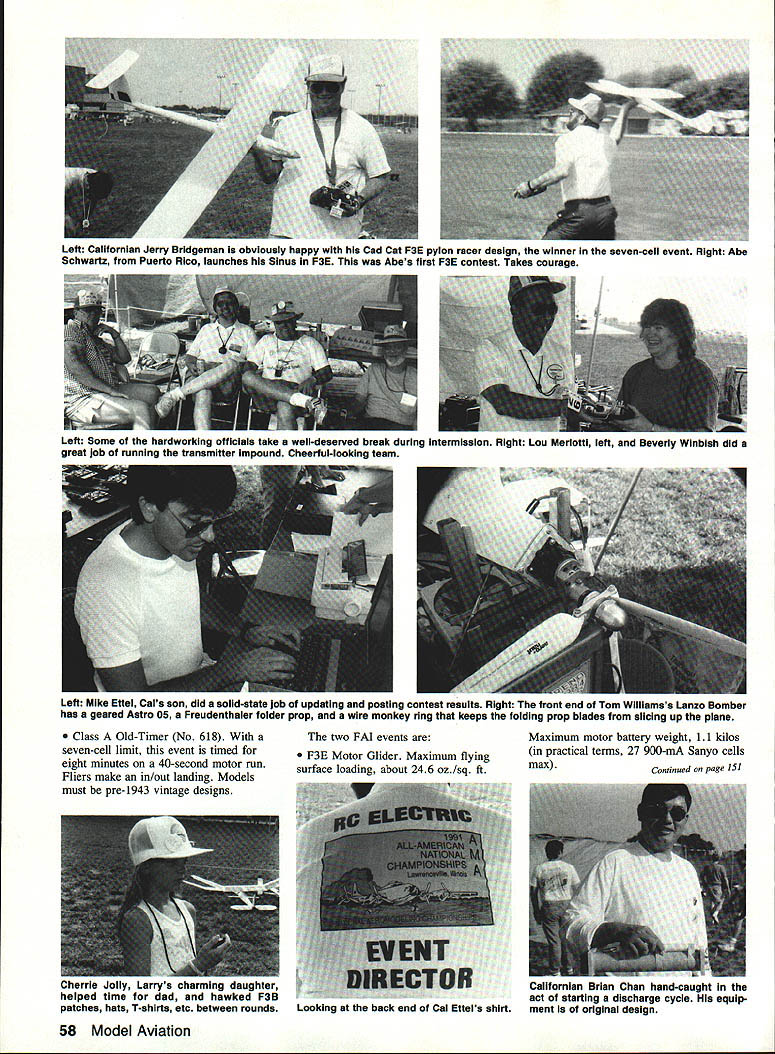
Kudos to CD C. D. (Cal) Ettel and his officials (including Gary Meissner, Dan McEntee, and Mark Nankivil). Thanks to the Kirkwood Thermalers, the Mississippi Valley Soaring Association and Mike Ettel for computer scoring. These events would not have taken place without Cal Ettel’s spadework and the Electric Aeromodel Association.
Suggested improvements:
- Do not mix F3B with F3E on the same block; give F3E a separate time block so three or four rounds can be staged.
- Consider holding Electric Pylon at the F3E site.
- Drop one of three rounds in other limited-motor events to save time and reduce pilot fatigue.
- Include Class B Old-Timer next year.
Cal Ettel mentioned a new 10-cell beginner's F3E event approved by the FAI. Power packs limited to 10 cells (max 550 g including connectors); wing + horizontal tail area must exceed 557.8 sq in. Task same as full F3E; minimum two flights required. A pilot may not compete in both full and 10-cell F3E at a given meet.
We're off to a great start. Let's keep charging!
Transcribed from original scans by AI. Minor OCR errors may remain.

