
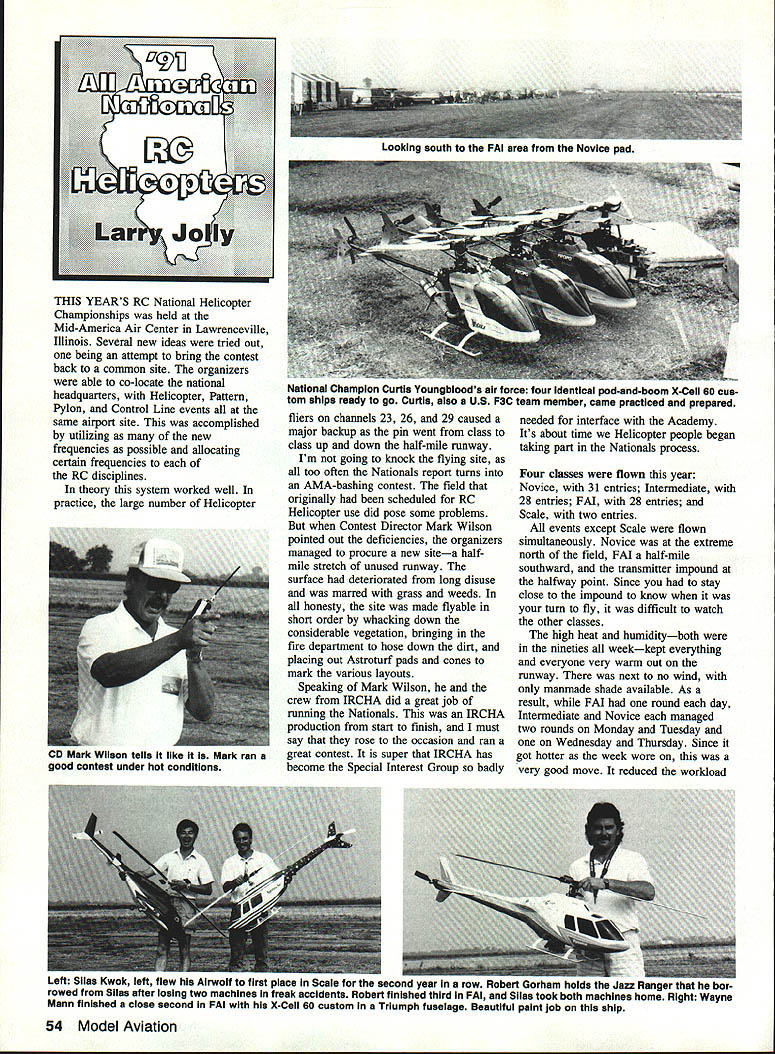
'91 All American Nationals: RC Helicopters
Larry Jolly
Introduction
This year's RC National Helicopter Championships was held at the Mid‑America Air Center in Lawrenceville, Illinois. Several new ideas were tried, including an attempt to bring the contest back to a common site. The organizers co‑located the national headquarters with Helicopter, Pattern, Pylon, and Control Line events at the same airport by utilizing as many new frequencies as possible and allocating certain frequencies to each RC discipline.
Site and Organization
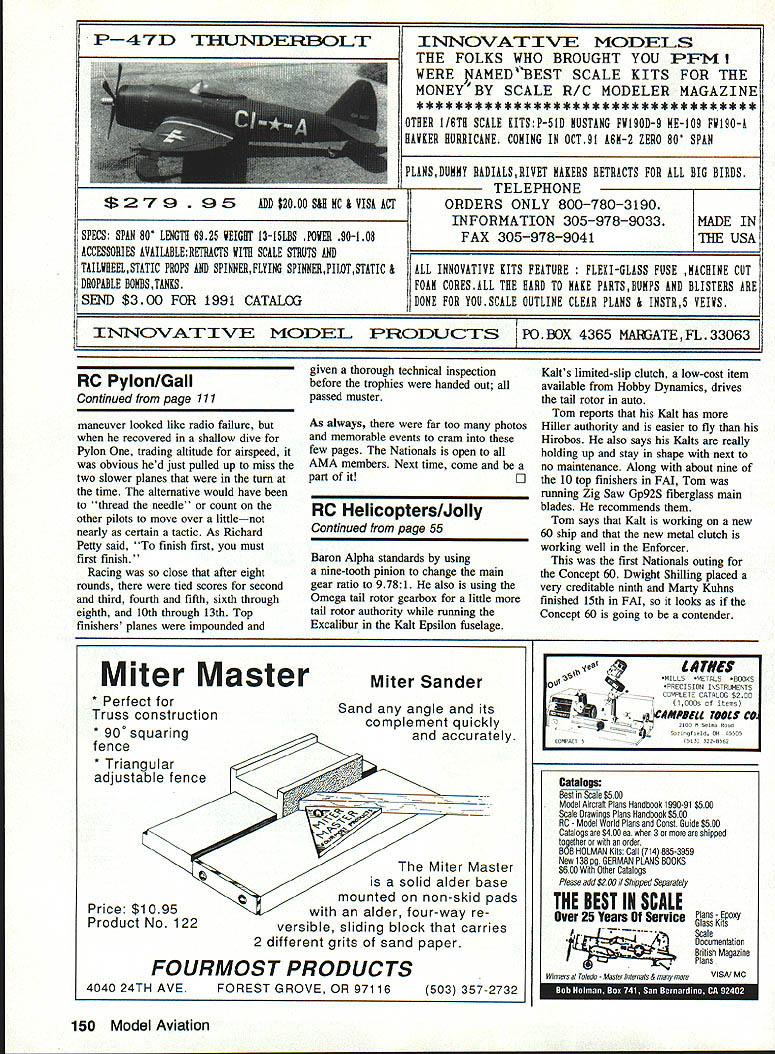
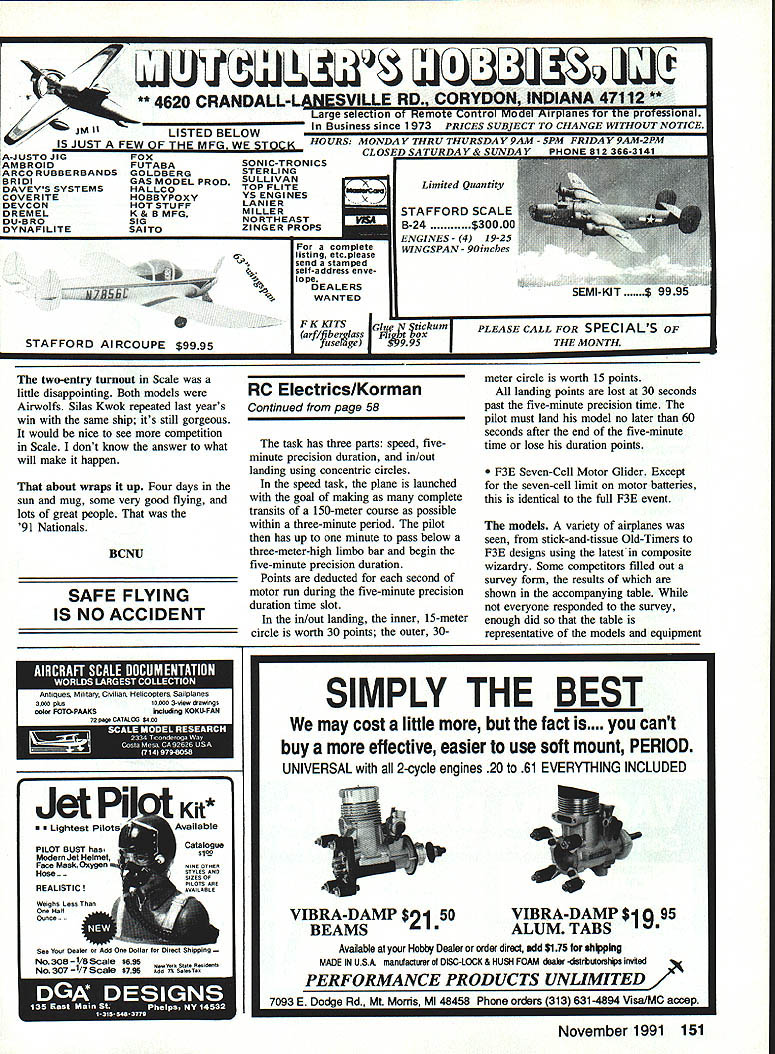
In theory the frequency allocation system worked well. In practice, the large number of helicopter fliers on channels 23, 26, and 29 caused major backups as fliers moved from class to class along the half‑mile runway. The original field scheduled for RC Helicopter use did pose problems, but when Contest Director Mark Wilson pointed this out, the organizers secured a new site—a half‑mile stretch of unused runway.
The surface had deteriorated from long disuse and was marred with grass and weeds. The site was made flyable quickly by cutting down vegetation, having the fire department hose down the dirt, and placing Astroturf pads and cones to mark the layouts.
IRCHA and Contest Direction
- This was an IRCHA production from start to finish. Mark Wilson and the IRCHA crew ran the Nationals very well.
- IRCHA has become the Special Interest Group needed for interface with the AMA, and it’s encouraging to see helicopter fliers taking part in the Nationals process.
Classes and Schedule
Four classes were flown:
- Novice: 31 entries
- Intermediate: 28 entries
- FAI (F3C): 28 entries
- Scale: 2 entries
All events except Scale were flown simultaneously. Novice was at the extreme north of the field, FAI a half‑mile south, and the transmitter impound at the halfway point. Because pilots had to stay near the impound to know when it was their turn, it was difficult to watch the other classes.
The high heat and humidity (both in the nineties all week) and the lack of wind influenced scheduling. FAI had one round each day; Intermediate and Novice managed two rounds on Monday and Tuesday and one round on Wednesday and Thursday to reduce workload as the week got hotter.
FAI Competition and Entrants
I spent time in the FAI area with Tom Dooley, Robert Gorham, Silas Kwok, and Wayne Mann. There were two Japanese entrants, both Hirobo team members:
- Seiji Suwabe — 4th place
- Takashi Tanaka — 8th place
Suwabe flew a new Hirobo Eagle with an SSRII head in his Suwabe Nova fuselage (a little narrower and longer than the stock Nova), powered by a YS engine with a prototype muffler. The high‑speed ship flew very smoothly. It’s possible American judges were looking for different presentation; the ship may have been too fast or too vertical in the rolling stall turn, which could give the impression of difficulty keeping it in the judging box.
This year all U.S. F3C team members competed and finished in the same positions as at the team trials. The U.S. team will be traveling to Australia this fall.
Top FAI finishers
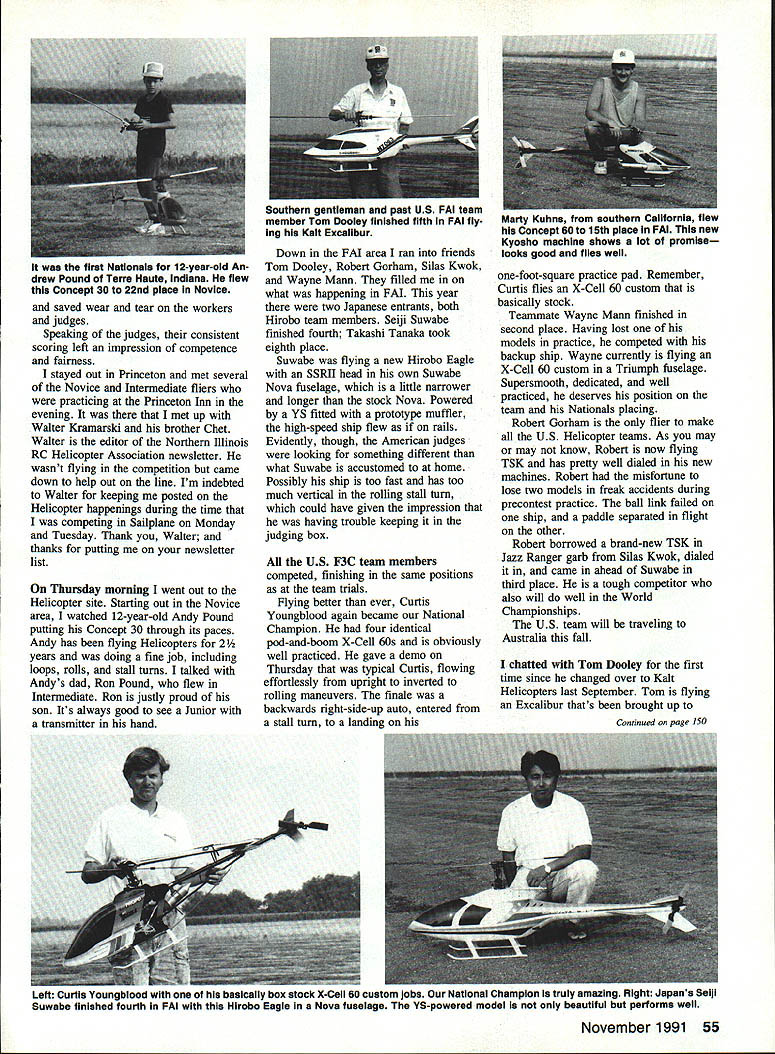
- 1st: Curtis Youngblood — National Champion
- Flew four identical pod‑and‑boom X‑Cell 60s; demonstrated effortless transitions and finished with a backwards right‑side‑up auto landed on a one‑foot‑square practice pad.
- 2nd: Wayne Mann
- Flew an X‑Cell 60 custom in a Triumph fuselage; smooth and well practiced.
- 3rd: Robert Gorham
- Now flying TSK; despite losing two models in precontest practice, borrowed a TSK from Silas Kwok and finished third.
Other notes
- Tom Dooley switched to Kalt Helicopters last September and was flying an Excalibur modified to Baron Alpha standards by using a nine‑tooth pinion to change the main gear ratio to 9.78:1 and an Omega tail rotor gearbox for more tail authority. Kalt’s limited‑slip clutch, available from Hobby Dynamics, drives the tail rotor in auto.
- Dooley reports his Kalt has more Hiller authority and is easier to fly than his Hirobos, with good reliability and low maintenance.
- About nine of the top 10 FAI finishers were running Zig Saw GP2S fiberglass main blades; Dooley recommends them.
- Kalt is working on a new 60 and a metal clutch for the Enforcer.
- Concept 60 had its first Nationals outing: Dwight Shilling placed 9th and Marty Kuhns 15th, indicating the Concept 60 will be a contender.
Novice, Intermediate, and Juniors
Judging was consistent, giving the impression of competence and fairness.
I met several Novice and Intermediate fliers practicing at the Princeton Inn in the evenings. Walter Kramarski (editor of the Northern Illinois RC Helicopter Association newsletter) and his brother Chet were present; Walter came down to help on the line and kept me posted on helicopter happenings. Thanks to Walter for organizing the newsletter list.
A memorable Novice highlight: 12‑year‑old Andy Pound was flying a Concept 30 and performing loops, rolls, and stall turns. Andy has been flying helicopters for 2½ years and is doing a fine job. His father, Ron Pound, flew Intermediate. It’s always great to see juniors flying.
Scale
Scale turnout was disappointing, with only two entries—both Airwolfs. Silas Kwok repeated last year’s win with the same, still‑gorgeous ship. It would be nice to see more competition in Scale; the cause of low participation remains unclear.
Judges and Atmosphere
Judges delivered consistent scoring and fairness. The week featured high heat and humidity, minimal wind, and limited shade, but also very good flying and great camaraderie among participants.
Conclusion
Four days in the sun and muggy weather, some outstanding flying, and lots of great people summed up the '91 Nationals.
BCNU
Transcribed from original scans by AI. Minor OCR errors may remain.

