
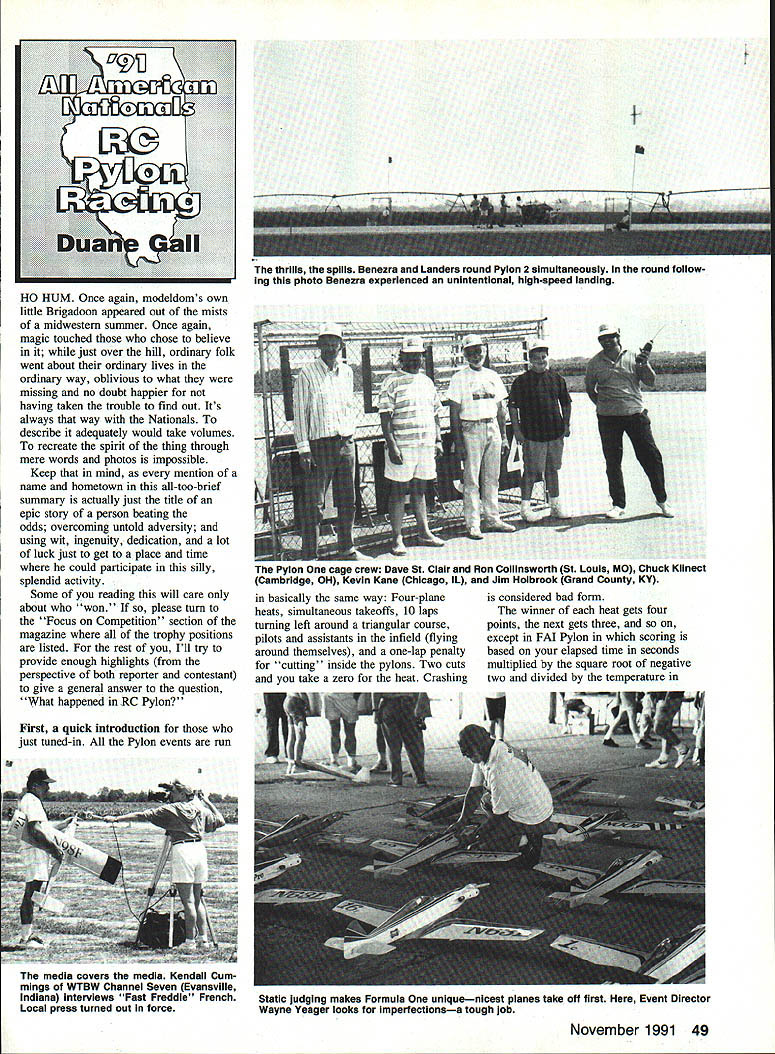
'91 All American Nationals: RC Pylon Racing
Duane Gall
Ho hum. Once again, modeldom's own little Brigadoon appeared out of the mists of a midwestern summer. Once again, magic touched those who chose to believe in it; while just over the hill, ordinary folk went about their ordinary lives in the ordinary way, oblivious to what they were missing and no doubt happier for not having taken the trouble to find out. It's always that way with the Nationals. To describe it adequately would take volumes. To recreate the spirit of the thing through mere words and photos is impossible.
Keep that in mind: every mention of a name and hometown in this all-too-brief summary is actually just the title of an epic story of a person beating the odds, overcoming untold adversity, and using wit, ingenuity, dedication, and a lot of luck just to get to a place and time where he could participate in this silly, splendid activity.
Some readers will care only about who "won." If so, please turn to the "Focus on Competition" section of the magazine where all of the trophy positions are listed. For the rest of you, I'll try to provide enough highlights (from the perspective of both reporter and contestant) to answer the question, "What happened in RC Pylon?"
A quick introduction for those who just tuned in: all the pylon events are run in basically the same way — four-plane heats, simultaneous takeoffs, 10 laps turning left around a triangular course. Scoring: winner of each heat gets four points, next gets three, and so on. Pilots and assistants in the infield watch for infractions. There's a one-lap penalty for "cutting" inside the pylons; two cuts and you take a zero for the heat. Crashing is considered bad form.
This contest wouldn't have happened without many volunteer workers who came from around the country at their own expense to get up before dawn and stand in the heat so we could play. Some were contestants who stayed after their events were over to help out. Hats off to all of them. Thanks to:
- Wayne and Karen Yeager
- Bob and Carolyn Brown
- Paul Page
- Nancy Telford
- Kathy Waters
- Jim and Brenda Holbrook
- "Mac" McWilliams
- Art Tattersall
- Sue Bowman
- Herb Hess
- Dick Coleman
- Dave St. Clair
- Ron Collinsworth
- Chuck Klinect
- Dan Kane Sr.
- Dan Kane Jr.
- Kevin Kane
- John Burke
- Joe Dodd
- Craig Grunkemeyer
Special thanks to Jim and "Bernie" Allen (parents of contestant Jim Allen), who ran the fuel station and set up tents and tables each morning at six o'clock.
Formula One
So, on to the racing action. We'll start with Formula One — last on the program but first in the hearts and minds of nitroholics everywhere. The planes are so pretty that, if they were cars, they'd be parked across two spaces in the far corner of the lot. When they fire up to fly, the ground quivers with the sound of exploding nitromethane. F1 is far more expensive and intimidating than a racing event needs to be, but it's magnificent.
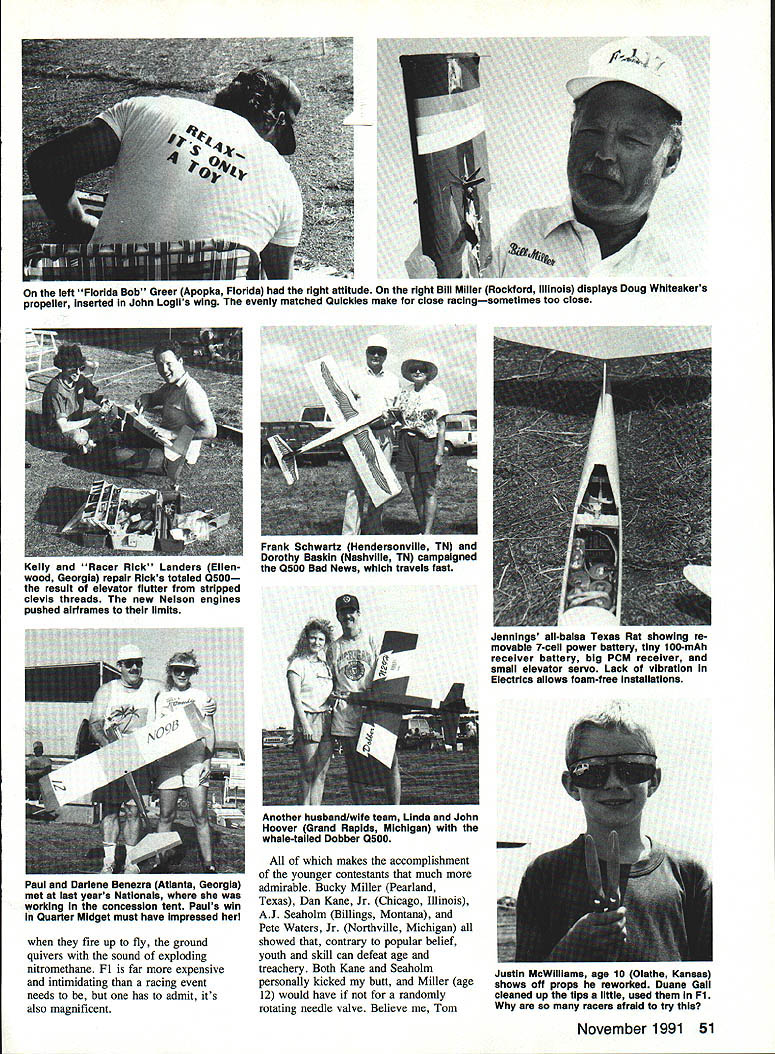
The younger contestants made the accomplishment that much more admirable. Bucky Miller (Pearland, Texas), Dan Kane Jr. (Chicago, Illinois), A.J. Seaholm (Billings, Montana), and Pete Waters Jr. (Northville, Michigan) all showed that youth and skill can beat age and treachery. Both Kane and Seaholm personally beat me, and Miller (age 12) would have if not for a randomly rotating needle valve.
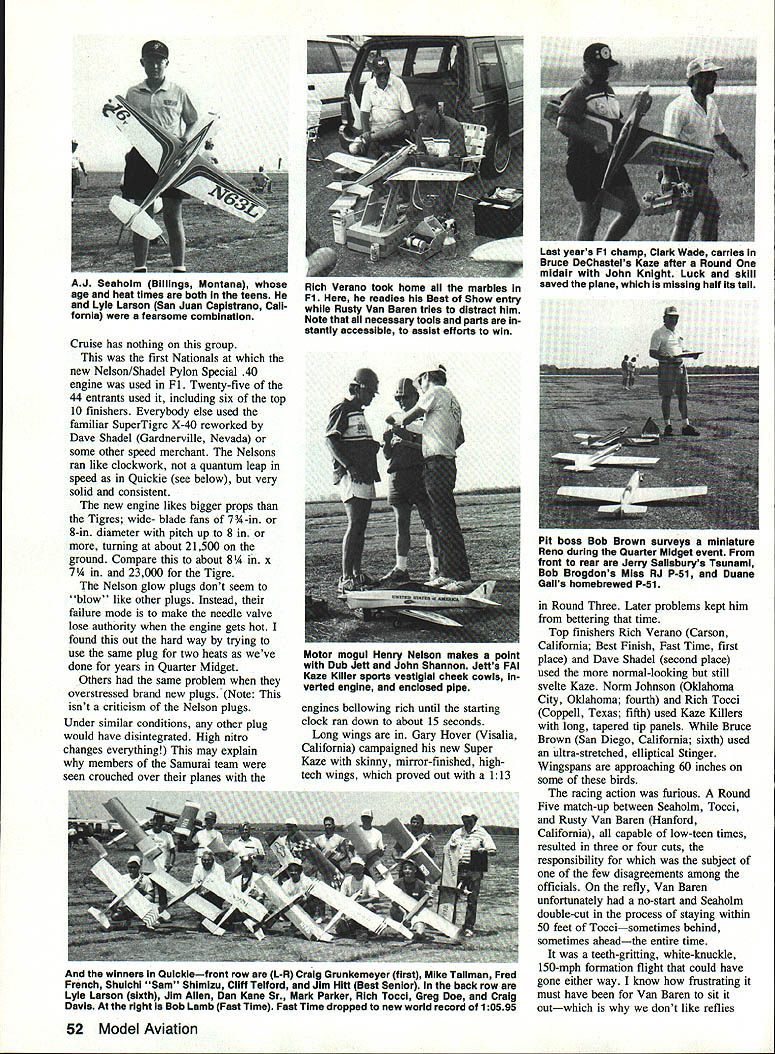
This was the first Nationals at which the new Nelson/Shadel Pylon Special .40 engine was used in F1. Twenty-five of the 44 entrants used it, including six of the top 10 finishers. Others used the familiar SuperTigre X-40 reworked by Dave Shadel (Gardnerville, Nevada) or other speed merchants. The Nelsons ran like clockwork — not a quantum leap in speed as in Quickie, but very solid and consistent.
A few technical notes:
- The new engine favors bigger props than the Tigres: wide-blade fans of 7¾ in. or 8 in. diameter with pitch up to 8 in. or more, turning around 21,500 rpm on the ground.
- By comparison, Tigres typically ran about 8¼ in. x 7¼ in. at about 23,000 rpm.
- Nelson glow plugs don't seem to "blow" like other plugs; their failure mode is loss of needle-valve authority when the engine gets hot. Several pilots overstressed brand-new plugs by running the same plug for multiple heats.
- Under heavy nitro conditions, any other plug might have disintegrated, which may explain why some teams ran engines rich until the start clock wound down to about 15 seconds.
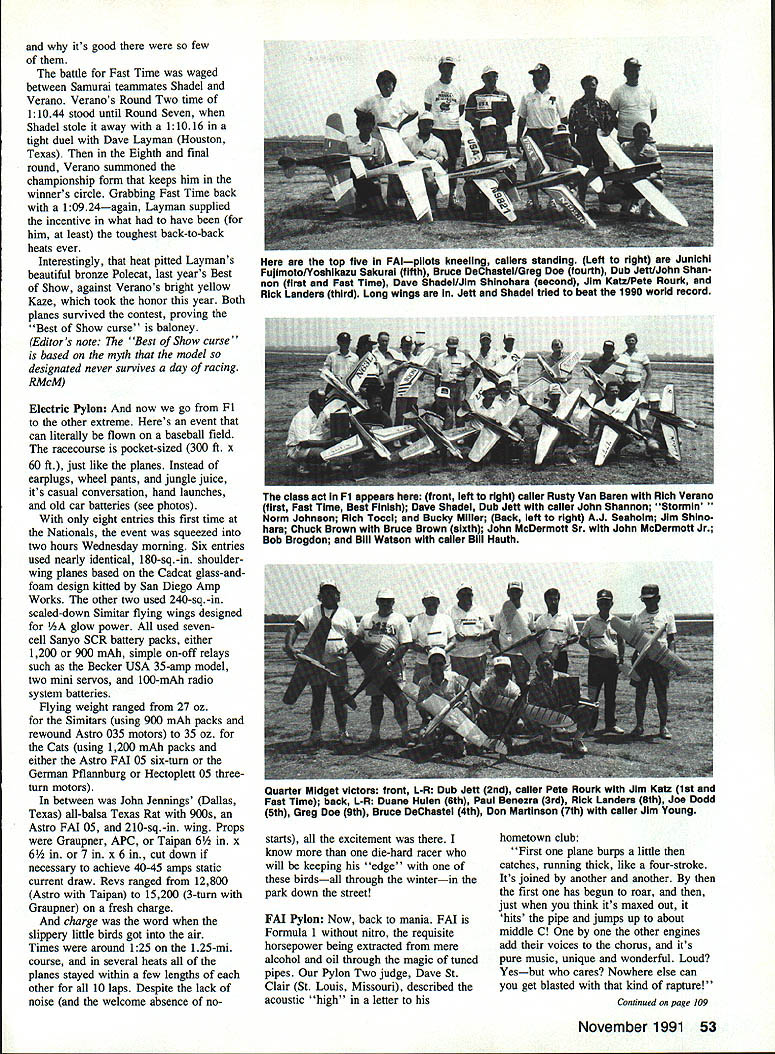
Long wings are in. Gary Hoyer (Visalia, California) campaigned a Super Kaze with skinny, mirror-finished, high-tech wings and posted a 1:13 in Round Three before later problems curtailed his progress. Top finishers used a variety of Kaze and Stinger airframes:
- Rich Verano (Carson, California) — first place, Best Finish, Fast Time
- Dave Shadel — second place
- Norm Johnson (Oklahoma City, Oklahoma) — fourth
- Rich Tocci (Coppell, Texas) — fifth
- Bruce Brown (San Diego, California) — sixth
Wingspans are approaching 60 inches on some of these birds. The racing was furious. A Round Five match-up between Seaholm, Tocci, and Rusty Van Baren (Hanford, California) — all capable of low-teens times — resulted in multiple cuts and one of the few disagreements among the officials. On replay, Van Baren had a no-start and Seaholm double-cut while trying to stay within 50 feet of Tocci. It was a teeth-gritting, white-knuckle, 150-mph formation flight that could have gone either way.
The battle for Fast Time was waged between Samurai teammates Shadel and Verano. Verano's Round Two time of 1:10.44 stood until Round Seven, when Shadel took it with a 1:10.16 in a tight duel with Dave Layman (Houston, Texas). In the eighth and final round, Verano grabbed Fast Time back with a 1:09.24—again pushed hard by Layman. Interestingly, that heat pitted Layman's bronze Polecat (last year's Best of Show) against Verano's bright yellow Kaze, which took Best of Show this year; both planes survived the contest (the "Best of Show curse" is baloney). (Editor’s note: The "Best of Show curse" is the myth that the model so designated never survives a day of racing. — RCMcM)
Electric Pylon
And now we go from F1 to the other extreme. Electric Pylon can literally be flown on a baseball field. The racecourse is pocket-sized (300 ft. x 60 ft.), and the planes are small. Instead of carplugs, wheel pants, and jungle juice, it's casual conversation, hand launches, and old car batteries.
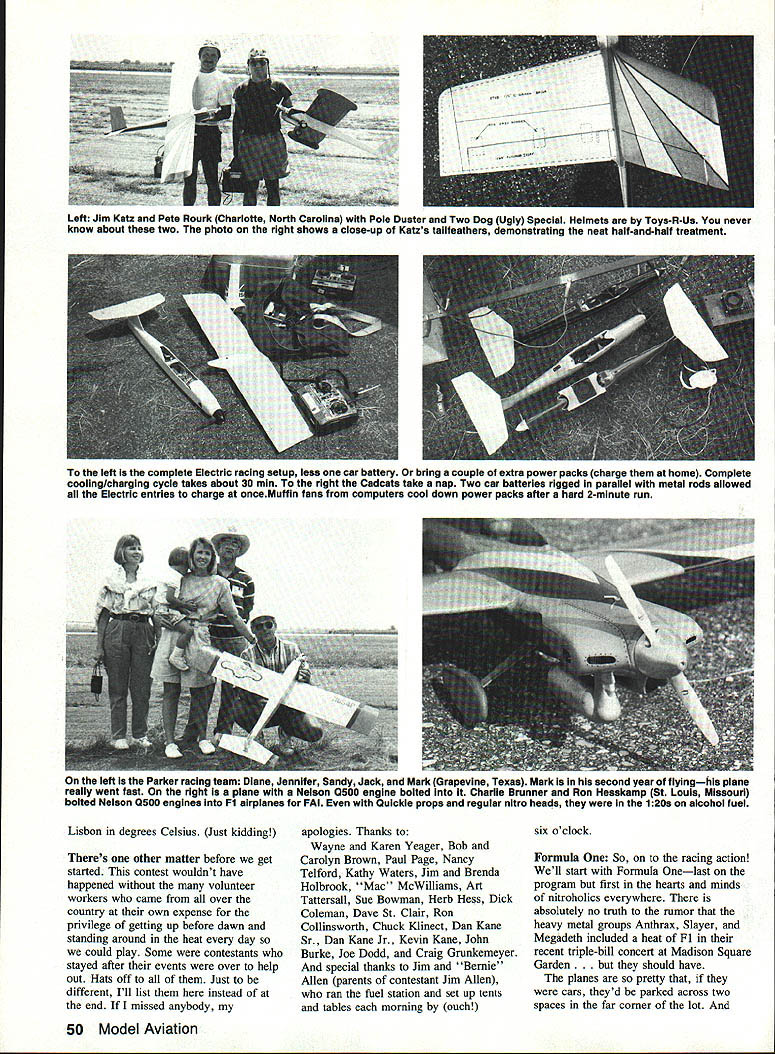
This was the first time Electric Pylon appeared at the Nationals; with only eight entries the event was squeezed into two hours Wednesday morning. Six entries used nearly identical, 180-sq.-in. shoulder-wing planes based on the Cadcat glass-and-foam design kitted by San Diego Amp Works. The other two used 240-sq.-in. scaled-down Simitar flying wings designed for 1/2A glow power. All used seven-cell Sanyo SCR battery packs (either 1,200 or 900 mAh), simple on-off relays (e.g., Becker USA 35-amp), two mini servos, and 100-mAh radio system batteries.
Typical specs:
- Flying weight: 27 oz. for Simitars (900 mAh packs, rewound Astro 035 motors) to 35 oz. for Cats (1,200 mAh packs, either Astro FAI 05 six-turn or German Pfannburg/Hectoplet 035 three-turn motors).
- Props: Graupner, APC, or Taipan trimmed to achieve 40–45 amps static current draw.
- Revs: 12,800 (Astro with Taipan) to 15,200 (3-turn with Graupner) on a fresh charge.
- Times: around 1:25 on the 1.25-mile course.
Despite the lack of noise (and the welcome absence of no-starts), all the excitement of pylon racing was there. Several heats saw all planes within a few lengths of each other for all 10 laps. Many die-hard racers will be keeping their edge through the winter with one of these birds in the local park.
Equipment summary
- Battery packs: 7-cell Sanyo SCR, 900 or 1,200 mAh
- Motor choices: rewound Astro 035, Astro FAI 05, Pfannburg/Hectoplet 035
- Simple relays (on-off), two mini servos, lightweight radio batteries
- Prop trimming to control amp draw and rpm
FAI Pylon
Back to mania. FAI is Formula 1 without nitro — the requisite horsepower extracted from alcohol and oil through tuned pipes. Dave St. Clair (St. Louis, Missouri), Pylon Two judge, described the acoustic thrill:
"First one plane burps a little then catches, running thick, like a four-stroke. It's joined by another and another. By the time the first one has begun to roar, and then just when you think it's maxed out, it 'hits' the pipe and jumps up to about middle C! One by one the other engines add their voices to the chorus, and it's pure music, unique and wonderful. Loud? Yes—but who cares? Nowhere else can you get blasted with that kind of rapture!"
FAI is sensory and technical — loud, beautiful, and intense.
Quarter Midget
Quarter Midget keeps refusing to die. There's something about the compact, scale-like airplane, low-nitro fuels, and the low-cost engines of any Nationals racing class that drew 35 entries despite only a half-day of flying.
This year the Nelson .15 was the only engine represented, applied to 13 different airframe designs. The result was a spread in best times of only about 25 seconds (less than 20 if you discount Katz's near-record 1:11 Fast Time). For many pilots the engine and airframe combination was so reliable that routine needle-valve and plug changes were unnecessary for multiple heats; it truly became a pilot's event.
Prop and rpm guidance:
- RPM should be between about 27,000 and 28,400, depending on how much the airplane unloads in the air and the pitch chosen for acceleration out of turns.
- Typical prop diameter minimum: 5½ in.; pitch chosen to suit the plane (I use a maximum pitch giving about 1:1.6 ratio).
Jim Katz again showed that long wings and glider airfoils work well. His Tiger Moth has a 50-in. span and reportedly uses computer-generated Quabeck 1.5 airfoils, with thicknesses down to 2% at the tip.
Quickie 500
How to sum up the new Quickie? It's an entry-level racing event, not a beginner's event. There were 78 entries this year, of which 59 used the new Nelson/Shadel .40 Quickie engine (over $300 each). Fast Time dropped by about 10 seconds to a new world record of 1:05.95 — roughly a 109 mph average course speed (compare to 115–120 mph for a decent F1).
Event notes:
- Three Senior and no Junior entrants.
- The highest-ranking pilot with a Best Time slower than 1:19 was in 28th place.
- The highest-ranking pilot not using a Nelson finished 31st.
The results show a big increase in speed and consistency. The Nelson .40, like the .15, is all-out racing equipment — not a "sport" engine. It also proved mechanically reliable (not shedding carburetor screws or muffler parts).
The bigger controversy this year was over propellers. Quickie rules call for stock, commercially available props. But what if someone produces high-performance props without diameter marked and offers to customer-trim them? Ron Hesskamp (St. Louis, Missouri) did just that. His props worked. If you can find a Rev-Up 9 in. x 8 in. that isn't underpitched, that will work too — but they can be inconsistent.
Rev-Up and other props worked well for:
- Craig Grunkemeyer (Columbus, Ohio) — 1:06 (winner)
- Fred French (Round Rock, Texas) — 1:09
- Jim Allen (Mesa, Arizona) — 1:09
- Jim Katz — 1:06
- Others posted competitive times
Nelson engines like to run about 17,500 to 18,500 rpm static. Aircraft choices varied; many used shoulder-wing, V-tail designs with glider airfoils (e.g., Jim Allen's Quick-V). Grunkemeyer won with the Dodger, a Scat Cat-like design using sharp leading edges and a laminar-flow section, named for teammate Joe Dodd.
Passing was an art. Both Grunkemeyer and Allen demonstrated evasive, high-skill maneuvers to avoid traffic — pulling up and trading altitude for airspeed to miss slower planes in the turn rather than trying to thread the needle. As Richard Petty said, "To finish first, you must first finish."
Racing was so close that after eight rounds there were tied scores for multiple placings (second/third, fourth/fifth, sixth–eighth, and 10th–13th). Top finishers' planes were impounded and given thorough technical inspections before trophies were handed out; all passed muster.
Closing
There were far too many photos and memorable events to cram into these few pages. The Nationals is open to all AMA members. Next time, come and be a part of it!
Transcribed from original scans by AI. Minor OCR errors may remain.

