
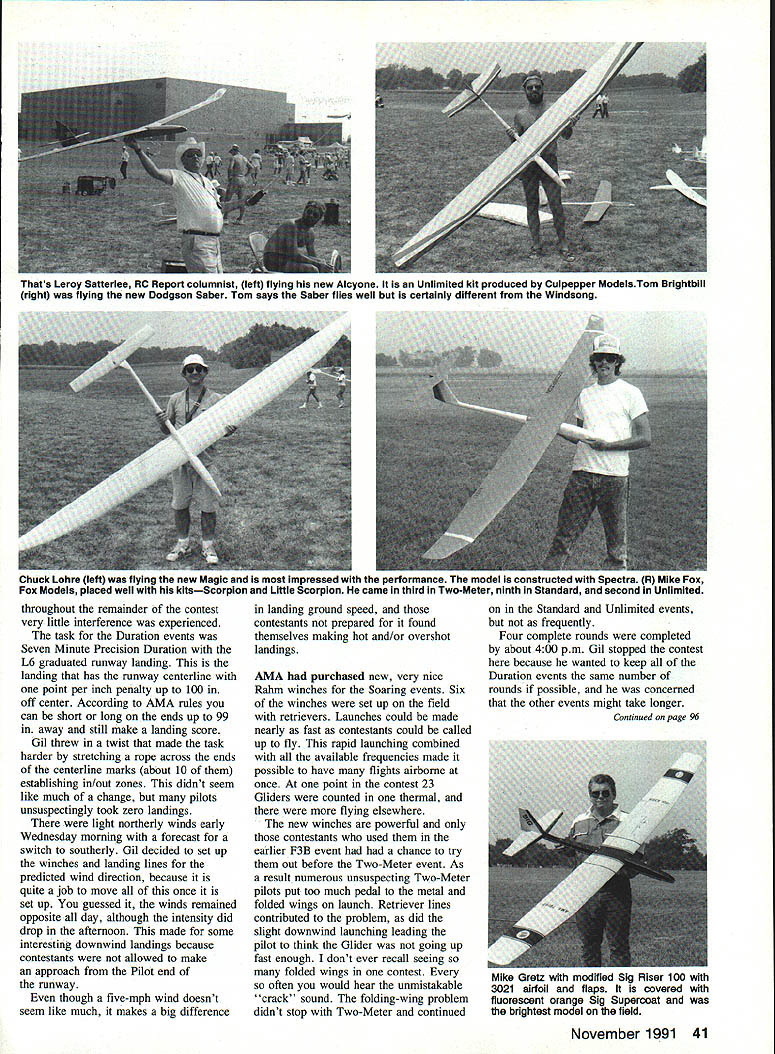
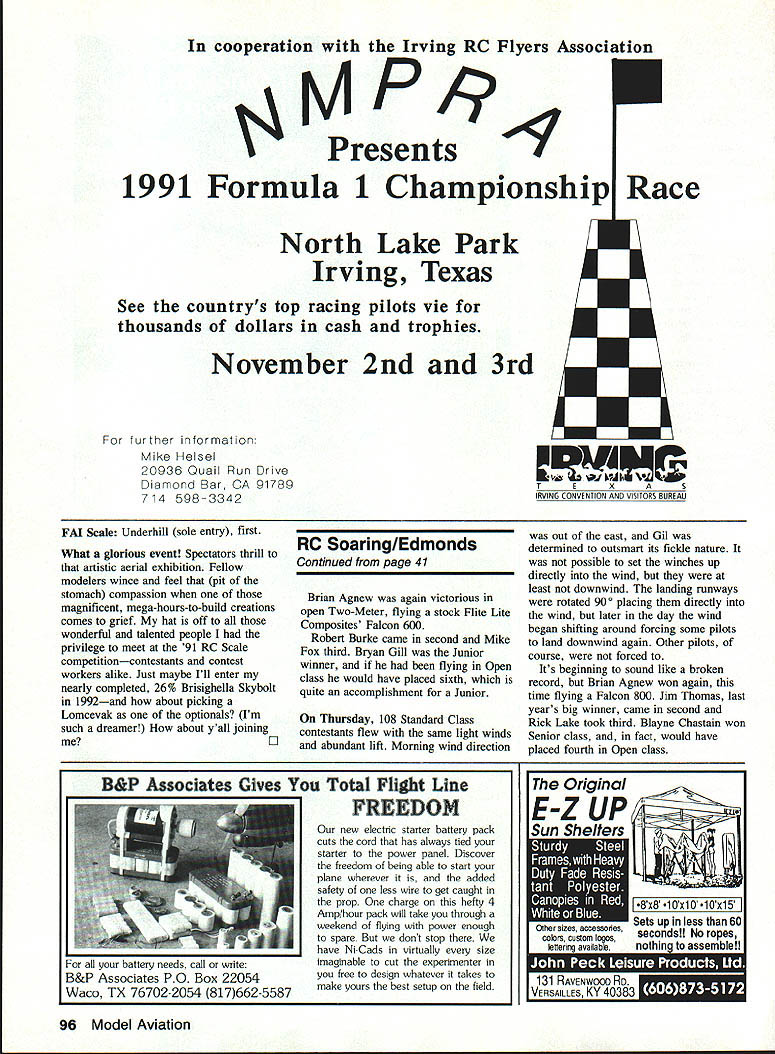
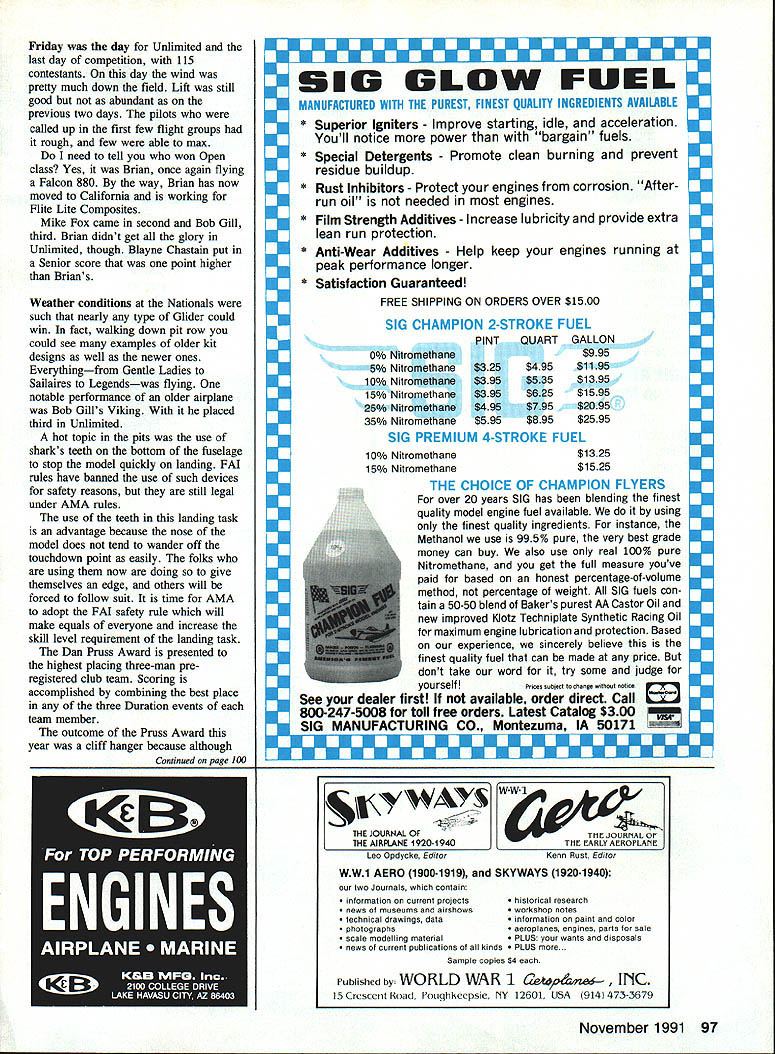
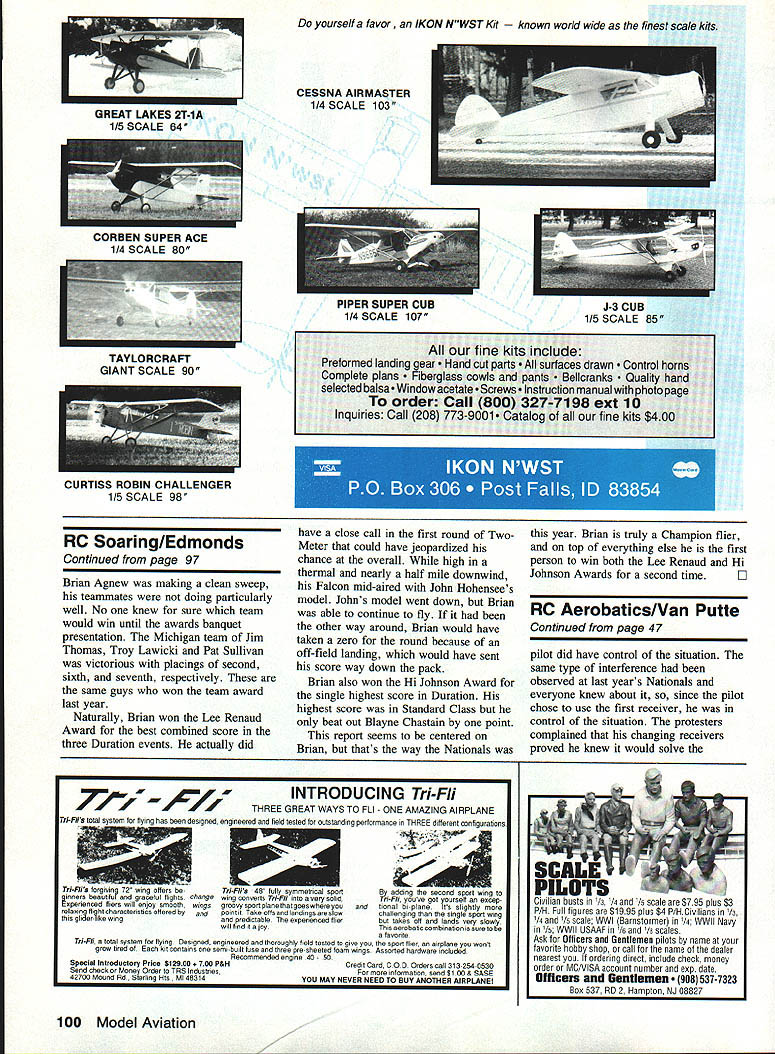
'91 All American Nationals: RC Sailplanes
Terry Edmonds
Overview The AMA Nationals remains the premier American soaring contest, combining many diverse soaring events and large contestant entries. Traditionally a come-one-come-all contest open to any AMA member, the Nationals is equal parts celebration and selection of National Soaring Champions.
The 1991 Nationals featured six official events: F3B, Sport Scale Sailplane, Hand Launch Sailplane, Two-Meter Duration, Standard Class Duration, and Unlimited Class Duration. Cross Country Racing was run as an unofficial event. Gil Gauger served as Soaring Event Director, delegating operation of several events to other individuals.
Cross Country (unofficial)
- Event Director: Frank Roales
- Course: 28½-mile course with rules similar to the "Great Race"; finish time could be taken when either the sailplane or the chase vehicle crossed the finish line.
- Entries: 10 teams
Results and notes:
- Team Agnew (Brian Agnew) was the only team to complete the course and won the event. Brian crashed his original Cross Country model on the first launch; Julian Tamez loaned him a Texas Shooting Star Cross Country glider to continue.
- Their first course attempt went about 15 miles but became lost; the next attempt suffered low transmitter batteries, and they finished with the transmitter meter in the red.
- Mike Fox's team placed second, flying 24 miles. Tom Siler's team finished third.
F3B and F3E (Monday)
- Event Director: Pete Carr
- F3B and F3E were run the same day because electrics and soaring shared the same site and course; tasks were interwoven to meet site and manpower constraints.
- Two full rounds of F3B were completed by early evening. Full FAI F3B rules were used except that winches were not strictly checked for rules compliance. Two AMA winches were available and contestants could use provided winches or their own.
Participants and results:
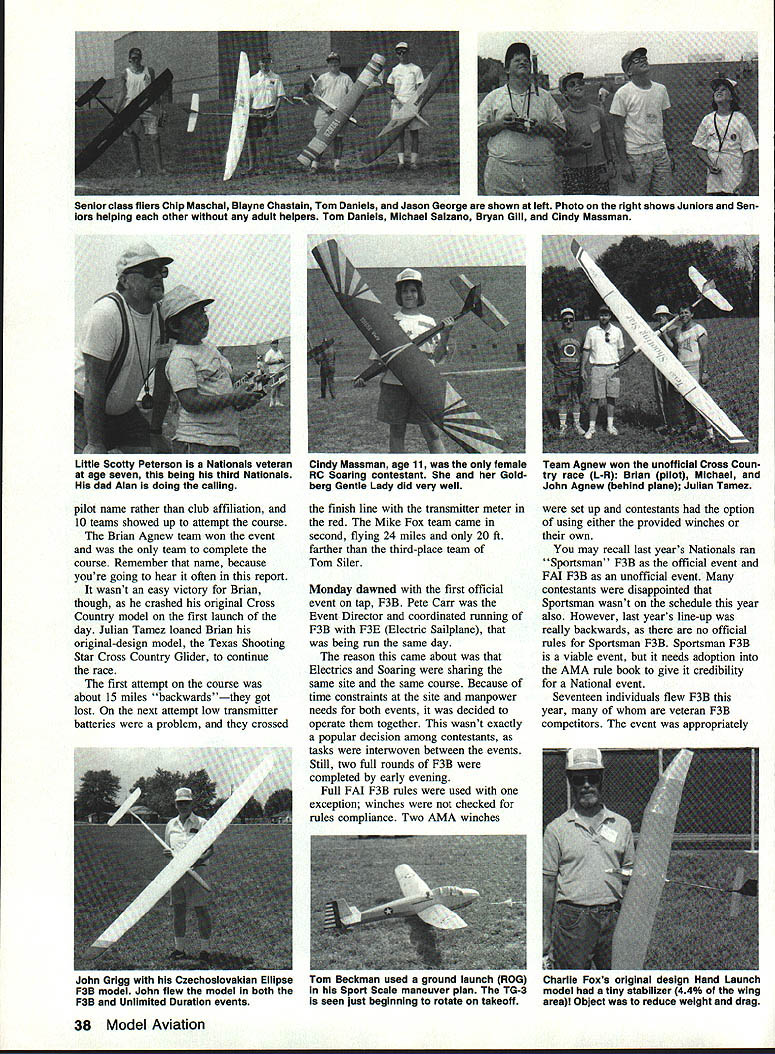
- Seventeen pilots flew F3B, including veteran competitors and junior participants (notables: Chip Maschal, Blayne Chastain, Tom Daniels, Jason George). Young competitors included "Little Scotty" Peterson (age seven) with his father Alan calling, and Cindy Massman (age 11).
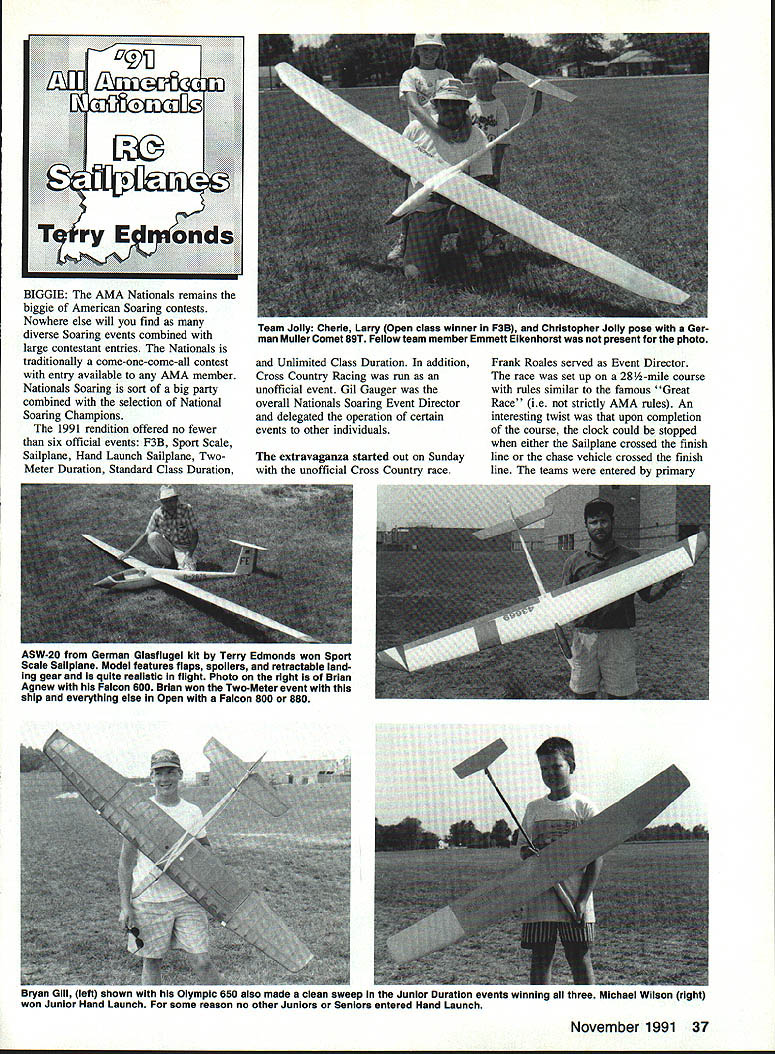
- Top placings: Larry Jolly won the event (flying a Comet 897 extended to three meters); Jack Hiner was second; Gerry Arana third (Gerry led after the first round but slipped back).
- Equipment highlights: John Grigg flew a molded Czechoslovakian Ellipse (prebuilt, well-crafted); Brian Agnew flew an Eagle F3B designed by Mark Allen (all-molded construction, 7003 airfoil).
Sport Scale Sailplane (Tuesday morning)
- Static judging took place inside a full-size sailplane hangar; flying tasks were on the field.
- Seven models flew four rounds of flying.
Results:
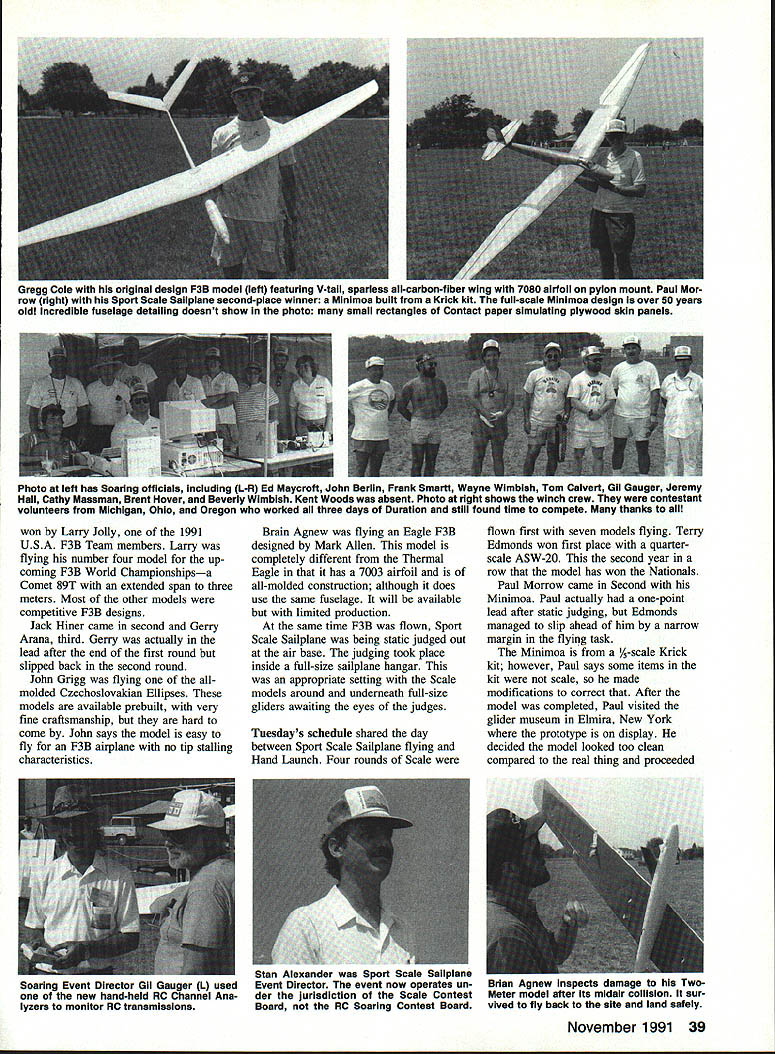
- 1st: Terry Edmonds — quarter-scale ASW-20 (second consecutive Nationals win for this model)
- 2nd: Paul Morrow — Minimoa (1/5-scale Krick kit, weathered to match the prototype)
- 3rd: Tom Beckman — TG-3 (smooth flyer; Tom plans to retire the model after this season)
Rule discussion and suggestions:
- Debate over new Sport Scale Sailplane rules: some favor returning to old rules; others want the new rules refined.
- Competitors were concerned about shortened line length (estimated ~200 m). Suggested rule change: require 300 m line length to ensure predictable launch height.
- Other suggestions: allow changing the order of maneuvers during flight to take advantage of encountered air; add sailplane-specific maneuver descriptions to replace those written for powered models.
Hand Launch Sailplane (Tuesday afternoon)
Four rounds were flown; each round had a different task:
- Obtain three two-minute maxes within a 10-minute time slot. Unlimited throws allowed.
- Obtain a total flight time of five minutes. Limited to three throws.
- Obtain as many two-minute maxes as possible within a 10-minute time slot. Unlimited throws; five best flights score.
- Obtain as many two-minute maxes as possible within a 10-minute time slot. Limited to seven throws; five best flights score.
- Entrants: 42 contestants
- The mass launches produced dramatic scenes of many gliders leaping at once; pilots often converged on lift spots in a mass migration across the field.
Results:
- 1st: Brian Agnew — flying his own kit design, Vertigo (perfect 4,000 score)
- 2nd: John Schmoll — stock Zephyr (perfect scores in first three rounds, fell short in fourth)
- 3rd: Rusty Shaw — Chuperosa (last year's Hand Launch champion)
Duration events — Two-Meter (Wednesday)
- Entrants: 112 contestants
- Soaring Event Director Gil Gauger conducted an interference test: roughly 47 channels represented, competitors turned on all transmitters at once; no significant interference reported during the contest.
- Task: Seven-Minute Precision Duration with L6 graduated-runway landing (one point per inch penalty up to 100 in. off center; AMA rules allow up to 99 in. short/long and still score).
- Gil added rope segments across the ends of the centerline marks to create in/out zones (about 10 ft), which made landing more difficult and caused many zero landings.
- Winds: light northerly early, forecast for southerly; winches and landing lines were set for the predicted direction but winds remained unchanged, creating some downwind landing challenges.
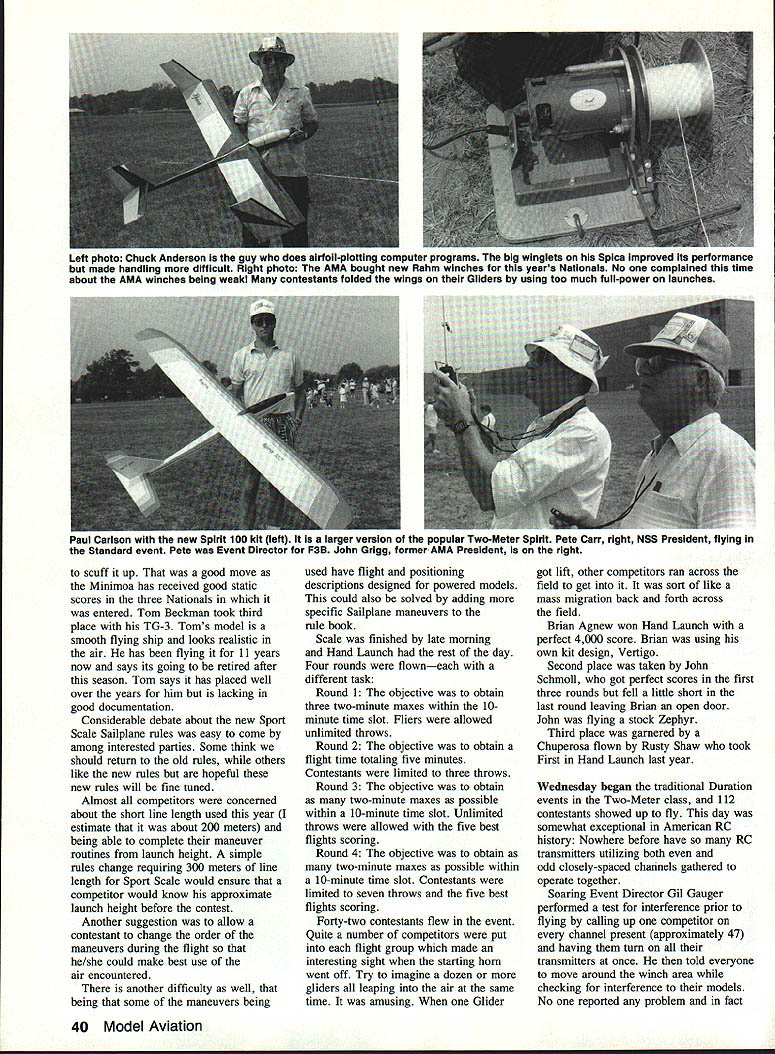
- Equipment: AMA provided new Rahm winches (six deployed with retrievers). The winches were powerful, enabling rapid launches and many gliders aloft simultaneously. However, several pilots experienced folded wings on launch due to aggressive launches and slight downwind bias.
Results:
- Open Two‑Meter winner: Brian Agnew — flying a stock Flite Lite Composites Falcon 600
- 2nd: Robert Burke
- 3rd: Mike Fox
- Junior winner: Bryan Gill (he would have placed sixth in Open class)
FAI Scale
- Sole entry: Underhill — placed first.
- Commentary: FAI Scale showcases spectacular, labor-intensive models; it draws admiration and sympathy when a model is damaged. The author encourages broader participation and even muses about entering a nearly completed 26% Skybolt in 1992.
Standard Class (Thursday)
- Entrants: 108 contestants
- Light winds and good lift characterized the day; wind shifts required adjustments to landing runways.
- Winner: Brian Agnew — flying a Falcon 800
- 2nd: Jim Thomas
- 3rd: Rick Lake
- Senior class winner: Blayne Chastain (would have placed fourth in Open)
Unlimited Class (Friday)
- Entrants: 115 contestants
- Winds were light for the field; lift was still present but less abundant than previous days. Early flight groups had difficulty maxing.
- Winner (Open): Brian Agnew — flying a Falcon 880 (Brian had moved to California and was working for Flite Lite Composites)
- 2nd: Mike Fox
- 3rd: Bob Gill (notable performance in an older design, the Viking)
- Senior class: Blayne Chastain posted a Senior score one point higher than Brian's Unlimited score.
Equipment, rules, and safety notes
- Winches: New Rahm winches proved powerful and increased launch rate but also contributed to launch-related damage when pilots were unprepared for the pull.
- Shark's teeth on fuselage bottoms (to decelerate on landing) were a hot topic. They are banned under FAI safety rules but remain legal under AMA rules. Their use provides a landing advantage by reducing nose wander. The author recommends AMA adopt the FAI safety rule to equalize safety and skill requirements.
Team and individual awards
- Dan Pruess Award (highest placing three-man pre-registered club team; scoring combines each team member's best placing in any of the three Duration events):
- Winner: Michigan team — Jim Thomas, Troy Lawicki, Pat Sullivan (placings: 2nd, 6th, and 7th). They also won the team award the previous year.
- Lee Renaud Award (best combined score in the three Duration events):
- Winner: Brian Agnew
- Hi Johnson Award (single highest score in Duration):
- Winner: Brian Agnew — highest score was in Standard Class, edging out Blayne Chastain by one point.
Notable incidents:
- Brian Agnew nearly lost his chance at an overall sweep when, during a Two‑Meter round, his Falcon mid‑aired with John Hohensee's model. John’s model went down; Brian was able to continue. If the outcome had been reversed and Brian suffered an off-field landing, his score would have been a zero for the round and his sweep could have been jeopardized.
Conclusion Brian Agnew dominated the 1991 Nationals, winning multiple events and awards. His performance, including the sweep of many Duration events and earning the Lee Renaud and Hi Johnson Awards (each for a second time), highlighted an exceptional Nationals week. Overall, the contest showcased a broad mix of new and classic designs, spirited competition, and lively debate on rules and safety that will likely shape future Nationals.
Transcribed from original scans by AI. Minor OCR errors may remain.

