
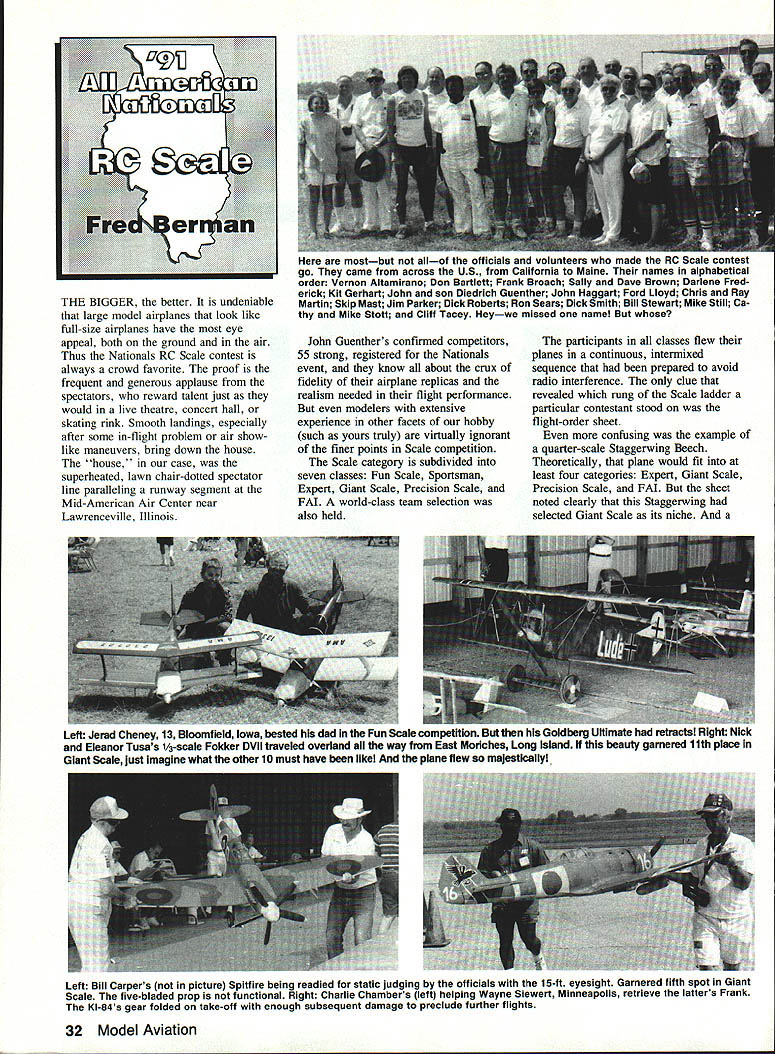
'91 All American Nationals: RC Scale
Byline
Fred Berman
Overview
The bigger, the better. Large model airplanes that look like full-size airplanes have the most eye appeal, both on the ground and in the air. The Nationals RC Scale contest is always a crowd favorite, evidenced by the frequent and generous applause from spectators—smooth landings, especially after in-flight problems or air-show-like maneuvers, bring down the house. The "house" in this case was the superheated, lawn-chair-dotted spectator line paralleling a runway segment at the Mid-American Air Center near Lawrenceville, Illinois.
John Guenther's confirmed competitors—55 strong—registered for the Nationals event. They know the crux of fidelity required: airplane replicas must look right and fly realistically. Even experienced modelers in other facets of the hobby can be virtually ignorant of the finer points of Scale competition.
A world-class team selection was also held.
Categories
The Scale category is subdivided into seven classes:
- Fun Scale
- Sportsman
- Expert
- Giant Scale
- Precision Scale
- FAI
- A world-class team selection
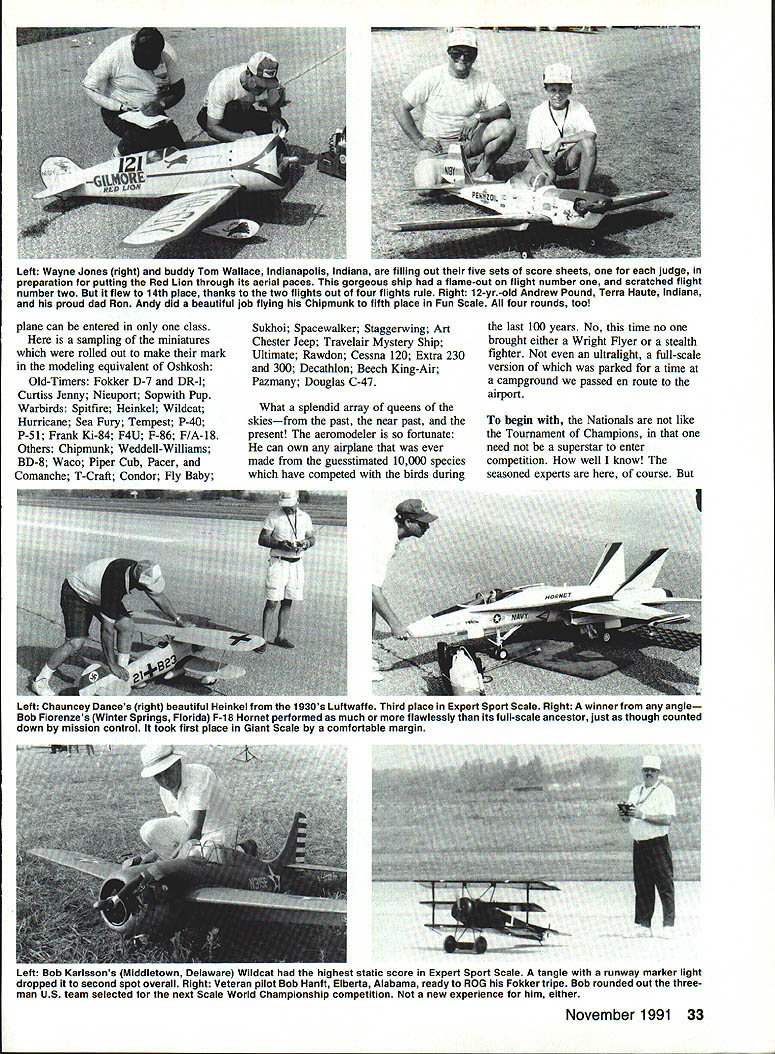
Participants in all classes flew in a continuous, intermixed sequence arranged to avoid radio interference. The only clue that revealed which rung of the Scale ladder a particular contestant occupied was the flight-order sheet. A plane can be entered in only one class—even if, theoretically, it would fit several (for example, a quarter-scale Staggerwing Beech could qualify as Expert, Giant Scale, Precision, and FAI).
Notable entries
Here is a sampling of the miniatures rolled out at the Nationals:
Old-Timers
- Fokker D-7 and DR-1
- Curtiss Jenny
- Nieuport
- Sopwith Pup
Warbirds
- Spitfire
- Heinkel
- Wildcat
- Hurricane
- Sea Fury
- Tempest
- P-40
- P-51
- Frank Ki-84
- F4U
- F-86
- F/A-18
Others
- Chipmunk
- Weddell-Williams
- BD-8
- Waco
- Piper Cub, Pacer, and Comanche
- T-Craft
- Condor
- Fly Baby
- Sukhoi
- Spacewalker
- Staggerwing
- Art Chester Jeep
- Travelair
- Mystery Ship
- Ultimate
- Rawdon
- Cessna 120
- Extra 230 and 300
- Decathlon
- Beech King-Air
- Pazmany
- Douglas C-47
What a splendid array—from the distant past, the near past, and the present! The aeromodeler is fortunate: he can own virtually any airplane that was ever made over the last 100 years. No one brought a Wright Flyer or a stealth fighter this time; not even an ultralight (though a full-scale ultralight was parked for a time at a campground we passed en route to the airport).
Judging and rules
Each airplane entry is judged two ways: by static appearance and by flight performance.
Static judging
Some paper proof of the airplane's full-scale antecedent must be presented (documentation). Judges may not handle the model or get closer than 15 ft.; they are required to consider:
- Outline accuracy
- Finish, color, and markings
- Craftsmanship
The rules do cover the pilot figure. If the torso of a pilot (such as the Red Baron) was visible above the cockpit coaming in the full-size plane, the replica must show a shrunken equivalent or be penalized.
There are weight limits:
- Maximum weight: 55 lb.
- Sport Scale maximum: 20 lb.
- To be classified Giant Scale a model must exceed a weight minimum: 15 lb. for a single fan, 20 lb. for a multi.
Balloons, Zeppelins, and space probes are disqualified because they fail the requirement of being "... heavier than air, man-carrying aircraft."
Scoring
Scoring varies by category.
- Precision Scale:
- Up to 450 static points.
- Up to 10 points for each of 15 flight maneuvers.
- Flight score is the sum of points awarded by three judges (another possible 450 points).
- Perfect score = 900 points.
- Contestants fly four times; only two of the four flights are averaged into the final score.
- Sport and Giant Scale:
- Up to 100 static points.
- Up to 10 points for each of 10 flight maneuvers (some compulsory, some selected by the competitor).
- Highest possible score = 200 points.
- Fun Scale:
- If the Fun Scalers present even minimal proof (such as a kit box top) that their model had full-scale inspiration, they automatically earn five static points.
- Required to do 10 maneuvers at up to 10 points each (like Sport Scalers).
- FAI categories:
- Use more complex point systems that can go into the four-digit range.
People and organization
Two things stand out: the magnificence of many models, and the dedication of the huge force of officials and handlers without whom the competition could not have taken place.
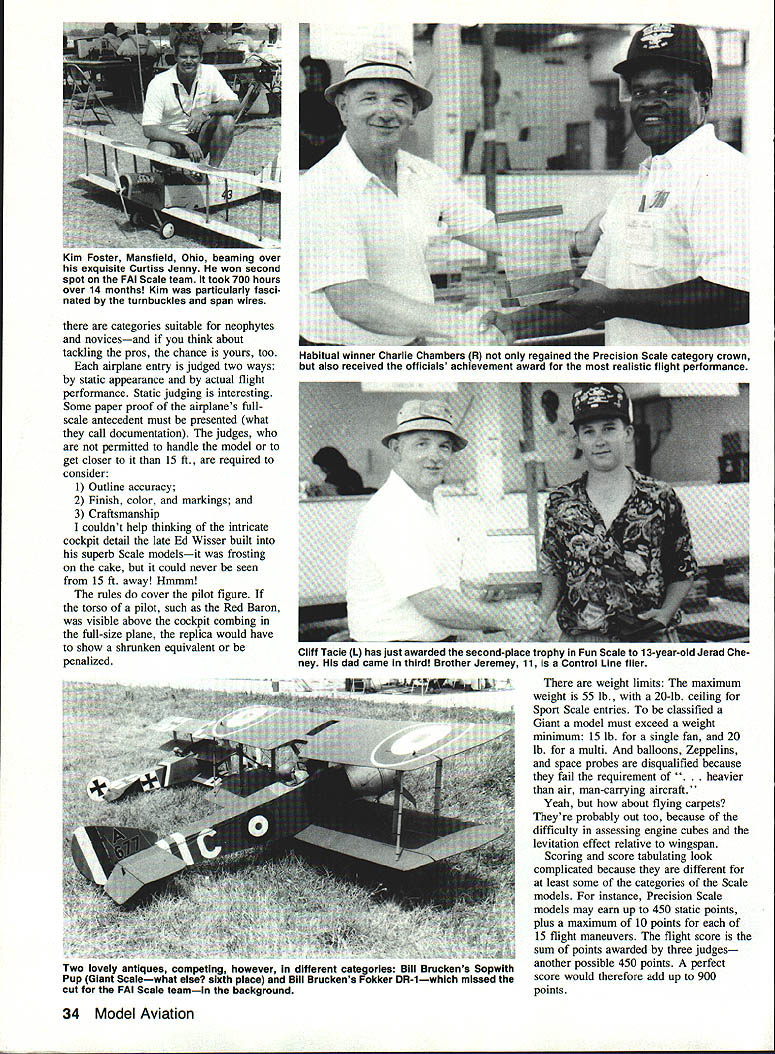
Cliff Tacie, Scale Events Director, is typical of the committed volunteers. Cliff (a Scale modeler cum laude who flew a Savoia-Marchetti—dubbed the Spaghetti Bomber—to fourth place at the 1990 Scale Masters) suppressed his urge to compete in 1991 in order to serve the modelers at Nationals.
Most contests are labor intensive. In RC Scale the ratio of participants to workers is at least one to one. Many others made sacrifices like Cliff; an army of distant members also pitched in. The unsinkable Sally Brown, for example, is the power behind the throne for many. Gratitude to those selfless people is always due.
Notable aircraft and incidents
The sight of majestic tri-deckers wrestling crosswinds pumps up the adrenaline. Some standouts and incidents:
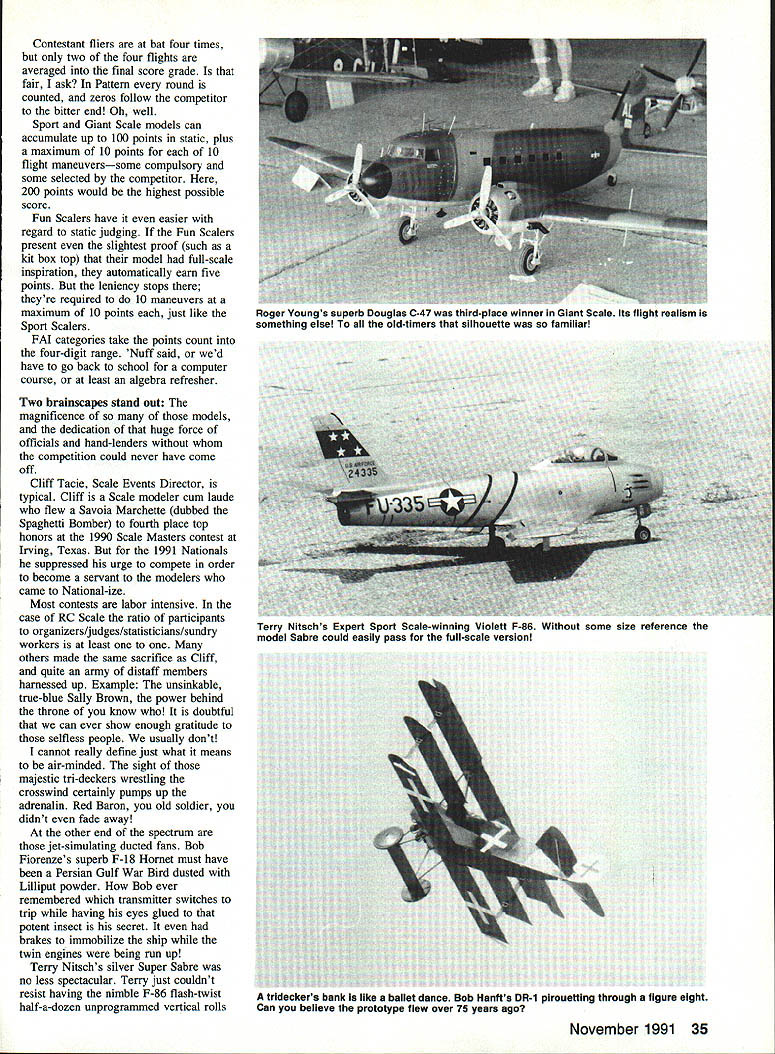
- Bob Fiorenze's superb F-18 Hornet looked like a Persian Gulf War bird dusted with Lilliput powder. It even had brakes to immobilize the ship while the twin engines were being run up.
- Terry Nitsch's silver Super Sabre was spectacular; he couldn't resist having the nimble F-86 flash-twist half a dozen unprogrammed vertical rolls after wheedling the judges' consent ahead of time.
- Nostalgia: the Weddell-Williams racer conjured up images of Roscoe Turner and his lion cub Gilmore (eventually taxidermied).
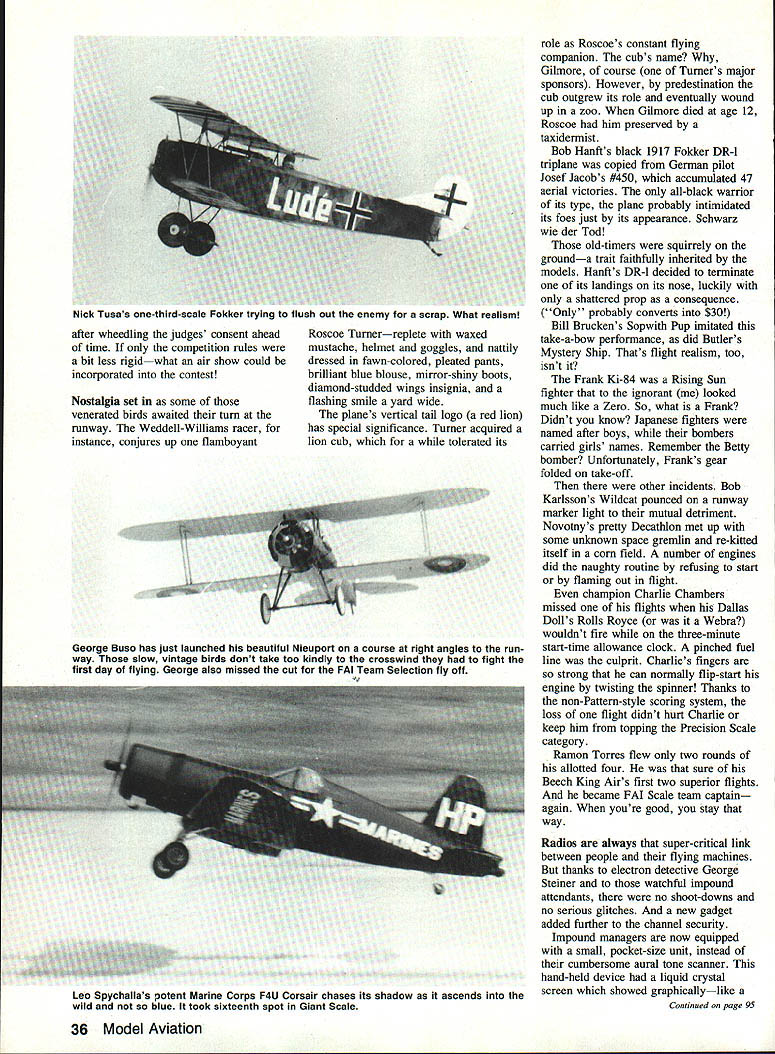
- Bob Hanft's black 1917 Fokker DR-1 was copied from Josef Jacobs' #450. The triplane was squirrely on the ground and ended a landing on its nose—luckily only a shattered prop resulted.
- Bill Bruckner's Sopwith Pup and Butler's Mystery Ship also suffered ground incidents—flight realism, too.
- Frank Ki-84 (a Rising Sun fighter often mistaken for a Zero) had its gear fold on takeoff.
- Bob Karlsson's Wildcat hit a runway marker light. Novotny's Decathlon ended up in a corn field. Several engines refused to start or flamed out in flight.
- Champion Charlie Chambers missed one flight when his Dallas Doll's engine wouldn't fire during the three-minute start-time allowance; a pinched fuel line was the culprit. Thanks to the scoring system, the loss of one flight didn't keep him from topping Precision Scale.
- Ramon Torres flew only two rounds but was confident of his Beech King Air's first two superior flights and became FAI Scale team captain.
Radio safety and equipment
Radios are the super-critical link between pilots and planes. Thanks to electron detective George Steiner and watchful impound attendants, there were no shoot-downs or serious glitches. A new gadget added to channel security:
Impound managers are now equipped with a small, pocket-size unit with a liquid crystal screen that shows graphically—like a bar chart—the presence and strength of broadcast signals in any RC frequency neighborhood. What a boon to any flying site—at a price (the scanner was rumored to list at about $500). Carl Wheeley will likely feature the gadget in his "Product Review" column once available.
About three years earlier a very close call had occurred at a show: during the finale, with six or seven models aloft, two pilots holding their transmitters came within less than 15 feet of each other. Suddenly one model went out of control and smashed into a lawn chair. Fortunately the chair had been vacated only seconds earlier by the young son of the flier of the wayward plane. The cause was third-order intermodulation interference (3IM). Lesson learned: never stand less than 15 feet from the next person holding a transmitter.
Other sights
AMA show teams that include a Flying Witch act—and many do—have a built-in seasonal motif as Halloween approaches. Don Huffines launched one of these charming old hags as part of his act.
Wherever you fly—in a show, at the field, or in your own backyard—remember: flying model airplanes is fun, even when the wings come off.
Winners (first, second, third)
- Fun Scale:
- Shelton, Ultimate
- A.L. Cheney, Ultimate
- J.L. Cheney, Ultimate
- Sport Scale, Expert:
- Nitsch, F-86 Sabre
- Karlson, Wildcat
- Dance, Heinkel
- Precision Scale:
- Chambers, P-51
- Parent, Comanche
- McCullough, Rawdon
- FAI F4C Scale team selection:
- Torres, Beech T-44A
- Foster, Curtiss Jenny
- Hanft, Fokker DR-1
- Wisser, Piper Pacer (alternate)
- Sport Scale, Sportsman:
- Mausolf, Sukhoi
- Fuller, Cessna 120
- Butler, Mystery Ship
- Giant Scale:
- Fiorenze, F-18
- Tharpe, Hornet Spacewalker
- Young, C-47
- FAI Scale:
- Underhill (sole entry)
Closing
What a glorious event! Spectators thrilled to the artistic aerial exhibition; fellow modelers winced with compassion when magnificent, labor-intensive creations came to grief. My hat is off to all the talented people I met at the '91 RC Scale competition—contestants and contest workers alike.
Just maybe I'll enter my nearly completed, 26% Brisighile Skybolt in 1992—and how about picking a Lomcevak as one of the optionals? (I'm such a dreamer!) How about y'all joining me?
Transcribed from original scans by AI. Minor OCR errors may remain.

