
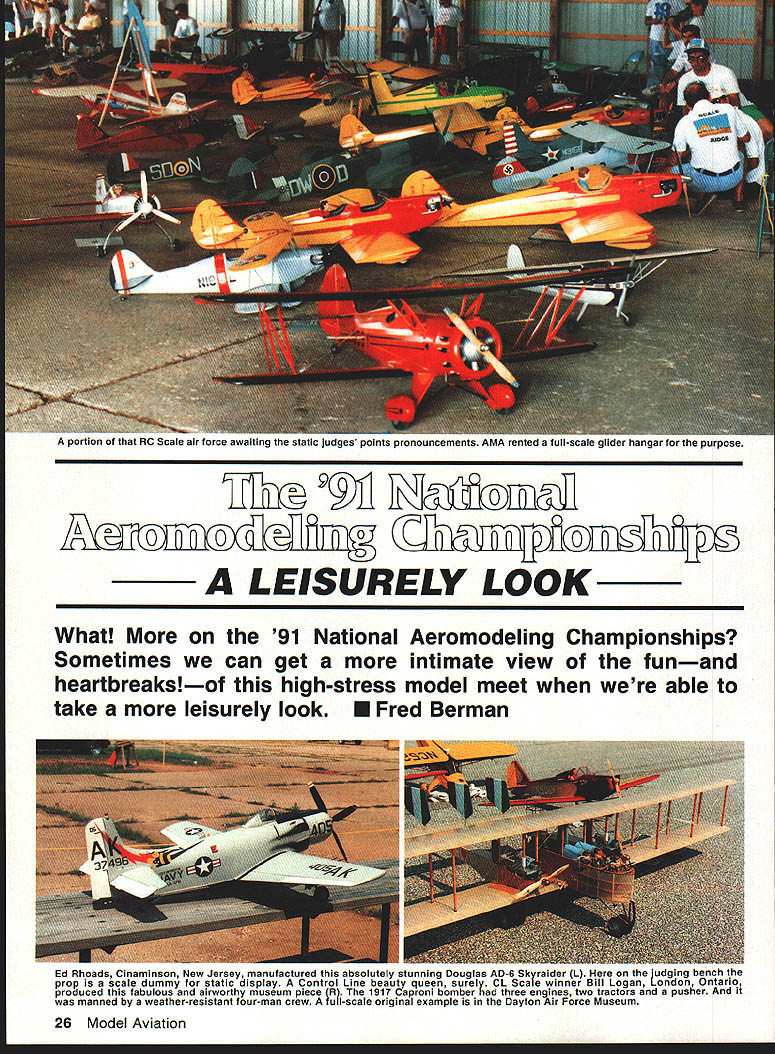

The '91 National Aeromodeling Championships
A LEISURELY LOOK
Fred Berman
DATELINE: The Mid‑American Air Center, July 1991
What! More on the '91 National Aeromodeling Championships? Sometimes we can get a more intimate view of the fun—and the heartbreaks—of this high‑stress model meet when we're able to take a more leisurely look. Let me share a box‑seat view for those who missed the show.
This year AMA conducted its National Aeromodeling Championships at the Mid‑American Air Center, a huge former U.S. Army air base that is reemerging as a joint municipal airport for the neighboring cities of Lawrenceville, Illinois, and Vincennes, Indiana. For the second year running the base hosted the Nationals. A total of 1,007 pilots registered to fly; adding families and support personnel swelled attendance to well over 2,000 people. AMA, however, is a club with over 165,000 members, so Nationals attendance translated to a little more than 1% of the membership.
For the first time the total Nationals was a three‑stage affair: the Johnson City Indoor Nationals, the Outdoor Free Flight Nationals (held earlier at Lawrenceville), and the big RC/CL Nationals reported on here. If those prior attendance numbers were added, the overall participation percentage would be higher. Those who attended will undoubtedly agree that AMA's leadership deserves high marks for organizing another super Nationals—the 65th in their history.
A competitor at the Nationals need not possess the aptitude and skill of a super‑talented ace. Categories are set up for any level of competence, each level retaining that spicy essence of standing up and being counted. The enjoyment of interfacing with so many other friendly aeromodelers who share like interests is equally rewarding.
Organization and Sites
George Field and Lincoln High School
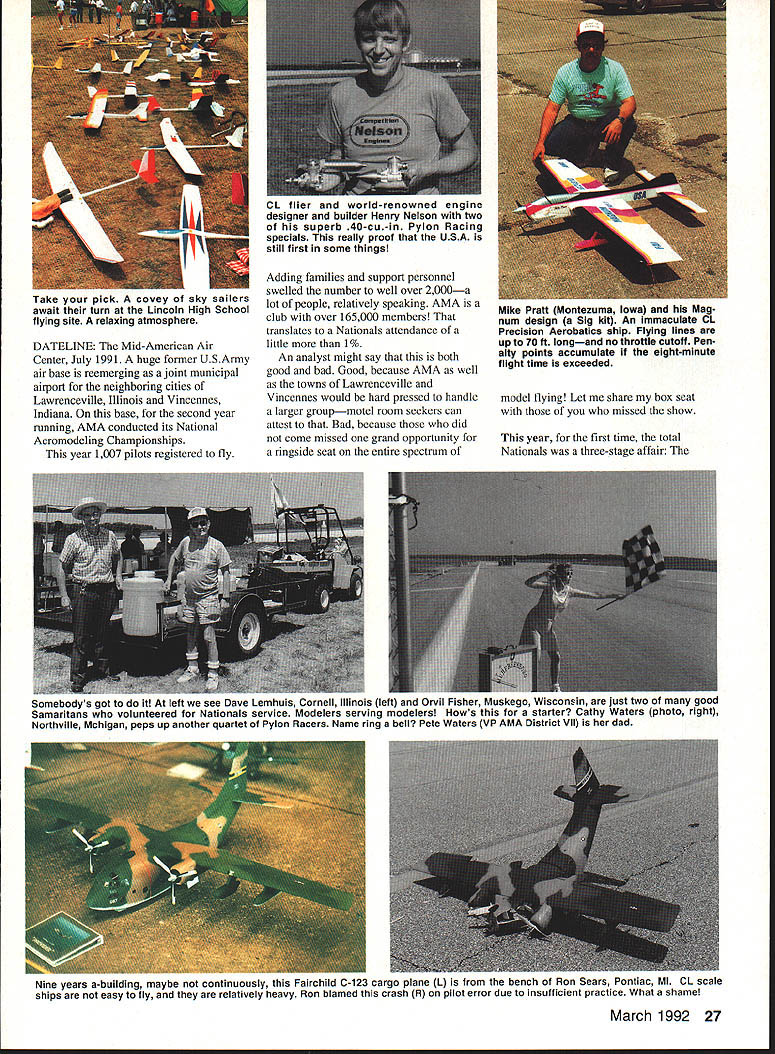
The glider fliers really camped out! Even though George Field is a huge facility, it was not big enough to embrace all of the Nationals activities. With up to 50 RC frequencies in use there is always a frequency‑allocation problem when trying to get all flying done within the tight schedule of one week.
The solution was to find another site at least four signal‑attenuating miles away and spread out the action. As luck—and the local AMA host club and the city fathers—would have it, Lincoln High School in nearby Vincennes was made available. Lincoln High sits in the center of a several‑acre grass area with cornfields along the perimeter and hosted sailplane events and other activities removed from the main field.
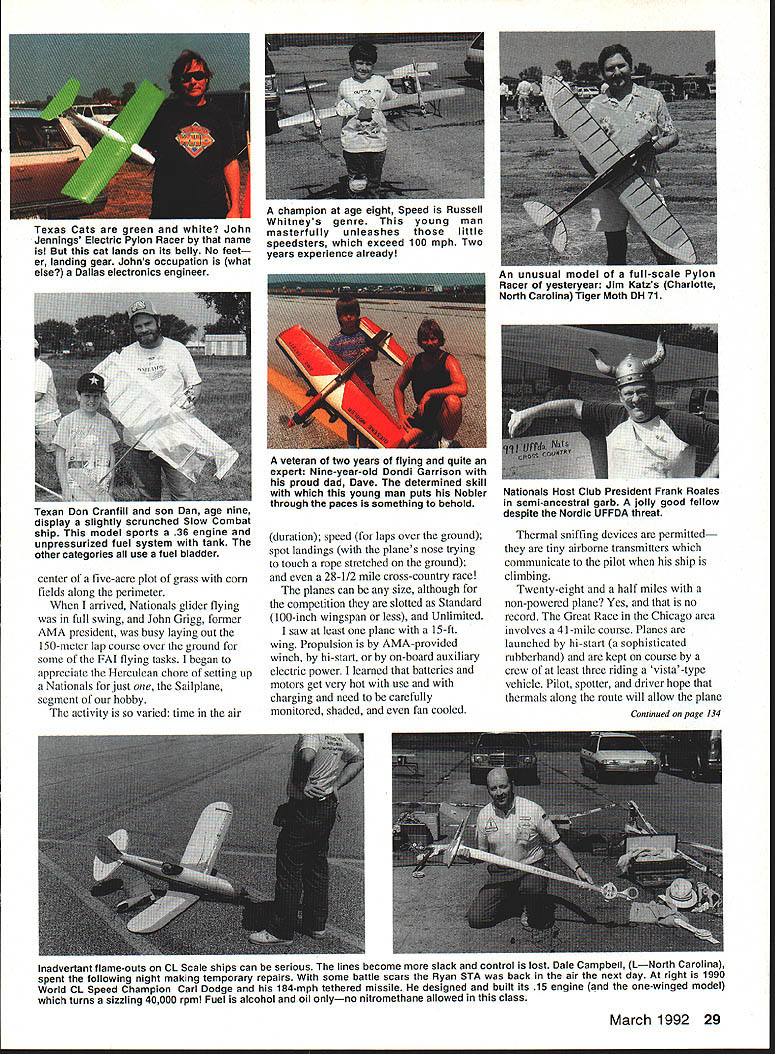
The Nationals hosts were the 35 members of the Tri‑County Aero Club of Vincennes. Club president Frank Roales and his crew ran the show with a sense of humor—the club patch read "UFFDA"—and community outreach included bringing a busload of disadvantaged children to the Lincoln School site to watch and talk with participants.
Volunteers and Officials
Many people worked in the searing sun all week to stage events. Special recognition goes to officials like Bob Brown (District IV VP), who stood on the pylon line every day managing the racing quartets, and to the many unannounced volunteers who made the week possible.
Sailplanes (Gliders)
The sailplane activities were a Herculean chore to set up and run. Events varied widely:
- Duration (time aloft)
- Speed (laps over the ground)
- Spot landings (aiming the nose to touch a rope on the ground)
- Large cross‑country races (including a 28½‑mile cross‑country event)
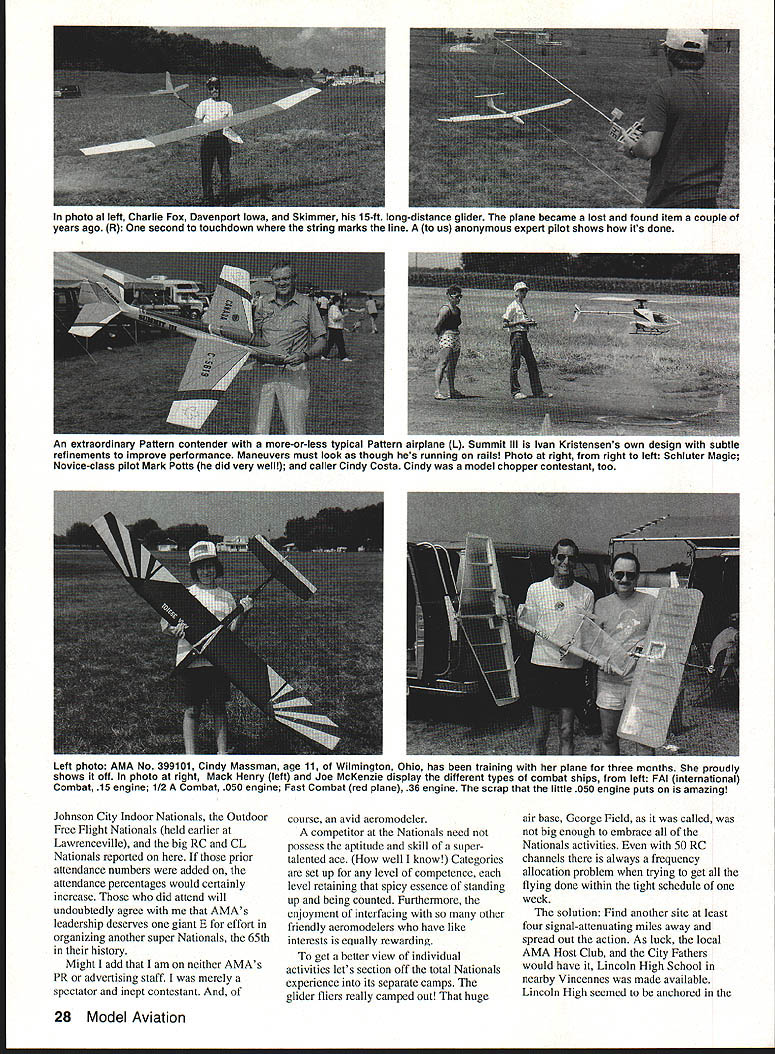
Planes were slotted by competition class as Standard (100‑inch wingspan or less) and Unlimited. I saw a sailplane with a 15‑ft wing on a pylon. Launch methods included AMA‑provided winches, hi‑starts (a sophisticated rubber‑band launcher), and on‑board auxiliary electric power. Batteries and motors can get very hot with use and charging and must be carefully monitored, shaded, and fan cooled. Thermal‑sniffing devices—tiny airborne transmitters that alert the pilot when the ship is climbing—were permitted.
Cross‑country launches typically used a hi‑start and crews of at least three riding a vista‑type vehicle (pilot, spotter, and driver) to follow the course and chase thermals. Planes have been recovered from surprisingly distant fields—sometimes with minimal damage, sometimes not.
Control Line (CL) Events
Back at the Mid‑American Air Center, Control Line fliers enjoyed events that require no radio—just the flying wire. The major CL groupings included Combat, Aerobatics (Precision), Speed, and Scale. The range of designs is wide: from fearsome speed machines to museum‑quality scale replicas.
CL Scale
Scale entries were remarkable. Bill Logan of London, Ontario, produced a fabulous airworthy museum piece: a 1917 Caproni bomber with three engines (two tractors and one pusher), three crew members, and exquisite detail. Its first‑place trophy came as no surprise—and it takes nerve to fly such a gem on the wires.
Henry Nelson, a world‑renowned engine designer/builder, brought two superb 40‑cu.‑in. pylon racing specials—proof the U.S. is still first in some things.
CL Speed
Speed ships are something else: minimal airframe, blistering velocities—some approaching 200 mph—with breakaway take‑off dollies. My eyeballs weren't fast enough to track them in flight. Pulse jets were also on display; they sound like lingering explosions and require ear protection.
Combat
Combat is all business: skeletonized, easily repaired frames designed to last through many encounters. Two combatants circle while trying to sever the opponent's trailing streamer. Matches are timed (five minutes), and after a collision contestants try to get back into the air quickly. Pit crews were feverish—many teams had the skills of an Indy‑500 crew. Average service life of a Combat ship was reported at about 22 matches, so contestants bring a dozen back‑ups.
Combat classes explained by competitors Mack Henry and Joe McKenzie:
- FAI Combat: limited to a .15‑cu.‑in. engine; objective is to score many cuts on an opponent's streamer.
- 1/2A Combat: oriented toward getting the "kill" on the streamer; typical engines are in the .049/.05 range.
- Fast Combat: uses a .36‑cu.‑in. engine and emphasizes speed and killing the streamer.
- Slow Combat: wing area must exceed 300 sq. in.; the objective focuses more on streamer‑cutting than outright kills.
Engines shown at the event included American makes: a .15 Nelson Combat built by Henry Nelson, a red Shurlin .050 for 1/2A use, and larger Fox .36 engines of long reputation.
RC Pylon Races
Pylon racing provided thrills reminiscent of Goodyear and Thompson races of earlier decades. Classes included Quickie 500, Quarter Midget, F3D, Formula 1, and Electric Pylon. Planes tear around a triangular course—angry hornet‑like and loud—for set lap counts.
- Quickie 500: beginner class for simple but agile .40‑size planes (Rick Esterbrook showed a Q‑500 Peppermint Stik powered by a Rossi).
- Quarter Midget: generally .15‑engine class.
- F3D and Formula 1: typically .40 engines (often Nelsons).
- Electric Pylon: may be hand‑launched (no landing gear). Class A planes are limited to 5.5 pounds and no more than seven Ni‑Cd cells. Racing is 8 laps around a triangular course one‑eighth of a mile long.
Dr. Keith Shaw and others have likely spent time optimizing current‑versus‑voltage ratios for battery packs to finish races reliably.
Helicopters
Not far from the pylon track was the helicopter area. Some helis were stunning scale replicas; others were sport and aerobatic machines. Renowned experts such as Maas, Gorham, and Schoonraad flew alongside novices like Mark Potts. Helicopters have great spectator appeal: they hover close, fly slowly, and perform maneuvers impossible for fixed‑wing aircraft—forward, backward, sideways, and even inverted flight in some cases. Judges had a feast of precision flying to evaluate.
Pattern (Precision Aerobatics)
Pattern flying is all about pilot skill. Pattern planes are streamlined, midwing designs built for function rather than scale resemblance, with thrust‑to‑weight ratios often better than 1:1. The object is to trace prescribed geometric flight paths as nearly perfectly as possible; judges deduct for asymmetry, off‑heading, or other deviations.
There are five groupings from Sportsman through FAI. FAI is the international class populated by champions such as Chip Hyde, Tony Prakowiak, and Steve Rojecski. The author confessed to competitive humiliation with a wry note—no trophy, but lots of fun trying.
Rumor (from Ron Van Putte) had it that for 1992 some lower‑skill Pattern lineups would be changed to Turnaround style maneuvers, requiring contestants to perform turnarounds close enough for judges to evaluate them accurately.
Radio Control Scale
Radio‑controlled scale models—beautiful, airworthy replicas of full‑size aircraft—were another favorite. For more detail on RC Scale the author refers readers to a prior article (November 1991 issue of MA).
Incidents and Safety
Among the casualties reported were a mid‑air collision, a buckled wing, and flight battery failures. On the positive side, no cross‑channel radio interference was reported, helped by new pocket scanners used by transmitter‑impound volunteers. The narrow‑band frequency allocation system and AMA's certification program are paying off.
Notable Absences
Two regulars, Rick Allison and his wife Joanie, were robbed in Tulsa, Oklahoma, when thieves off‑loaded their van overnight, ending their trip. Also missed was Johnnie Clemens, who for the first time in about 40 years could not attend; he had a prior commitment—and, a month later, embarked on the one‑way flight that will prevent all of us from attending one day. He is surely keeping an eye on us.
Final Notes
Events ranged from the intimate and humorous (Tri‑County's UFFDA patch and community involvement) to the adrenaline‑charged (pylon and speed runs), to the meticulous and artistic (scale replicas). The Nationals offered something for every aeromodeler—spectators and contestants alike—and the combined efforts of volunteers, clubs, and AMA staff made it a memorable week.
Transcribed from original scans by AI. Minor OCR errors may remain.

