
'91 National Rally
By Fred Berman
WRIGHT‑PATTERSON AFB
Orientation for the first‑time visitor is a bit complex. The base is as big as a good‑sized county, and negotiating the maze of gates and runways can take some doing. A map and compass—and the base security guards, who were courteous and helpful—made it manageable. My Boy Scout intuition finally led me to the right area, and I was surprised to find RC activity already in progress.
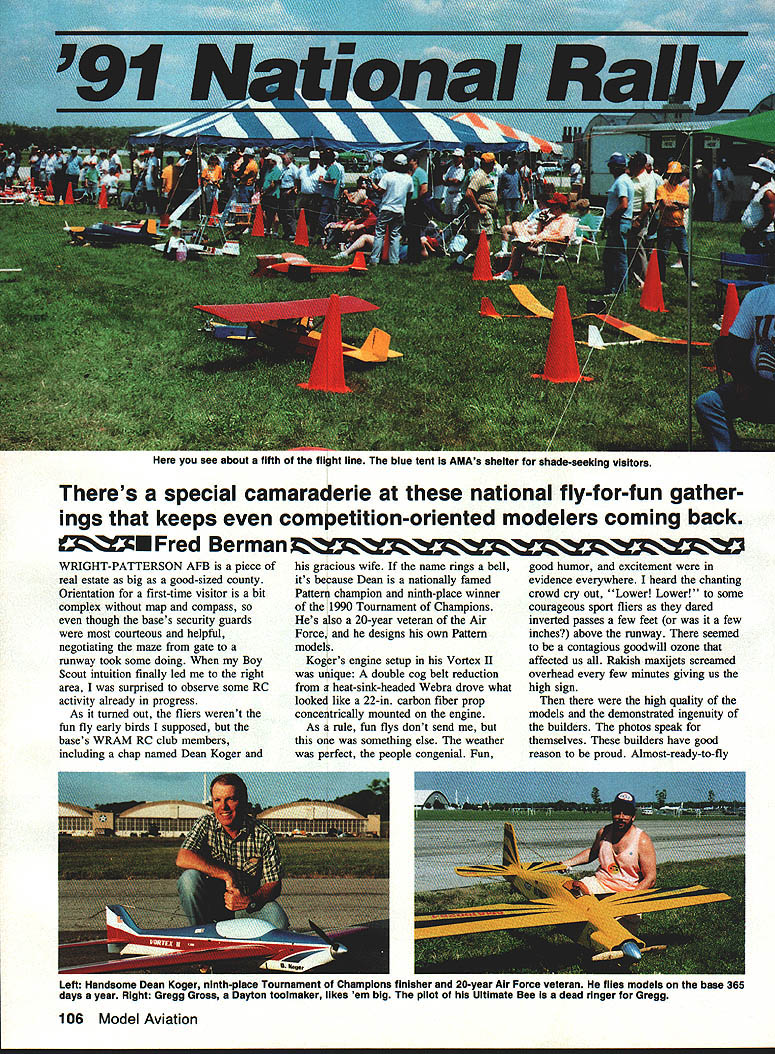
The fliers turned out not to be mere early birds but members of the WRAM RC club, including Dean Koger and his gracious wife. If the name rings a bell, it's because Koger is a nationally famed pattern champion and a ninth‑place finisher in the 1990 Tournament of Champions. He's also a 20‑year Air Force veteran and designs his own pattern models. His engine setup on a Vortex II was unique: a double‑cog belt reduction from a heat‑sink‑headed Webra drove what looked like a 22‑inch carbon‑fiber prop concentrically mounted to the engine.
As a rule, fun‑flys don't usually draw me, but this one was something else. The weather was perfect, the people congenial, and fun, good humor, and excitement were evident everywhere. A chanting crowd cried out "Lower! Lower!" as some courageous sport fliers dared inverted passes just a few feet—or inches—above the runway. A contagious goodwill seemed to affect us all. Maxi‑jets screamed overhead every few minutes, adding to the excitement.
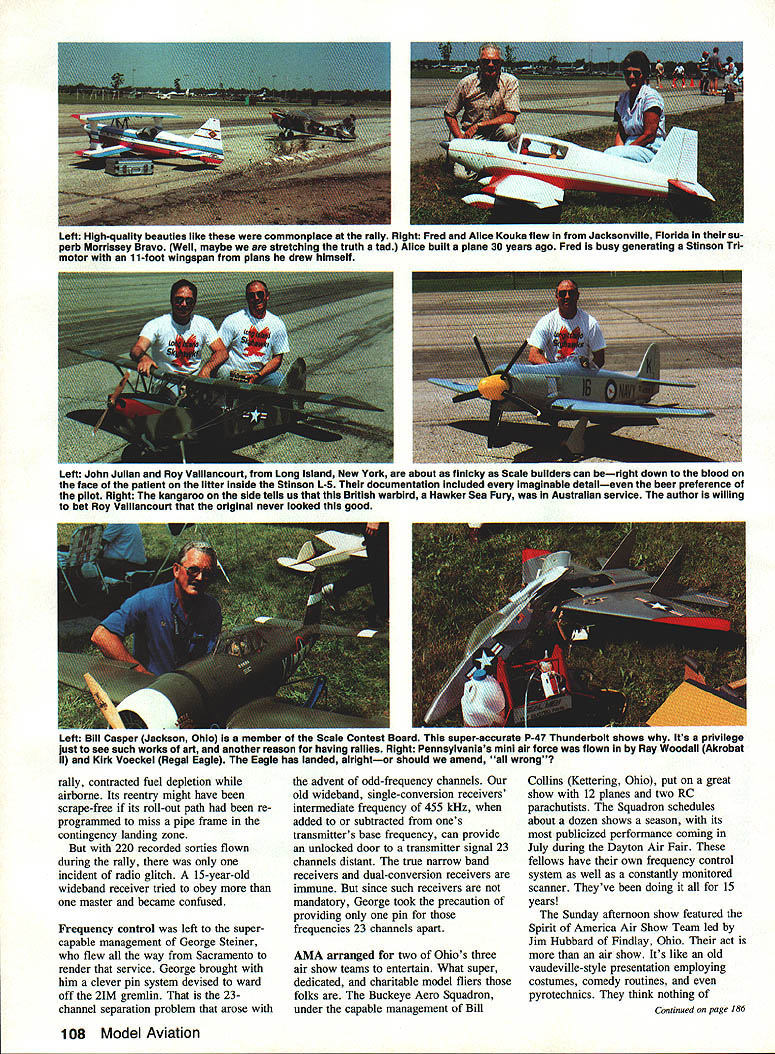
High‑quality models and the demonstrated ingenuity of builders were on display. Craftsmanship and individual creativity are alive and thriving in the U.S.A., and it isn't only competition that motivates modelers to excel. Simple conviviality such as we experienced seems to spawn the urge to create craft worthy of exhibition.
Incidents and repairs
There were a few accidents. Dead‑stick landings damaged some models, while structural failures claimed others. One pilot put a beautifully executed Flying Quarter through a tight aerobatic routine when suddenly the model broke into pieces—announcer Bob Underwood quipped, "That coin must have been counterfeit!" We all commiserated with the unfortunate pilot and hoped he would rebuild his mashed masterpiece. Its reentry might have been scrape‑free if its roll‑out path had been reprogrammed to miss a pipe frame in the contingency landing zone.
With 220 recorded sorties flown during the rally, there was only one incident of radio glitch: a 15‑year‑old wideband receiver tried to obey more than one master and became confused.
Frequency control
Frequency control was ably managed by George Steiner, who came from Sacramento to provide that service. George brought a clever pin system designed to ward off the "23‑channel" problem that arose with the advent of odd‑frequency channels. Older wideband single‑conversion receivers have an intermediate frequency of 455 kHz; when that IF is added to or subtracted from a transmitter's base frequency it can unlock a transmitter signal 23 channels distant. True narrow‑band and dual‑conversion receivers are immune, but since such receivers were not mandatory, George prudently provided only one pin for frequencies 23 channels apart.
Air show teams
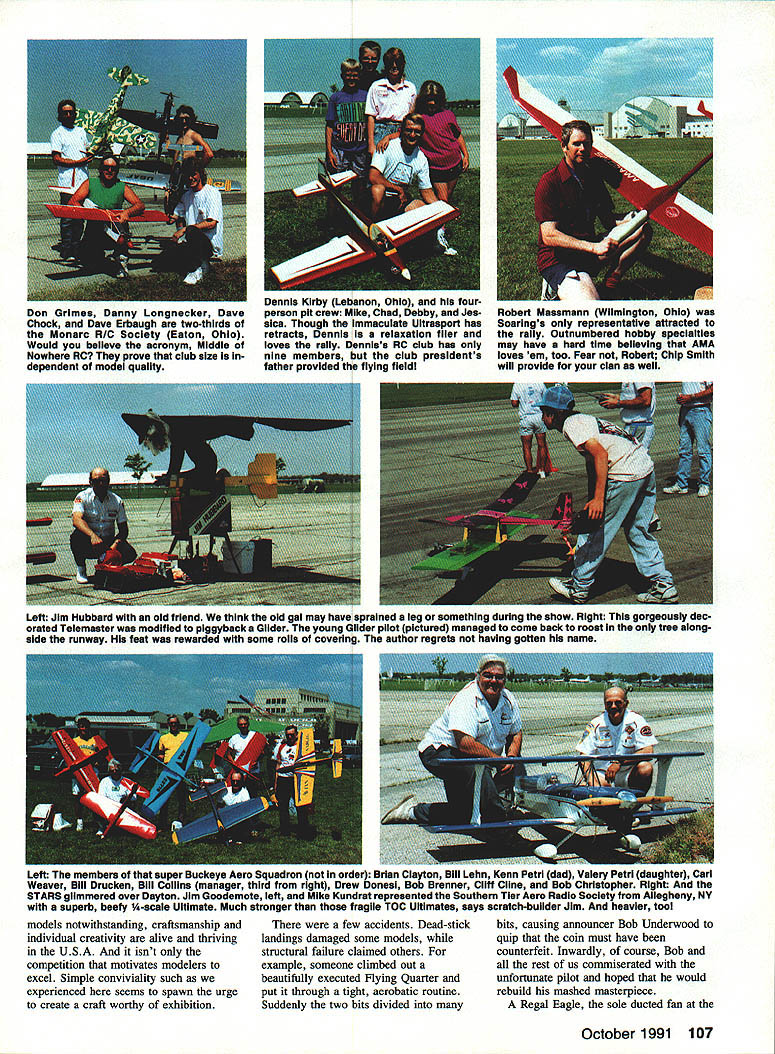
AMA arranged for two of Ohio's air show teams to entertain. The Buckeye Aero Squadron, managed by Bill Collins of Kettering, Ohio, put on a great show with 12 planes and two RC parachutists. The Squadron schedules about a dozen shows a season and is a regular at the Dayton Air Fair; they've had their frequency control system and a constantly monitored scanner for some 15 years.
The Sunday afternoon show featured the Spirit of America Air Show Team led by Jim Hubbard of Findlay, Ohio. Their act goes beyond flying—vaudeville‑style presentation, costumes, comedy routines, and even pyrotechnics make it a full entertainment experience.
Clubs, pits, and displays
Monarc R/C Society of Eaton, Ohio, was represented, and retracts and other refinements were on display. Pit crews, friends, and family helped with final checks across the field. Immaculate Ultrasports and other refined entries attracted attention. Club size isn't everything—small clubs can still make a big impression.
Sound and model engines
Howard Crispin presented a learned dissertation on model engines and sound. The District IV VP has spent years researching sound and its relationship to engine speeds, propeller pitch, and mufflers. His new book, Sound and Model Aeronautics, is available from AMA Supply and Service for $10 and provides an in‑depth discussion. Some of the points made at the membership meeting:
- If we want to perpetuate our hobby, we must get noise levels down. Noise, regardless of decibel level, can irritate neighbors and create bad will.
- Lower engine revs, higher prop pitches, and more effective mufflers reduce noise pollution.
- Diesels and electrics are inherently quieter than other engine types.
- Chain‑saw‑engine mufflers were found wanting; there are good aftermarket mufflers available.
- Cushioned (soft) engine mounts help reduce vibration and noise.
Other attractions and activities
What else was at the National Rally?
- Raffle prizes (including radios)
- Free commemorative T‑shirts
- Hot dogs and soda
- Mini‑contests such as two‑minute timed flights
- The 960th Strike Force stay‑along project with proceeds donated to the Heart Fund
- Many hardworking AMA volunteers who made the event possible
Was that Bob Underwood taking breaks to fly his Aerostar (an ARF—tsk, tsk!)? Was Vince Mankowski breaking in a Fox Stunt engine by the hour? Possibly. We owe AMA staff a big vote of thanks for bringing off such a successful affair; attendance was nearly double that of last year.
With overlapping daytime hours of operation, there simply wasn't enough time to take in all that the Wright‑Patterson attraction—the Air Force Museum—offers. What a pity. But the museum remains; the rally won't come again for another year.
Conclusion
Model rallies are fun. They bring the AMA and its members together—the very reason the organization was founded. Rallies should be perpetuated: they're simple, have wide appeal, and promote a fraternal spirit among modelers. Most participants and spectators at Wright‑Patterson live within a day's drive; wouldn't it be great to hold rallies closer to other membership population centers as well? These are the thoughts of a competition‑oriented AMA member. What's your opinion?
Transcribed from original scans by AI. Minor OCR errors may remain.

