
'91 TOC
Overview
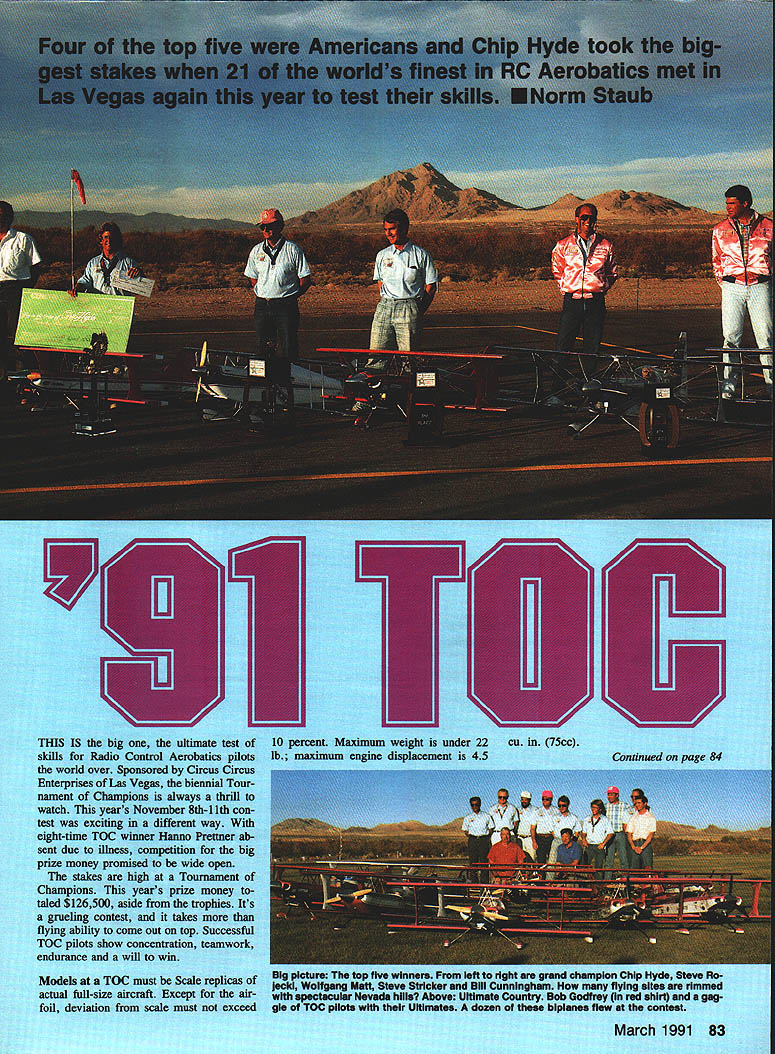
This is the big one — the ultimate test of skills for radio-control aerobatics pilots from around the world. Sponsored by Circus Circus Enterprises of Las Vegas, the biennial Tournament of Champions is always a thrill to watch. This year's November 8–11 contest was exciting in a different way. With eight-time TOC winner Hanno Prettner absent due to illness, competition for the big prize money promised to be wide open.
The stakes are high at a Tournament of Champions. This year's prize money totaled $126,500, aside from the trophies. It's a grueling contest, and it takes more than flying ability to come out on top. Successful TOC pilots show concentration, teamwork, endurance and a will to win.
Aircraft rules
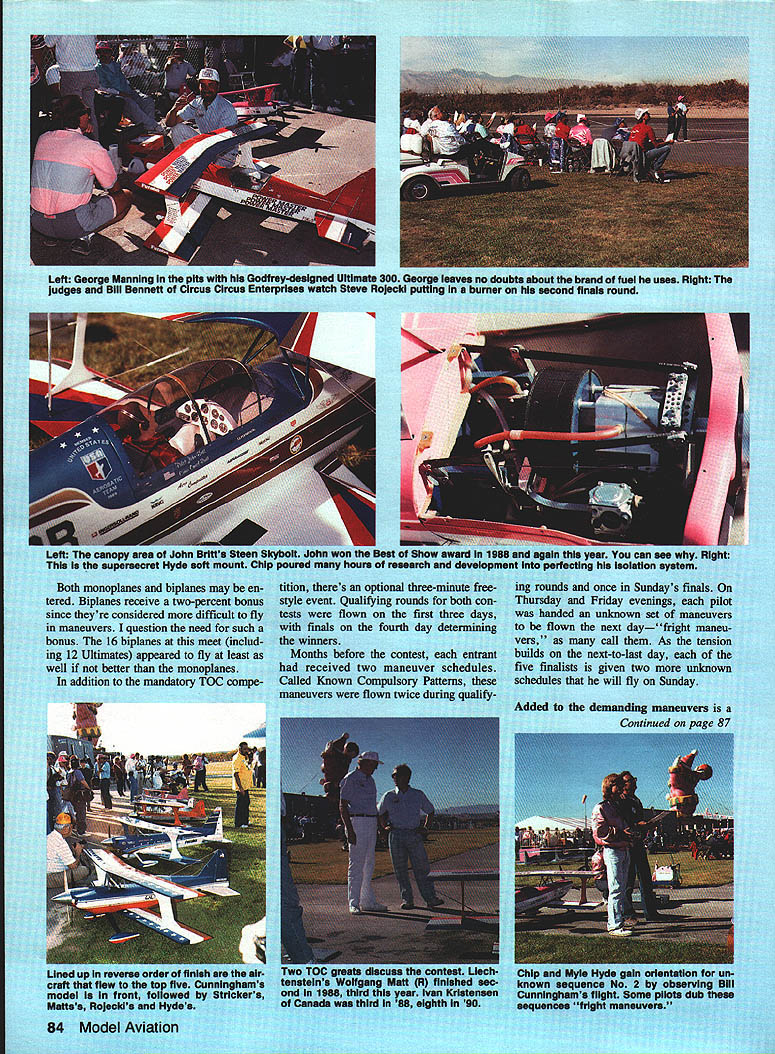
Models at a TOC must be scale replicas of actual full-size aircraft. Except for the airfoil, deviation from scale must not exceed 10 percent.
- Maximum weight: under 22 lb.
- Maximum engine displacement: 4.5 cu. in. (75 cc)
- Both monoplanes and biplanes may be entered.
- Biplanes receive a two-percent bonus since they're considered more difficult to fly in maneuvers.
I question the need for such a bonus. The 16 biplanes at this meet (including 12 Ultimates) appeared to fly at least as well as the monoplanes.
Events and format
In addition to the mandatory TOC competition, there's an optional three-minute freestyle event. Qualifying rounds for both contests were flown on the first three days, with finals on the fourth day determining the winners.
Months before the contest, each entrant received two Known Compulsory Patterns. These maneuvers were flown twice during qualifying rounds and once in Sunday's finals.
On Thursday and Friday evenings, each pilot was handed an unknown set of maneuvers to be flown the next day — often called "flight maneuvers." As the tension builds on the next-to-last day, each of the five finalists is given two more unknown schedules to fly on Sunday.
Scoring
A stringent scoring system is applied:
- For every five degrees of deviation from a proper attitude, fliers lose a point.
- Deviations of over 45 degrees or omission of a maneuver receive a zero.
- Maneuvers can be zeroed only by unanimous decision of the judges.
Many pilots see the sun rise on the days they're scheduled to fly.
Example: Maneuver scoring
To give an idea of the exactitude involved, here's a maneuver from Known Compulsory Pattern No. 2 and how it was judged.
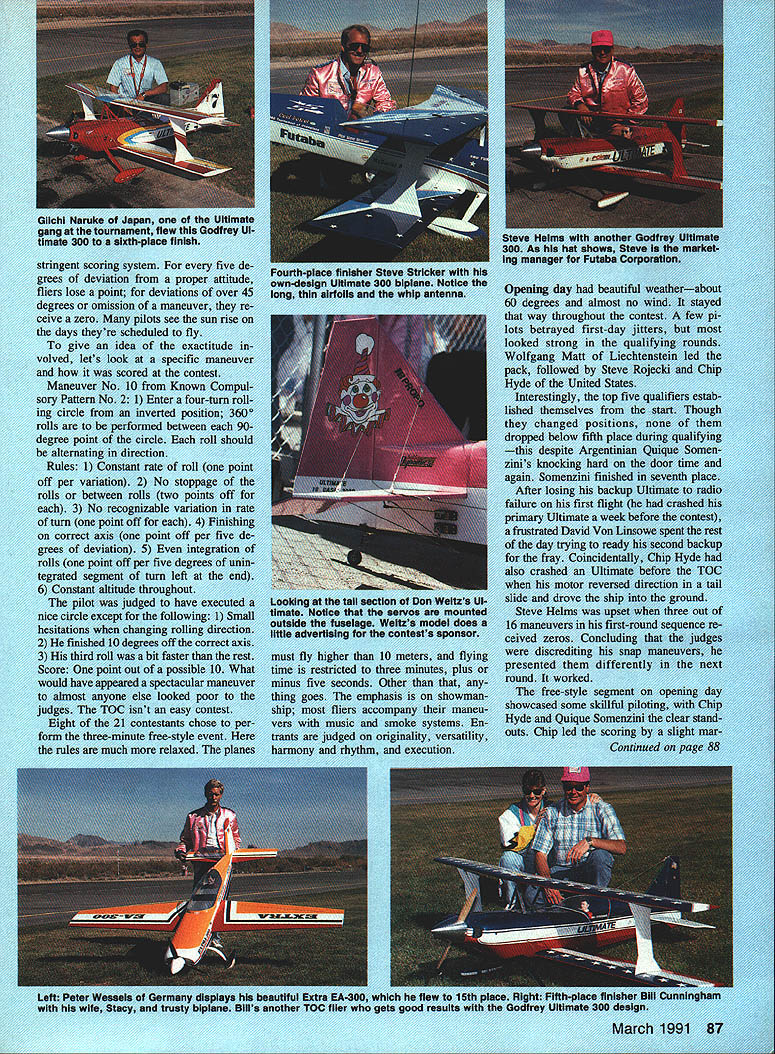
Maneuver No. 10: 1) Enter a four-turn rolling circle from an inverted position; 360° rolls are to be performed between each 90-degree point of the circle. Each roll should be alternating in direction.
Rules:
- Constant rate of roll (one point off per variation).
- No stoppage of the rolls or between rolls (two points off for each).
- No recognizable variation in rate of turn (one point off for each).
- Finishing on correct axis (one point off per five degrees of deviation).
- Even integration of rolls (one point off per five degrees of unintegrated segment at turn left at the end).
- Constant altitude throughout.
The pilot was judged to have executed a nice circle except for:
- Small hesitations when changing rolling direction.
- He finished 10 degrees off the correct axis.
- His third roll was a bit faster than the rest.
Score: 1 point out of a possible 10. What would have appeared spectacular to most looked poor to the judges. The TOC isn't an easy contest.
Freestyle rules
Eight of the 21 contestants chose to perform the three-minute freestyle event. Rules are much more relaxed:
- Planes must fly higher than 10 meters.
- Flying time: three minutes, plus or minus five seconds.
- Emphasis is on showmanship; most fliers use music and smoke systems.
Entrants are judged on originality, versatility, harmony and rhythm, and execution.
Day One
Opening day had beautiful weather — about 60 degrees and almost no wind — and it stayed that way throughout the contest. A few pilots betrayed first-day jitters, but most looked strong in the qualifying rounds. Wolfgang Matt of Liechtenstein led the pack, followed by Steve Rojecki and Chip Hyde of the United States.
The top five qualifiers established themselves from the start. Though they changed positions, none of them dropped below fifth place during qualifying — this despite Argentinian Quique Somenzini repeatedly knocking on the door. Somenzini finished seventh in qualifying.
After losing his backup Ultimate to radio failure on his first flight (he had crashed his primary Ultimate a week before the contest), a frustrated Dave Von Linsowe spent the rest of the day readying his second backup. Coincidentally, Chip Hyde had also crashed an Ultimate before the TOC when his motor reversed direction in a tail slide and drove the ship into the ground.
Steve Helms was upset when three out of 16 maneuvers in his first-round sequence received zeros. Concluding that the judges were discrediting his snap maneuvers, he presented them differently in the next round. It worked.
The freestyle segment on opening day showcased skillful piloting, with Chip Hyde and Quique Somenzini the clear standouts. Chip led the scoring by a slight margin.
Day Two
Fliers had to perform the unknown sequence they'd received the night before. Most were still studying their maneuvers up to the point of flying them. Many tried to orient themselves by simulating the sequence with tiny stick airplanes, which looked like adults playing with toys to onlookers. Some pilots, transmitter in hand, had their caller read out the maneuvers while they moved the sticks in sync with whatever competitor was flying.
Dave Von Linsowe's H. Haig Special, or Courtesan, was the only model with retractable landing gear at the contest. Though Dave had put only about five flights on the Special before the contest, by the end of Friday's rounds he'd flown it to 12th place.
At the TOC, a good caller is crucial to a flier's success. Caller and flier must work out a foolproof system of communication; any errors can damage the flight irrevocably. Quique Somenzini and his dad used an innovative approach: they tape-recorded the calling sequences each evening. During the next day's flying, each wore an earphone connected to the recorder. Quique's father simply started and stopped the recorder for each maneuver without taking his eyes off his son's plane.
Dean Koger benefited from a quick reaction when his Extra 230 threw a prop on his second flight. Dean's efficiency in switching to his backup Lazer 200 had him flying again within the official three-minute starting period.
The freestyle portion again showed bravura flying. Quique Somenzini reversed the previous day's scoring tables by coming in ahead of Hyde, and Von Linsowe placed third. Quique pulled off outstanding half-inverted spins and a knife-edge spin — the only one the author had seen other than Hanno Prettner's (known in TOC argot as the Prettner Screw).
Hyde and Somenzini stretched their craft doing turbo rolls, which brought the crowd to its feet. Hyde went on to a vertical knife-edge figure eight with snaps at the top of each loop, a maneuver that draws an incredible amount of horsepower. Steve Rojecki, a former Air Force F-15 pilot who now flies for Delta Airlines, choreographed extraordinary flying to the score from the movie "Top Gun."
Day Three (last day of qualifying)
Day Three was the last day of qualifying for Sunday's finals. The top five qualifiers held the fortress while those below them jockeyed for position. Giichi Naruke of Japan moved to sixth place, with Quique Somenzini, Ivan Kristensen and Dean Koger right behind.
At a TOC, a flier's maneuver can be zeroed only by unanimous decision of the judges. Frequently the judges gathered after a flight to discuss whether or not to zero particular maneuvers while the fliers tensely awaited the verdict. If the judges didn't convene after a set of maneuvers, the pilots who'd flown them were unanimously relieved.
Steve Rojecki was forced to land in the middle of the last qualifying flight when he lost a cylinder in his Tartan Twin. Fortunately he already had a lock on the finals.
In order of finish, the five qualifiers for Sunday's finals were:
- Chip Hyde
- Wolfgang Matt
- Quique Somenzini
- Steve Rojecki
- Bill Cunningham
Qualifying for the three-minute freestyle finals were:
- Quique Somenzini
- Chip Hyde
- Dave Von Linsowe
- Steve Rojecki
- Bill Cunningham
Finals and results
After months of preparation and three days of intense competition, the finalists faced scrutiny from the judges, the other fliers and the week's largest group of spectators. Pressure seemed to bring out the best in them.
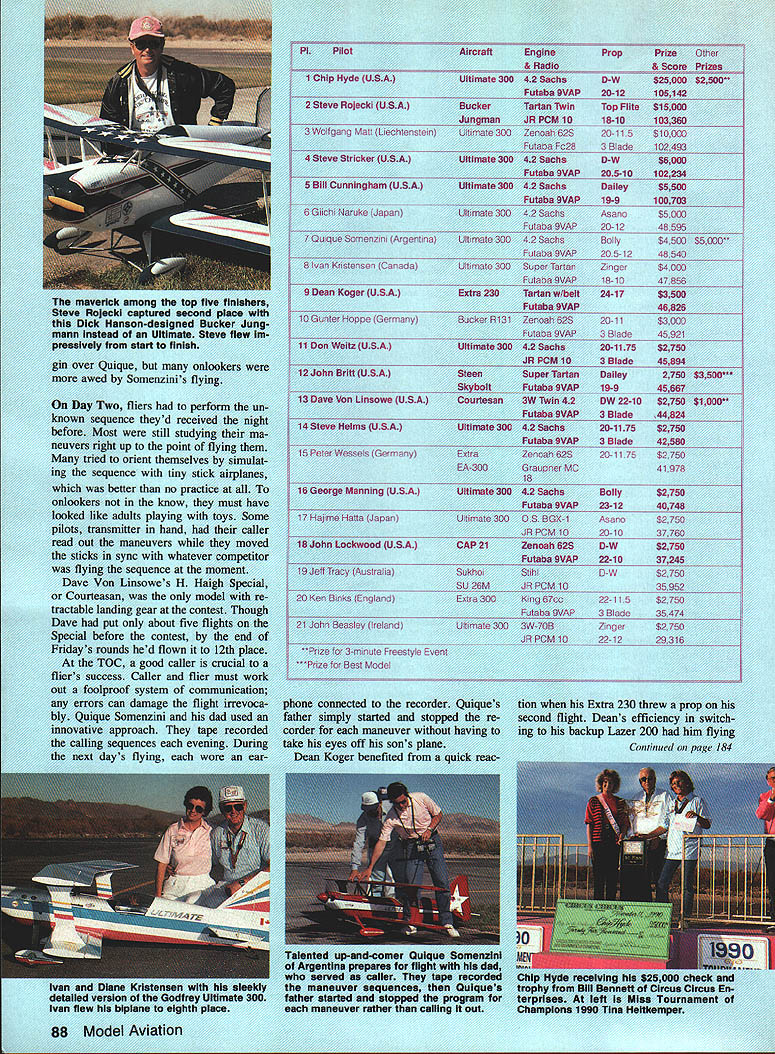
Chip Hyde swept all the final rounds to break Hanno Prettner's longtime monopoly on the grand champion title. Chip flew like a machine; even Prettner might have had difficulty keeping pace. He was awarded $25,000 and a custom-made trophy about four feet high, decorated with a model airplane in 24-carat gold.
Steve Rojecki climbed from fourth place to second, earning $15,000. Wolfgang Matt dropped to third place, receiving $10,000. Steve Stricker and Bill Cunningham finished fourth and fifth, respectively.
The freestyle finalists finished in the same order as in the last qualifying round:
- Quique Somenzini — $5,000 (freestyle champion)
- Chip Hyde — $3,000
- Dave Von Linsowe — $1,000
- Steve Rojecki
- George Manning
Bill Bennett, chairman of the board for Circus Circus Enterprises, handed out the prize checks and trophies as the contest ended on Sunday.
Acknowledgments
The Tournament of Champions owes its spectacular success largely to the sponsorship of Circus Circus and Bill Bennett's participation. Bill earned the gratitude of everyone at the contest. Since this biennial event does much to promote model aviation, Bill also deserves the gratitude of all of us in the hobby.
Transcribed from original scans by AI. Minor OCR errors may remain.

