
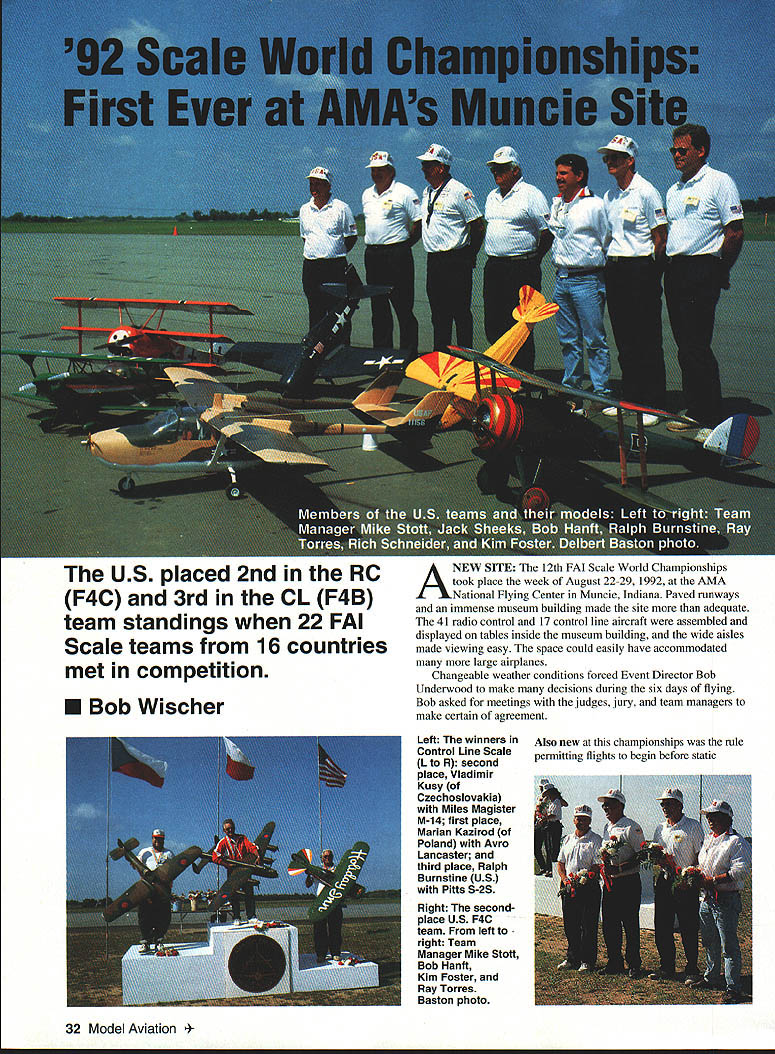
'92 Scale World Championships: First Ever at AMA's Muncie Site
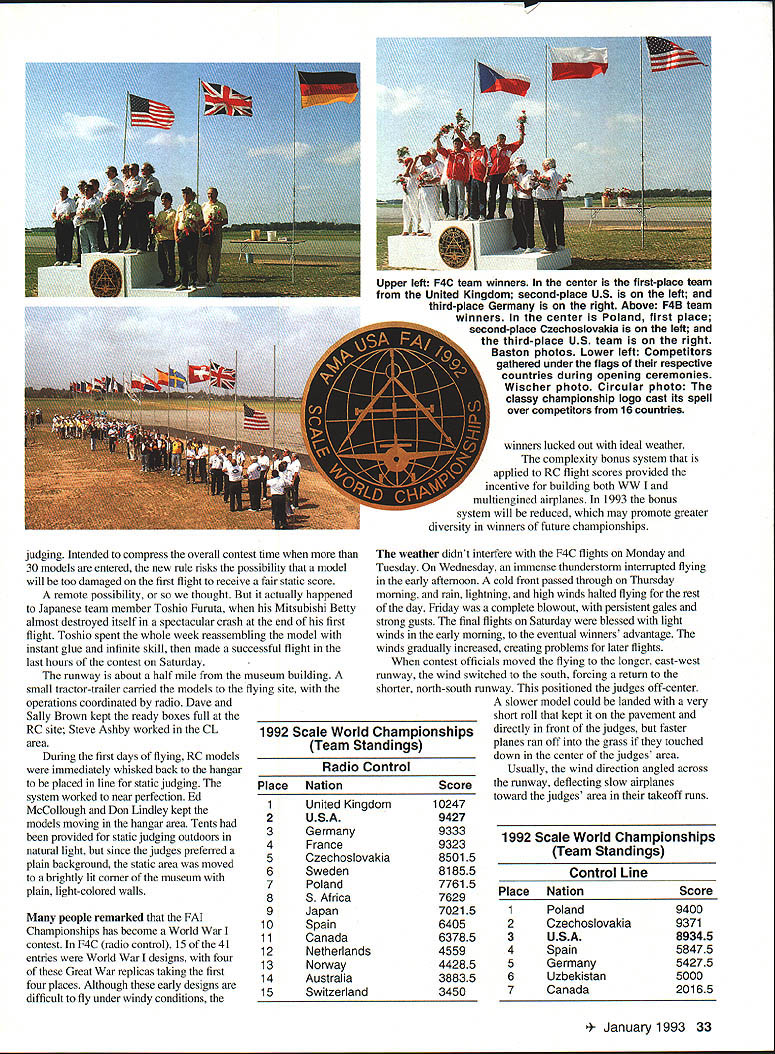
The U.S. placed 2nd in radio control (F4C) and 3rd in control line (F4B) team standings when 22 FAI Scale teams from 16 countries met in competition the week of August 22–29, 1992.
■ Bob Wischer
New site and facilities
The 12th FAI Scale World Championships took place at the AMA National Flying Center in Muncie, Indiana. Paved runways and an immense museum building made the site more than adequate. The 41 radio-control and 17 control-line aircraft were assembled and displayed on tables inside the museum; wide aisles made viewing easy, and the space could have accommodated many more large airplanes.
The runway was about a half mile from the museum building. A small tractor-trailer carried models to the flying site, and operations were coordinated by radio. Dave and Sally Brown kept ready boxes full at the RC site, Steve Ashby worked the CL area, and Ed McCollough and Don Lindley kept models moving in the hangar and static-judging area.
Tents were provided for static judging outdoors because judges preferred natural light, but the static area was later moved to a brightly lit corner of the museum with plain, light-colored walls to provide a neutral background.
Judging and new rules
A new championships rule permitted flights to begin before static judging, intended to compress overall contest time when more than 30 models are entered. Thirty models entered under the new rule. The system worked near perfectly during the first days: RC models were whisked back to the hangar and placed in line for static judging.
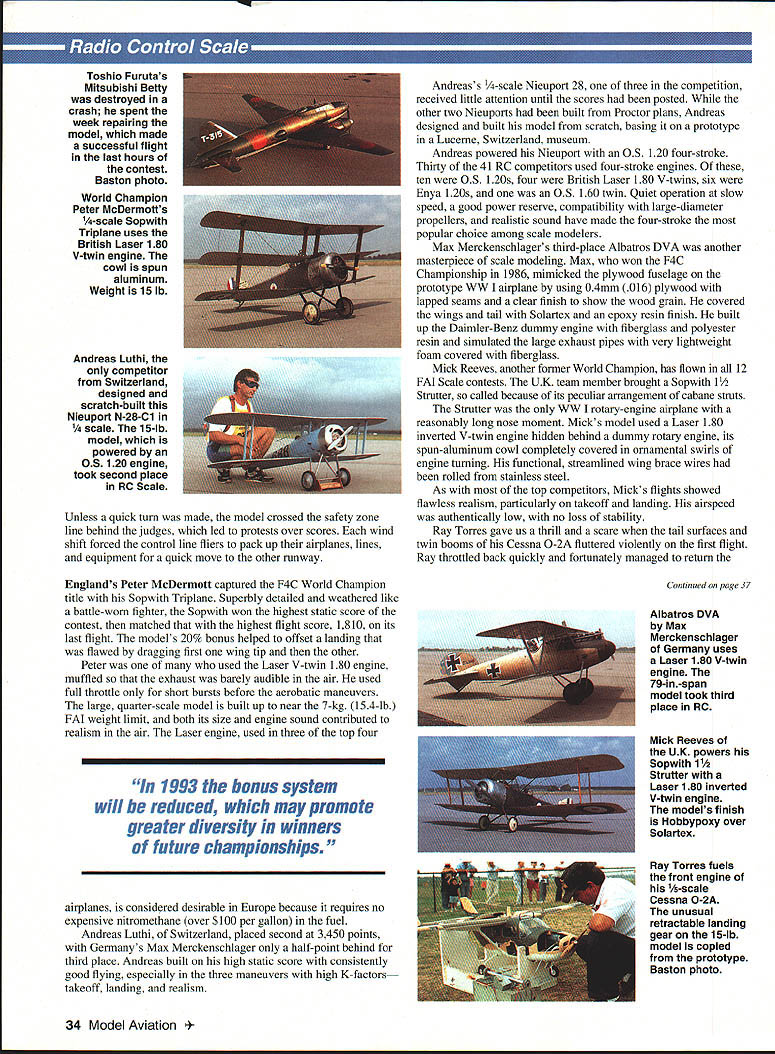
However, the rule carries the risk that a model may be too badly damaged on its first flight to receive a fair static score. That remote possibility actually occurred when Japanese team member Toshio Furuta's Mitsubishi Betty was almost destroyed in a spectacular crash at the end of its first flight. Toshio spent the week reassembling the model using instant glue and skill, reassembled it for static judging, then disassembled it for permanent repairs and flew it successfully in the last hours of the contest.
The complexity-bonus system applied to RC flight scores provided an incentive for building WWI types and multi-engined airplanes. For 1993 the bonus system will be reduced; organizers hope this will promote greater diversity among future winners.
Weather and flying operations
Changeable weather forced Event Director Bob Underwood to make many decisions during the six days of flying. Bob consulted regularly with the judges, jury, and team managers to secure agreement on weather-related changes.
An immense thunderstorm interrupted flying one afternoon. A cold front passed through Thursday morning with rain, lightning, and high winds that halted flying. Friday was a rest day after persistent gales and strong gusts. Final flights on Saturday began in light winds in the early morning, giving early flyers an advantage; winds increased as the day progressed, creating problems for later flights.
Contest officials moved flying between runways to adjust for wind direction. When winds required using the shorter north–south runway, judges were positioned off-center, which favored slower models that could land with a short roll in front of the judges; faster planes tended to run off onto the grass and touch down closer to the judges' area.
Radio-control highlights
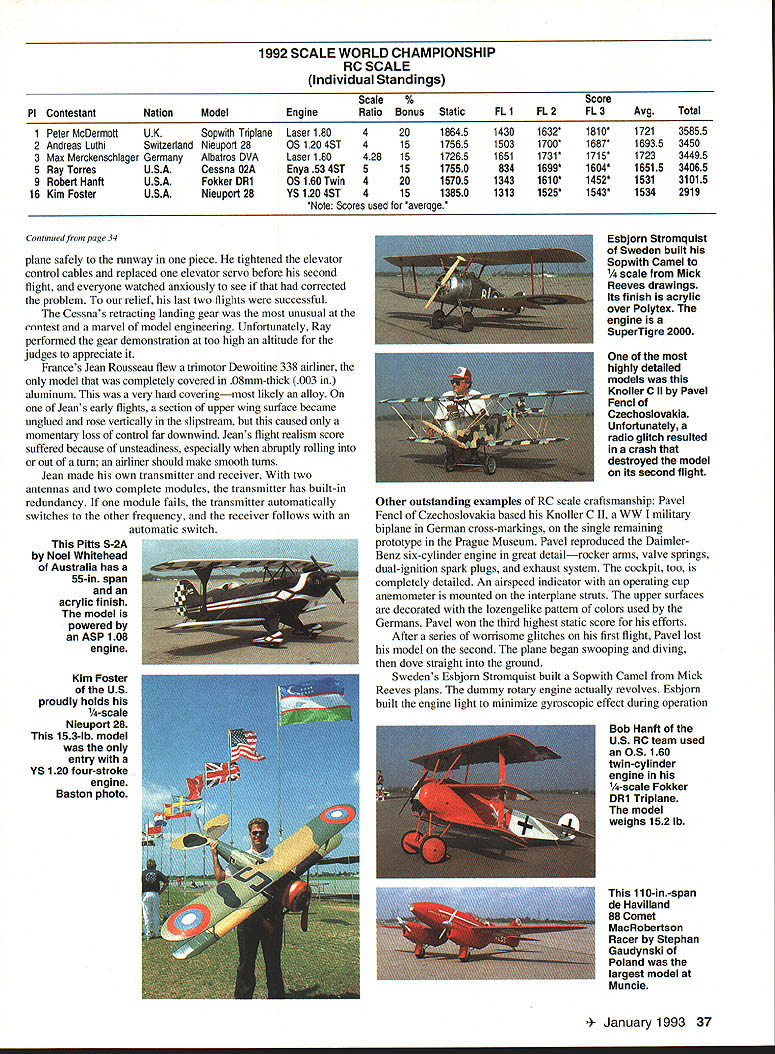
Many observers remarked that the championships had become a World War I contest: of the 41 F4C entries, 15 were WWI designs, and four Great War replicas took the first four places in the individual standings. Early designs are difficult to fly in wind, but weather on Monday–Wednesday allowed most F4C flights to proceed.
Andreas Luthi (Switzerland) finished second with 3,450 points; Germany's Max Merckenschlager placed third, only half a point behind. Andreas built his 1/4-scale Nieuport 28 from scratch, basing it on a prototype in a Lucerne museum and powered it with an O.S. 1.20 four-stroke.
Max Merckenschlager's third-place Albatros D.Va was a masterpiece of scale detailing. Max mimicked the plywood fuselage using 0.4 mm (.016") plywood with lapped seams and a clear finish to show the wood grain. He covered the wings and tail with Solartex and an epoxy resin finish, and sculpted a convincing Daimler‑Benz dummy engine and exhaust using fiberglass, polyester resin, and lightweight foam.
Mick Reeves (United Kingdom), a former world champion who has flown in all 12 FAI Scale contests, brought a Sopwith 1½ Strutter powered by a Laser 1.80 inverted V-twin hidden behind a dummy rotary engine. His model showed flawless realism in takeoff and landing, with authentically low airspeed and stable handling.
Ray Torres provided a scare when the tail surfaces and twin booms of his Cessna O-2A fluttered violently on his first flight. He throttled back and returned safely, tightened elevator control cables and replaced an elevator servo, and his last two flights were successful. His model's retracting landing gear was a marvel of engineering, though a gear demonstration was performed too high for the judges to appreciate.
France's Jean Rousseau flew a trimotor Dewoitine 338 airliner that was completely covered in .08 mm (.003") aluminum—most likely an alloy. On one early flight a section of upper wing surface became unglued and rose in the slipstream, causing momentary instability downwind. Jean's transmitter/receiver setup included built-in redundancy: two antennas and two complete modules that automatically switch frequencies if one fails.
Most top competitors copied prototypes in museums; repeat visits to photograph and measure details and markings were considered necessary for World Championship–level accuracy. Winners combined top piloting skills with top model-building skills; high flight scores alone cannot make up for large deficits in static scores.
Engines and equipment
Thirty of the 41 RC competitors used four-stroke engines. Of these, ten used O.S. 1.20s, four used British Laser 1.80 V-twins, six used Enya 1.20s, and one used an O.S. 1.60 twin. Four-strokes are popular for quiet operation at slow speed, good power reserve, compatibility with large-diameter propellers, and realistic sound. In Europe, the four-stroke’s lack of need for nitromethane is desirable, since nitromethane can cost over $100 per gallon.
Control-line highlights
Of the 17 control-line scale models, three stood out as the elite.
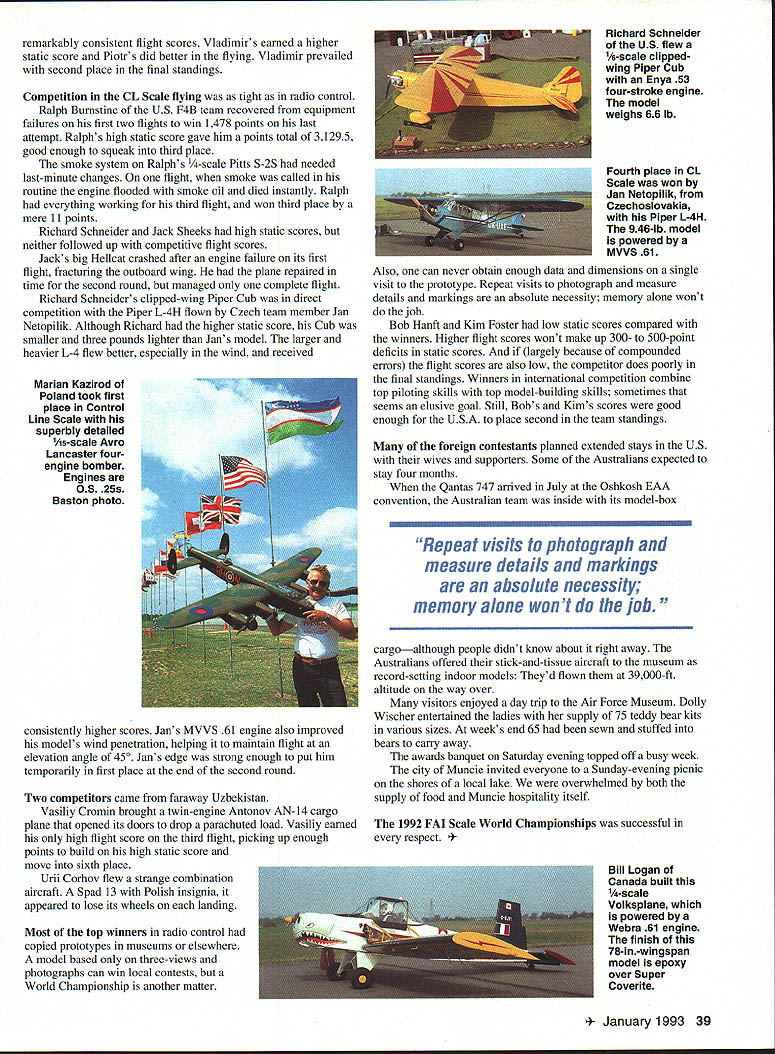
- Poland's Marian Kazirod built a 1/5-scale Avro Lancaster and lavished it with fine detail—panel lines, rivets, retracting landing gear, and four engines. He received a high static score and the highest flight score of the F4B contest on his final flight. In past championships the Soviet team had been dominant; their absence this year opened the field.
- Czechoslovakia's Vladimir Kusy and Poland's Piotr Zawada flew nearly identical 1/5-scale Miles Magisters. Vladimir earned the higher static score while Piotr scored better in flying; Vladimir prevailed with second place.
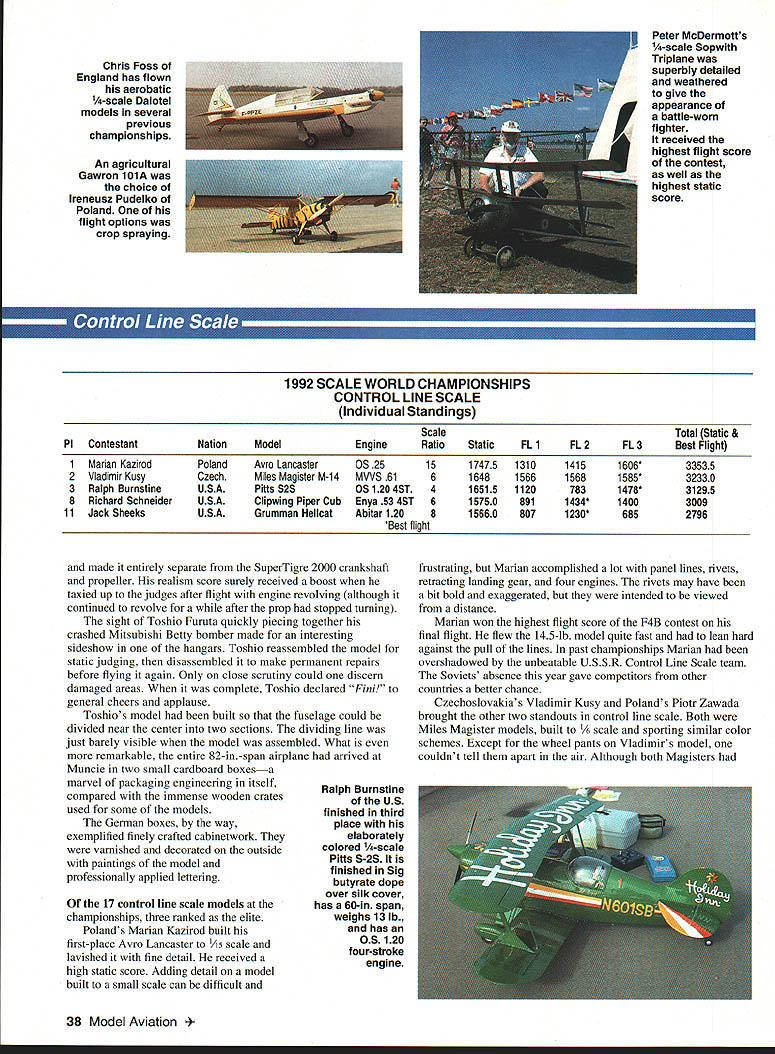
Competition in CL Scale flying was as tight as in radio control. Ralph Burnstine (U.S.) recovered from equipment failures on his first two flights to score 1,478 points on his last attempt. His high static score gave him a total of 3,129.5 points—enough to squeak into third place by 11 points. Ralph's 1/4-scale Pitts S-2S smoke system required last-minute changes; on one flight the engine flooded with smoke oil and died, but everything worked for his final flight.
Other CL competitors included Richard Schneider and Jack Sheeks, who had high static scores but could not match them with flight points. Jack's Hellcat crashed after an engine failure on its first flight and fractured the outboard wing; he repaired it in time for the second round but managed only one complete flight. Richard's clipped-wing Piper Cub competed with Jan Netopilik's larger Piper L-4H; Jan's heavier model and stronger MVVS .61 engine gave better wind penetration and higher scores.
Two competitors came from Uzbekistan. Vasiliy Cromin brought a twin-engine Antonov An-14 cargo plane that opened its doors to drop a parachuted load; his third flight produced enough points to move him into sixth place. Uiri Corhov flew an unusual Spad 13 with Polish insignia that seemed to lose its wheels on each landing.
Shipping, craftsmanship and visitors
Toshio Furuta's Mitsubishi Betty had been built so the fuselage could divide near the center; the entire 82‑in. span airplane arrived at Muncie in two small cardboard boxes—a marvel of packaging engineering compared with the immense wooden crates used by other teams. German crates were noted for fine craftsmanship, varnish, external paintings of the airplane, and professional lettering.
Many foreign contestants planned extended stays in the U.S. Some Australians expected to stay for months; their models had even flown aboard a Qantas 747 en route to Oshkosh, arriving inside the aircraft's cargo.
Visitors enjoyed museum tours and a day trip to the Air Force Museum. Dolly Wischer entertained the ladies with 75 teddy bear kits; by week’s end 65 bears had been sewn and stuffed to take home.
Awards and hospitality
The awards banquet on Saturday evening capped a busy week. The city of Muncie invited everyone to a Sunday-evening picnic on the shores of a local lake, where competitors enjoyed plentiful food and warm hospitality.
The 1992 FAI Scale World Championships was successful in every respect.
1992 Scale World Championships (Team Standings)
Radio Control
- Place 1: United Kingdom — 10,247
- Place 2: U.S.A. — 9,427
- Place 3: Germany — 9,333
- Place 4: France — 9,323
- Place 5: Czechoslovakia — 8,501.5
- Place 6: Sweden — 8,185.5
- Place 7: Poland — 7,761.5
- Place 8: South Africa — 7,629
- Place 9: Japan — 7,021.5
- Place 10: Spain — 6,405
- Place 11: Canada — 6,378.5
- Place 12: Netherlands — 4,559
- Place 13: Norway — 4,428.5
- Place 14: Australia — 3,883.5
- Place 15: Switzerland — 3,450
Control Line
- Place 1: Poland — 9,400
- Place 2: Czechoslovakia — 9,371
- Place 3: U.S.A. — 8,934.5
- Place 4: Spain — 5,847.5
- Place 5: Germany — 5,427.5
- Place 6: Uzbekistan — 5,000
- Place 7: Canada — 2,016.5
Transcribed from original scans by AI. Minor OCR errors may remain.

