
'92 Schneider Cup: Re-Enactment
This annual re-creation of a historic series of races attracts exceptional participants as well as a crowd of spectators. — Bob Benjamin
Over the years, great effort has been devoted to finding ways to make model airplanes more interesting and less disturbing to the general public. These attempts have ranged from control of engine noise (to eliminate complaints) to shows intended to interest and educate nonmodelers. Such shows range from open houses at flying fields to static mall shows arranged in cooperation with a civic agency or charity. In recent years, modelers have encouraged public interest in major competitive events.
In his "Focus on Competition" column in the September 1992 Model Aviation, AMA Technical Director Bob Underwood discusses gaining public acceptance of aeromodeling as a sport. He mentions the Tournament of Champions, Reno-style RC racing, and Top Gun as examples of activities that might interest nonmodelers. Organizer Frank Tiano's exclamation during Top Gun—"We've got them! They're not modelers, they're involved."—offers a key to what we are really trying to accomplish. Whether to prevent complaints that close flying sites, to interest potential modelers, to promote aerospace education, or to foster widespread acceptance of aeromodeling as a legitimate activity, a prime goal should be to give the general public a sense of identification with what we are doing.
The Desert Hawks R/C Club of Lake Havasu City, Arizona, has taken a giant step in this direction with the Schneider Cup Re-Enactment. By 1989 the Desert Hawks had several years of experience running the London Bridge Seaplane Classic (Lake Havasu City being home to the historic London Bridge). Bob Martin, a Desert Hawks member and owner of Bob Martin R/C, saw the potential of a new event based on the historic Schneider Cup races. He and his wife and business partner, Katie, approached several local business leaders with the idea of promoting an aeromodeling event that would be a spectator attraction for residents and visitors alike.
From the beginning, the concept was presented as a no-excuses activity that could interest a wide range of spectators. In particular, Bob and Katie talked to realtor/broker Jerry Sheehan of G&S Realty, who offered active help. Several other members of the Lake Havasu business community, including city council member Melanie Grinstead-Hanak and John Parrott, manager of the Chamber of Commerce, became interested in the Schneider Cup Re-Enactment project and began working with the Desert Hawks contest committee.
A group of modelers with enough experience to organize and run a major event made a commitment to see the project through. So that civic leaders could be presented with a concise and businesslike proposal, this group attended to considerations such as insurance, safety inspections, flying site control, and a rationale for public involvement before contacting anyone outside the club.
Basing the new event on the Schneider Cup races offered great potential for attracting public interest. By combining floatplane activity with the community's focus on the recreation-oriented lake, the organizers took maximum advantage of the facilities at hand. Use of scale flying models to re-create a historic event provided an out-of-the-ordinary attraction, and the element of competition offered excitement with which nonmodelers could identify.
Arrangements were made to base the event at the Nautical Inn, a popular resort on the lakefront near London Bridge. The Nautical Inn has an extensive private beach that offered an excellent flying site with fine spectator access.
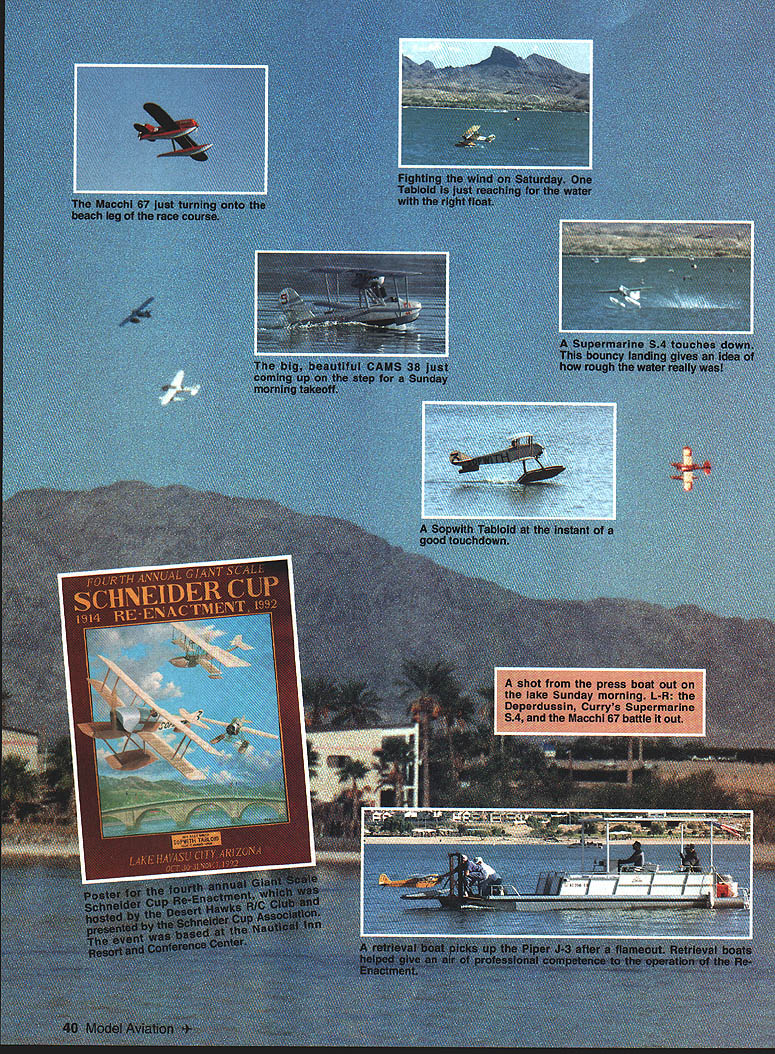
The Desert Hawks proposed an event that promised to be interesting to the public and proved themselves capable of organizing it. Lake Havasu City business leaders were ready to listen when Bob Martin presented the idea, and they supported it to an extraordinary extent. A local tax levied on facilities and attractions, with proceeds invested to promote tourism and local participation, made funds available to help promote the Re-Enactment, including underwriting the promotional poster.
THE SCHNEIDER CUP RACES
The historic full-scale Schneider Cup races originated in 1912 as an attempt by French patron Jacques Schneider to encourage development of water-based aircraft. At the time, water takeoffs and landings were still relatively new, and many early entrants failed to get off the water; the notion of an international seaplane race thus seemed premature to some.
Schneider reasoned that, since a major portion of the earth's surface consists of water, it made sense to encourage development of water-based aircraft. Competition was among teams selected to represent their nations, with a trophy awarded on the basis of annual competition. Permanent possession of the trophy would go to a nation that won it three times within five years.
France, Italy, England, and the United States competed for the Schneider Cup from 1913 until 1931. The 1913 race, held in Monaco, was won by French pilot Maurice Prevost flying a specially modified Deperdussin monoplane at an average lap speed of about 61 mph. When England retired the Schneider Cup in 1931, the winning airplane was a Supermarine S.6B flown by John Boothman at an average speed of about 340 mph.
Though at first glance a racing floatplane seems odd given the drag and weight of floats and hulls, the competition evolved into an important proving ground. The 1931 S.6B became the world's fastest airplane at 340.08 mph and, with an uprated engine, shortly thereafter exceeded 400 mph. Its Rolls-Royce "R" engine design became the basis for the legendary Merlin V-12 of World War II. The Italian Macchi-Castoldi MC.72, not ready for the 1931 race, went on in 1934 to set an as-yet-unbeaten world record for floatplanes of 440.68 mph.
THE SCHNEIDER CUP RE-ENACTMENT
When Bob Martin and the Desert Hawks contest committee set out to host the first Schneider Cup Re-Enactment, they had to invent a new model aviation event. Two challenges faced them: create a competitive event that would attract experienced model builders and fliers in sufficient numbers, and create a show that would interest nonmodelers.
It was assumed that many nonmodelers would be watching. Large models, which eliminate the "toy airplane" image at first glance, are far more impressive to spectators than small ones. For practical reasons—Lake Havasu is a large body of water and rough water is often a fact of life—a minimum wingspan of 85 inches is required. Most Schneider Cup Re-Enactment models are one-quarter scale or larger; they are impressive up close and easy to see from the beach.
A set of rules was written to balance attractiveness to entrants and appeal to the public. As the event is a scale contest, AMA Sport Scale rules were used as the basis for static judging for scale fidelity.
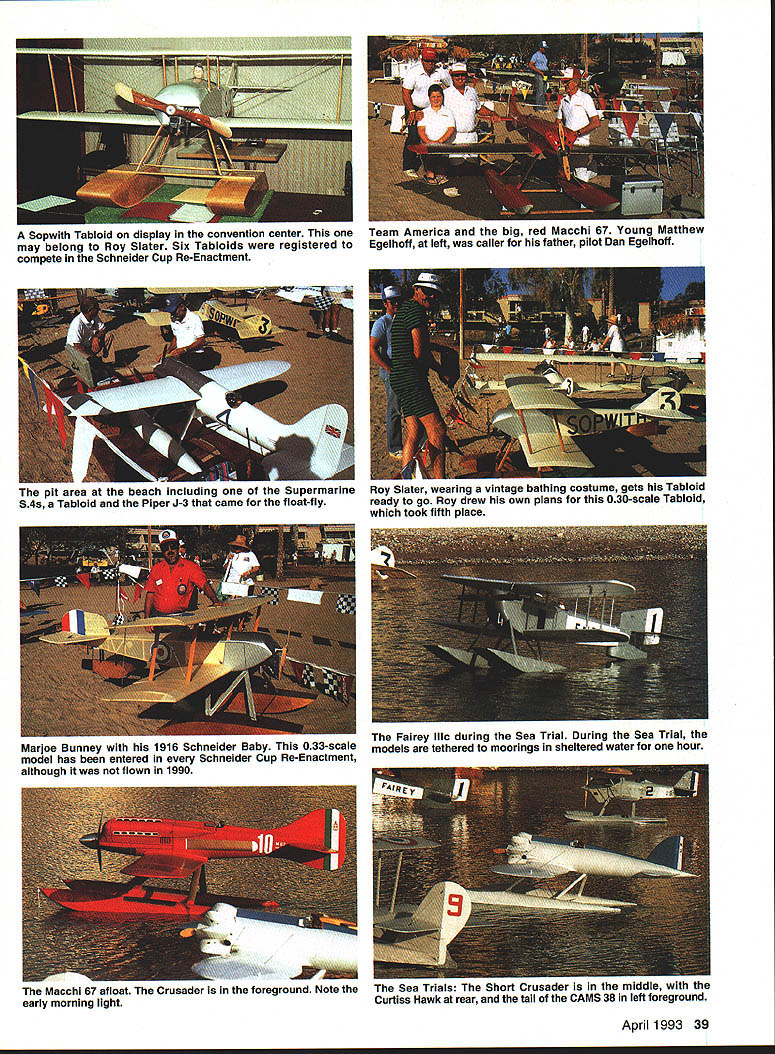
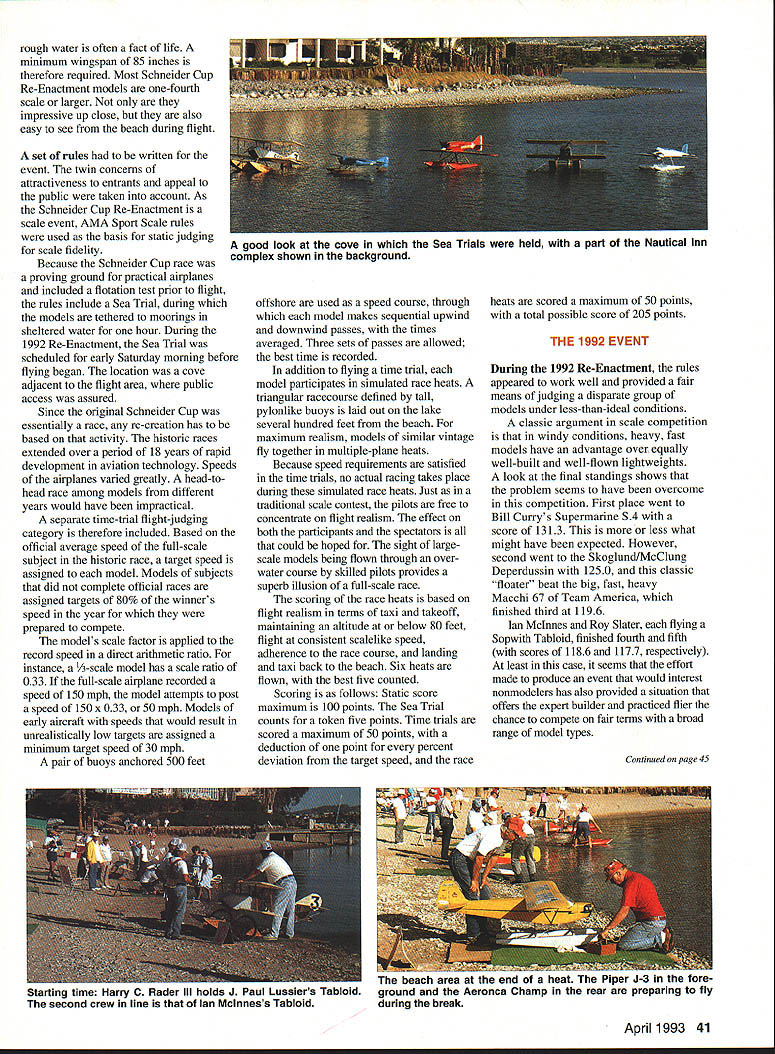
Because the original Schneider Cup included a flotation test prior to flight, the rules include a Sea Trial: models are tethered to moorings in sheltered water for one hour. During the 1992 Re-Enactment the Sea Trial was scheduled for early Saturday morning before flying began, in a cove adjacent to the flight area where public access was assured.
Since the original Schneider Cup was essentially a race, any re-creation had to base activity on that premise. The historic races spanned 18 years of rapid development in aviation technology and varied greatly in speed, so head-to-head races among models from different years would be impractical. Therefore, a separate time-trial flight-judging category is included. Based on the official average speed of the full-scale subject in the historic race, a target speed is assigned to each model. Subjects that did not complete official races are assigned targets of 80% of the winner's speed for the year they intended to compete.
The model's scale factor is applied to the record speed in direct arithmetic ratio. For example, a 1/4-scale model (scale ratio 0.25) based on a full-scale airplane with a 150 mph record attempts to post 150 × 0.25 = 37.5 mph. Models of very fast full-scale aircraft that would result in unrealistically low target speeds are assigned a minimum target speed of 30 mph.
A pair of buoys anchored 500 feet offshore is used as a speed course; each model makes sequential upwind and downwind passes, with times averaged. Three sets of passes are allowed; the best time is recorded.
In addition to the time trial, each model participates in simulated race heats. A triangular racecourse defined by tall, pylonlike buoys is laid out several hundred feet from the beach. For maximum realism, models of similar vintage fly together in multiple-plane heats. Because speed requirements are satisfied in the time trials, no actual racing takes place during these simulated heats—pilots concentrate on flight realism. The sight of large-scale models flown through an overwater course by skilled pilots provides a superb illusion of a full-scale race.
Race-heat scoring emphasizes flight realism—taxi and takeoff, maintaining an altitude at or below 80 feet, flight at consistent scale-like speed, adherence to the race course, and landing and taxi back to the beach. Six heats are flown, with the best five counted.
Scoring summary:
- Static score maximum: 100 points.
- Sea Trial: 5 points.
- Time trials: maximum 50 points; deduction of 1 point for every percent deviation from the target speed.
- Race heats: maximum 50 points.
- Total possible score: 205 points.
THE 1992 EVENT
During the 1992 Re-Enactment the rules worked well and provided a fair means of judging a disparate group of models under less-than-ideal conditions.
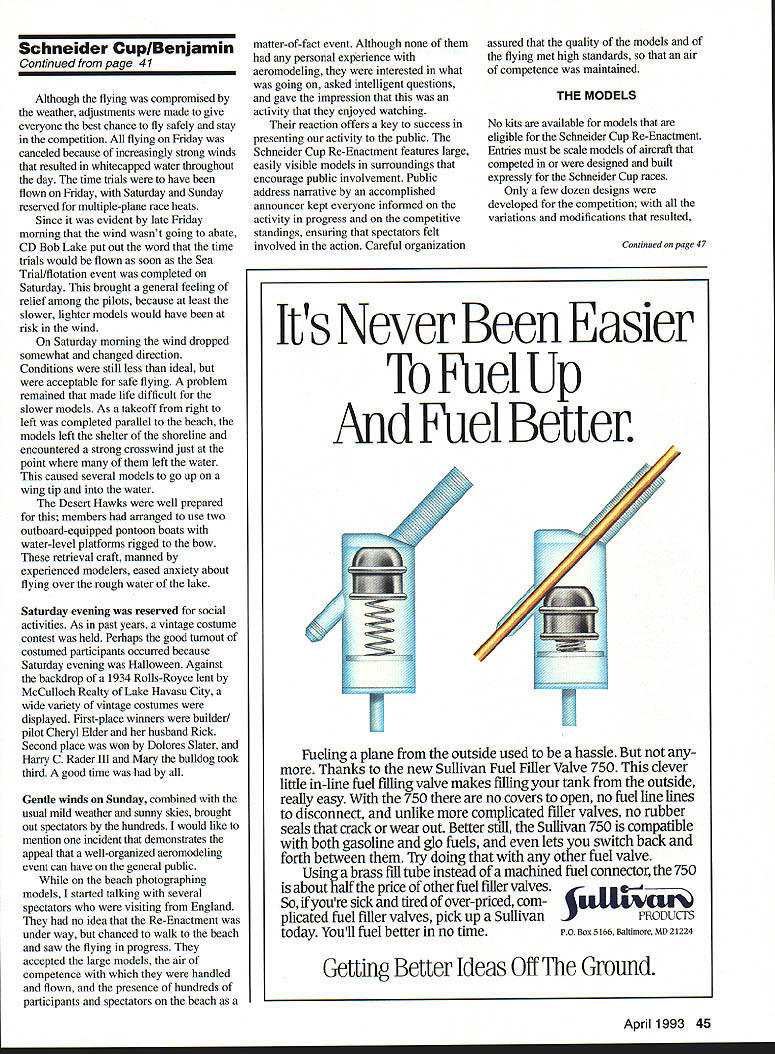
A classic argument in scale competition is that in windy conditions, heavy, fast models have an advantage over equally well-built, well-flown lightweights. A look at the final standings suggests the problem was largely overcome. First place went to Bill Curry's Supermarine S.4 with a score of 131.3. Second was the Skoglund/McClung Deperdussin with 125.0, and third was the big, fast, heavy Macchi 67 of Team America at 119.6.
Ian McInnes and Roy Slater, each flying a Sopwith Tabloid, finished fourth and fifth with scores of 118.6 and 117.7, respectively. In this case, the effort to produce an event that would interest nonmodelers also produced a situation that offered expert builders and practiced fliers the chance to compete on fair terms with a broad range of model types.
Although flying was compromised by weather, adjustments were made to give everyone the best chance to fly safely and stay in the competition. All flying on Friday was canceled because of increasingly strong winds that produced whitecapped water. The time trials were originally scheduled for Friday, with Saturday and Sunday reserved for multiple-plane race heats. By late Friday morning it was evident the wind would not abate, so Contest Director Bob Lake announced that the time trials would be flown as soon as the Sea Trial/floatation event was completed on Saturday. Pilots were relieved because this gave slower, lighter models a better chance.
On Saturday morning the wind dropped somewhat and changed direction. Conditions were still less than ideal, and a problem remained for the slower models: as takeoffs completed parallel to the beach, models left the shoreline shelter and encountered a strong crosswind where many left the water, causing several to tip and flip into the lake.
The Desert Hawks were prepared: members arranged two outboard-equipped pontoon boats with water-level platforms rigged to the bows. These retrieval craft, manned by experienced modelers, eased anxiety about flying over rough water.
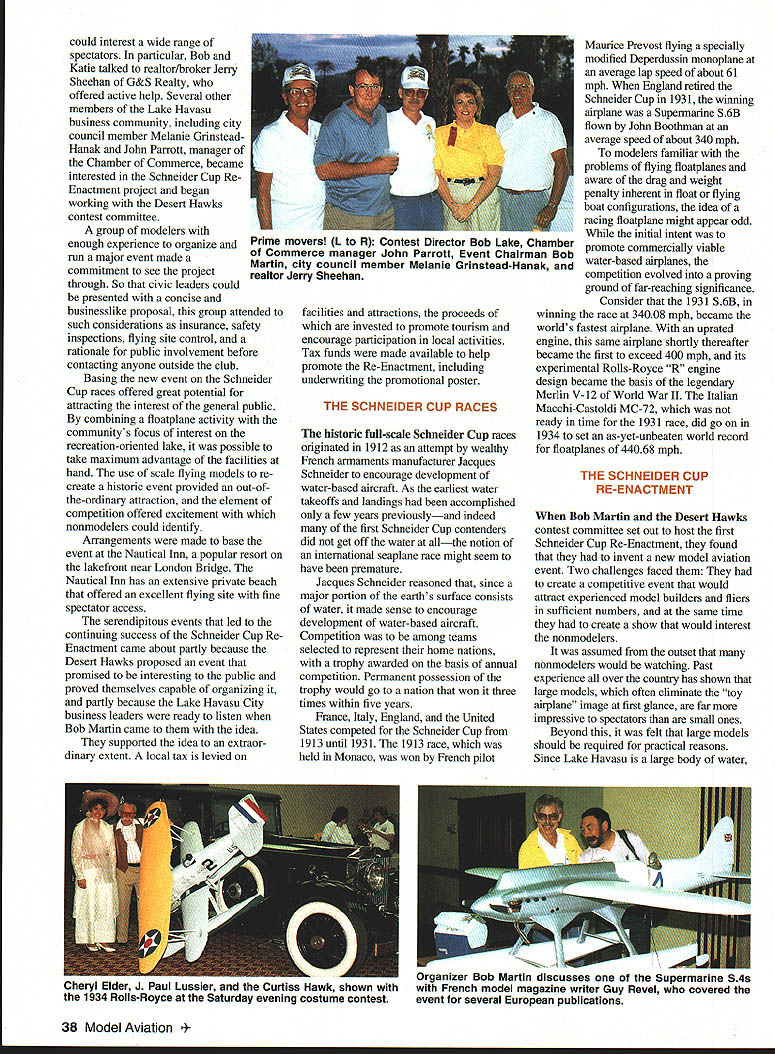
Saturday evening was reserved for social activities. As in past years, a vintage costume contest was held—perhaps aided by Saturday evening being Halloween. Against the backdrop of a 1934 Rolls-Royce lent by McCulloch Realty of Lake Havasu City, a wide variety of vintage costumes were displayed. First-place winners were builder/pilot Cheryl Elder and her husband Rick. Second place went to Dolores Slater, and Harry C. Rader III and Mary the bulldog took third.
Gentle winds on Sunday, with mild, sunny weather, brought out hundreds of spectators. One incident demonstrates the appeal of a well-organized aeromodeling event: while photographing models on the beach, the author spoke with several spectators visiting from England who had chanced upon the Re-Enactment. They had no prior experience with aeromodeling but accepted the large models, the competence of the pilots, and the presence of hundreds of participants and spectators as a matter-of-fact event. They asked intelligent questions and gave the impression they enjoyed watching.
Their reaction highlights key elements of success: large, easily visible models in surroundings that encourage public involvement; public-address narrative by an accomplished announcer to inform spectators and keep them involved; and careful organization to assure high quality of models and flying, maintaining an air of competence.
THE MODELS
No kits are available for models eligible for the Schneider Cup Re-Enactment. Entries must be scale models of aircraft that competed in or were designed and built expressly for the Schneider Cup races. Only a few original designs were developed specifically for the competition; with variations and modifications included, approximately 90 specific airplanes are eligible as scale subjects. Most are obscure—often built as single examples or in very small numbers. Military counterparts of a few were produced, but none were active service aircraft or had commercial applications.
Because data on Schneider Cup racers can be scarce, showing up at Lake Havasu with a competition-ready model represents considerable effort and dedication. These airplanes are among the most interesting a modeler is likely to encounter, which helps justify the work they represent.
Seventeen airplanes were registered to compete in the 1992 Re-Enactment. Several more eligible models appeared in the Nautical Inn Convention Center on registration and static-judging day but were not entered—likely incomplete or insufficiently tested to fly in competition.
In addition to the Schneider Cup aircraft, several scale models of more recent vintage participated in the Giant Scale Float-Fly, included by the contest committee to encourage greater participation. These models were given opportunities to fly during breaks between official race heats.
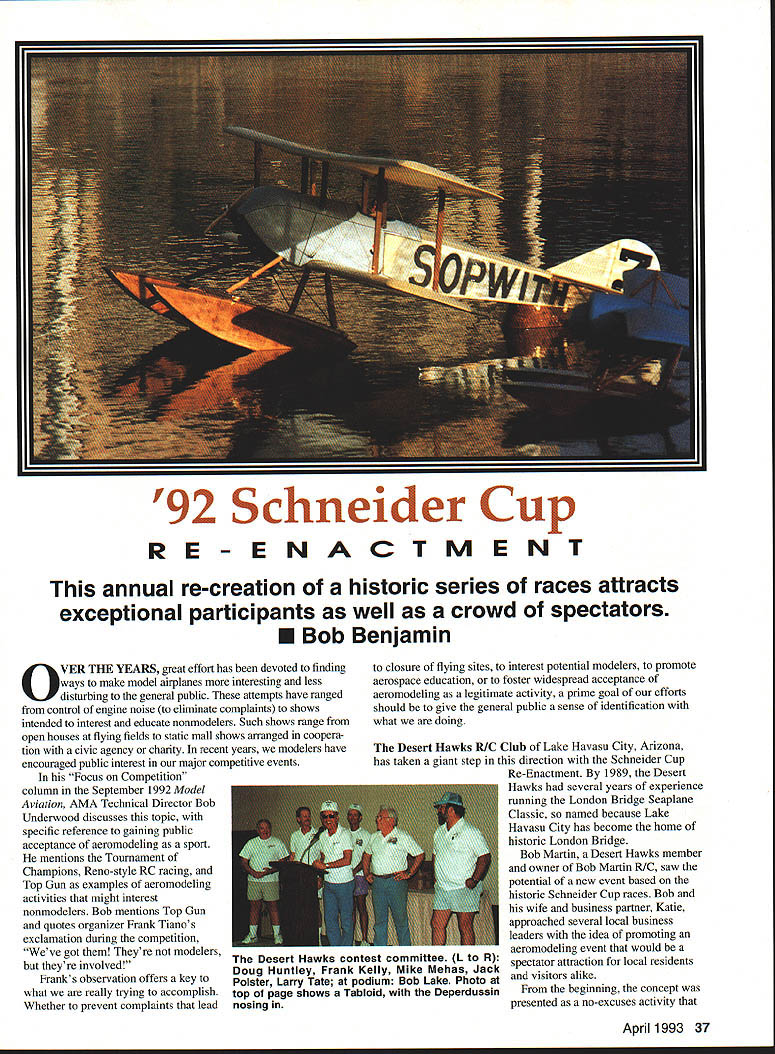
The most successful design at the 1992 Re-Enactment was the Supermarine S.4—three were registered and flown. Bill Curry's first-place S.4 was built concurrently with that of flying partner Don Panek (who placed lower). Don drew plans around a set of fiberglass float and fuselage shells sold by R/C City; these models use foam wing cores with balsa structure and fiberglass/resin skin reinforcement. Bill indicated he used carbon fiber throughout his airplane. These S.4s are built to 1/4 scale; both span 92 inches and weigh 27 pounds. Bill's airplane uses a Saito 300 four-stroke; Don's uses a Saito 270.
The third S.4 was built by Ian McInnes, who drew plans based on original Supermarine factory drawings to supplement fiberglass float and fuselage shells from molds made by competitor Roy Slater; R/C City subsequently used these molds to produce commercial parts. Ian's model uses a Super Tigre 3000; it flew well, though Ian had power-system problems in the first round and chose to concentrate on his other model, the Sopwith Tabloid, rather than troubleshoot the S.4.
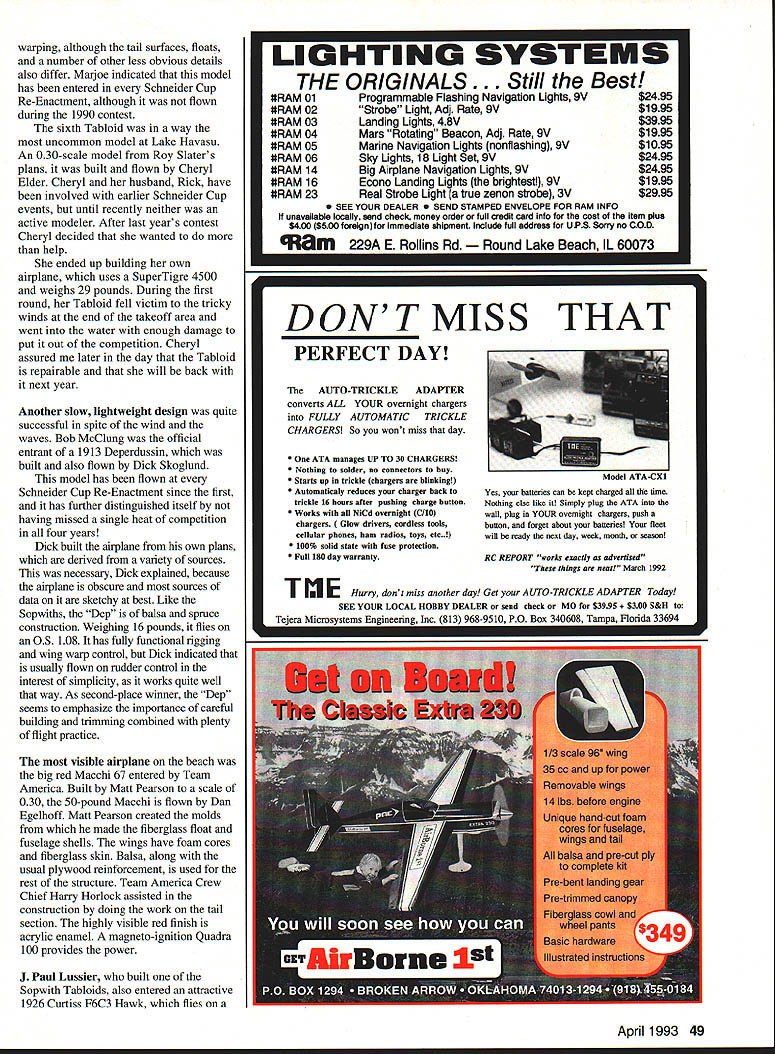
The Sopwith Tabloid was the most numerous design—six were registered to compete (a seventh, very large Tabloid appeared in the convention center but was not registered). Ian McInnes also entered a Tabloid: at 0.27 scale it was the smallest at the Re-Enactment. Ian drew his own plans from factory drawings and incorporated full-scale structure throughout, including fully functional rigging and wing-warp control. Constructed primarily of balsa and spruce, his Tabloid flies on a Super Tigre 3000 and weighs 21 pounds.
Fifth-place winner Roy Slater built his Tabloid to 0.30 scale from his own plans (available commercially). Roy uses a Zenoah G-38 in his 30-pound model. J. Paul Lussier entered a larger 0.33-scale Tabloid (48 pounds) powered by a Quadra 82, but it did not complete a full schedule of flights. A variant on the Tabloid—the 0.33-scale 1915–1916 modified Tabloid or Schneider Baby—was entered by Marjorie Bunney. The most obvious change from the 1914 version is the addition of ailerons in place of wing warping; tail surfaces, floats, and other details also differ. Marjorie indicated this model has been entered in every Schneider Cup Re-Enactment, although it was not flown during the 1990 contest.
The sixth Tabloid was in a way the most uncommon: a 0.30-scale model of Roy Slater's plans built and flown by Cheryl Elder. Cheryl and her husband Rick had been involved with earlier Schneider Cup events, but until recently neither was an active modeler. After last year's contest Cheryl decided she wanted to do more than help and ended up building her own airplane, which uses a Super Tigre 4500 and weighs 29 pounds. During the first round her Tabloid fell victim to the tricky winds at the end of the takeoff area and went into the water with enough damage to put it out of the competition; Cheryl later assured that the Tabloid is repairable and she will be back next year.
Another slow, lightweight design performed well despite wind and waves: the 1913 Deperdussin entered by Bob McClung and built and flown by Dick Skoglund. This model has been flown at every Schneider Cup Re-Enactment since the first and has not missed a single heat in all four years. Dick built the airplane from his own plans, derived from a variety of sketchy sources because the subject is obscure. Constructed of balsa and spruce, it weighs 16 pounds and flies on an O.S. 108. It has fully functional rigging and wing warps but is usually flown on rudder control in the interest of simplicity. As a second-place winner, the Deperdussin emphasizes the importance of careful building, trimming, and plenty of practice.
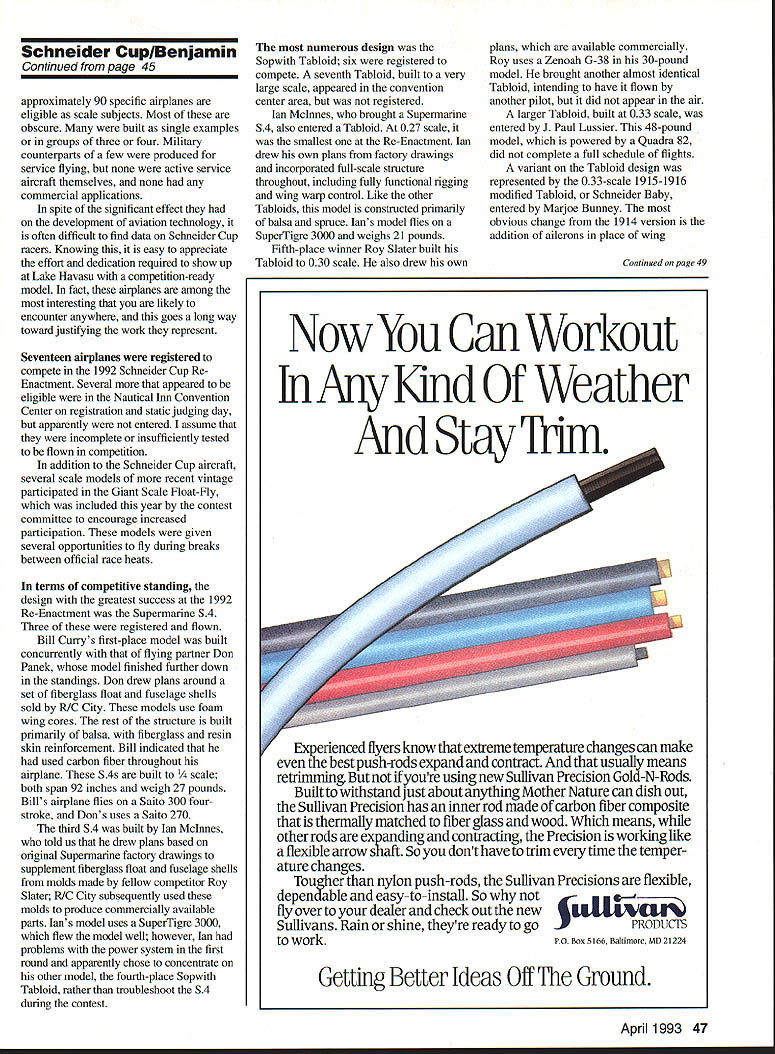
The most visible airplane on the beach was the big red Macchi 67 entered by Team America. Built by Matt Pearson to a scale of 0.30, the 50-pound Macchi is flown by Dan Eggehoff. Matt created the mold from which he made the fiberglass float and fuselage shells; the wings have foam cores and fiberglass skins, with balsa and plywood reinforcement for the rest of the structure. Team captain Dick Harry Horlock assisted in tail-section work. The red finish is acrylic enamel, and a magneto-ignition Quadra 100 provides power.
J. Paul Lussier, who built one of the Sopwith Tabloids, also entered an attractive 1926 Curtiss F6C3 Hawk.
THOUGHTS FOR THE FUTURE
It appears the Desert Hawks have hit upon a successful formula for mixing aeromodeling with public involvement. Even though circumstances reduced activity at the 1992 Re-Enactment, the cooperation demonstrated between the club and the business community provides an excellent example of what is possible.
Elements of success include:
- Designing an event that will interest an audience unfamiliar with the details of aeromodeling.
- Presenting a polished organizational package that leaves nothing to chance.
- Identifying a business or civic entity with a need for the kind of event well-organized model airplane clubs can provide.
One vivid impression many weeks after returning home: on Friday afternoon of the Re-Enactment weekend, after high winds had shut down flying, the author accompanied Bob Martin on errands around town. On half a dozen occasions Bob encountered local businesspeople who inquired about the event's success with obvious interest—never a hint of condescension about model airplane activities. Local interest was genuine; modelers were made to feel welcome and appreciated. That, the author suggests, is the true standard of success for this event.
Planning is already under way for the 1993 Schneider Cup Re-Enactment. Your interest will help make it even better, and the contest committee would like to hear from you.
For information on future plans or on availability of scale drawings, plans, or aircraft components, write to Schneider Cup Association, Attn.: Bob Martin, 1520-B Corona Drive, Lake Havasu City, AZ 86403.
Transcribed from original scans by AI. Minor OCR errors may remain.

