
'92 Tournament of Champions
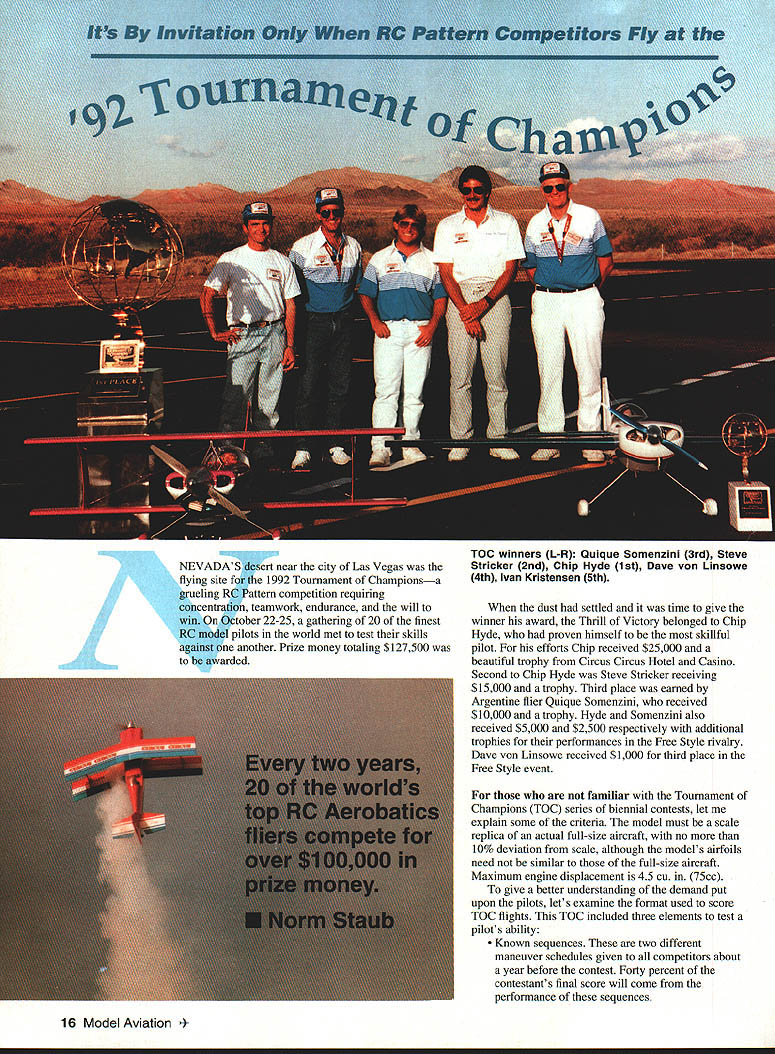
NEVADA's desert near Las Vegas was the flying site for the 1992 Tournament of Champions (TOC), held October 22–25. Twenty of the world's finest R/C pattern pilots gathered to test their skills. Prize money totaling $127,500 was awarded.
Winners
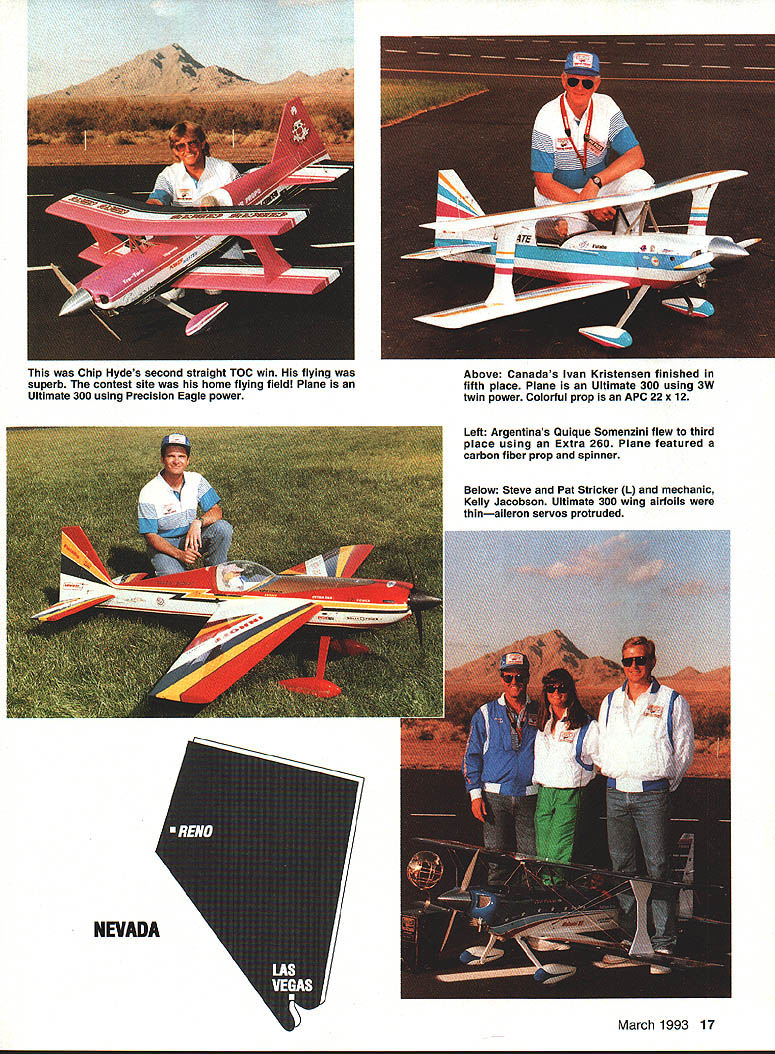
- Chip Hyde (U.S.A.) — Thrill of Victory; $25,000 and a trophy from Circus Circus Hotel-Casino. Also received $5,000 and a trophy for winning Free Style.
- Steve Stricker (U.S.A.) — $15,000 and a trophy.
- Quique Somenzini (Argentina) — $10,000 and a trophy; also received $2,500 and a trophy for second place in Free Style.
- Dave von Linsowe received $1,000 for third place in the Free Style event.
TOC Format and Rules
Aircraft rules
- Model must be a scale replica of an actual full-size aircraft, with no more than 10% deviation from scale (airfoils need not match the full-size aircraft).
- Maximum engine displacement: 4.5 cu. in. (75 cc).
Scoring elements
The 1992 TOC score consisted of three elements:
- Known sequences — Two different maneuver schedules given to all competitors about a year before the contest. Accounts for 40% of the final score.
- Unknown sequences — Given the evening before flying with no practice in the air. Five finalists flew two completely different Unknown schedules during the finals. Accounts for 40% of the final score.
- Free Style — Original three-minute routine, accounting for the remaining 20% of the final score. Most competitors used aircraft smoke and music over the PA to enhance presentations.
Qualifying format
- Known sequences: flown twice; the highest score counted.
- Unknown sequences: flown three times; the best score counted.
- Free Style: two performances; best score counted.
One qualifying day was lost to rain, reducing flight opportunities and tightening the battle for the final qualifying spot.
Contest Director
Steve Rojecki (Navarre, Florida) served as Contest Director. A commercial airline and former Air Force pilot, Rojecki was the first American to win the TOC (1984) and placed second in 1990. Major changes he made for 1992:
- Incorporated the three-minute Free Style into the total score (trophies and money still awarded to top three Free Style contestants).
- Removed the bonus score previously awarded for flying a biplane.
- Required Unknown sequences to be flown in qualifying rounds.
The consensus among pilots was that Rojecki did a fine job running the event.
Evolution and Pilot Preparation
This was the writer's third consecutive TOC. Pilot proficiency and state-of-the-art technology have advanced dramatically:
- Maneuvers such as rolling circles and one-roll rolling circles are now common in sequences.
- Nearly every competitor now has power to perform vertical snap rolls; horsepower and performance expectations have increased.
Preparation is intensive. As Steve Stricker noted, "There is more preparation than anyone would think. A good effort takes at least a year and a half."
Event Summary by Day
Day One (Thursday)
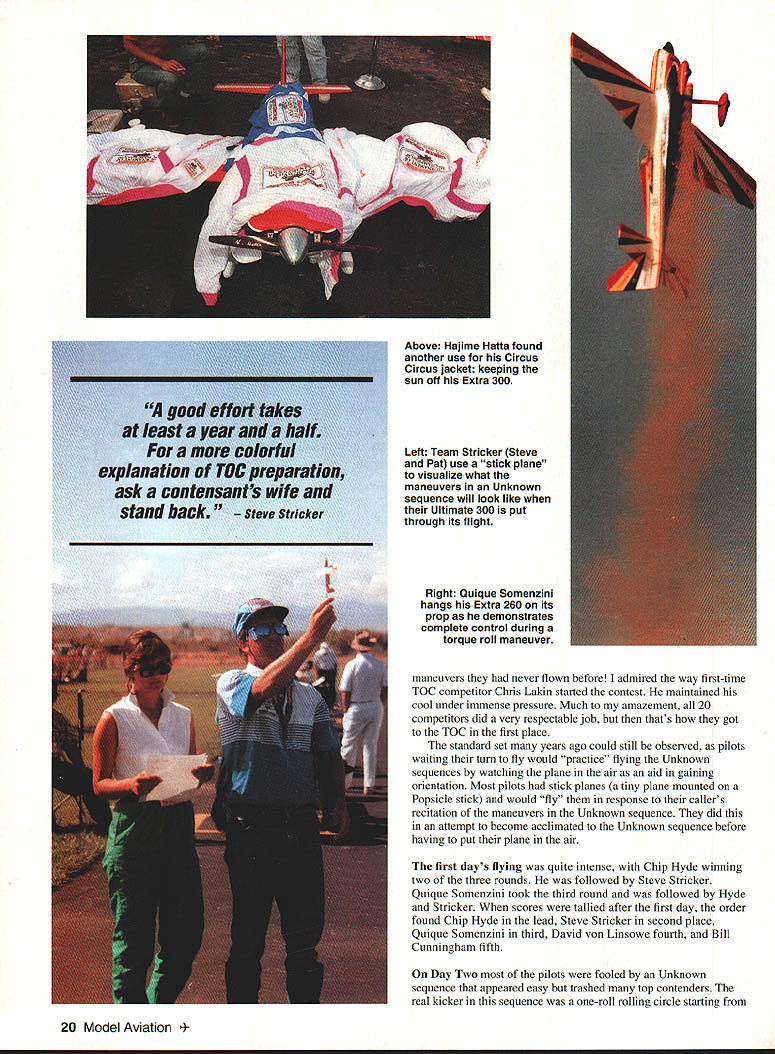
- Weather started uncertain but warmed to 75° and sunny by noon. Rojecki opened the contest with an Unknown sequence first, putting first-time TOC competitors under immediate pressure. All 20 competitors performed respectably.
- Pilots often rehearsed Unknown sequences on the ground by "flying" stick-plane models while listening to the caller.
- Day One results: Chip Hyde led, followed by Steve Stricker, Quique Somenzini, David von Linsowe, and Bill Cunningham.
Day Two (Friday)
- An Unknown sequence that appeared easy caused many zeros; a one-roll rolling circle inverted was especially troublesome.
- Ivan Kristensen won that Unknown sequence, strengthening his bid for the finals. The fifth final spot remained competitive among Ivan Kristensen, Bill Cunningham, Giichi Naruke, and Greg Marsden.
- Free Style (first flown on Day Two) proved the crowd favorite. Free Style top five: Quique Somenzini (winner), David von Linsowe, Chip Hyde, Steve Stricker, Ivan Kristensen.
Day Three (Saturday)
- Rain, thunder, and lightning delayed flying until about noon. Only a few pilots flew before the day was lost, eliminating some pilots’ chances to make the finals (notably Bill Cunningham).
Finals (Sunday)
- Qualifiers (order going into finals): Chip Hyde, Quique Somenzini, David von Linsowe, Steve Stricker, Ivan Kristensen. All previous scores were discarded for the finals.
- Finals format: each finalist flew two Unknown sequences, two Known sequences, and two Free Style sequences; the best score in each category counted.
- In a tense final Unknown sequence, Steve Stricker scored a zero on one maneuver and Chip Hyde delivered an outstanding Unknown flight plus an excellent final Free Style, securing both the TOC title and the Free Style win.
- Final TOC order: 1) Chip Hyde, 2) Steve Stricker, 3) Quique Somenzini, 4) David von Linsowe, 5) Ivan Kristensen.
Final Standings (top 10)
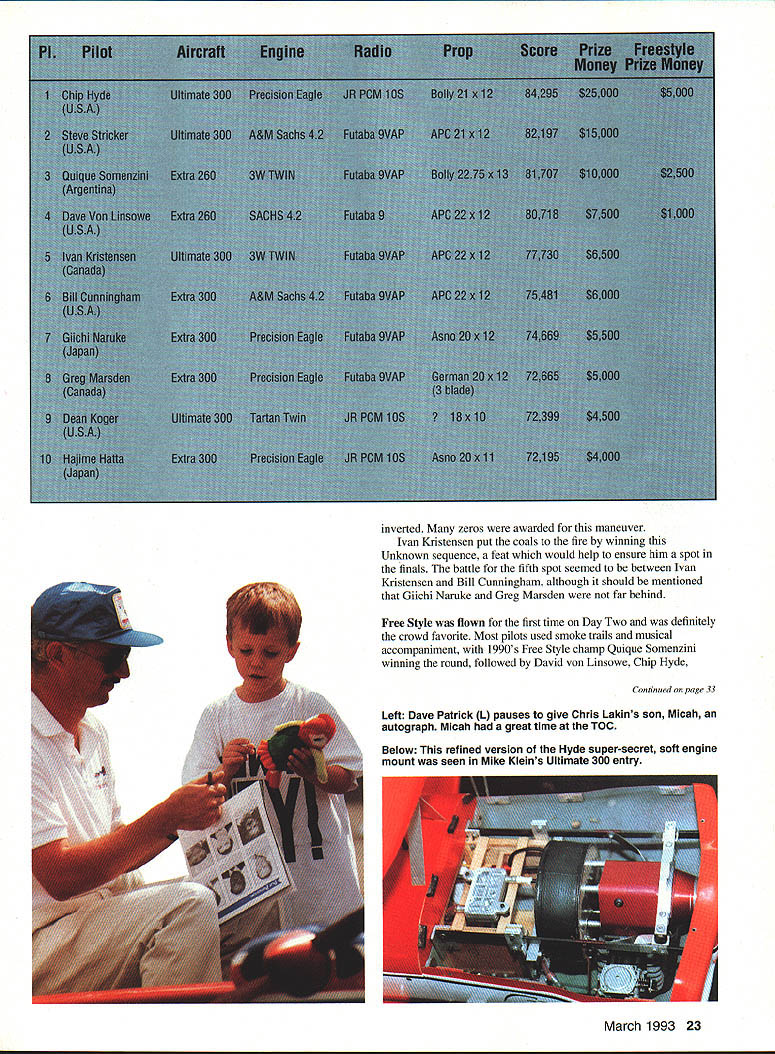
- Chip Hyde (U.S.A.) — Aircraft: Ultimate 300; Engine: Precision Eagle; Radio: JR PCM 10S; Prop: Bolly 21×12; Score: 84.295; Prize: $25,000; Free Style prize: $5,000
- Steve Stricker (U.S.A.) — Aircraft: Ultimate 300; Engine: A&M Sachs 4.2; Radio: Futaba 9VAP; Prop: APC 21×12; Score: 82.197; Prize: $15,000
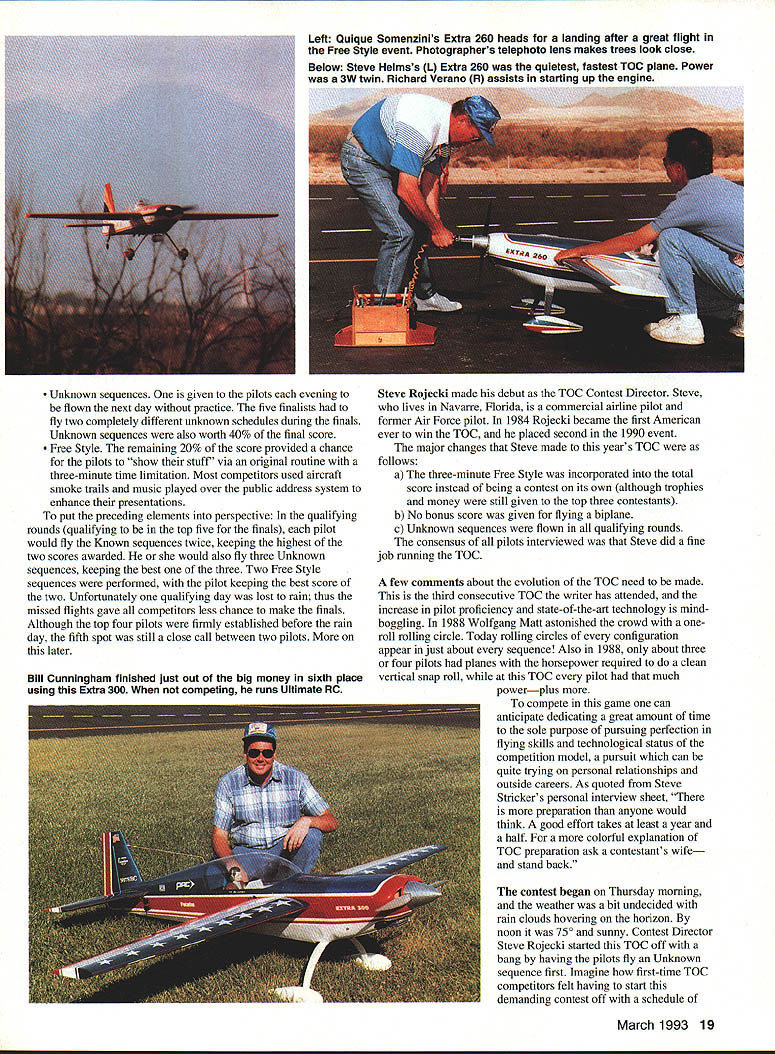
- Quique Somenzini (Argentina) — Aircraft: Extra 260; Engine: 3W Twin; Radio: Futaba 9VAP; Prop: Bolly 22.75×13; Score: 81.707; Prize: $10,000; Free Style prize: $2,500
- Dave von Linsowe (U.S.A.) — Aircraft: Extra 260; Engine: SACHS 4.2; Radio: Futaba 9; Prop: APC 22×12; Score: 80.718; Prize: $7,500; Free Style prize: $1,000
- Ivan Kristensen (Canada) — Aircraft: Ultimate 300; Engine: 3W Twin; Radio: Futaba 9VAP; Prop: APC 22×12; Score: 77.730; Prize: $6,500
- Bill Cunningham (U.S.A.) — Aircraft: Extra 300; Engine: A&M Sachs 4.2; Radio: Futaba 9VAP; Prop: APC 22×12; Score: 75.481; Prize: $6,000
- Giichi Naruke (Japan) — Aircraft: Extra 300; Engine: Precision Eagle; Radio: Futaba 9VAP; Prop: Asno 20×12; Score: 74.669; Prize: $5,500
- Greg Marsden (Canada) — Aircraft: Extra 300; Engine: Precision Eagle; Radio: Futaba 9VAP; Prop: German 20×12 (3-blade); Score: 72.665; Prize: $5,000
- Dean Koger (U.S.A.) — Aircraft: Ultimate 300; Engine: Tartan Twin; Radio: JR PCM 10S; Prop: 18×10; Score: 72.399; Prize: $4,500
- Hajime Hatta (Japan) — Aircraft: Extra 300; Engine: Precision Eagle; Radio: JR PCM 10S; Prop: Asno 20×11; Score: 72.195; Prize: $4,000
Free Style Judging and Controversy
Free Style was judged in four categories:
- Originality
- Versatility
- Harmony and Rhythm
- Execution
Many participants and spectators felt Free Style scoring was too subjective. Examples cited included Yoichiro Akiba, who performed an excellent routine in prelims but placed 18th, and observations that use of smoke systems influenced scores (e.g., Steve Stricker might have scored higher with smoke). Because of this subjectivity, some advocated reducing Free Style's weight in the total score or reverting Free Style to a separate contest.
Presentation and Thanks
Bill Bennett, Chairman of the Board of Circus Circus Enterprises, accompanied by Miss TOC Debbie Ellis, presented trophies and checks to prize winners. The TOC's success is credited largely to Circus Circus Enterprises and Bill Bennett's personal support. The TOC remains the pinnacle of R/C aerobatics competition and the hobby owes thanks to its sponsors.
Transcribed from original scans by AI. Minor OCR errors may remain.

