
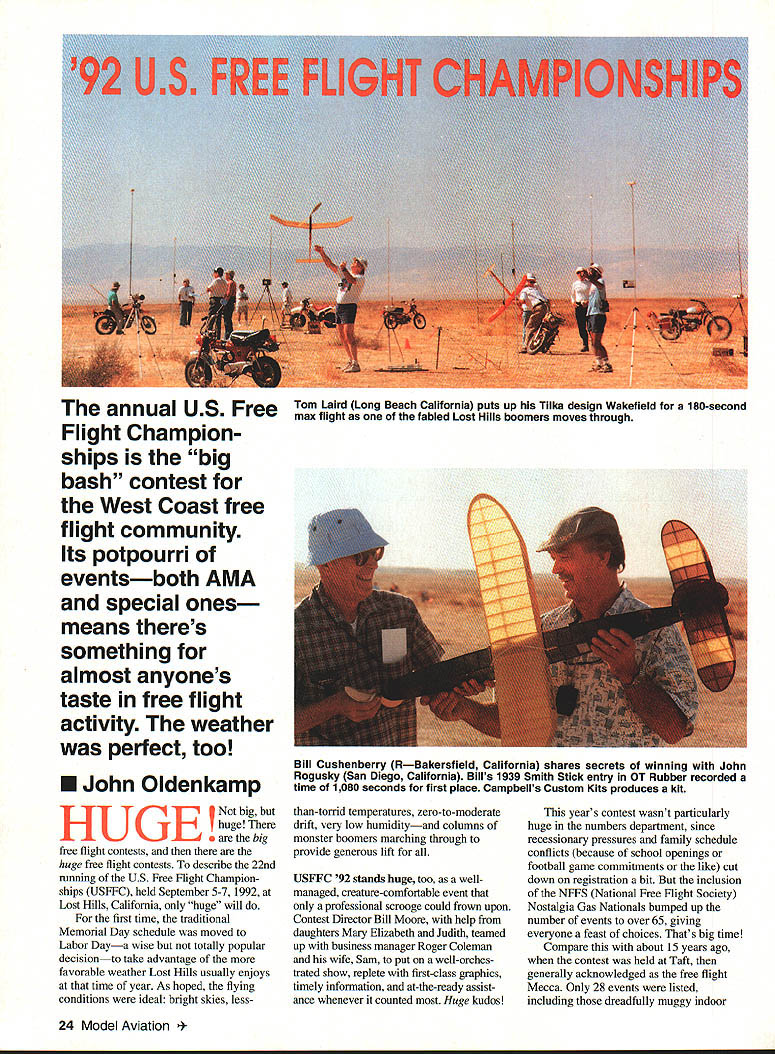
'92 U.S. FREE FLIGHT CHAMPIONSHIPS
John Oldenkamp
The annual U.S. Free Flight Championships is the "big bash" contest for the West Coast free flight community. Its potpourri of events—both AMA and special ones—means there's something for almost anyone's taste in free flight activity. The weather was perfect, too!
Huge — Not big, but huge!
To describe the 22nd running of the U.S. Free Flight Championships (USFFC), held September 5–7, 1992, at Lost Hills, California, only "huge" will do.
For the first time, the traditional Memorial Day schedule was moved to Labor Day—a wise but not totally popular decision—to take advantage of the more favorable weather that Lost Hills usually enjoys at that time of year. As hoped, the flying conditions were ideal: bright skies, less-than-torrid temperatures, zero-to-moderate drift, very low humidity—and columns of monster boomers marching through to provide generous lift for all.
USFFC '92 stood out as a well-managed, creature-comfortable event that only a professional scrooge could frown upon. Contest Director Bill Moore, with help from his daughters Mary Elizabeth and Judith, teamed up with business manager Roger Coleman and his wife Sam to put on a well-orchestrated show, replete with first-class graphics, timely information, and at-the-ready assistance whenever it counted most. Huge kudos!
This year's contest wasn't particularly huge in the numbers department, since recessionary pressures and family schedule conflicts (because of school openings or football game commitments or the like) cut down on registration a bit. But the inclusion of the NFFS (National Free Flight Society) Nostalgia Gas Nationals bumped up the number of events to over 65, giving everyone a feast of choices. That's big time!
Compare about 15 years ago, when the contest was held at Taft, then generally acknowledged as the free flight Mecca. Only 28 events were listed, including those dreadfully muggy indoor sessions at the local community college gymnasium. Those early USFFCs may be considered vintage today, but they can't match the dynamic, come-one-come-all diversity of the current offerings. Bigger may not be better, but most free flight diehards prefer the circus-type contest.
Many of us arrived on Thursday or early on Friday to shake off the freeway wobbles, set up house, do a little last-minute testing of new machinery, and acquaint or reacquaint ourselves with the open spaces of Lost Hills, which seem to inspire a sanguine, upbeat mood.
Lost Hills is fast becoming the premier outdoor FF site in the U.S., if not one of five or six such stellar fields worldwide. The site has matured steadily since its first general use in the 1988–89 season. Border monuments have been erected, and the access road has been graded and oiled with an environmentally acceptable mixture that cuts down on the dust drifting over us from auto traffic. A large, graded, and oiled parking area is planned, along with other improvements for spectator comfort, to accommodate the anticipated overloads at the October 1993 FAI Free Flight World Championships.
An added benefit this year was a carpet of assorted knee-high vegetation thanks to heavy late-spring rains. The vegetation, by then quite dry, was useful in keeping down those nasty dust cells that develop as the wind sporadically gusts in the late afternoon. Footing remained soft, however, so motorcycle-riding retrievers had to be alert for sandy spots—although airplanes got some protection from all but the terminal kinds of dive-ins. And—thanks a bunch—no bugs this time!
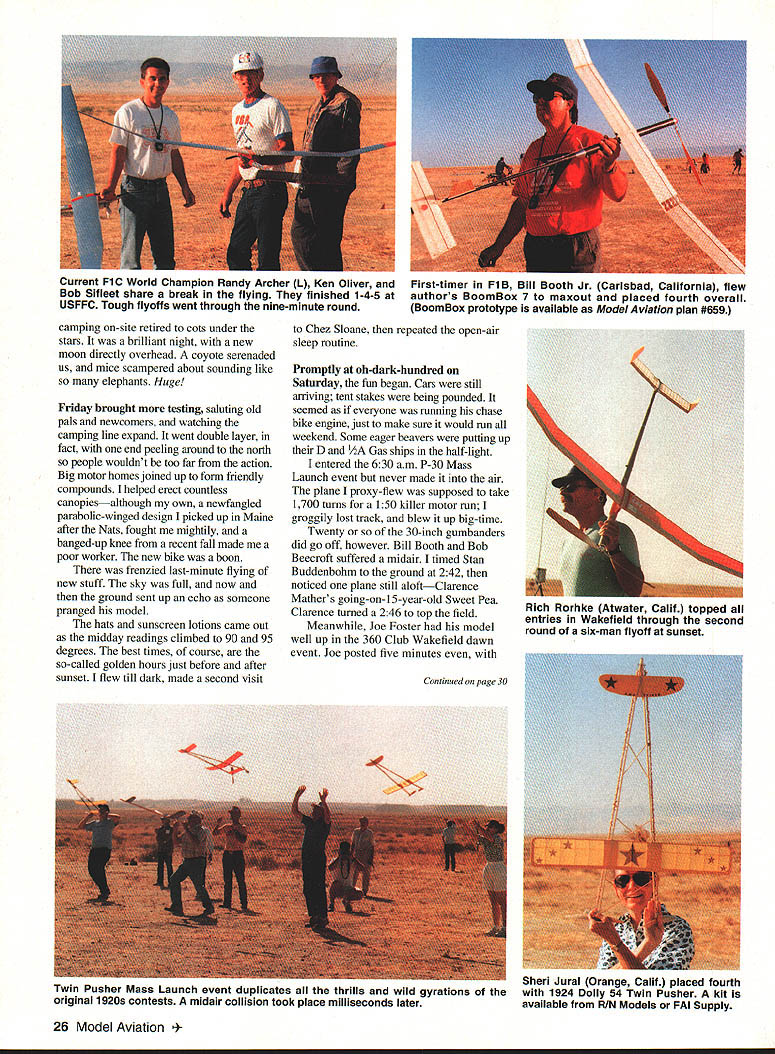
As we wound and flew and chased, sniffing out the whole of the playground as best we could, chef/caterer Jay Sloane and his family were hard at work creating a large field kitchen/restaurant with ample awnings, seating areas, and a "downtown" menu, much to the delight of us stranded gourmet types. The first dinner, for example, was a cooked-to-order sirloin, real mashed potatoes, pineapple and mango salad, green beans, and a roll—all for four bucks. Top that, Chez Denni! Nice treat after a day in the sun, many miles on the motorcycle, and the inevitable ache or two.
Many people camping on-site retired to cots under the stars. It was a brilliant night, with a new moon directly overhead. A coyote serenaded us, and mice scampered about sounding like so many elephants. Huge!
Friday brought more testing, saluting old pals and newcomers, and watching the camping line expand. It went double layer, in fact, with one end peeling around to the north so people wouldn't be too far from the action. Big motor homes joined up to form friendly compounds. I helped erect countless canopies—although my own, a newfangled parabolic-winged design I picked up in Maine after the Nats, fought me mightily, and a banged-up knee from a recent fall made me a poor worker. The new bike was a boon.
There was frenzied last-minute flying of new stuff. The sky was full, and now and then the ground sent up an echo as someone pranged his model.
The hats and sunscreen lotions came out as the midday readings climbed to 90 and 95 degrees. The best times, of course, are the so-called golden hours just before and after sunset. I flew till dark, made a second visit to Chez Sloane, then repeated the open-air sleep routine.
Promptly at oh-dark-hundred on Saturday, the fun began. Cars were still arriving; tent stakes were being pounded. It seemed as if everyone was running his chase-bike engine, just to make sure it would run all weekend. Some eager beavers were putting up their D and 1/2A Gas ships in the half-light.
I entered the 6:30 a.m. P-30 Mass Launch event but never made it into the air. The plane I proxy-flew was supposed to take 1,700 turns for a 1:50 killer motor run; I groggily lost track, and blew it up big-time.
Twenty or so of the 30-inch gumbanders did go off, however. Bill Booth and Bob Beecroft suffered a midair. I timed Stan Buddenbohm to the ground at 2:42, then noticed one plane still aloft—Clarence Mather's going-on-15-year-old Sweet Pea. Clarence turned a 2:46 to top the field.
Meanwhile, Joe Foster had his model well up in the 360 Club Wakefield dawn event. Joe posted five minutes even, with Herb Sessums, Bob White, and T. Hatazawa following closely. A great way to jump-start one's FF adventure.
By midmorning, the Mulvihill crowd had finished their work for the day. Roger Gregory had a maxout-plus at 1,816 seconds.
The P-30 event also was under way. Joe Foster led a big entry, going through the six-minute flight to finish at 1,140 seconds.
The air conditions were absolutely super, albeit with a 10:00 a.m. lull that is fairly typical at Lost Hills. During these periods, thermals are abundant but generally quite small in diameter, and they're apt to peter out quickly. Even expert fliers can be fooled, finding themselves suddenly caught in a down-air disaster. Experienced (or lucky?) hands, like Terry Thorkildsen, use much self-discipline and patience to wait it out.
Terry won 1/2A Gas with a huge score of 2,786—nine maxes and then some. This exemplified Category I competition as defined in the rule book. Site, skill, and good timing all contribute, of course, but for the real enthusiast, it's benchmark performances like Terry's that are a joy to behold. More often than not, they inspire fliers to go home and immediately start cutting wood for the next go-around at Lost Hills.
I wrapped up the day by timing many flights for others (a good way to meet and greet the whole group), slugging down red Gatorade and some Buds from the stash, and resting under various canopies. I fueled the bike, repaired tatters in the F1Bs, participated in the golden-hours madness, and retired to my cot. The mice and kangaroo rats made it clear that the desert is their home, too!
Sunday and Monday brought even more spectacular weather. Opportunities for huge performances were almost boundless. Some fliers were up and about before dawn. It was quite cool, quite still.
Results and highlights
- Terry Kerger won the Sunrise Shoot-out one-flight Gas event with a strong 10:08.
- Clarence Mather, another early flier, had his lightweight, full-area Mulvihill wound to the breaking point and turned no less than a 12:33—certainly a record for the Lost Hills field.
- The 7:00 a.m. Wakefield rounds began with a heightened 3 1/2-minute maximum requirement. On Sunday perhaps 20 or so fliers easily made the time. Though some contestants dropped their rounds during the midmorning lull, six out of 22 maxed out to compete in the five- and seven-minute flyoff rounds.
- F1C Power devotees had a big day. World Champion Randy Archer, of Scottsdale, Arizona, came out on top after a grueling nine-minute final round.
Two national records were set—one in AMA Category I, the other in FAI—along with several near-misses. Doug Galbreath, flying in C Gas, used every trick in his extensive FF repertoire to string out 20 full maxes, shutting down at 100 minutes total (6,000 seconds). Think about it: Doug had to pick correct air 20 times, go for it, make long retrieves, then do it all over again. A cool, calculating, convincing performance.
On Monday Martyn Cowley, assisted by Tanya, did some true Labor Day work in upping his own 1991 USFFC record of 27:07 in F1H (A1 Towline Glider) to an exhausting 61:37. That's an incredible, possibly even intimidating, performance. It's doubtful that these two high marks could be achieved anywhere but at Lost Hills.
More hugeness: On top of his C Gas record, Doug Galbreath came close to Martyn Cowley's USFFC record time by taking D Gas with 11-plus maxes and a 57:19. Doug also got up early with the rest of us and went to third place in the Sunrise Shoot-out.
Not to be outgunned, our designated ironman, Bud Romak, entered enough rubber and power events to take home no less than six trophies. Great effort—and Bud obviously enjoyed every minute of it.
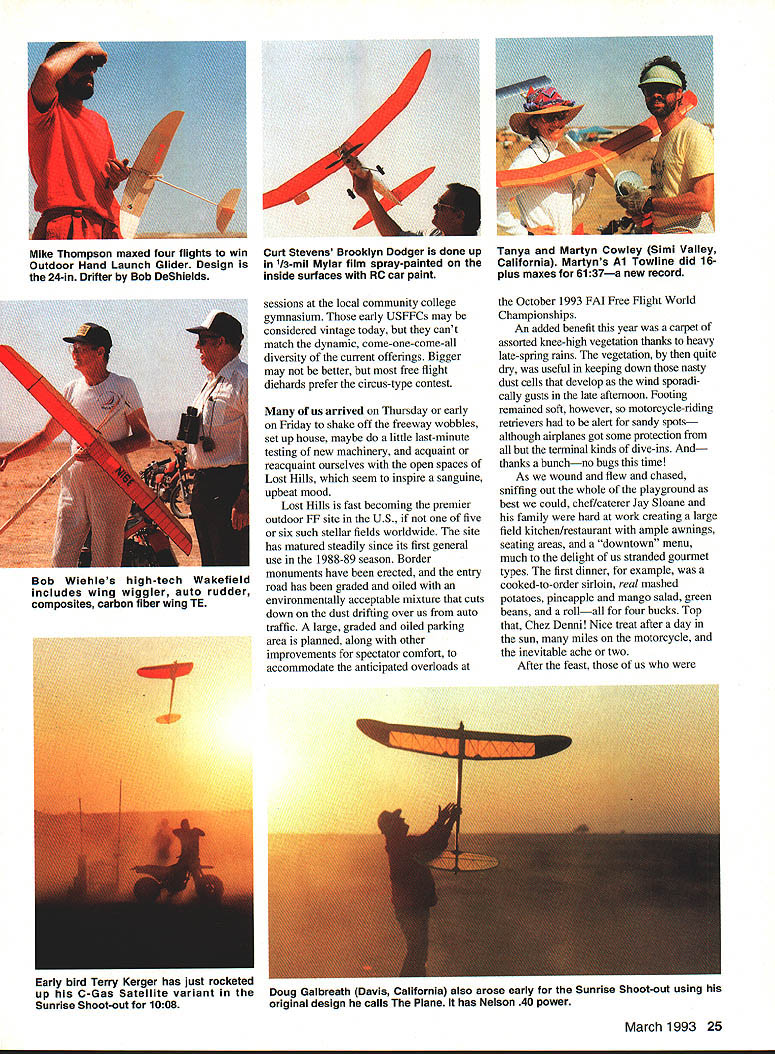
Clarence Mather, of Bishop, California, won both the P-30 and Mulvihill dawn events, then cruised to a first in Rubber Scale and a third in Mulvihill.
Besides his Sunrise Shoot-out win, Terry Kerger was up for 55 minutes with 11 maxes in A Gas. But he turned (only!) about 45 minutes in C Gas to finish second, behind Galbreath.
Septuagenarian Bob Wiehle took second in Wakefield, thus qualifying for the '92 FAI Team Selection finals, then went on to dominate the competition in Vintage Wakefield (1939–1950)—this despite a two-hour retrieve after his plane was carried away by the tail end of a robust dust devil.
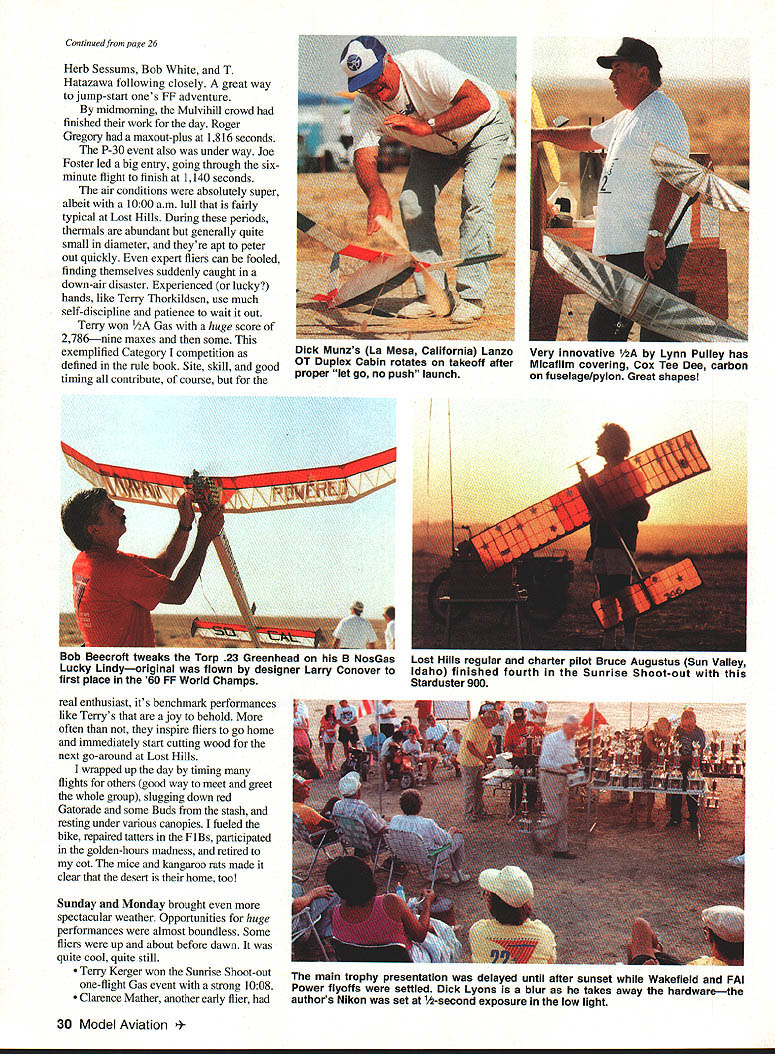
Terry Thorkildsen won the Individual Sweepstakes crown and shared the Team prize with Bob DeShields and Mike Thompson. Addie Naccarato was Women's High Time winner (B Electric). Philip Jensen was all over the place and justly earned the Junior trophy.
All of which leaves out another 196 or so folks who had an equally grand time, performed admirably, and once again reaffirmed, for us and for themselves, the joys and true value of free flight.
Build your airplane, get a bunch of people together on a nice day, and go for it! If you had your druthers, you'd make it happen at Lost Hills, certain to become known as the next free flight mecca.
I wish to give special thanks to CD Bill Moore for supplying timely data and remarks that were useful in filing this report. A big thanks, too, to the model aero clubs of southern California, who hosted the contest, and to the nice folks of Lost Hills, who are gradually but surely beginning to understand what "those airplane people" are all about. And to the nice minions, who are saving our space for next year.
But, hey! I want a bigger cot!
Transcribed from original scans by AI. Minor OCR errors may remain.

