
'92 WRAM SHOW
George M. Myers
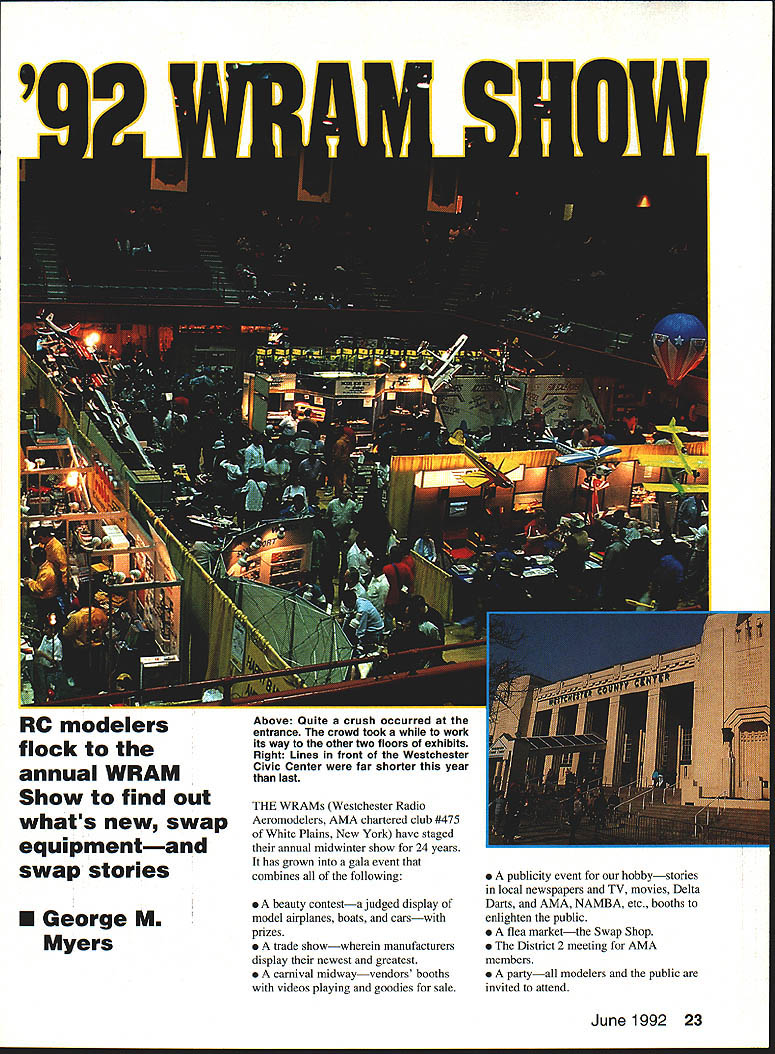
The WRAMs (Westchester Radio Aeromodelers, AMA chartered club #475 of White Plains, New York) have staged their annual midwinter show for 24 years. It has grown into a gala event that combines all of the following:
- A beauty contest — a judged display of model airplanes, boats, and cars — with prizes.
- A trade show — manufacturers display their newest products.
- A carnival midway — vendors' booths with videos playing and goodies for sale.
- A publicity event for the hobby — stories in local newspapers and TV, movies, Delta Darts, and AMA, NAMBA, etc., booths to enlighten the public.
- A flea market — the Swap Shop.
- The District 2 meeting for AMA members.
- A party — all modelers and the public are invited.
WRAMs members also vote to invite certain members of national FAI teams to visit and participate in the show. The food concessions are open and there are plenty of seats in the balcony. There are many opportunities to schmus (schmus, schmooze, or smooze — a New York word meaning "chatter, blarney, soft-soap," etc.).
"They do that much work just to get a flying site?" you ask. No; the purpose has always been to give aeromodelers a chance to get together in the middle of winter for good fellowship. Modelers show off their latest models, drool over the latest gadgets from the manufacturers, exchange used models and surplus equipment — and talk. In other words — a party!
You might feel inclined to thank some of the hosts: Jerry Judge, WRAM president; Hank Nielsen, publicity; Louis V. Scarlino, show manager; Allen Reinhardt, static competition; John Isbester, Swap Shop; Ed Alexis, tickets; and Fred Coleman, Secretary, 28 Park Circle, White Plains, NY 10603.
SO, WHAT'S NEW?
Each year the WRAMs honor a prominent modeler with the McEntee Medal. This year's recipient was Bill Winter, whose long career as a writer, modeler, and editor of model magazines made the selection an easy one. Bill couldn't attend, so the award was accepted for him by John Worth.
I didn't discover anything radically different, such as the introduction of PCM radios, but there are some new companies, products, and developments. Highlights, listed alphabetically:
- Ace R/C, Inc., Higginsville, Missouri: The improved Micropro 8000 transmitter now offers the long-awaited RS232 interface and either AM or FM operation, with coverage on 27, 50, 53, 72, or 75 MHz. There are eight channels, eight configurations stored inside the transmitter, and AM and FM are available using the universal PPM encoding scheme. List price is $395. The system brings the possibility of needing only one transmitter for many models closer: configurations can be created and stored on a computer (an XT-class laptop adequate for these tasks can be had for under $500), then uploaded to the transmitter. If you don't have or want a computer, the transmitter can still be programmed via the control sticks and the built-in screen.
- Whiz 40 (American-made complete kit): The kit provides everything needed to build the plane except glue, covering, engine, and radio. It includes about $75 (retail) of parts such as wheels, hinges, and pushrods. Die-cut parts tab together for perfect alignment. A 44-page primer and a 28-page step-by-step illustrated construction manual are included, making the kit suitable for first-time builders. The design emphasizes ease of construction, slow and stable flight, and economy. A float kit will be available. Retail cost is $109.
- Airtronics, Inc., Irvine, California: Developing the bean-shaped Infinity 1000 system, which uses the airplane's receiver as a scanning receiver to check for unused RC channels. Programming of many functions is done via a touch-screen on the transmitter face. The system records interference "hits" in flight and reports them on a computer screen after flight. The ATRCS-style feature set is large (described in a 150-page manual). Delivered in a carry case with new coreless-motor ball-bearing servos, the system offers selection from 50 synthesized 72 MHz "airplane-only" RC channels (about $1,600 version) or single-crystal operation (about $1,300 version). Airtronics also plans the Whisper sailplane in two-meter standard class (100-in. span) for electric power; all kit production has been brought to the Irvine plant. An Airtronics Specialty Division has been established at 11 Autry, Irvine, CA 92718. Note: Soaring Exchange is a related quarterly newsletter; Airtronics intends to service the sailplane market directly.
- Aristo-Craft / Polk's Model Craft Hobbies, Inc., Jersey City, New Jersey: Displayed a prototype of the Valiant system in a production plastic case. If it meets specifications and price targets, it should be competitive. The system features active channels, a 30-channel PLL synthesizer, PCM, uses the airplane receiver to scan for an empty channel, and supports four servos.
- Hitec R/C USA, Inc.: Reporting strong sales of mid-priced Hitec systems. Hitec notes that the rubber-duck antenna produces a much stronger signal off the end of the antenna than a conventional whip antenna and is less of a threat to other fliers; this may appeal to pylon racing pilots.
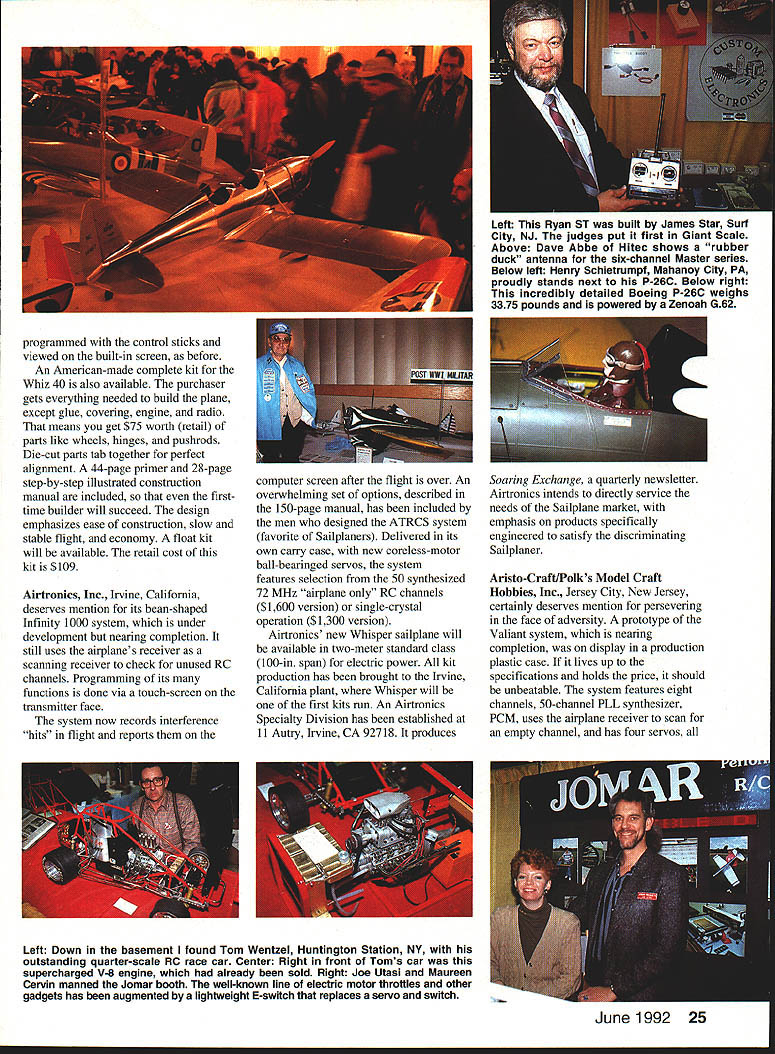
- Kress Jets, Saugerties, New York: Offers a light belt-drive system to power small, multi-engined models (novice-level application). Setups for Guillow's Models B-24, B-17, B-25, P-38, and PBY Catalina are offered. One Astro .035 (electric) or Cox Queen Bee .074 (glow) engine is required; for lightness, the glow engine is preferred. Kress also exhibited a B-24 (belt-drive power unit) and an A-10 Warthog scale model.
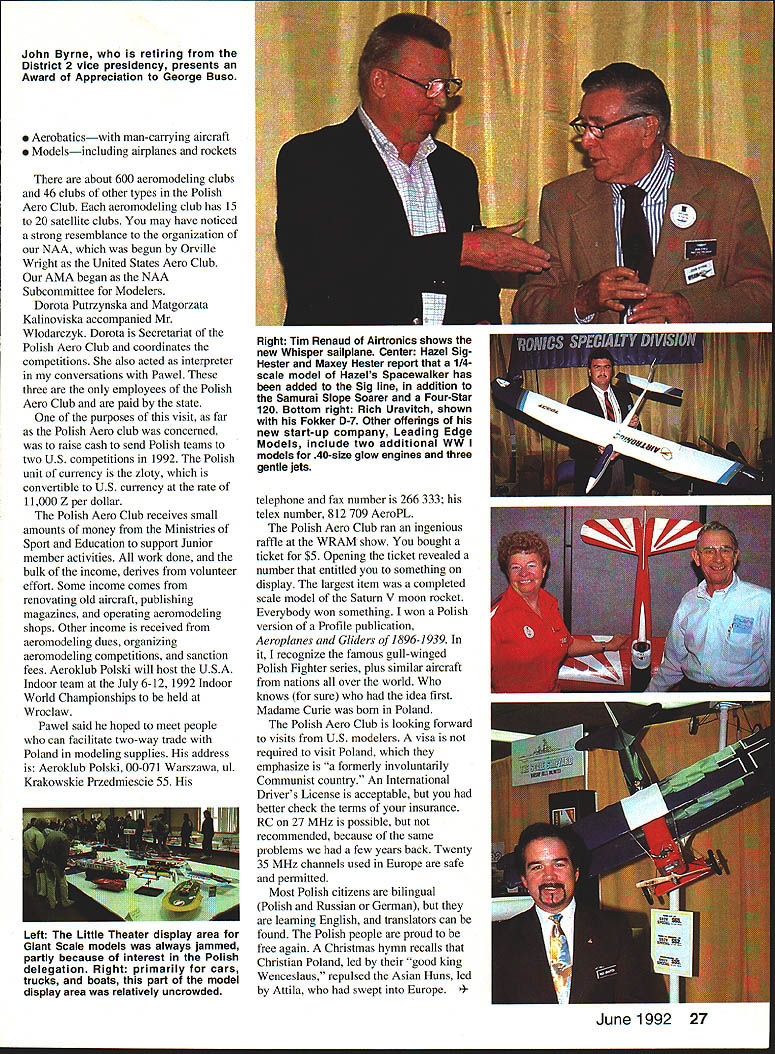
- Leading Edge Models, Central Islip, New York: Rich Uravitch's start-up company. First offerings include three WWI models for .40-size glow engines (Ziroli Eindecker, Morane-Saulnier, and Uravitch's Fokker D-7) and three gentle jets previously kitted by Sterner Engineering (F-80 Shooting Star, T-33 T-Bird, and LTV A-7 Corsair II).
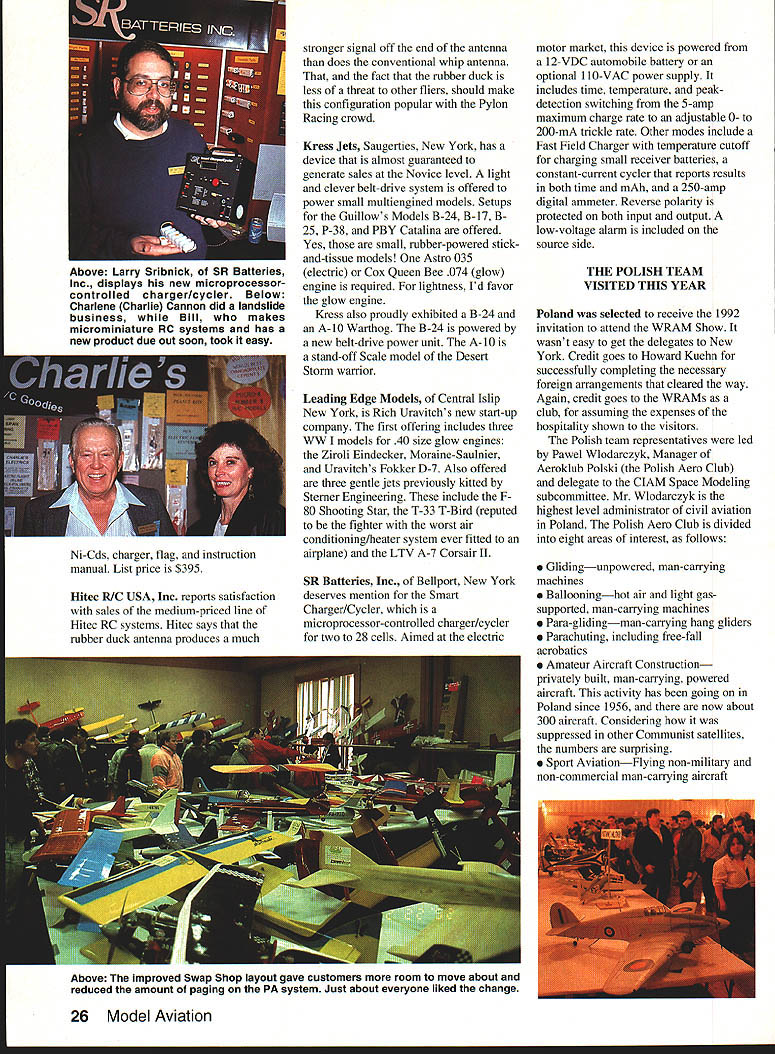
- SR Batteries, Inc., Bellport, New York: Introduced the Smart Charger/Cycler, a microprocessor-controlled unit for two to 28 cells, aimed at the electric motor market. Powered from a 12-VDC automobile battery or optional 110-VAC supply, it offers temperature and peak-detection switching from a 5-amp maximum charge rate to an adjustable 0–200 mA trickle rate. Modes include a Fast Field Charger with temperature cutoff for small receiver batteries, a constant-current cycler reporting results in time and mAh, and a 250-amp digital ammeter. Reverse polarity protection is included on both input and output, and a low-voltage alarm is provided on the source side.
THE POLISH TEAM VISITED THIS YEAR
Poland was selected to receive the 1992 invitation to attend the WRAM Show. Credit goes to Howard Kuehn for completing the necessary foreign arrangements, and to the WRAMs club for assuming the hospitality expenses.
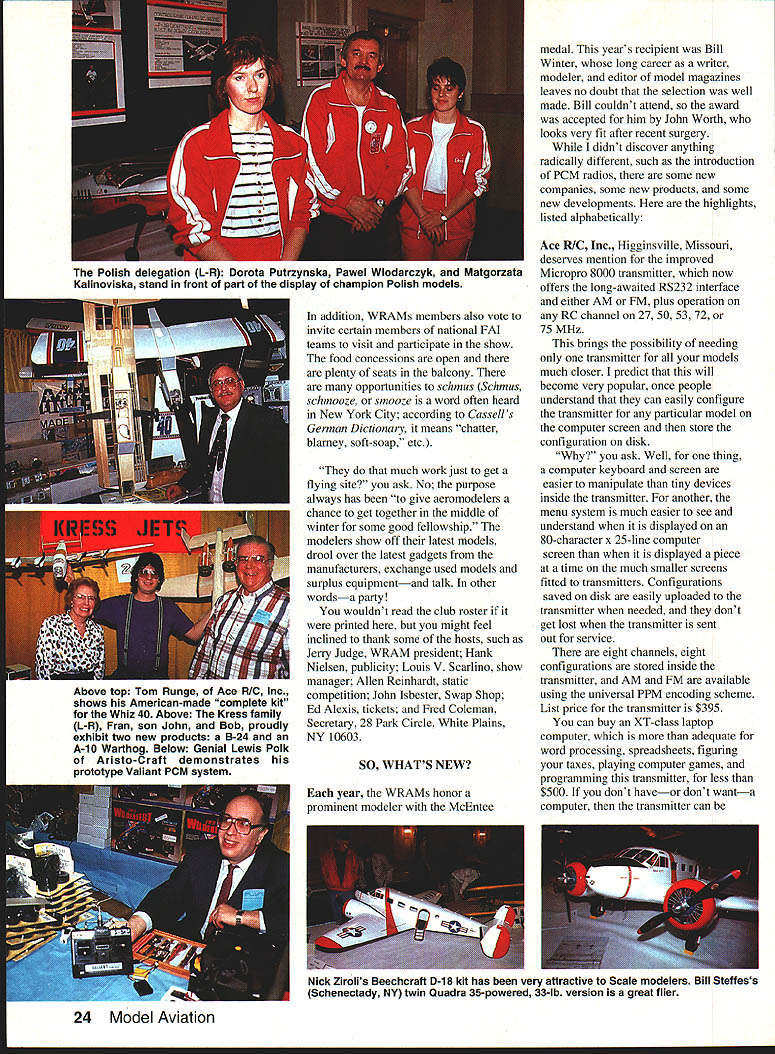
The Polish team was led by Pawel Wlodarczyk, Manager of Aeroklub Polski (the Polish Aero Club) and delegate to the CIAM Space Modeling subcommittee. Mr. Wlodarczyk is a high-level administrator of civil aviation in Poland. The Polish Aero Club is divided into the following areas of interest:
- Gliding — unpowered, man-carrying machines
- Ballooning — hot-air and light-gas-supported, man-carrying machines
- Paragliding — man-carrying hang gliders
- Parachuting — including free-fall acrobatics
- Amateur Aircraft Construction — privately built, man-carrying, powered aircraft (activity in Poland since 1956; about 300 aircraft)
- Sport Aviation — flying non-military and non-commercial man-carrying aircraft
There are about 600 aeromodeling clubs and 46 clubs of other types in the Polish Aero Club. Each aeromodeling club has 15 to 20 satellite clubs. The organization resembles the early structure of the NAA and the AMA.
Accompanying Mr. Wlodarczyk were Dorota Putrzynska and Matgorzata Kalinoviska. Dorota is Secretariat of the Polish Aero Club and coordinates competitions; she also acted as interpreter. These three are the only employees of the Polish Aero Club and are state-paid.
One purpose of the visit was to raise funds to send Polish teams to two U.S. competitions in 1992. The Polish unit of currency is the zloty, quoted here at 11,000 Z per U.S. dollar. The Polish Aero Club receives modest support from the Ministries of Sport and Education for junior activities; most work and income derive from volunteers. Other income sources include renovating old aircraft, publishing magazines, operating aeromodelling shops, dues, organizing competitions, and sanction fees. Aeroklub Polski will host the U.S.A. Indoor team at the July 6–12, 1992 Indoor World Championships in Wroclaw.
Pawel hoped to meet people who can facilitate two-way trade with Poland in modeling supplies. His address: Aeroklub Polski, 00-071 Warszawa, ul. Krakowskie Przedmiescie 55. Telephone/fax: 266 333. Telex: 812 709 AeroPL.
The Polish Aero Club ran an ingenious raffle at the WRAM Show: a $5 ticket revealed a number entitling the buyer to something on display. The largest item was a completed scale model of the Saturn V moon rocket. Everybody won something.
The Polish Aero Club welcomes visits from U.S. modelers. A visa was not required at the time; they describe Poland as "a formerly involuntarily Communist country." An International Driver's License is acceptable, though you should check insurance terms. RC on 27 MHz is possible but not recommended due to interference issues; the twenty 35 MHz channels used in Europe are permitted and safe. Most Polish citizens speak Polish plus Russian or German, and English is increasingly learned; translators are available. The Polish people are proud to be free again.
Transcribed from original scans by AI. Minor OCR errors may remain.

