
'93 WRAM Show
George M. Myers
WHAT'S NEW?
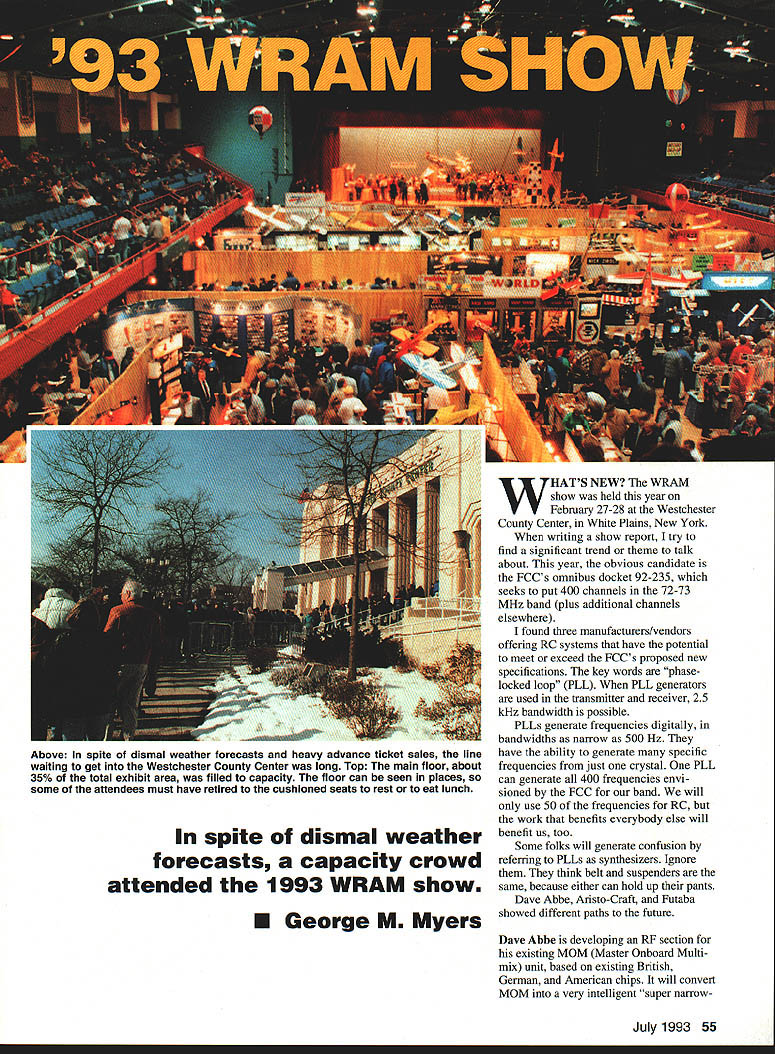
In spite of dismal weather forecasts, a capacity crowd attended the 1993 WRAM show, held February 27–28 at the Westchester County Center in White Plains, New York.
A clear theme at the show was the FCC omnibus docket 92-235, which proposes putting 400 channels in the 72–73 MHz band (plus additional channels elsewhere). I found three manufacturers/vendors showing RC systems that have the potential to meet or exceed the FCC's proposed new specifications. The key technology is the phase-locked loop (PLL). When PLL generators are used in both transmitter and receiver, a 2.5 kHz bandwidth is possible; PLLs can generate frequencies digitally in bandwidths as narrow as 500 Hz and can produce many specific frequencies from a single crystal. One PLL can generate all 400 frequencies envisioned by the FCC for the band.
Ignore anyone who carelessly calls PLLs "synthesizers" as if that were an insult. PLLs are the practical path forward.
Manufacturers and systems
- Dave Abbe / MOM
- Dave Abbe is developing an RF section for his existing MOM (Master Onboard Multimix) unit using widely available chips. The modification will turn MOM into a very intelligent, super-narrow-band receiver. The idea is that MOM can accept signals from a basic transmitter (no reversing switches, dual-rate switches, span adjustments, or mixers) and create the same tricks normally done by a full-feature transmitter.
- Dave has sold his interest; Hitec will build the new product for the American market. Given Abbe's record—bringing the narrow-band replacement 1991 Platinum receiver to market in time to meet a previous FCC change—one can anticipate he'll do it again. The modified MOM should provide an inexpensive upgrade path to the new band plan.
- Aristo‑Craft / Valiant
- Aristo‑Craft's Valiant is an inexpensive ($450) system with PLL RF sections and a full feature set in the transmitter. Lewis Polk and his company appear to have overcome the regulatory and engineering obstacles.
- A pre-production transmitter is under FCC examination, and production units may be available by the Toledo show, with dealers possibly stocking them in early summer. Initially the system will access the 50 RC channels now in use; later, if the FCC implements its proposals, Aristo‑Craft can replace the current 100-channel chip with a 400-channel chip.
- The Valiant's unique feature is that it uses the receiver in the airplane as a scanning receiver. Connected by cable, the transmitter will not radiate until the receiver finds an unused channel and can lock on it. You can then lock that open channel, unplug the airplane, and fly; or you can key an assigned channel, and the transmitter won't radiate until that channel is clear. This is a significant improvement over current systems. With such a system, my WACO wouldn't have been shot down.
- Futaba / FP-9HP
- Steve Helms of Futaba showed an all-digital, PLL, PCM FP-9HP system ($1,900) with channel-switchable PLL RF sections in both the plug-in transmitter module and the receiver. The same chip upgrades will be possible in the future. The system offers every feature expected of a top-end product and benefits from Futaba's service network and long servo heritage.
Show atmosphere and vendors
People seemed happy and relaxed at this WRAM show—an unusual mood for New York. The bombing of the World Trade Center didn't appear to worry attendees, and there was noticeably less pushing and shoving in the aisles, even late in the day.
A casual vendor survey indicated sales were good despite tough economic times and job concerns among hobbyists. I simply report what I observed.
WRAM volunteers
WRAM members get into the County Center a couple of days early to set up tables, drapes, partitions, electrical drops, and more for the exhibitors. During the three days of the show they direct traffic, operate security, answer questions, and keep everything running. After the show they reverse the process and tear everything down.
I saw about 20 WRAM members on the job at all times. On Sunday night I was helping a friend tear down his booth when I saw Jerry Judge, WRAM president, pushing carts full of pipes and cast-iron bases, rolling up drapery, and helping vendors move boxes out the door. The WRAMs get their way the old-fashioned way—they work for it.
Notable models and displays
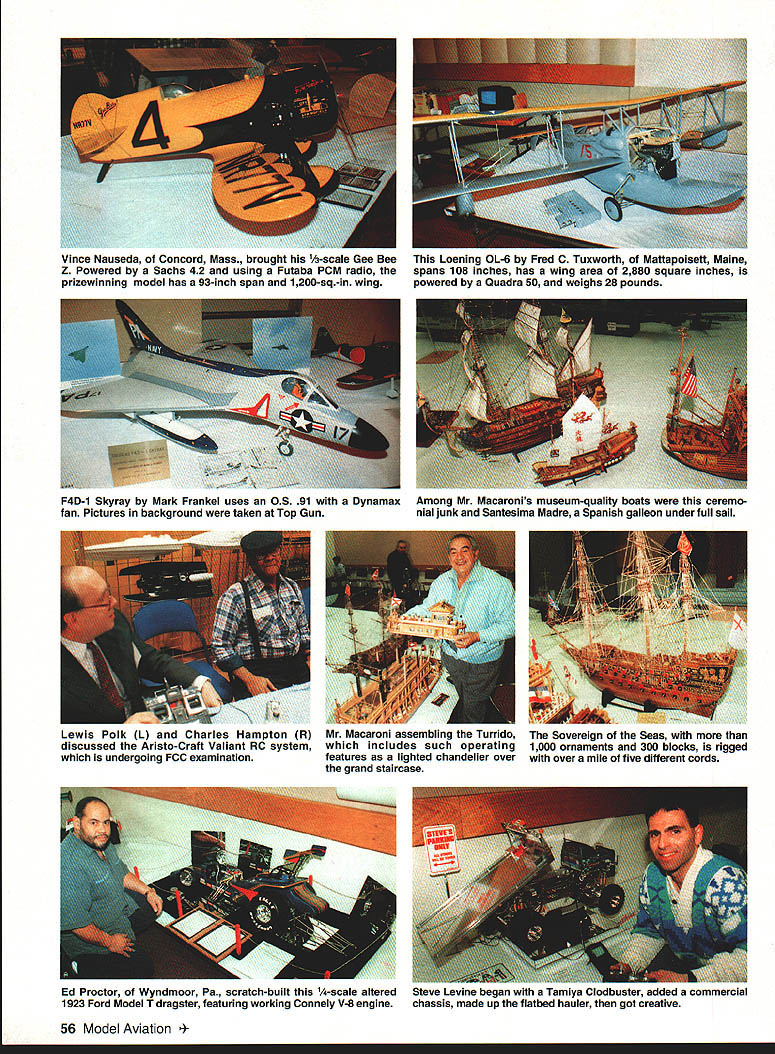
- Vince Nauseda — 1/3-scale Gee Bee Z
- 93-inch span, Sachs 4.2 engine, Futaba PCM radio, and scale, functioning shock absorbers.
- Fred C. Tuxworth — Loening OL-6
- 108-inch span, 2,880 sq. in. wing area, Quadra 50 power, 28-pound weight. Prizewinner.
- Mark Frankel — F4D-1 Skyray
- Powered by an O.S. .91 engine with a Dynamax fan.
- Mr. Macaroni (Queens, NY)
- Age 70, has been building model boats for "four or five years." Brought four award-winning boats, including the Mississippi riverboat Turrido (assembling when I arrived), Sovereign of the Seas (1/600-scale British naval warship), Santisima Madre (Spanish galleon), and a ceremonial junk with an on-board Shinto shrine. These are museum-quality, highly detailed models.
- Ed Proctor (Wyndmoor, PA)
- 1/4-scale altered 1923 Ford Model T dragster, scratch-built chrome-moly chassis, working Connely V-8 engine, Futaba PCM radio.
- Steve Levine
- Began with a Tamiya Clodbuster, added a commercial chassis and flatbed hauler, and added many features: radio-controlled throttle, steering, and braking; bed tilting and chain-haul; switches for lights, gull-wing doors, hood; and even a micro TV camera over the front bumper playing out to a miniature TV set on the display.
WHO CAME THIS YEAR?
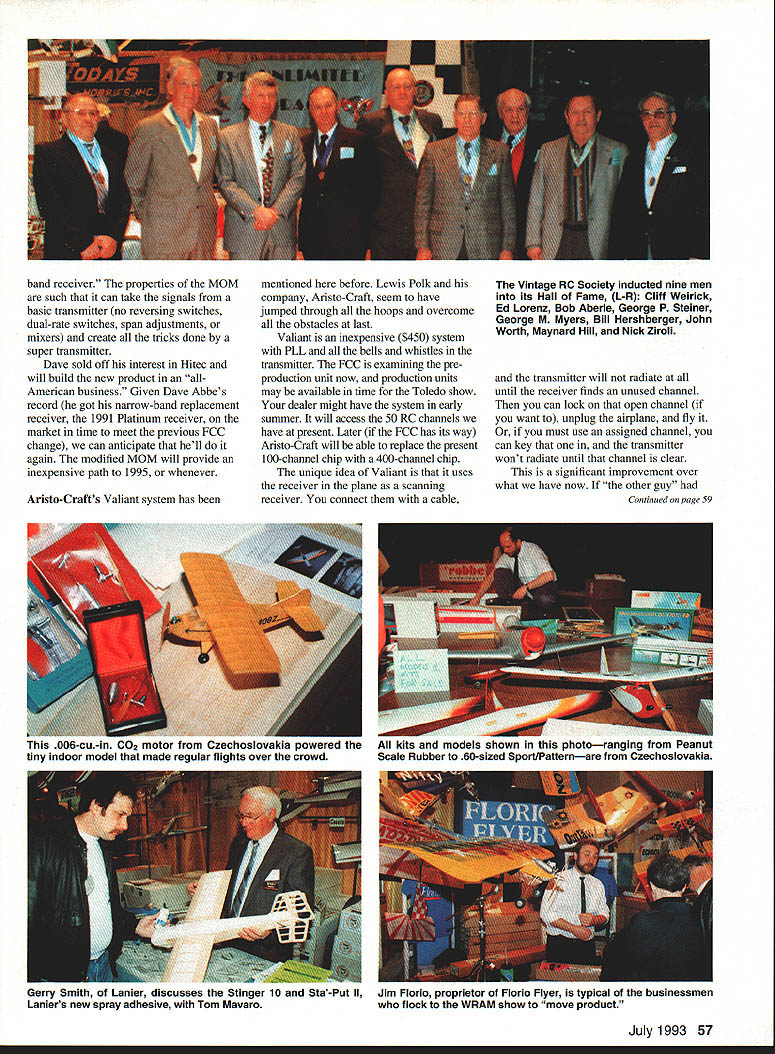
This was the year for the Czechs and Slovakians. Howard Kuhn, the U.S. representative to the FAI Spacemodeling Committee, arranged the visit.
I spoke with Otakar Šafek, editor of Modelářství magazine and vice president of a FAI Spacemodeling activity. He said companies from what was then Czechoslovakia (now the Czech Republic and Slovakia) came to establish themselves in the model business. Based on the quality of the kits, motors, and accessories they sold at very attractive prices, they succeeded.
Jim Florio, proprietor of The Florio Flyer (P.O. Box 88, Dagus Mines, PA 15831), is typical of the small U.S. businessmen who come to WRAM to move product; he brought a large inventory.
Genial Gerry "For What It's Worth" Smith was at the Lanier booth to explain the Stinger 10 that he designed for Lanier. Lanier's new spray adhesive for Styrofoam, Sta-Put II, was also featured.
Hall of Fame
During the awards ceremony on Sunday afternoon, the Vintage RC Society inducted nine men into its Hall of Fame. All had previously been awarded the McEntee medal by the WRAMs. Inductees:
- Cliff Weirick
- Ed Loreni
- Bob Aberle
- George P. Steiner
- George M. Myers
- Bill Hershberger
- John Worth
- Maynard Hill
- Nick Ziroli
Transcribed from original scans by AI. Minor OCR errors may remain.

