
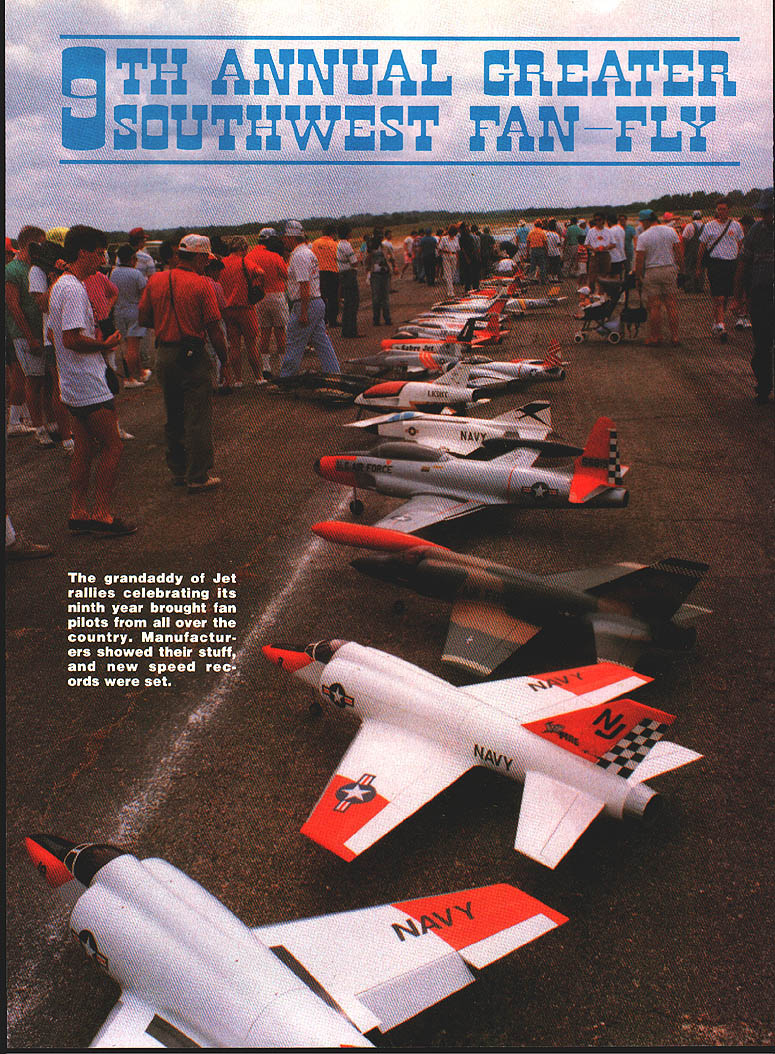
9th Annual Greater Southwest Fan-Fly
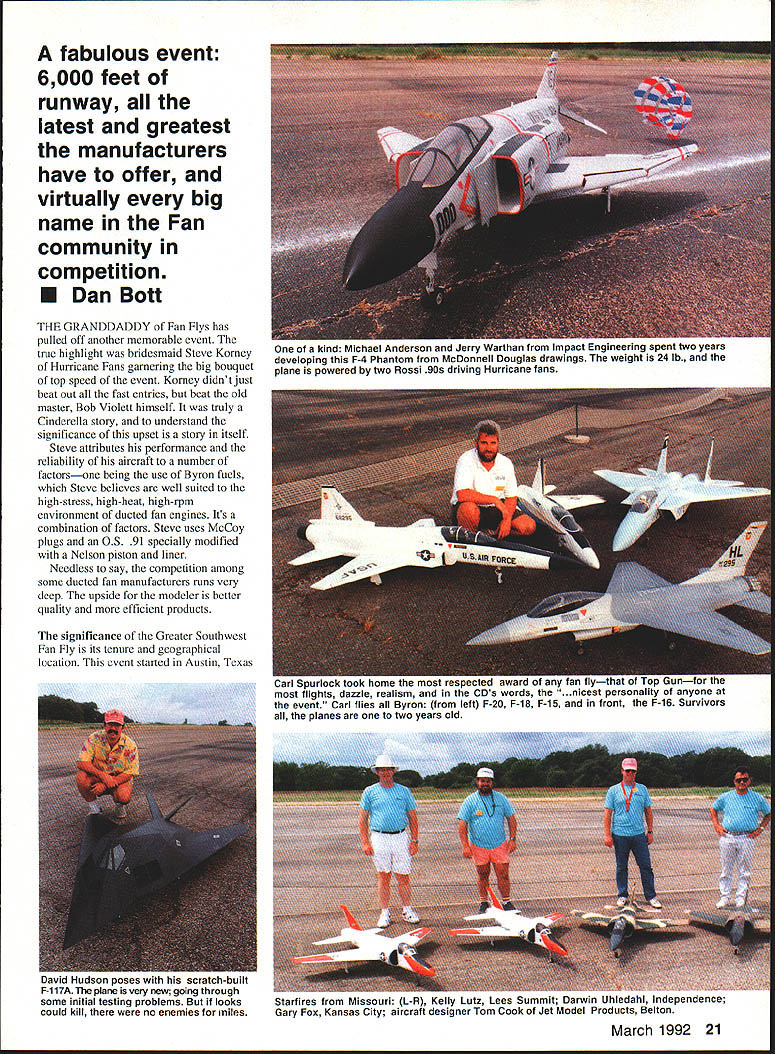
The granddaddy of fan flies celebrated its ninth year, drawing fan pilots from across the country. Manufacturers showcased new products and several speed records were challenged. The true highlight was Steve Korney of Hurricane Fans, long a perennial runner-up, who captured top speed honors in a major upset over veteran Bob Violett.
Steve credits his performance and the reliability of his aircraft to several factors: the use of Byron fuels (well suited to the high-stress, high-heat, high-rpm environment of ducted-fan engines), McCoy spark plugs, and an O.S. .91 engine specially modified with a Nelson piston and liner. Competition among ducted-fan manufacturers runs deep, and the upside for modelers is steadily improving quality and efficiency of products.
Highlights
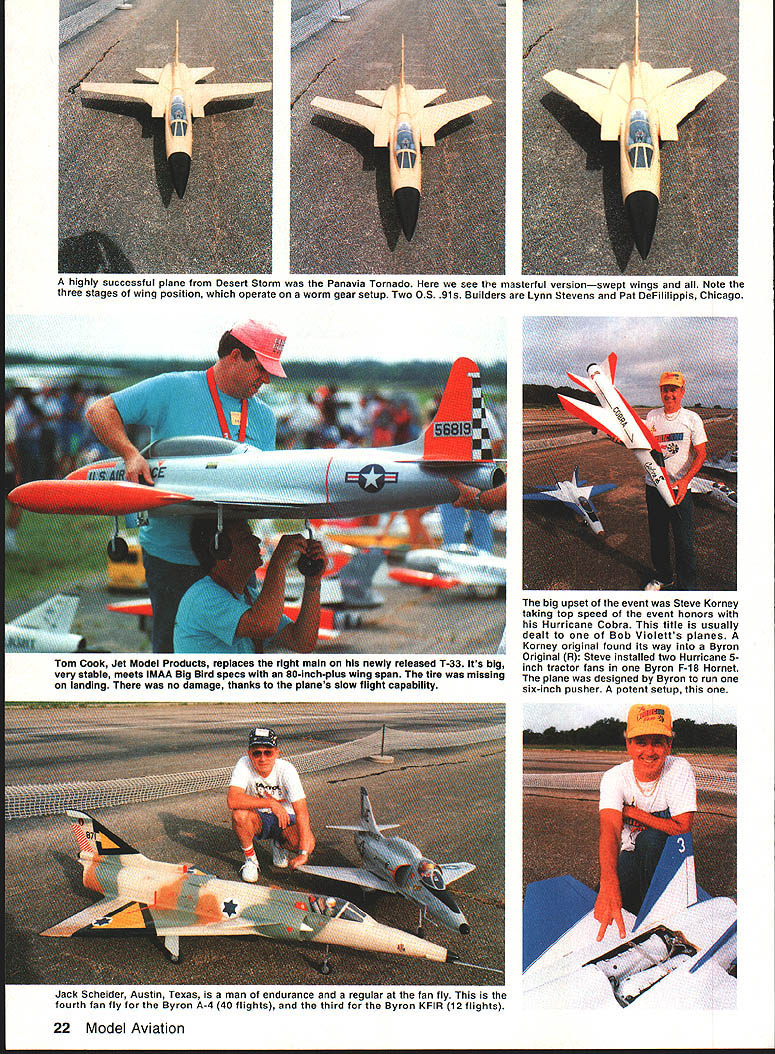
- Steve Korney took top speed of the event with his Hurricane Cobra, upsetting Bob Violett.
- Korney also installed two Hurricane 5-inch tractor fans in a Byron F-18 Hornet originally designed for a single six-inch pusher — a potent, high-speed setup.
- Tom Cook of Jet Model Products demonstrated the new T-33: large, very stable, meeting IMAA Big Bird specs with an 80-inch-plus wingspan. He recovered from a landing where a tire was missing, and the plane suffered no damage thanks to its slow-flight capability.
- Carl Spurlock won the Top Gun award; his fleet of Byron Originals was busy and reliable throughout the event.
- The event showcased a wide cross-section of special projects and newcomers to ducted fans.
Awards
- CD's (Contest Director's) Choice: Tom Cook, Jet Model Products
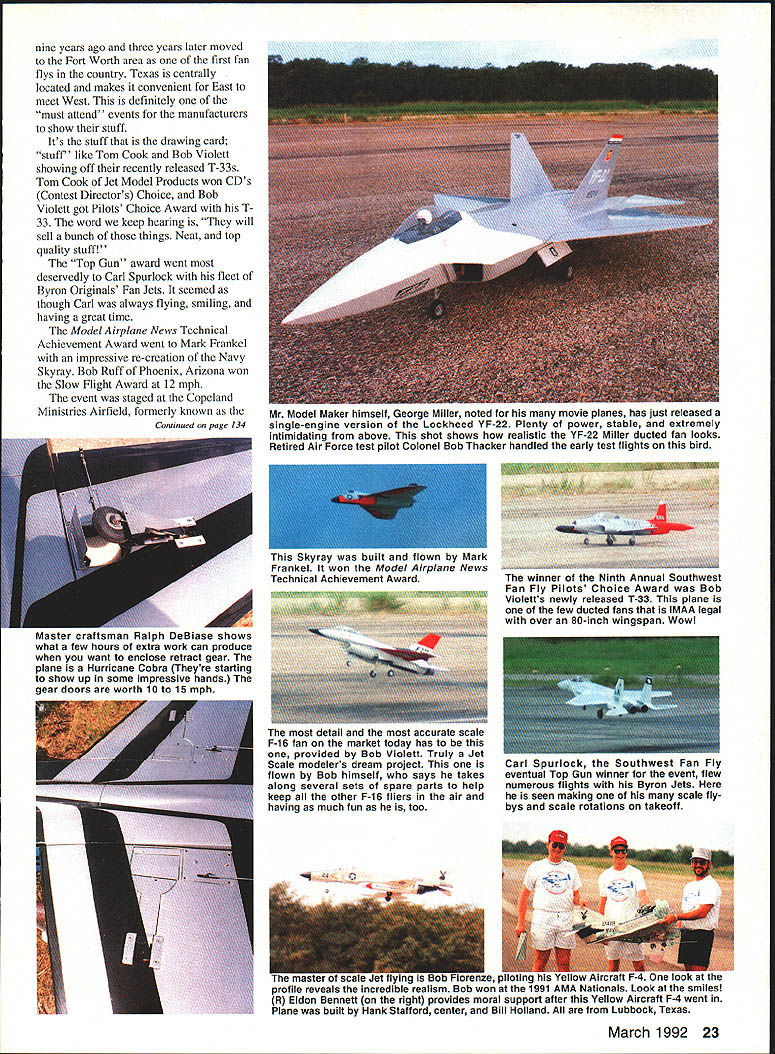
- Pilots' Choice Award: Bob Violett (newly released T-33)
- Top Gun: Carl Spurlock
- Model Airplane News Technical Achievement Award: Mark Frankel (re-creation of the Navy Skyray)
- Slow Flight Award (12 mph event at Copeland Ministries Airfield): Bob Ruff, Phoenix, Arizona
Notable Aircraft and Projects
- Byron Originals T-33 — new release noted for quality and expected commercial success.
- Byron F-18 Hornet modified by Steve Korney — two 5-inch Hurricane tractor fans in place of the original single six-inch pusher; estimated speeds over 150 mph, with additional structural work planned.
- George Miller’s YF-22 — flew surprisingly well for its large size and single engine; available in kit form.
- David Hudson’s scratch-built F-117A — very realistic appearance; new-plane shakedown prevented a successful flight.
- Mark Frankel’s Navy Skyray — awarded for technical achievement.
- Jack Scheider (Austin, Texas) — demonstrated endurance: fourth fan fly for his Byron A-4 (40 flights) and third for his Byron KFIR (12 flights).
Venue and Organization
The event was staged at Copeland Ministries Airfield (formerly Old Eagle Mountain Air Base). The runway is 6,000 feet long and 150 feet wide — an excellent venue for large-scale sport jets. After six years in the Fort Worth area, the event was scheduled to return to Austin, Texas in 1992.
Dawn Buckley ran the event for the past six years with help from the Mid Cities R/C Club. Although proud of her role, she was ready to pass the responsibilities to new organizers in 1992.
Clubs and Participants
- Wings R/C Club (Lubbock, Texas) — attended with eight to ten members and a similar number of jet aircraft; they were there for fun and camaraderie rather than awards.
- Many attendees expressed friendly interest in increased coverage of ducted fans in Model Aviation Magazine, reflecting growing enthusiasm for this area of the hobby.
A fan fly of this size continues to be a place where new projects make their first public appearance, veteran models are refined, and modelers share innovation and enthusiasm for ducted-fan flight.
Transcribed from original scans by AI. Minor OCR errors may remain.

