
About the Size of It
Bradford W. Powers
HERE ARE a few questions of the kind that arise when "scale" is mentioned, together with the answers. Let's see if we can discover how the answers were obtained.
1) Bud Nosen builds a 1/4-scale kit of the Citabria airplane. If the real airplane has a 130-hp engine, how much power should the model have? (Answer: 1.17 hp)
2) If the real Citabria has a high speed of 150 mph, how fast should the scale model fly to look natural? (Answer: 38 mph) But how fast will it actually fly? (Answer: 75 mph)
3) I want to take real-looking movies of the model in flight. I suspect that slow motion is involved, but how much? If 24 frames per second is "normal" film transport speed, at what speed should I shoot? (Answer: 48 frames per second)
4) If a real pilot and his chute weigh 200 lbs., what weight would represent that of the pilot and his chute in the 1/4-scale model? (Answer: 3 lbs. 2 oz.)
5) My grandson got a Dumas 1/12-scale Trojan Cruiser for Xmas. If the real boat weighs 12,000 lbs., what should the model weigh to float at the proper scale water line? (Answer: 6.9 lbs.)
6) A Ryan ST experiences 5 g's acceleration while performing a maneuver. If I put my Sig 1/5-scale model through the same maneuver, what acceleration should be present? (Answer: 5 g's)
Intuitively felt, but not widely understood, is the relationship between models and their full-scale counterparts. With changes in size or "scale," power, weight, speed and almost everything else vary in different but precise ways. A model embodying the proper relative values for these items is said to be "dynamically similar" to the full-scale prototype, and, as we shall see, is very much the same as your own pet scale job.
7) If the above maneuver puts a stress of 5000 lbs./sq. in. into the spar flanges of the real Ryan, what will be the stress in the spar flanges of the model? (Answer: 1000 lbs./sq. in.)
8) If the Trojan Cruiser in problem No. 5 cruises at 20 knots (23 mph), what should be the speed of the model to produce a dynamically similar wake and spray pattern? (Answer: 5.8 knots or 6.6 mph)
9) Joe is building a 1/10th-scale model of the Lockheed P-80. If this airplane had 4000 lbs. of thrust, will Joe's Scozzi fan, rated at 5 lbs. of thrust, be adequate to power the model? (Answer: yes.)
10) If the real Chattanooga Choo Choo can go 65 mph (96 ft./sec.), how fast should I run my HO gauge (1/96th scale) model train to achieve 65 mph scale speed? (Answer: 1 ft./sec.)
Except for questions 7 and 10, answers to the foregoing problems appear to bear no relation to scale at all; but, as we go further, we shall see that they do, indeed.
Since about the time of the development of the steamboat, engineers have employed the laws of dynamic similitude to find the answers to vexing questions reliably and inexpensively, through the use of dynamically similar models. A dynamic model is that which would result when, by some magic, the full-scale article could be literally shrunk to a more convenient size for testing. Strictly speaking, such a model should be identical in every way to the prototype—just smaller. However, such mod... els rarely, if ever, built to such complexity. If the weight, CG location and general configuration are held, small adjustments in weight distribution can make the model dynamically similar for all practical purposes.
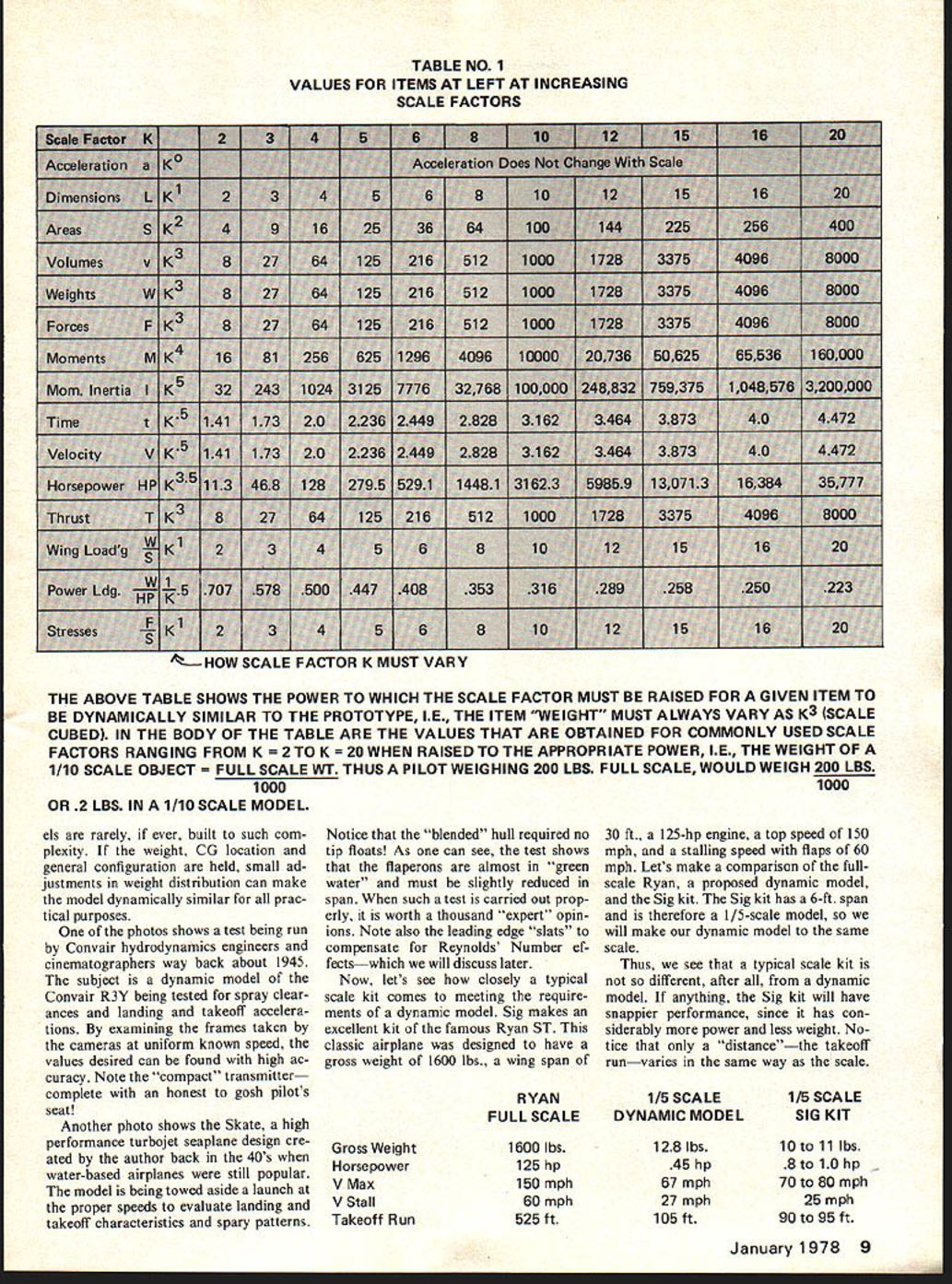
THE ABOVE TABLE SHOWS THE POWER TO WHICH THE SCALE FACTOR MUST BE RAISED FOR A GIVEN ITEM TO BE DYNAMICALLY SIMILAR TO THE PROTOTYPE, I.E., THE ITEM "WEIGHT" MUST ALWAYS VARY AS K^3 (SCALE CUBED). IN THE BODY OF THE TABLE ARE THE VALUES THAT ARE OBTAINED FOR COMMONLY USED SCALE FACTORS RANGING FROM K = 2 TO K = 20 WHEN RAISED TO THE APPROPRIATE POWER, I.E., THE WEIGHT OF A 1/10 SCALE OBJECT = FULL SCALE WT. THUS A PILOT WEIGHING 200 LBS., FULL SCALE, WOULD WEIGH .2 LBS. IN A 1/10 SCALE MODEL.
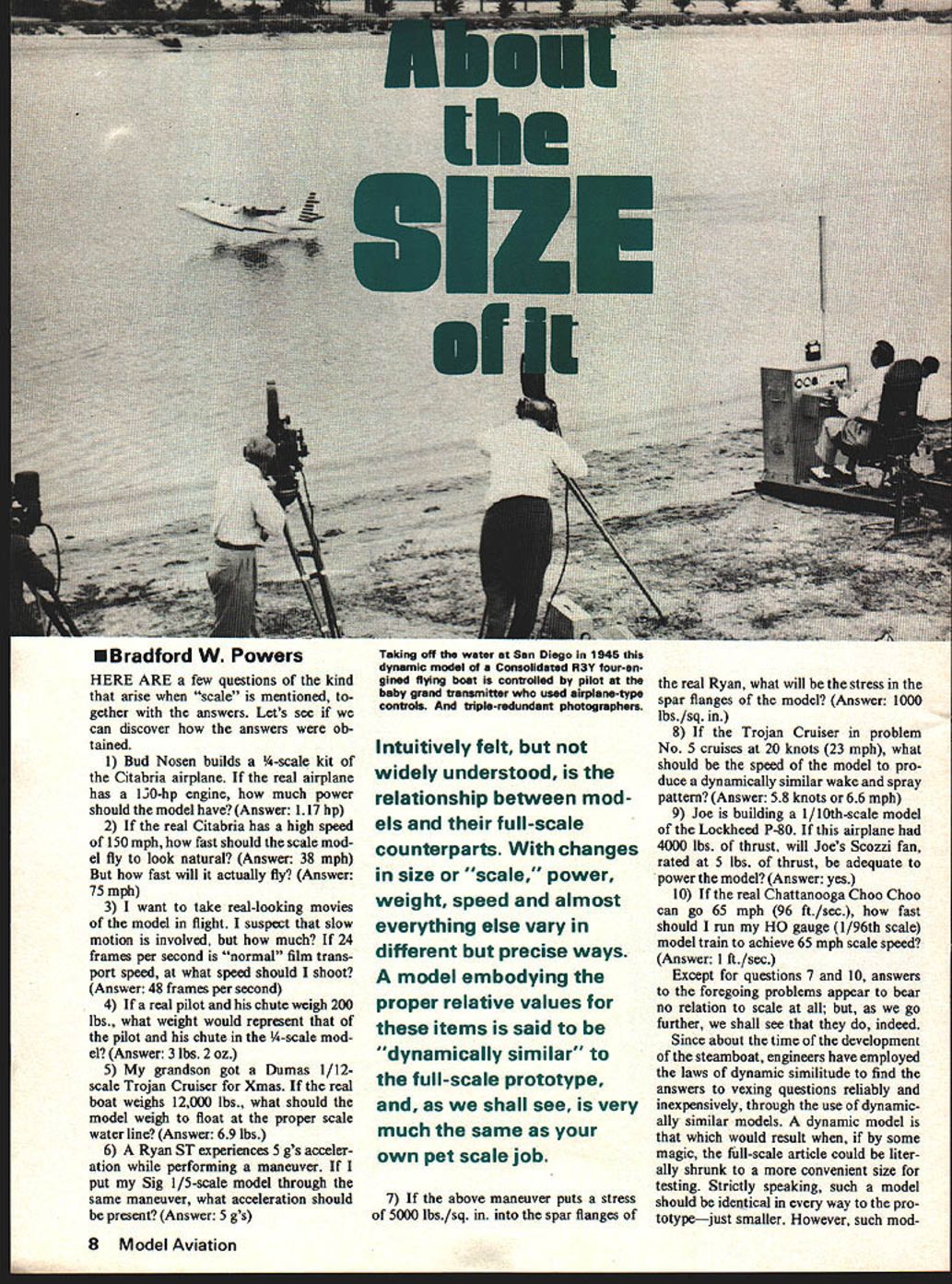
One of the photos shows a test being run by Convair hydrodynamics engineers and cinematographers way back about 1945. The subject is a dynamic model of the Convair R3Y being tested for spray clearances and landing and takeoff accelerations. By examining the frames taken by the cameras at uniform known speed, the values desired can be found with high accuracy. Note the "compact" transmitter complete with an honest to gosh pilot's seat!
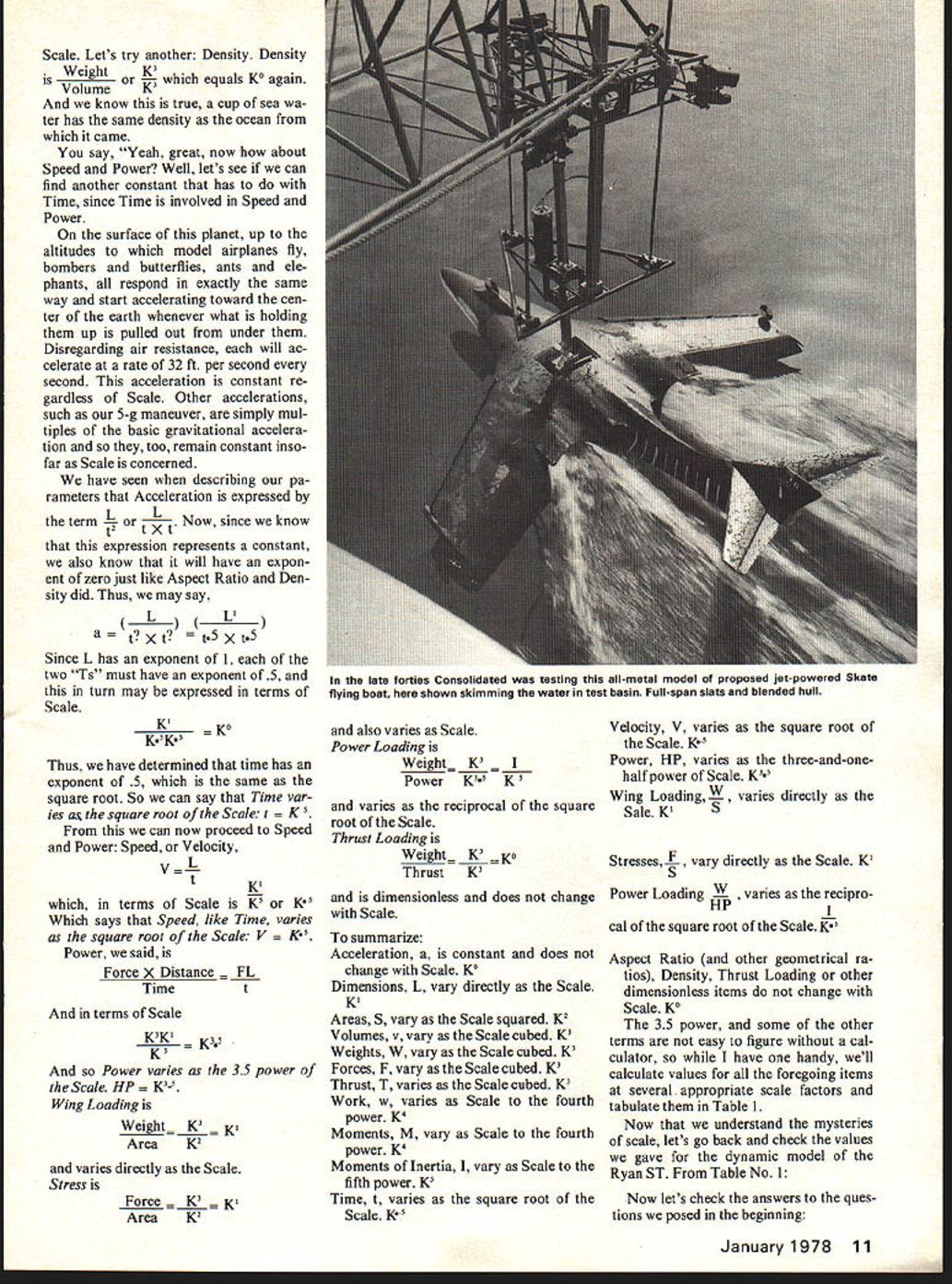
Another photo shows the Skate, a high performance turbojet seaplane design created by the author back in the 40's when water-based airplanes were still popular. The model is being towed aside a launch at the proper speeds to evaluate landing and takeoff characteristics and spray patterns. Notice that the "blended" hull required no tip floats! As one can see, the test shows that the flaperons are almost in "green water" and must be slightly reduced in span. When such a test is carried out properly, it is worth a thousand "expert" opinions. Note also the leading edge "slats" to compensate for Reynolds Number effects — which we will discuss later.
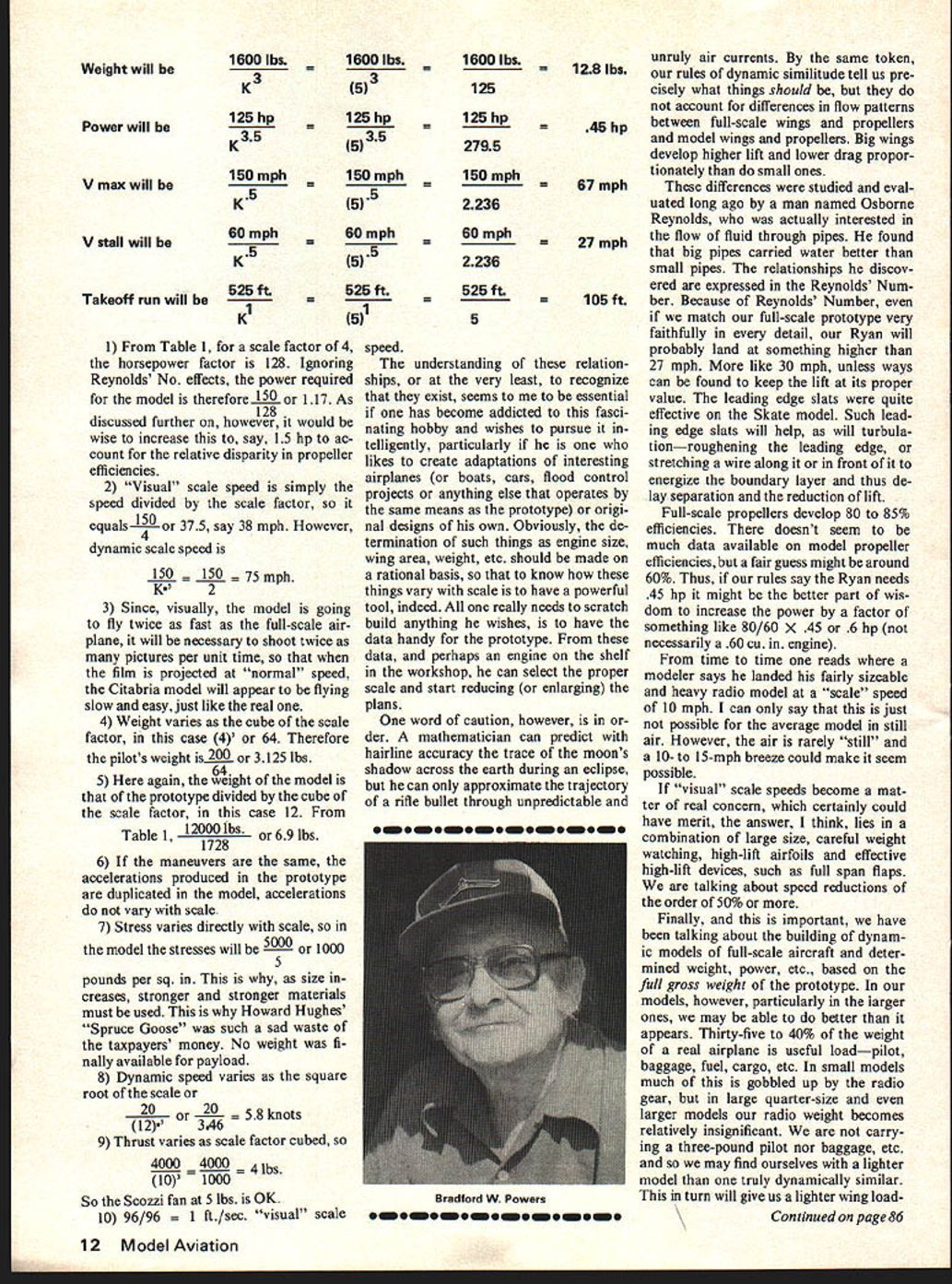
Now, let's see how closely a typical scale kit comes to meeting the requirements of a dynamic model. Sig makes an excellent kit of the famous Ryan ST. This classic airplane was designed to have a gross weight of 1600 lbs., a wing span of 30 ft., a 125-hp engine, a top speed of 150 mph, and a stalling speed with flaps of 60 mph. Let's make a comparison of the full-scale Ryan, a proposed dynamic model, and the Sig kit. The Sig kit has a 6-ft. span and is therefore a 1/5-scale model, so we will make our dynamic model to the same scale.
Thus, we see that a typical scale kit is not so different, after all, from a dynamic model. If anything, the Sig kit will have snappier performance, since it has considerably more power and less weight. Notice that only a "distance" — the takeoff run — varies in the same way as the scale.
RYAN FULL SCALE 1/5 SCALE DYNAMIC MODEL 1/5 SCALE SIG KIT Gross Weight 1600 lbs. 12.8 lbs. 10 to 11 lbs. Horsepower 125 hp .45 hp .8 to 1.0 hp V Max 150 mph 67 mph 70 to 80 mph V Stall 60 mph 27 mph 25 mph Takeoff Run 525 ft. 105 ft. 90 to 95 ft. The other items, again, seem to have little or nothing to do with scale. Notice, however, that weight is far below 1/5 that of the real airplane, yet the speed of 67 mph is more than double the 1/5 × 150 or 30 mph we would have if the speed were to "scale." It is this characteristic which makes models fly so outrageously fast, and spoils the effect — for some, at least.
In problem 10, we were able to slow our model train down to "scale" speed, or even to zero, without danger of it falling out of the sky. But a model airplane must sustain itself in the air, and as we shall see, wing loading and not speed, must vary directly with scale. Thus, we can see that there are really two kinds of speed as far as scale is concerned: visual speed and dynamic speed. Visual speed pleases observers; dynamic speed pleases Mother Nature.
Now, it's about time we get down to the nitty-gritty of all this and see if we can discover the principles involved. First, let's look at scale itself. Scale is simply the ratio of the dimensions of one object to those of a similar object differing in size only — like a large tuna to a small tuna, but not a large tuna to a small halibut! Before going further, let's put some of the commonly used "scales" in proper form for our purpose:
COMMON USAGE ACTUAL SCALE SCALE FACTOR, K 3" = 1'-0" 1/4 4 2" = 1'-0" 1/6 6 1 1/2" = 1'-0" 1/8 8 1" = 1'-0" 1/12 12 3/4" = 1'-0" 1/16 16 1/2" = 1'-0" 1/24 24 1/4" = 1'-0" 1/48 48 1/8" = 1'-0" 1/96 96
The Sig Ryan has dimensions 1/5 those of the full-scale airplane, and may be said to have a scale factor of 5. The scale factor is placed in the numerator when comparing big things to little ones, and is placed in the denominator when little things are compared to big ones. Thus, the full-scale Ryan is 5/1 or 5 times the size of the model, and the model is 1/5 the size of the full-scale Ryan. In order to facilitate computation, we will do as the engineers do and indicate the scale factor by the Greek letter, Kappa K. This gives a certain mystique to the process and makes other people think we are smarter than they are — sort of like a doctor writing prescriptions in Latin.
Now then, all physical properties can be expressed in terms of Length, Mass (or for our purpose, Force, which is proportional to Mass) and Time, as follows:
L = Any linear measurement — Length, Width, Height, Distance or Circumference. F = Any Force, Weight or Thrust. t = Any interval of Time.
Using these three basic parameters, we can describe the following:
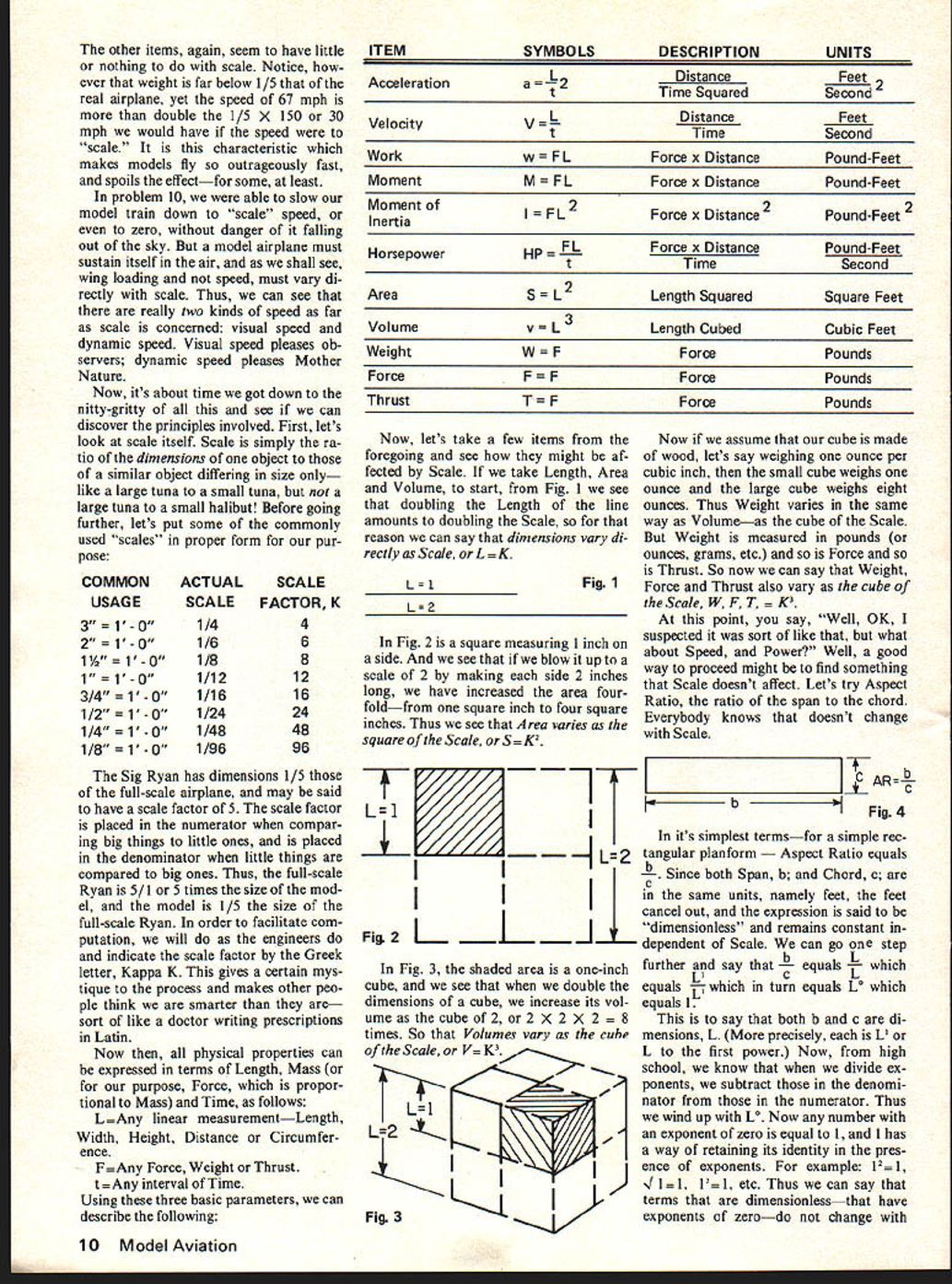
ITEM SYMBOLS DESCRIPTION UNITS Acceleration a = L/t^2 Distance/Time Squared Feet/Second^2 Velocity v = L/t Distance/Time Feet/Second Work w = F L Force × Distance Pound-Foot Moment M = F L Force × Distance Pound-Foot Moment of Inertia I = F L^2 Force × Distance^2 Pound-Foot^2 Horsepower HP = F L/t Force × Distance/Time Pound-Foot/Second Area S = L^2 Length Squared Square Feet Volume v = L^3 Length Cubed Cubic Feet Weight W = F Force Pounds Force F = F Force Pounds Thrust T = F Force Pounds
Now, let's take a few items from the foregoing and see how they might be affected by Scale. If we take Length, Area and Volume, to start, from Fig. 1 we see that doubling the Length of the line amounts to doubling the Scale, so for that reason we can say that dimensions vary directly as Scale, or L = K.
In Fig. 2 is a square measuring 1 inch on a side. And we see that if we blow it up to a scale of 2 by making each side 2 inches long, we have increased the area four-fold — from one square inch to four square inches. Thus we see that Area varies as the square of the Scale, or S = K^2.
In Fig. 3, the shaded area is a one-inch cube, and we see that when we double the dimensions of a cube, we increase its volume as the cube of 2, or 2 × 2 × 2 = 8 times. So that Volumes vary as the cube of the Scale, or V = K^3.
Now if we assume that our cube is made of wood, let's say weighing one ounce per cubic inch, then the small cube weighs one ounce and the large cube weighs eight ounces. Thus Weight varies in the same way as Volume — as the cube of the Scale. But Weight is measured in pounds (or ounces, grams, etc.) and so is Force and so is Thrust. So now we can say that Weight, Force and Thrust also vary as the cube of the Scale, W, F, T = K^3.
At this point, you say, "Well, OK, I suspected it was sort of like that, but what about Speed, and Power?" Well, a good way to proceed might be to find something that Scale doesn't affect. Let's try Aspect Ratio, the ratio of the span to the chord. Everybody knows that doesn't change with Scale.
In its simplest terms — for a simple rectangular planform — Aspect Ratio equals b^2 / S. Since both Span, b, and Chord, c, are in the same units, namely feet, the feet cancel out, and the expression is said to be "dimensionless" and remains constant independent of Scale. We can go one step further and say that b/c equals L/L which equals L^0 which in turn equals 1. This is to say that both b and c are dimensions, L. (More precisely, each is L^1 or L to the first power.) Now, from high school, we know that when we divide exponents, we subtract those in the denominator from those in the numerator. Thus we wind up with L^0. Now any number with an exponent of zero is equal to 1, and has a way of retaining its identity in the presence of exponents. For example: 2^0 = 1, 1^0 = 1, etc. Thus we can say that terms that are dimensionless — that have exponents of zero — do not change with Scale. Let's try another: Density. Density is Weight/Volume or K^3/K^3 which equals K^0 again. And we know this is true, a cup of sea water has the same density as the ocean from which it came.
You say, "Yeah, great, now how about Speed and Power?" Well, let's see if we can find another constant that has to do with Time, since Time is involved in Speed and Power.
On the surface of this planet, up to the altitudes to which model airplanes fly, bombers and butterflies, ants and elephants, all respond in exactly the same way and start accelerating toward the center of the earth whenever what is holding them up is pulled out from under them. Disregarding air resistance, each will accelerate at a rate of 32 ft. per second every second. This acceleration is constant regardless of Scale. Other accelerations, such as our 5-g maneuver, are simply multiples of the basic gravitational acceleration and so they, too, remain constant insofar as Scale is concerned.
We have seen when describing our parameters that Acceleration is expressed by the term L/t^2 or L^1 t^-2. Now, since we know that this expression represents a constant, we also know that it will have an exponent of zero just like Aspect Ratio and Density did. Thus, we may say,
Since L has an exponent of 1, each of the two "T's" must have an exponent of .5, and this in turn may be expressed in terms of Scale.
Thus, we have determined that time has an exponent of .5, which is the same as the square root. So we can say that Time varies as the square root of the Scale: t = K^0.5.
From this we can now proceed to Speed and Power: Speed, or Velocity, V = L/t, which, in terms of Scale is K^1 / K^0.5 or K^0.5. Which says that Speed, like Time, varies as the square root of the Scale: V = K^0.5.
Power, we said, is Force x Distance / Time = F L / t. And in terms of Scale, Power varies as the 3.5 power of the Scale. HP = K^3.5.
Wing Loading is Weight / Area = K^3 / K^2 = K^1 and varies directly as the Scale.
Stress is Force / Area = K^3 / K^2 = K^1 and also varies as Scale.
Power Loading is Weight / Power = K^3 / K^3.5 = K^-0.5 and varies as the reciprocal of the square root of the Scale.
Thrust Loading is Weight / Thrust = K^3 / K^3 = K^0 and is dimensionless and does not change with Scale.
To summarize:
- Acceleration, a, is constant and does not change with Scale. K^0
- Dimensions, L, vary directly as the Scale. K^1
- Areas, S, vary as the Scale squared. K^2
- Volumes, V, vary as the Scale cubed. K^3
- Weights, W, vary as the Scale cubed. K^3
- Forces, F, vary as the Scale cubed. K^3
- Thrust, T, varies as the Scale cubed. K^3
- Work, W, varies as Scale to the fourth power. K^4
- Moments, M, vary as Scale to the fourth power. K^4
- Moments of Inertia, I, vary as Scale to the fifth power. K^5
- Time, t, varies as the square root of the Scale. K^0.5
- Velocity, V, varies as the square root of the Scale. K^0.5
- Power, HP, varies as the three-and-one-half power of Scale. K^3.5
- Wing Loading, W/S, varies directly as the Scale. K^1
- Stresses, F/S, vary directly as the Scale. K^1
- Power Loading, W/HP, varies as the reciprocal of the square root of the Scale. K^-0.5
- Aspect Ratio (and other geometrical ratios), Density, Thrust Loading or other dimensionless items do not change with Scale. K^0
The 3.5 power, and some of the other terms are not easy to figure without a calculator, so while I have one handy, we'll calculate values for all the foregoing items at several appropriate scale factors and tabulate them in Table 1.
Now that we understand the mysteries of scale, let's go back and check the values we gave for the dynamic model of the Ryan ST. From Table No. 1:
Now let's check the answers to the questions we posed in the beginning: 1) From Table I, for a scale factor of 4, the horsepower factor is 128. Ignoring Reynolds' No. effects, the power required for the model is therefore 150/128 or 1.17. As discussed further on, however, it would be wise to increase this to, say, 1.5 hp to account for the relative disparity in propeller efficiencies.
2) "Visual" scale speed is simply the speed divided by the scale factor, so it equals 150/4 or 37.5, say 38 mph. However, dynamic scale speed is 150/K^0.5 = 150/2 = 75 mph.
3) Since, visually, the model is going to fly twice as fast as the full-scale airplane, it will be necessary to shoot twice as many pictures per unit time, so that when the film is projected at "normal" speed, the Citabria model will appear to be flying slow and easy, just like the real one.
4) Weight varies as the cube of the scale factor, in this case (4)^3 or 64. Therefore the pilot's weight is 200/64 or 3.125 lbs.
5) Here again, the weight of the model is that of the prototype divided by the cube of the scale factor, in this case 12. From Table 1, 12000 lbs/1728 = 6.9 lbs.
6) If the maneuvers are the same, the accelerations produced in the prototype are duplicated in the model; accelerations do not vary with scale.
7) Stress varies directly with scale, so in the model the stresses will be 5000/5 or 1000 pounds per sq. in. This is why, as size increases, stronger and stronger materials must be used. This is why Howard Hughes' "Spruce Goose" was such a sad waste of the taxpayers' money. No weight was finally available for payload.
8) Dynamic speed varies as the square root of the scale or 20/(12)^0.5 = 5.8 knots.
9) Thrust varies as scale factor cubed, so 4000/(10)^3 = 4000/1000 = 4 lbs. So the Scozzi fan at 5 lbs is OK.
10) 96/96 = 1 ft./sec. "visual" scale.
Our rules of dynamic similitude tell us precisely what things should be, but they do not account for differences in flow patterns between full-scale wings and model wings and propellers. Big wings develop higher lift and lower drag proportionately than do small ones.
These differences were studied and evaluated long ago by a man named Osborne Reynolds, who was actually interested in the flow of fluid through pipes. He found that big pipes carried water better than small pipes. The relationships he discovered are expressed in the Reynolds' Number. Because of Reynolds' Number, even if we match our full-scale prototype very faithfully in every detail, our Ryan will probably land at something higher than 27 mph. More like 30 mph, unless ways can be found to keep the lift at its proper value. The leading edge slats were quite effective on the Skate model. Such leading edge slats will help, as will turbulating—roughening the leading edge, or stretching a wire along it or in front of it to energize the boundary layer and thus delay separation and the reduction of lift.
Full-scale propellers develop 80 to 85% efficiencies. There doesn't seem to be much data available on model propeller efficiencies, but a fair guess might be around 60%. Thus, if our rules say the Ryan needs 45 hp it might be the better part of wisdom to increase the power by a factor of something like 80/60 × .45 or .6 hp (not necessarily a .60 cu. in. engine).
From time to time one reads where a modeler says he landed his fairly sizeable and heavy radio model at a "scale" speed of 10 mph. I can only say that this is just not possible for the average model in still air. However, the air is rarely "still" and a 10- to 15-mph breeze could make it seem possible.
If "visual" scale speeds become a matter of real concern, which certainly could have merit, the answer, I think, lies in a combination of large size, careful weight watching, high-lift airfoils and effective high-lift devices, such as full span flaps. We are talking about speed reductions of the order of 50% or more.
Finally, and this is important, we have been talking about the building of dynamic models of full-scale aircraft and determined weight, power, etc., based on the full gross weight of the prototype. In our models, however, particularly in the larger ones, we may be able to do better than it appears. Thirty-five to 40% of the weight of a real airplane is useful load—pilot, baggage, fuel, cargo, etc. In small models much of this is gobbled up by the radio gear, but in large quarter-scale and even larger models our radio weight becomes relatively insignificant. We are not carrying a three-pound pilot nor baggage, etc., and so we may find ourselves with a lighter model than one truly dynamically similar. This in turn will give us a lighter wing load-
About the Size of It
loading and slower speed and even reduce somewhat the power requirements. This is because we are scaling down our prototype in its weight-empty condition, rather than its gross-weight condition.
And that's..."About the Size of It."
(Questions and comments may be addressed to Bradford W. Powers, in care of this magazine.)
Transcribed from original scans by AI. Minor OCR errors may remain.

